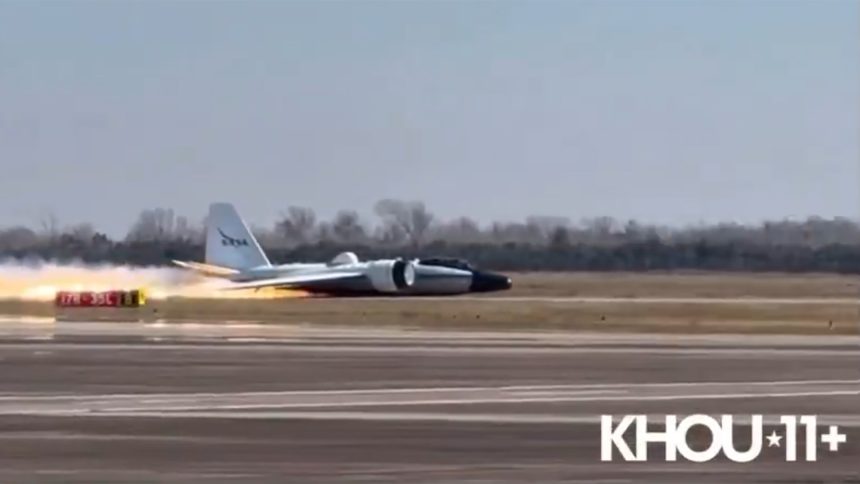
NASA has confirmed that crew members are safe after one of its three WB-57 Canberra high-altitude research aircraft made an emergency gear-up landing in Texas.
N927NA, the most recent addition to NASA’s fleet of high-altitude research aircraft that trace their lineage back to the English Electric Canberra, was seen in video footage making a gear-up landing at its home station of Ellington Field Joint Reserve Base in Houston, Texas. Ellington Field, close to Johnson Space Centre, is a major hub for NASA’s array of fixed wing research and training aircraft.
Spokesperson Bethany Stevens confirmed via social media at around 1830 UTC that, although the response to the incident was ongoing, all crew aboard the aircraft are safe. An investigation into the incident’s specific cause will be launched, with official communications referring to it as a mechanical issue.
NASA WB-57 involved in landing incident at Ellington Airport in #houston @KHOU pic.twitter.com/HOvr2YuHsh
— Houston Air Watch 🚁🛰️ (@houstonairw) January 27, 2026
Gear up landings, due to the direct contact between the fuselage and the runway, almost always result in a large amount of flame, sparks, and smoke, though it should be noted that many aircraft have been through such ordeals and then been repaired. This aircraft’s age may present some issues, though the Canberra family is well known for its longevity and robustness.
Having first flown in 1949, the last Royal Air Force Canberra was not retired from active, frontline service until 2006. It was one of the handful of British designs adopted into the Cold War U.S. Air Force, produced under licence by Martin as the B-57 and serving until 1983.
The aircraft is currently NASA’s only active WB-57 – its two sister aircraft are grounded while awaiting completion of routine major inspections. According to NASA’s website at the time of writing, N926NA is expected to complete its inspection in February 2026, while N928NA’s inspection is on indefinite hold. Assuming that N927NA will be deemed repairable and able to return to service, it is still likely to be out of service for a considerable time, so NASA may reevaluate N928NA’s status and get the inspection completed to ensure aircraft availability.
Today, a mechanical issue with one of NASA’s WB-57s resulted in a gear-up landing at Ellington Field. Response to the incident is ongoing, and all crew are safe at this time. As with any incident, a thorough investigation will be conducted by NASA into the cause. NASA will…
— Bethany Stevens (@NASASpox) January 27, 2026
Able to operate comfortably at altitudes above 60,000 feet, the WB-57 has provided value to NASA – and to the U.S. military – through its payload capacity of up to 8,800 lbs. This is far in excess of the capability provided by the U-2, also operated by NASA as the ER-2, though the ‘Dragon Lady’ is almost certain to offer a (classified) altitude advantage.
Based on available flight tracking data, it appears that N927NA was carrying out a training sortie at the time of the incident.
NASA’s WB-57 N927NA took off around 1619Z, and made a number of touch and go landings, but the last one became a full stop as the gear wasn’t deployed. pic.twitter.com/4i8sayTcIV
— Scott Manley (@DJSnM) January 27, 2026
In recent years, the WB-57’s most high profile role has been as a camera platform for recording detailed footage of rocket launches and capsule recovery for technical analysis. This includes footage from test launches of the new SpaceX Starship heavy-lift launch vehicle.
The WB-57 involved in todays incident shot this footage a couple of months ago: pic.twitter.com/qY7UxY9MFG
— Scott Manley (@DJSnM) January 27, 2026
The platform’s altitude and payload capability combination was put to use by the U.S. military during the war in Afghanistan when forward deployed aircraft were fitted out as testbeds for the Battlefield Airborne Communications Node (BACN) role, now fulfilled by the E-11A.