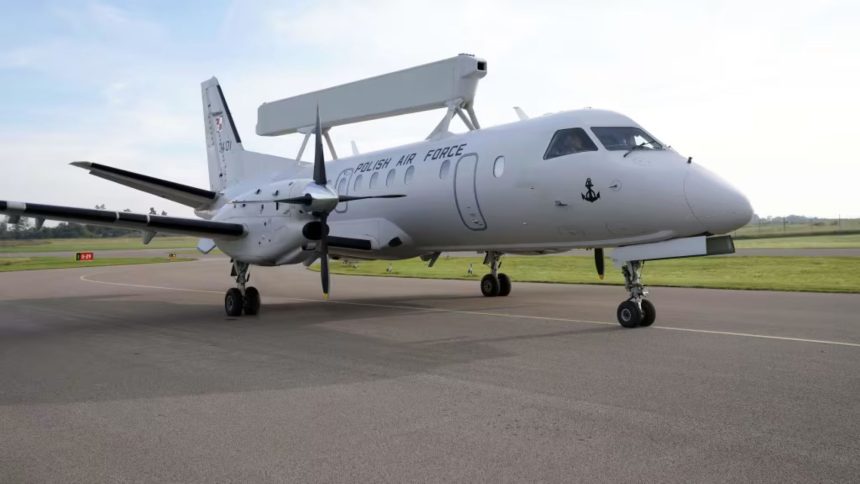
In interviews to Defence 24, Deputy General Commander Maj. Gen. Ireneusz Nowak pointed to the need for a new AEW&C platform, given the limited remaining lifespan of the Saab 340s.
The Polish Air Force (PolAF) would like to replace its Saab 340 Airborne Early Warning and Control (AEW&C) aircraft, bought second-hand a few years ago, given the platform’s age and the limited remaining lifespan. These issues were covered in two extensive interviews with the PolAF brass and an L3Harris executive by Defence 24 in December 2025 and this month, respectively.
With the E-7A Wedgtail considered over-budget, business jet-based AEW&C platforms are favorable options, given their current flavor with a variety of special mission roles like ISR and Signals Intelligence (SIGINT). Saab’s GlobalEye and L3Harris’ Conformal Array Airborne Early Warning (CAEW) aircraft, both based on the Bombardier Global 6500 business jet, fit the bill.
At the moment, the GlobalEye and the CAEW were mentioned as an independent observation by Defence 24, and have not figured in any formal acquisition process launched by the Ministry of National Defense. However, a competition for the selection of the new AEW&C platform might be on the horizon.
Defence 24 interviews with PolAF leaders and L3Harris
Defence 24 published on Dec. 19 and Dec. 22, 2025 a wide-ranging interview with Polish Air Force Deputy General Commander Maj. Gen. Ireneusz Nowak, Head of the Military Equipment Col. Sebastian Paluch and Head of the Team for the Implementation of the F-35, Col. Paweł Muzyczuk.
In a ceremony today in Sweden, we unveiled the first 340 AEW system to the Polish customer. The solution, presented only two months after the order, will provide Poland’s Armed Forces with a national asset to reinforce territorial integrity and national security. #AEWC pic.twitter.com/TRo94IyjoV
— Saab (@Saab) September 29, 2023
The officers said that the two Saab 340s, acquired from the United Arab Emirates and inducted in the Polish Air Force in 2024, have an aging radar that can last only for the next four years. It must be noted they did not mention any possible competitor, or a formal acquisition launched by the Ministry of National Defense, except stressing upon how the Saab 340 merely meets an immediate need.
However, on Jan. 12, 2026, an interview emerged with L3Harris’ marketing and communications senior manager Re-Essa Buckels, titled “Eye in the sky. The race to replace Poland’s airborne radars.” Defence 24 independently mentions the Saab GlobalEye and the L3Harris CAEW are natural contenders for cost-effective AEW platforms that leverage small, existing carrier aircraft and proven radars.
Polish 🇵🇱 Air Force F-16 Falcon and MiG-29 Fulcrum fighter aircraft escort @usairforce 🇺🇸 B-52 Stratofortress strategic bombers during will fly over Poland on August 28, 2020. #StrongerTogether
📸 by Piotr Łysakowski pic.twitter.com/WRLZOduJUN
— Baltic Security (@balt_security) August 28, 2020
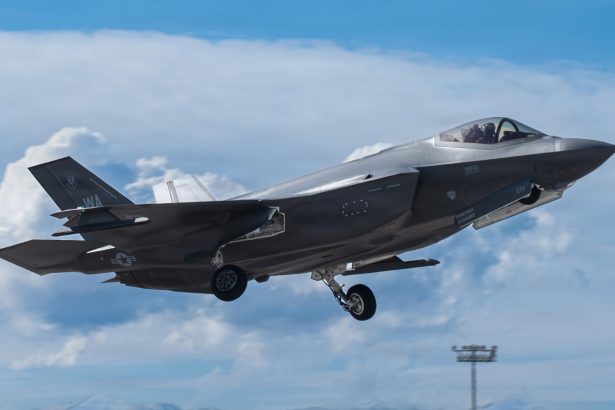
The PolAF leaders also spoke about their future plans, including strategic airlift, refueling tanker and multirole fighter fleet, including the F-35A Husarz, the F-16, the FA-50PL and the interest in the KF-21 Boramae. They also reflected on the military and strategic situation amid the continuing war in Ukraine, evolving military trends, doctrines, standoff surface-strike fires and UAV threats from Russia and asymmetric drone warfare.
Air Policing detachments are on Quick Reaction Alert 24/7/365
🇬🇧 in 🇵🇱
🇵🇹 in 🇪🇪
🇵🇱🇷🇴in 🇱🇹
🇮🇹in 🇷🇴
Safeguarding the integrity of NATO airspace is a permanent peacetime task contributing to NATO’s collective defence pic.twitter.com/IREo1jpog2
— NATO Air Command (@NATO_AIRCOM) July 2, 2025
Saab 340 and Poland’s AEW capability
Poland had signed a € 52 million contract for two used ex-United Arab Emirates (UAE) Saab 340 AEW&C aircraft in July 2023, and both the aircraft were delivered by June 2024. They have been known to operate from the 43rd Naval Air Base in Gdynia and the 44th Naval Aviation Base in Siemirowice.
Reports said that, given the age of the aircraft, their operational life is expected to be about ten years, and that the systems were considered as mere stopgap arrangements.
Based on a variant of the Saab 340 aircraft twin-engine turboprop aircraft and designated S 100B Argus by the Swedish Air Force (Flygvapnet), the system carries a fixed non-movable PS-890 Active Electronically Scanned Array (AESA) radar. It can track targets up to a range of 300-400 km but the side-facing arrays don’t allow for front and rear scanning.
This week the second of 🇸🇪 @Saab 340 AEW early warning aircraft procured for the Polish Army landed at the base in Gdynia! ✈️
After a series of crew training sessions, the planes will soar over the 🇵🇱 sky, guarding the security of our region and the entire eastern #NATO flank! pic.twitter.com/PwnosNoSk4
— Polska Ambassaden i Sverige (@PLinSweden) June 12, 2024
Nowak told Defence 24 about the Saab 340: “The military is satisfied with this solution because it’s better to have something than nothing. This solution is a bridge and has its limitations. The biggest drawback is its network-centricity – the platform’s lack of integration with Link 16. The aircraft itself, as a platform, is very good, proven, and reliable. [But] the radar’s lifespan […] will be exhausted by 2030. So we need to think about the ultimate solution now.”
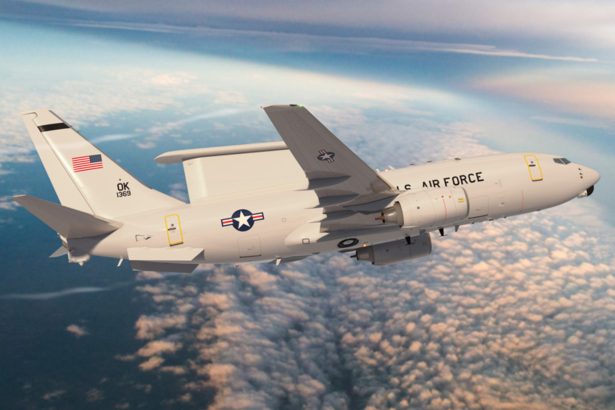
Poland had looked at the E-7A Wedgetail, Nowak added, but despite the platform’s impressive capability, the service found it to bee “too expensive.” The E-7’s future within the NATO alliance and the U.S. Air Force is also bleak, although the U.S. Congress has asked the service to either order a sufficient number of E-7s or prepare an exhaustive plan to keep the older E-3 Sentries flying, in order to maintain a credible airborne radar sensing capability.
Poland is also acquiring four aerostat-based platforms for the same purpose, in a May 2024 $1 billion deal with the U.S. Defense News quoted a press release by the MND saying that Poland would be the second such country to use the system.
After a major 9+ hour mission hunting Russian drones and coordinating air defenses overnight, Poland’s SAAB 340 airborne early warning aircraft is heading for home. pic.twitter.com/L1McAqVWz1
— OSINTtechnical (@Osinttechnical) September 10, 2025
L3Harris pitches its CAEW
Buckels reiterated L3Harris’s proven engineering experience with modifying existing business jets like the Bombardier Global 6500 and the Gulfstream G550. These include recently winning South Korea’s new AEW program with its CAEW, and the various ISR aircraft under the U.S. Army’s High Accuracy Detection and Exploitation System (HADES) program. All are based on the Global 6500, similar to the Saab GlobalEye AEW&C recently ordered by France.
Platforms based on the G550 carrier aircraft modified by L3Harris include the EA-37B Compass Call electronic warfare aircraft for the U.S. and Italian Air Force/Aeronautica Militare, the latter’s Joint Airborne Multi-Mission Multi-Sensor System (JAMMS), and the Royal Australian Air Force’s MC-55A Peregrine SIGINT and EW system.
RELEASE: Saab receives order for GlobalEye, including ground equipment, training and support, from France. https://t.co/bi92NMcp31
— Saab (@Saab) December 31, 2025
Buckels highlighted the challenging airframe modification, systems integration, certification and flight trial work for missionizing business jets, while stressing upon the advantages of a Conformal Array antenna for special mission ISR, AEW and SIGINT/EW/Stand-Off Jamming (SOJ) roles.
📢 Landmark contract: We’ve been chosen to deliver modified @Bombardier Global 6500 aircraft with airborne early warning and control systems to the Republic of Korea Air Force. These advanced aircraft promise mission readiness!✈️ Read more: https://t.co/QDGD71EFA4#SeoulADEX2025 pic.twitter.com/WXRRYsRdyi
— L3Harris (@L3HarrisTech) October 19, 2025
“The conformal antenna approach does not impact the aircraft’s performance in terms of maneuverability, speed, and altitude. The nose and tail array, coupled with the side cheeks provide full 360-degree radar coverage,” she told Defence 24.
L3Harris showcased a model of the Global 6500 “Phoenix” AEW&C at the #TADTE2025. The aircraft, based on the Bombardier Global 6500 business jet, is equipped with the latest-generation EL/W-2085 CAEW (L&S) dual-band AESA radar from Israeli company ELTA Systems, using GaN… https://t.co/Jfms6K3XzA pic.twitter.com/0rnRYuRI8c
— 笑脸男人 (@lfx160219) September 20, 2025
What the Poles want
Listing the expected capabilities of any new future AEW&C platform, Nowak said it must be capable of a highest possible flight altitude, a “maximum” surveillance/tracking range, Ground Moving Target Indication (GMTI) capabilities and “should have flight controllers and weapon allocators.” It is unclear whether this refers to an ability to give mid-course guidance to missiles launched by friendly aircraft.
Przestrzeń powietrzna pod specjalnym nadzorem. Polskie Saab 340 AEW rozpoczynają dyżury operacyjne@MON_GOV_PL @SztabGenWP @DGeneralneRSZ @DowOperSZ https://t.co/XJW2vB8phg pic.twitter.com/aIYLMfBd59
— polska_zbrojna (@Polska_Zbrojna) November 22, 2024
The radar must also be able to detect “the full spectrum of threats – from drones to ballistic missiles.”
About the aerostats, Nowak said the system has its limitations, beginning with their “lack of experience” in operating them, along with their vulnerability to the elements like “precipitation, icing and gusts of wind.” They are nevertheless “very necessary, not only in the interests of Poland but also of partner countries.”