Lockheed Martin completed the first flight test of its Next-Generation Short-Range Interceptor (NGSRI) design as part of the competition for the FIM-92 missile’s replacement.
Lockheed Martin has announced on Jan. 13, 2026, the first test fire of its design for the U.S. Army’s Next-Generation Short-Range Interceptor (NGSRI) competition. The program was launched with the goal of replacing the FIM-92 Stinger Man-Portable Air-Defense System (MANPADS), which has been in service since 1981.
Lockheed Martin is one of two leading contenders in the competitive replacement program. In fact, both Lockheed Martin and Raytheon received in September 2023 a contract to develop a design for the new interceptor.
First Test
The press release did not mention when the first flight test took place, however previous statements mentioned that testing was planned to start in 2025. The latest press release mentioned that the company “has taken the missile from concept to flight in just 26 months since the initial contract award in 2023,” meaning that the test might have taken place anytime between December 2025 and January 2026, depending on when the work started.
“The successful completion of this first flight test is a testament to our team’s agility and drive to deliver critical capabilities on an accelerated timeline. We completed our controlled flight test series in less than six months, demonstrating the speed and agility the Lockheed Martin team brings to this exciting competition,” said Chris Murphy, business development lead, Lockheed Martin Advanced Programs.
The test, described as the first of a series, took place at the U.S. Army White Sands Missile Range in New Mexico. The image included in the press release shows the missile being fired from a launch tube installed on a scaffold, surrounded by cameras and sensors for data collection.
According to the company, the flight validated core interceptor subsystems and represented a significant maturation of the design in a relatively short timeframe. The design is said to leverage Lockheed Martin’s extensive experience in air and missile defense and also includes artificial intelligence and machine learning features.
“Our team’s shared mission, innovative approach and agility were essential to achieving this milestone,” said Randy Crites, vice president, Lockheed Martin Advanced Programs.
Quadstar
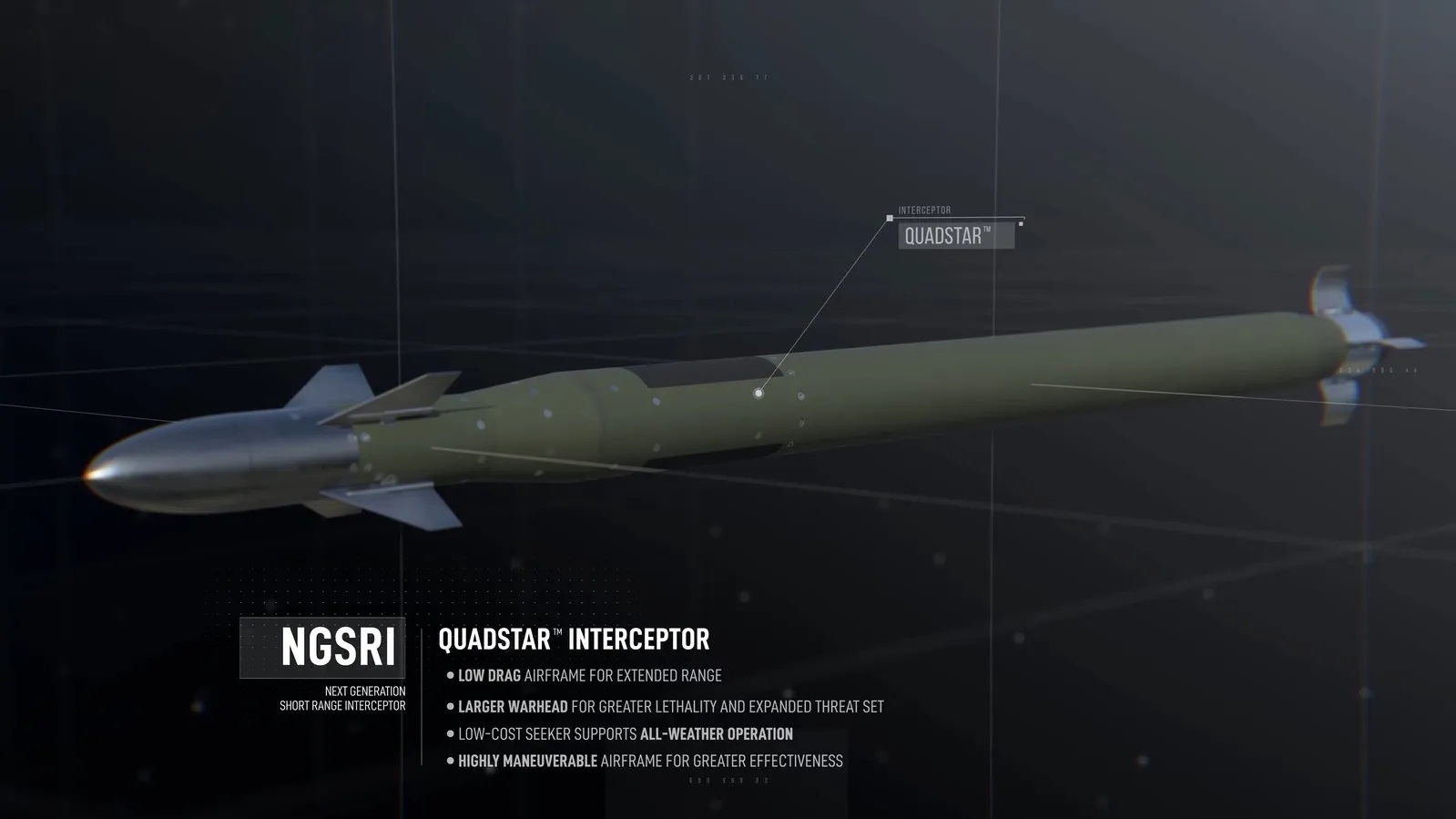
The design appears to be called Quadstar, as mentioned by Murphy in an interview to The War Zone last year. The QuadStar missile draws heavily on the company’s past work in miniature interceptors, including the Miniature Hit-to-Kill (MHTK) program, to create an aerodynamically efficient, highly maneuverable interceptor with enhanced seeker and guidance performance.
According to the interview, the development focused on the integration of advanced seeker technology into a lightweight package. The goal was to address traditional rotary- and fixed-wing aircraft threats, as well as new small, low-signature aerial threats such as Group 2 and 3 unmanned aerial systems (UAS).
In the latest press release, the company said the NGSRI design meets all soldier safety and performance needs. The company also reiterates that the weapon is designed to be highly effective against unmanned aerial systems, rotary- and fixed-wing aircraft, while claiming that “NGSRI more than doubles the capability of the legacy system.”
Additionally, Lockheed Martin has developed a new Command Launch Assembly (CLA) to accompany the weapon. This CLA integrates modern optics and digital fire-control systems, leveraging artificial intelligence and machine learning to enable quicker target discrimination and engagement while reducing the operator’s workload.
Next-Generation Short-Range Interceptor
The U.S. Army launched in recent years a modernization push for a FIM-92 Stinger successor, which stems from evolving threat sets and the limitations of legacy systems. The Stinger entered service in 1981, serving for over 40 years in many conflicts around the world.

The weapon uses infrared homing with a blast-fragmentation warhead, and has proven effective against many targets throughout the years. However, the age of its technology and production has now started to show its effects, highlighting the need for a new interceptor.
In September 2023 the Army awarded contracts to both Lockheed Martin and Raytheon (part of RTX) to develop competing designs for the Next-Generation Short-Range Interceptor (NGSRI). The two prototypes are being developed under a competitive rapid prototyping and demonstration framework, with the service planning multiple evaluation phases before a selection.
According to Defense News, the Army anticipates a five-year development and evaluation cycle for the NGSRI program, before the low-rate production. The first two years will be dedicated to design, before a “fly-off” competition.
If both competitors pass the fly-off, they will be asked to improve the weapon during the next phase, before another fly-off. The service plans to select only one design for the production and start fielding it by 2028.
The Competitor
Similarly to Lockheed Martin, Raytheon is also making progress with its NGSRI design, developed in partnership with Northrop Grumman.
In early 2025, Raytheon announced the completion of ten successful NGSRI subsystem tests designed to verify critical components such as the interceptor’s advanced seeker, command launch assembly (CLA), rocket motor, guidance systems, warhead functionality, aerodynamic control, fuzing, and safety subsystems. These demonstrations precede flight testing, allowing to verify the performance and engineering maturity.
Raytheon claims the NGSRI seeker assembly demonstrated acquisition ranges exceeding those of legacy Stinger systems, both in laboratory and outdoor conditions. The rocket motor has been developed jointly with Northrop Grumman using Highly Loaded Grain (HLG) solid propellant technology, promising greater interception range and maneuverability.