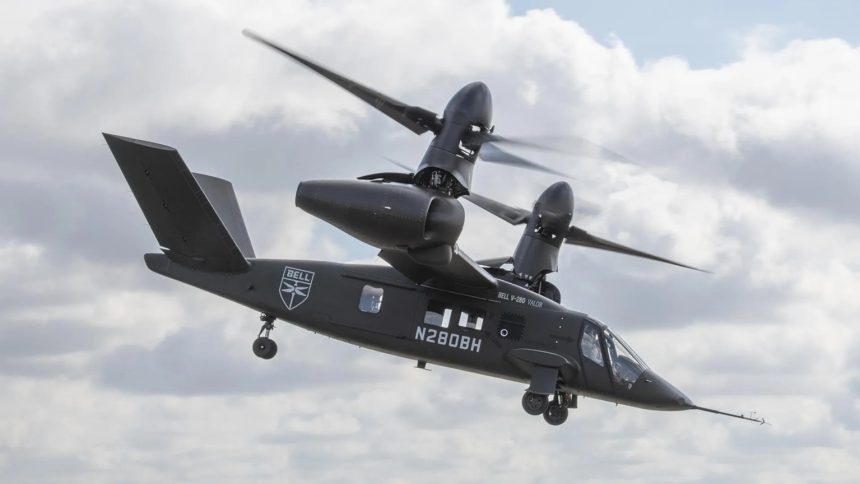
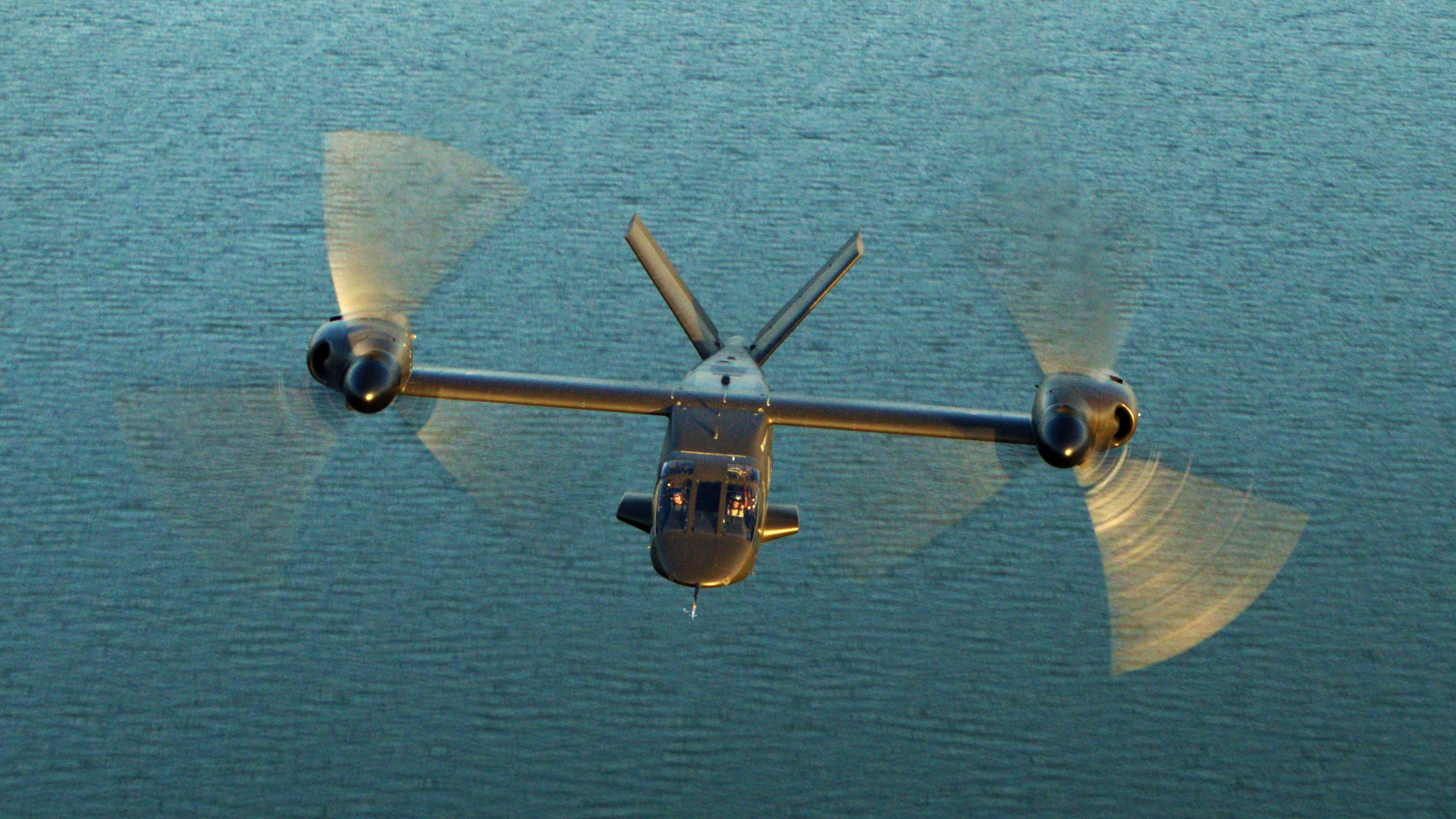
The U.S. Army’s MV-75 tiltrotor is advancing rapidly toward the delivery to operational units, now expected well before the original plans.
The U.S. Army’s next-generation tiltrotor assault aircraft, the Bell MV-75, is rapidly transitioning from concept and prototype into an accelerated fielding path. We previously reported here at The Aviationist in October 2025 on the Army’s plans for possible prototype delivery in Fiscal Year 2027 and early production in Fiscal Year 2028.
First Flight by the End of the Year
New compressed timelines and acquisition approaches could now see the MV-75 flying by the end of 2026, according to comments by the U.S. Army Chief of Staff Gen. Randy A. George. These comments were part of the first Army Senior Leader Situation Report, hosted at Fort Drum, New York, on Jan. 12, 2026, where the General, together with Secretary of the Army Dan Driscoll and Sgt. Maj. of the Army Michael R. Weimer, discussed Soldier readiness, transformation initiatives, emerging technologies and the acquisition models, including the Future Long Range Assault Aircraft (FLRAA) program.
Here is the transcription of the passage where George referred to the MV-75:
“We have a new tiltrotor aircraft and it was supposed to be delivered in 2031-2032 and we said ‘No, we need it very quickly.’ At the end of this year we will actually have those flying and out in formations, in both Compo 1 [Active Duty/Regular Army] and Compo 2 [Army National Guard] and in our SOF [Special Operations Forces] formations.”
— Gen. Randy A. George, U.S. Army Chief of Staff
As mentioned earlier, senior Army officials earlier said, on the sidelines of the AUSA (Association of the United States Army) Symposium, that the YMV-75 might possibly delivered in Fiscal Year 2027, which is set to start on Oct. 1, 2026. Gen. George’s remarks could thus refer to that timeline, indicating that the delivery and the first flight are planned between October and December, although no deliveries to operational units were mentioned.
The reason for the acceleration of the fielding path was mentioned few minutes earlier by the General, citing the urgency of rapidly integrating advanced capabilities in response to global technological shifts and battlefield needs:
“We used to talk about ‘Hey, we got to change by 2030.’ And 2030, in our view, was that arbitrary timeline, it was based on all these palm and budget cycles and all of those things. I think we’ve proven that we can change more rapidly. We are talking about how we can get better in the next four months, the next six months, and making sure that we are moving as rapidly as possible.
You guys all know what’s happening out there in the world and how fast technology is changing. We’re passing out some of those lessons with what is happening in Ukraine. In Ukraine things are moving very rapidly, we can do the same thing. “
— Gen. Randy A. George, U.S. Army Chief of Staff
Last year, the service already designated the 101st Airborne Division as the first unit to field the MV-75, and said special operations-specific requirements were incorporated into the FLRAA’s design to facilitate the introduction in the elite 160th Special Operations Aviation Regiment (SOAR). Personnel from these and also other units are being involved in the development trough Special User Evaluations to start gathering feedback with the goal of having a prototype which requires as few changes as possible before becoming operational.
This will be valid also for the early fielding, as mentioned by George:
“We want to give things to units and let you tell us what works and what doesn’t. You guys should be the ones deciding what we buy and what we don’t buy. It’s going to be a little different.”
— Gen. Randy A. George, U.S. Army Chief of Staff
Accelerated Fielding
Going by Gen. George’s remarks, should the first MV-75s be really delivered to units by the end of 2026, the fielding would happen five years than originally planned, considering the initial 2031-2032 timeline. We reached out to the U.S. Army to clarify this aspect and a spokesperson told us in an emailed statement that “the MV-75 prototype is scheduled to be delivered at the end of this calendar year and begin testing in early 2027.”
This appears to be in contrast with the initial interpretation circulating online that the fielding would start this year. It is thus possible that, with “at the end of this year,” Gen. George was only referring to the will to begin flight testing in 2026, while the “out in formations” could have been a reference to the involvement of units to get an up close look at the new aircraft for feedback, in line with the General’s words about including the soldiers, helicopter maintainers and crews – the final users – in the acquisition process.
Bell also published a post on social media on Jan. 14, on occasion of the Secretary of the Army’s visit to the company’s Wichita Assembly Center. The company, showing part of a fuselage’s structure, said the assembly of the first six MV-75 test aircraft is ongoing, following efforts to accelerate the production.
We were honored to welcome @SecArmy Dan Driscoll and Senator @JerryMoran to Bell’s Wichita Assembly Center, where assembly efforts have begun on the first six #MV75 test aircraft. We are proudly accelerating the production of the MV-75 fuselage demonstrating the impact of digital… pic.twitter.com/LmSrK63atU
— Bell (@BellFlight) January 14, 2026
Anyway, moving up five years the fielding of the new platform would be a significant acceleration, which would be in line with the urgency mentioned by the General, but would also require some compromises, accepting some risks. However, Col. Jeffrey Poquette, the FLRAA program manager, previously noted that the service is willing to accept the risk with the goal of minimizing the gap between prototype development and initial operational fielding.
Poquette mentioned that the MV-75’s critical design review (CDR) is targeted for 2026. However, compared to standard major weapon acquisition, he said Bell might receive funding immediately after the CDR to prepare for production, instead of waiting for the Milestone C decision at the end of the prototype’s testing.
As the Colonel explained, the risk comes as the Army is planning Milestone C for the MV-75 alongside developmental testing, which would then be followed by operational testing. The Milestone B was already reached in June 2024, allowing the acceptation of the virtual prototypes a year later, in June 2025.
Army officials also explained that, in order to make that possible early Milestone C call, the service and Bell held exhaustive interactions with the supply base, releasing engineering drawings and purchase orders earlier than usual. Poquette further said they got Bell to agree to this as a “non-negotiable” requirement from the outset.
As for the compromises, Poquette said that the service had to establish with Bell the bare minimum requirements the Army needs and Bell can provide if an advance production is taken. With this, the service decided which capabilities are needed the quickest and which can be deferred to a later date.
A key enabler of the accelerated schedule has been the Army’s adoption of digital engineering techniques, including the use of the virtual prototypes mentioned earlier. Brig. Gen. David Phillips, the Army’s Program Executive Officer for Aviation, emphasized that such tools reduce development risk and help bring next-generation capabilities to warfighters more quickly than traditional methods.
In fact, these tools allow an earlier involvement of the final user in the development, using the feedback to introduce improvements even before the physical aircraft is delivered. At the same time, these also allow to start working on the initial doctrine, sustainment models, and maneuver concepts of the MV-75.
This article has been updated to include a statement from a U.S. Army spokesperson and the post by Bell.