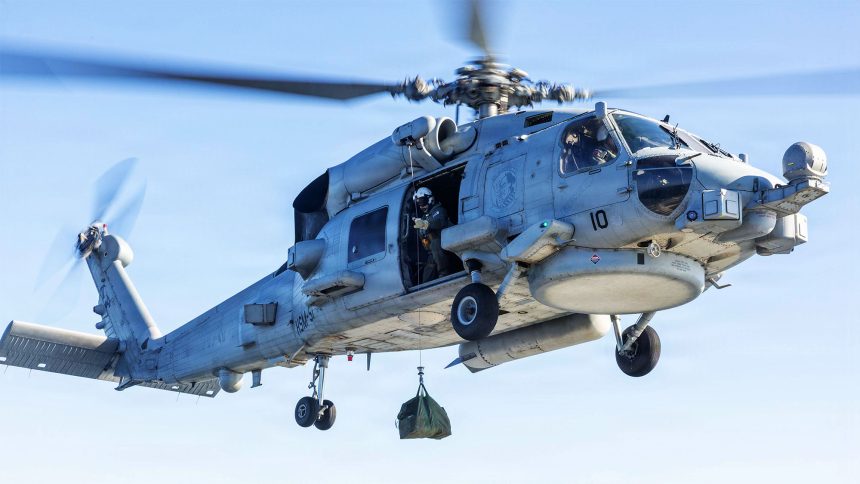
Lockheed Martin, parent of Sikorsky, marked the milestone with a ceremony as the aircraft, also known as the ‘Romeo’, was handed over to Helicopter Maritime Strike Squadron 41 (HSM-41).
Twenty years after entering initial service with the U.S. Navy, the MH-60R ‘Romeo’ – the latest and current generation of the Seahawk family – has surpassed one million total flight hours across seven operators. The 350th example of the MH-60R was delivered to HSM-41 during a recent ceremony, with Lockheed Martin then announcing the occasion on Jan. 13, 2026.
HSM-41, based at Naval Air Station North Island, San Diego, is the U.S. Navy’s west coast MH-60 Fleet Replacement Squadron, responsible for the training of pilots and aircrew for onward deployment to frontline units. The squadron is also known by the moniker ‘Seahawks’ – it has flown the H-60 Seahawk in multiple variants since first commissioning in 1983. First designated Helicopter Anti-Submarine Light 41 (HSL-41), the squadron was rebadged as HSM-41 in 2006 as part of a wider overhaul reflecting the expanded mission capabilities offered by the MH-60R variant.
The MH-60R, a product of Lockheed Martin subsidiary Sikorsky, is regarded as a highly capable multirole maritime helicopter. As well as torpedoes for anti-submarine warfare (ASW) and crew-served door guns, the MH-60R is equipped to routinely carry guided missiles like the AGM-114 Hellfire and Advanced Precision Kill Weapons System (APKWS). In January 2025, it was confirmed that an MH-60R operating over the Red Sea had engaged and destroyed an incoming Houthi drone for the first time.
🇺🇸 An MH-60R Seahawk, attached to the “Easyriders” of Helicopter Maritime Strike Squadron (HSM) 37, prepares for take-off from the flight deck of the USS Stockdale (DDG 106) in the Caribbean Sea, Dec. 16, 2025. Note the four AGM-114R-2 Hellfire II multi-purpose missiles.… pic.twitter.com/uQJQf5atAC
— Guy Plopsky (@GuyPlopsky) December 21, 2025
Although its sibling, the MH-60S, is more specialized for these utility tasks, the MH-60R is also capable of providing for personnel and cargo transfers as well as search and rescue (SAR). Both aircraft share lineage tracing back to the UH-60 Black Hawk, but the MH-60S is closer to a marinized version of the Black Hawk while the MH-60R carries over distinctive features from the SH-60/S-70B like a reinforced and repositioned tail landing gear. It should be noted that the MH-60S is still capable of carrying strike weapons, and can also be configured with a mine countermeasures (MCM) package.

“The MH-60R has been the U.S. Navy’s primary anti-submarine and surface warfare helicopter since 2010. This true multi-mission asset has proven itself in all aspects of land or maritime operations providing various mission requirements around the globe. We are grateful to the artisans at Sikorsky for keeping this invaluable asset at the ready for all our service men and women for decades to come,” said Captain William Hargreaves, H-60 Multi-Mission Helicopters program manager at Naval Air Systems Command (NAVAIR).
MH-60Rs are expected to continue in service through to the 2050s, and, as aircraft are still being delivered, it is almost certain that many will continue flying beyond this point. In addition to the U.S., the MH-60R variant is currently operated by Australia, Denmark, Saudi Arabia, India, Greece, and South Korea. Orders yet to be fulfilled include those from Norway and Spain, and other nations have expressed clear interest in the aircraft though have yet to formally confirm the contracts.
“The delivery of the 350th MH-60R helicopter is a testament to the exceptional capabilities of this aircraft and the dedication of our team,” said Ali Ruwaih, Maritime Systems vice president. “We are proud to support the U.S. Navy and our global partners with this highly advanced multi-mission platform, which will remain a critical component of global ASW operations for decades to come.”
MH-60R vs Alternatives
The aircraft’s strong support pipeline, owing to its widespread service in the U.S. Navy, is surely a key factor in attracting buyers. Other options for maritime helicopters, including the NH90 and AW159 Wildcat, are theoretically well equipped and of good performance, but suffer from a narrower base of operators that restricts the budget available for introducing new upgrades and integrating new weapon systems. It has taken almost ten years of the Wildcat’s service life in the Royal Navy for it to be seen regularly equipped with the missiles that were touted as the helicopter’s armament during development.
Norway will become the 9th country to operate the advanced MH-60R multi-mission Seahawk helicopter after a $364.3 million Foreign Military Sales order by the US govt 26 Oct. Sikorsky will produce 6 “Romeos” for Norway’s Navy by July 2027. This follows… https://t.co/bCehvhBaFa pic.twitter.com/MGMcH1UGfP
— Chris Cavas (@CavasShips) October 27, 2023
Nonetheless, it has been rumored that Norway – while also awaiting MH-60R deliveries – is interested in a potential order of the ASW variant of the AW101 Merlin to operate alongside its new frigates, which will be almost identical to those operated by the Royal Navy. The Merlin is a much larger helicopter than the Seahawk, and both represent different approaches to conducting ASW. Both aircraft can, if required, operate ASW missions independently of a ship or linked shore base, but the Merlin’s systems have been geared specifically to support this further while the MH-60R instead usually offboards more advanced data processing to its parent unit.

As a smaller aircraft, though, the Seahawk is much more flexible in terms of which ships it can and cannot operate from for long periods. These differences could mean there is a niche in Norwegian service for both types of aircraft. For the U.S., meanwhile, a much larger surface fleet essentially guarantees that their MH-60Rs would rarely be called on to operate completely independently from a wider ASW effort.