Airstrikes and helicopter raids have been seen inside Venezuelan territory as President Trump confirms attacks, stating that President Nicolás Maduro has been captured by U.S. forces.
After a huge buildup of military assets, unparalleled to anything seen before in the U.S. Southern Command (SOUTHCOM) region, and attacks against alleged drug trafficking vessels as far back as September, the U.S. has now commenced direct operations against Venezuela and the administration headed by Nicolás Maduro. U.S. officials told CBS News shortly after airstrikes began that the directive had been issued by President Donald Trump.
Then, shortly before 09:22 UTC, U.S. President Donald Trump confirmed a ‘large scale strike’ against Venezuela and said that Venzuelan President Nicolás Maduro and his wife have been captured by U.S. forces.
🚨BREAKING via @CBSNews: President Trump ordered strikes on sites inside Venezuela including military facilities, U.S. officials said, as the administration early Saturday ratcheted up its campaign against the regime of President Nicolás Maduro. via @JimLaPorta and me
— Jennifer Jacobs (@JenniferJJacobs) January 3, 2026
— Rapid Response 47 (@RapidResponse47) January 3, 2026
Very little detail is presently known about the airstrikes, which could have come from any, or even all, of the assorted combat aircraft that have been assembled at airfields in the region and on U.S. Navy vessels in the surrounding seas. The USS Gerald R. Ford carrier strike group (CSG) sails with the usual complement of F/A-18E/F Super Hornets and EA-18G Growlers, while the Iwo Jima amphibious ready group (ARG) is equipped with the AV-8B Harrier II – though most of the ARG’s air wing has been staged ashore.
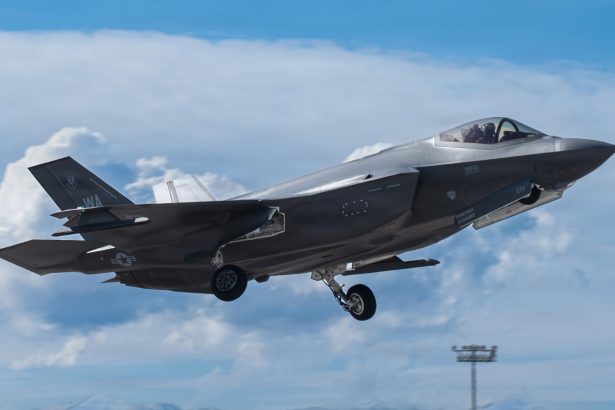
F-35A and F-35B Lightning II stealth fighters have been deployed to land bases alongside additional EA-18Gs. It would seem likely that the Growlers and Lightning IIs, of all aircraft available, would have been some of the first to join the attacks and provide suppression of enemy air defences (SEAD) capabilities. Targets known to have been struck include military bases, port facilities, and communications towers, though there are almost certainly more that have been or will be targeted.
BREAKING via @CBSNews — Locations hit in US strikes in Venezuela include:
1. Fuerte Tiuna – military base in Caracas
2. La Carlota – airbase in Caracas
3. El Volcán – signal antenna
4. La Guaira Port – main port of Venezuela
via @margbrennan
— Jennifer Jacobs (@JenniferJJacobs) January 3, 2026
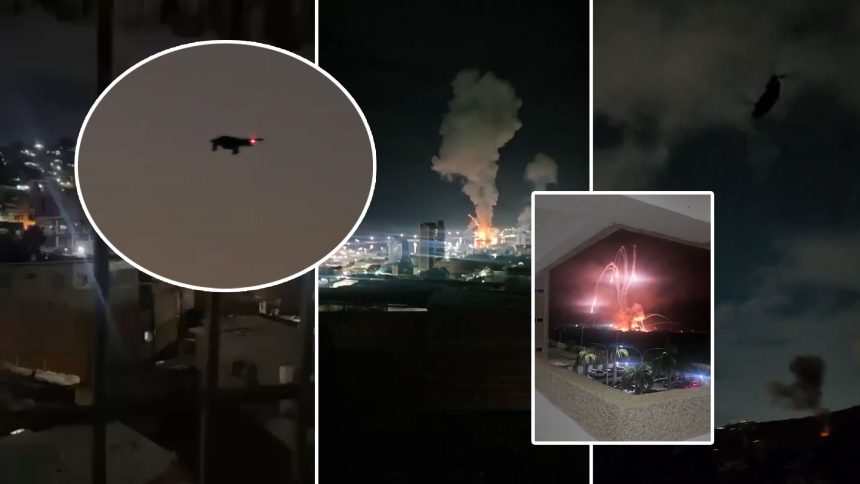
📷 Flames rise after a series of explosions at Fort Tiuna, Venezuela’s largest military complex in capital Caracas this morning.
(Luis Jaimes/AFP) pic.twitter.com/EUqI85lK5S
— Conflict Radar (@Conflict_Radar) January 3, 2026
SEAD cover would have been especially prudent as video footage confirms the activity of U.S. helicopters over Venezuelan territory, namely MH-47G Chinooks of the 160th Special Operations Aviation Regiment (SOAR) as well as an unconfirmed attack helicopter carrying out rocket and gun attacks. This may be, as many sources have claimed, an AH-64 Apache, or it could be an MH-60 Direct Action Penetrator (SAP) from the 160th SOAR itself which, unlike an Apache, can be refueled in flight, or one of the unit’s AH-6 Little Birds.
NOW – Suspected U.S. Apache and CH-47 aircraft fly over Caracas, Venezuela. pic.twitter.com/FqDOJBYmRX
— Disclose.tv (@disclosetv) January 3, 2026
Caracas is under fire. Multiple U.S. strikes have hit key military sites: Fuerte Tiuna, La Carlota airbase, and a communications center in El Hatillo, all under Maduro’s control. Explosions echo through the capital, the power is out in parts of the city, and U.S. helicopters are… pic.twitter.com/GAtW2NWVy7
— NOELREPORTS 🇪🇺 🇺🇦 (@NOELreports) January 3, 2026
The 160th SOAR – the most experienced and specialised special forces helicopter unit in U.S. service – were almost certainly involved in the operation that President Trump says has captured the Venezuelan leader, and it will likely become one of their most famous raids alongside Operation Neptune Spear against Osama bin Laden’s compound in Pakistan. This time, it appears they were used to transport members of the U.S. Army’s Delta Force (officially 1st Special Forces Operational Detachment–Delta)
#BREAKING via @JenniferJJacobs – Nicolas Maduro was captured by Delta Force, the U.S. military’s top special mission unit, according to U.S. officials. Army Delta Force was also responsible for the mission that killed al-Baghdadi in 2019.
— Jim LaPorta (@JimLaPorta) January 3, 2026
Venezuela’s government declared a state of emergency, and an official statement read: “The Bolivarian Government calls on all social and political forces in the country to activate mobilization plans and repudiate this imperialist attack.”. While no official statement from the U.S. had yet appeared, beyond anonymous comments to reporters, Venezuela named the U.S. and declared the attacks a “very serious military aggression”. It is still too early to have a firm idea on potential casualties.
The U.S. Federal Aviation Administration issued a NOTAM closing Venezuelan airspace to all U.S. airlines and civilian aircraft due to ongoing military operations. The notice took effect from 0600 UTC on Jan. 3, 2026.
Amid reports of explosions around Caracas, the US FAA issued a new NOTAM prohibiting US aircraft from operating at all altitudes within Venezuelan airspace as of 0600Z today, 3 Jan.
Flightradar24 is not currently tracking any aircraft over Venezuela.https://t.co/BZhEhwjD1j pic.twitter.com/AEyB7o2Je1
— Flightradar24 (@flightradar24) January 3, 2026
Prior to these strikes, it has become known in recent days that a drone strike had been carried out on Venezuelan soil by the Central Intelligence Agency (CIA) early in December. It is also very likely that other covert U.S. actions, including intelligence, surveillance, and reconnaissance (ISR) overflights by stealth UAVs, have also breached Venezuelan borders well in advance of direct kinetic action.
Unsurprisingly, and contrasting many days in the lead-up to these strikes, very little activity is visible on flight tracking websites like Flightradar24.
Authorization for the strikes apparently came days in advance, with all capabilities in place by Christmas Day, but world events delayed the start date. A full press conference led by President Trump is expected at 1600 UTC on Jan. 3.
Scoop: Trump gave the U.S. military the green light to conduct land strikes in Venezuela days ago, U.S. officials told @CBSNews. U.S. was ready on Christmas day but airstrikes in Nigeria against ISIS targets took precedence, sources said. The days following Christmas opened more…
— Jennifer Jacobs (@JenniferJJacobs) January 3, 2026
Update 10:26 UTC:
Senator Mike Lee of Utah has said that Marco Rubio, U.S. Secretary of State, informed him during a phone call that the U.S. intends for Maduro to stand trial. Military operations, he claims, were limited to supporting and protecting the mission to capture the Venezuelan leader. Rubio reportedly anticipates no further action now that Maduro has been apprehended.
He anticipates no further action in Venezuela now that Maduro is in U.S. custody
— Mike Lee (@BasedMikeLee) January 3, 2026
A $50 million bounty has been on Maduro’s head since August, and criminal charges against him have been pending in U.S. courts for several years. Venezeuelan sources have reported that Maduro’s capture was a ‘negotiated exit’. What exactly is meant by this phrase isn’t clear.
BREAKING: The Venezuelan government does not know the whereabouts of President Nicolas Maduro, says the country’s vice-president Delcy Rodriguez in an audio message on state television.
Rodriguez demanded “proof of life” of Maduro and his wife.
🔗 https://t.co/D40FIyT5hP pic.twitter.com/diBppeL7gY
— Sky News (@SkyNews) January 3, 2026
The Vice President of Venezuela Delcy Rodriguez spoke via national television to say that the Venezuelan state had no information on the whereabouts of Maduro, and demanded that the U.S. confirm both his and his wife’s safety – or ‘proof of life’.
Aircraft seen returning to U.S. forward bases in Puerto Rico apparently confirm the involvement of F-35s. So many aircraft were seemingly involved in the mission that recovering them all is taking some time. For the first time, F-22 Raptors have also been reported.
There are in fact F-22s… https://t.co/VvjXjUplSY
— SA Defensa (@SA_Defensa) January 3, 2026
More video footage of the aftermath of the operation is continually appearing across social media. Venezuelan air defences, including Buk missile systems, which were said to have been reinforced by Russia in recent months, are seen burning near strategic sites following SEAD strikes.
Venezuelan military BUK air defence burning at Higuerote airport this morning after being hit by US strikes#Venezuela https://t.co/mBmacAcJ1F
— CNW (@ConflictsW) January 3, 2026
Update 12:23 UTC: Aftermath
Now the sun has risen, we are getting better views of the damage done by the U.S. airstrikes. Burned out wreckage of a Buk system confirms without doubt that attacks targeted Venezuelan air defence capabilities.
This Venezuelan BUK has seen better days. pic.twitter.com/ntSPQlgUth
— Oliver Alexander (@OAlexanderDK) January 3, 2026
Strikes hit La Carlota airbase, officially Generalissimo Francisco de Miranda Air Base, which is located in Caracas and used by the Venezuelan state for VIP movements. These appear to have been precisely targeted and little damage can be seen in wide views of the airfield. Plans to defend the site appear to have been activated, with aircraft parked sideways on the runway likely in an attempt to deny its use by U.S. forces.
The Associated Press has a livestream of La Carlota AB. H/t @ShabanianAram. https://t.co/7FTLdMGtEE pic.twitter.com/exT1qVRGTb
— Christiaan Triebert (@trbrtc) January 3, 2026
Vice President Rodriguez, who has become the de jure leader of Venezuela, is reportedly currently in Moscow on an official visit.
Update 12:56 UTC: F-22 Raptors
We now have an image showing 12 F-22 Raptors on the ground at Roosevelt Roads, alongside F-35s, HC-130J Combat King IIs, and a U.S. Marine Corps KC-130J.
F-22A Raptors assigned to the 1st Fighter Wing out of Joint Base Langley-Eustis have been observed operating from the former Roosevelt Roads Naval Station in Puerto Rico.
📸 HR Planespotter pic.twitter.com/yDsR6XH0HB
— GMI (@Global_Mil_Info) January 3, 2026
The deployment of F-22s has been heavily rumored in recent days and weeks, though no confirmation has previously been available. It is unclear whether these aircraft were deployed immediately prior to the operation beginning, or if they had been staged somewhere in the region ahead of time and simply not picked up on through local reporting.
Update 14:30 UTC: RQ-170 and U.S. injuries
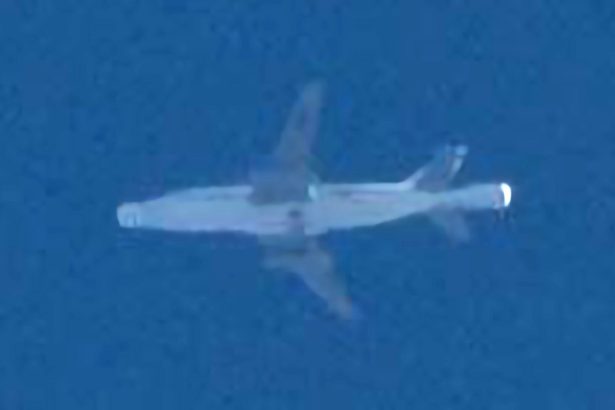
Social media posts have yielded yet more discoveries. From nearby Roosevelt Roads, civilians have captured footage of an apparent RQ-170 stealth UAV. These are the clearest views we’ve had so far of their operations in the SOUTHCOM region, with only a handful of vague sightings and the appearance of an RQ-170 patch in a now-deleted DVIDS image having been seen previously.
Avión militar sobre el cielo de Naguabo/Ceiba – 6:20am de hoy. (📷 DVS Encarnación) #PuertoRico pic.twitter.com/0nbMeFAkkk
— Robby Cortés🇵🇷 (@RobbyCortes) January 3, 2026
President Trump, though in some cases giving conflicting information, appeared to confirm that U.S. forces had suffered no fatalities though there were some injuries. A helicopter was also reportedly damaged, but managed to recover to a friendly airfield or deck safely.
President Trump tells Fox & Friends “I think we had nobody killed” in the operation to capture Maduro, but “a couple of guys were hit.” A helicopter was hit “pretty hard,” Trump added.
— Lucas Tomlinson (@LucasFoxNews) January 3, 2026
Update 15:00 UTC: Maduro taken to the USS Iwo Jima
President Trump has said that Maduro was taken to the amphibious assault ship USS Iwo Jima (LHD 7), and will be transported to New York to face pending criminal charges.
President Donald Trump says Maduro was taken to the USS Iwo Jima and will be heading to New York to face the courts.
— Idrees Ali (@idreesali114) January 3, 2026
He was reportedly captured while attempting to escape to a secure room inside his home. A final demand to surrender had been issued by Trump to Maduro around a week prior. U.S. forces had also prepared a second wave of strikes, but these were, Trump says, not necessary.
Trump’s later press conference will be held alongside a U.S. military official and U.S. Secretary of Defense Pete Hegseth.
The timing of this raid, though apparently dictated by weather, is interesting. It comes almost exactly six years after the consequential decision to assassinate the Iranian General Qasem Soleimani – one of the defining military moment’s of Trump’s first term. Jan. 3 is also 36 years to the day that Panama leader Manuel Noriega surrendered to U.S. forces in Operation Just Cause. Noriega was transported to the U.S. to face criminal charges, echoing the situation now unfolding.
Update 16:30 UTC: Image of Maduro in custody released
President Trump has released an image apparently taken on board the USS Iwo Jima of President Maduro in custody. He is pictured in casual clothes, with a blacked-out visor and ear defenders.
— Rapid Response 47 (@RapidResponse47) January 3, 2026
A U.S. Drug Enforcement Agency (DEA) officer can be seen standing to the right of Maduro. The image appears to be larger, what we have actually being a phone image of a printed page that seemingly was handed to Trump.
Nicolas Maduro is expected to arrive at the U.S. military base in Guantanamo Bay before being transferred to an FBI plane en route to New York, sources tell me, @PierreTABC & @SweeneyABC
— Katherine Faulders (@KFaulders) January 3, 2026
Latest reports indicate that Maduro will be transferred first to the controversial U.S. facility at Guantanamo Bay, where he will then board an FBI aircraft for transit to New York.
Final Update 17:10 UTC: Operation Absolute Resolve, 150 aircraft including B-1B Lancers
Following President Trump’s press conference, which did not reveal much new information, Chairman of the Joint Chiefs of Staff Dan Caine spoke to confirm further details about the military operation. Codenamed Operation Absolute Resolve, Caine revealed the mission involved over 150 aircraft operating from over 20 locations. These included F-22 Raptors, F-35 Lightning IIs, F/A-18 Super Hornets, EA-18G Growlers, E-2 Hawkeyes, and, confirming their involvement for the first time, B-1B Lancer strategic bombers. Various unmanned aircraft also took part.
The 160th SOAR helicopter force began their ingress at 0601 UTC (0201 local time), and exited Venezuelan airspace back over the water by 0820 UTC (0420 local time). He confirmed the earlier story about a helicopter coming under fire and being hit, saying it remained flyable throughout the operation.
Chairman of Joint Chiefs of Staff Dan Caine explains how the United States “maintained the element of surprise” in an operation which led to them capturing Venezuela’s leader Nicolas Maduro ⬇️
Latest updates: https://t.co/QiYZWZ6Hlk pic.twitter.com/y2YFsqc704
— Sky News (@SkyNews) January 3, 2026
Space and cyber capabilities were employed as part of the overall effort. Caine said U.S. forces from multiple branches took part in ‘dismantling and disabling’ Venezuelan air defences. The goal of the air component was given solely as protecting the helicopter force.
The final go-ahead was received by military commanders from President Trump at 0346 UTC (10:46PM EST) with a personal message that was apparently broadcast to the units taking part. Caine said that Maduro ‘gave up’ and was subsequently apprehended by U.S. forces, which included a contingent of law enforcement officers.