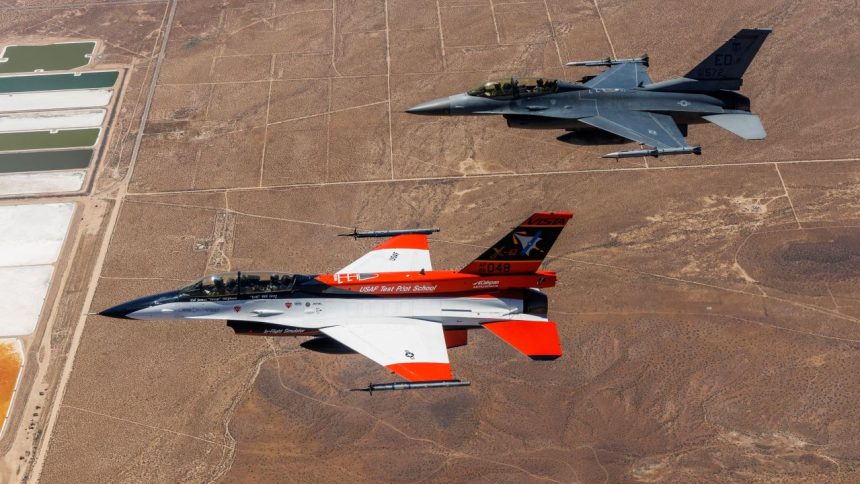
The PhantomStrike AESA radar will be integrated on the U.S. Air Force’s X-62 VISTA as part of the recently announced Mission Systems Upgrade to expand autonomy testing.
The U.S. Air Force’s X-62 Variable Stability In-Flight Simulator Test Aircraft (VISTA) will receive Raytheon’s PhantomStrike AESA (Active Electronically Scanned Array) radar as a part of its Mission Systems Upgrade (MSU), announced RTX on Dec. 19, 2025. We recently reported here at The Aviationist about the MSU, part of a strategic investment from the Test Resource Management Center (TRMC) meant to expand autonomy testing in more complex scenarios.
The X-62 is assigned to the U.S. Air Force Test Pilot School (TPS), part of the 412th Test Wing at Edwards Air Force Base, California. It has so far been successfully piloted by Artificial Intelligence (AI) agents of the Air Force Research Laboratory’s (AFRL) Autonomous Air Combat Operations (AACO) and DARPA’s Air Combat Evolution (ACE) in Beyond Visual Range (BVR) and Within Visual Range (WVR) scenarios, respectively, in 12 flights conducted between Dec. 1 and 16, 2022.
The MSU upgrade is expected to inform and firm up autonomous air combat doctrine, technology and tactics, concurrently being tested by industry and Air Force joint programs. These include the YFQ-44A, YFQ-42A and XQ-58A Collaborative Combat Aircraft, pairing tests of the F-22 Raptor with GA-ASI’s MQ-20 Avenger, as well as the GA-ASI XQ-67A Off-Board Sensing Station (OBSS).
📰 The @usairforce has awarded Raytheon a contract to equip the autonomous X-62A Variable In-flight Simulation Test Aircraft with a PhantomStrike radar. More: https://t.co/68NiUL9QKe
📸: U.S. Air Force pic.twitter.com/t7DMYgegXt
— RTX (@RTX_News) December 19, 2025
Raytheon’ PhantomStrike Radar
Raytheon announced on Dec. 19 the award of an U.S. Air Force contract “to equip the autonomous X-62A VISTA with a PhantomStrike radar.” The company said “PhantomStrike delivers powerful radar capability ensuring superior battlespace awareness.”
Moreover, Raytheon describes the PhantomStrike as a first-of-its-kind “smaller, lighter […] air-cooled and compact fire-control radar” with reduced power requirements than current conventional AESA radars. “It’s designed for a wide range of platforms, including uncrewed aerial vehicles, light-attack aircraft, and rotary-wing aircraft,” RTX said in the press release.
The press release also touched upon the radar’s features like “digital beam forming, steering, multimode functionality and interleaved ground and air targeting,” which enable it to deliver “superior radar capability at nearly half the cost of typical fire control radars.”
📰 #NEWS: Raytheon delivers the first PhantomStrike radar for Korea Aerospace Industries’ FA-50 fleet. At nearly half the cost of a typical fire control radar, the next-generation radar provides superior battlespace situational awareness. More: https://t.co/j7S575s5Yj pic.twitter.com/9CKvBCzy8c
— RTX (@RTX_News) October 21, 2025
Raytheon’s president of advanced products and solutions Dan Theisen noted PhantomStrike’s role in the U.S. Air Force’s air dominance goals with uncrewed aerial systems. “Autonomous aircraft are poised to play a key role in helping the U.S. maintain air superiority, and Raytheon’s PhantomStrike radar is uniquely designed to help them do it. This radar is revolutionary in its use of Gallium Nitride (GaN), completely air-cooled technology, and innovation in how we manufacture it – at a lower cost than other modern-day radars,” Theisen said.
Radar transceivers made with GaN materials, now adopted in radar and electronic warfare systems of many countries, are more sensitive and powerful, and have also been said to contribute in tracking stealth aircraft.
As we have previously reported, steps for upgrading the X-62 VISTA to include more sophisticated autonomous air combat technology were reflected in an August 2024 Request for Information (RFI). Seeking a potential radar upgrade on the X-62, the future radar was specifically described as “part of a set of modular components that can be used individually or together to provide sensory input to aircraft.”
NEWS: X-62 VISTA to receive radar and sensor capabilities through an investment by the Test Resource Management Center.
Enhancements will push X-62 to evaluate more complex #AI and #autonomy scenarios with the #USAF Test Pilot School. @HQ_AFMC
More- https://t.co/cuKi89MCnR pic.twitter.com/A331fXATXy
— Edwards Air Force Base (@EdwardsAFB) December 18, 2025
The RFI also stipulated that the AI agents should be able to autonomously control and use the radar. “The aircraft will be capable of processing raw data from the AESA radar in an autonomy enclave that can use machine learning to process the data and directly control the sensors using either the existing modes available via the radar OFP or via experimental modes and experimental combinations of modes inaccessible or unachievable by human use,” mentioned the RFI.
Among the requirements, air cooling, a weight less than 200 lb, AESA technology “that can be operated in an unclassified mode,” air-to-air and air-to-ground modes and startup time less than 2 minutes, as the physical and performance requirements for the radar were also noted. In May 2025, the service hosted an industry day focused on the MSU.
X-62 VISTA
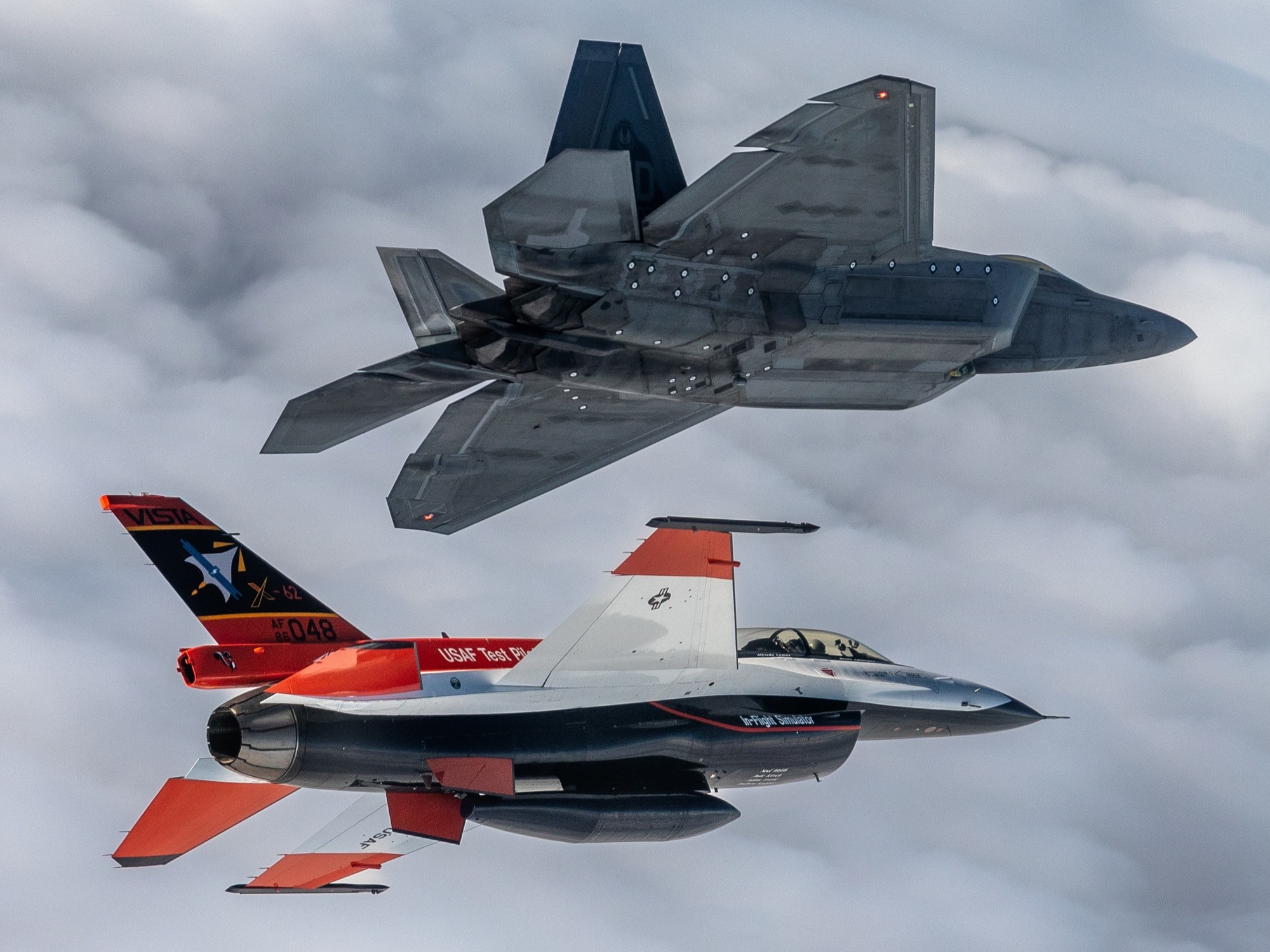
RTX’s press release described the VISTA as a modified F-16D Block 30 test aircraft upgraded with Block 40 avionics, a hybrid used as a test bed integrated with machine learning and specialized software. It flew for the first time with the new configuration in 1992, becoming an important part of the Test Pilot School curriculum.

The aircraft’s existing VISTA Simulation System was fully replaced with a new System for Autonomous Control of Simulation (SACS) to support autonomy testing, prompting the redesignation as an X-plane. The aircraft however retained its central control stick connected to the simulation system, in addition to the F-16’s peculiar side stick.
Following the upgrade, it was redesignated as the X-62A in 2021 for participation in the AFRL’s Skyborg autonomous flight tests, with the X denoting its experimental status.
Then, during the 12 flights between Dec. 1 and 16, 2022, AFRL’s AACO and DARPA’s ACE agents, as we mentioned earlier, conducted BVR and WVR, respectively, against constructive AI red-team agents. AACO and ACE executed autonomous tactical maneuvering while maintaining real-world airspace boundaries, explained the service.
A test in 2023 saw the X-62 VISTA successfully flown by an Artificial Intelligence agent during a simulated dogfight against a human-piloted F-16. For safety purposes, the X-62A is flown with test pilots onboard with the independent ability to disengage the AI agent.
The addition of the PhantomStrike will allow seeing both whether the AI agents can identify/discriminate potential threats upon detection (off-board sensing) and how they maneuver and respond with simulated air-to-air missile fire (off-board weapons release). Air Force, AFRL and DARPA testers can then use Machine Learning (ML) to train and refine their action.
Future
Regarding the broader MSU program, the 412th Test Wing at Edwards AFB said that the “advanced radar and sensors for advance testing” mark its journey “as it continues to collaborate across government and industry on test projects” through the Test Pilot’s School Curriculum.
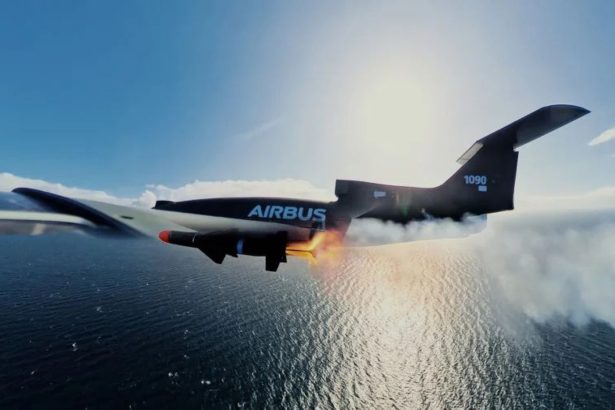
While the X-62 VISTA has been trialing sophisticated autonomous combat technology for a while, the MSU upgrade comes in the backdrop of other autonomous aerial vehicles like the Turkish Kizilelma and Australian MQ-28A Ghost Bat live-fire missile tests with the use of both on-board and off-board sensors.