The U.S. Air Force says the YFQ-48A Mission Design Series acknowledges Northrop Grumman’s Project Talon as a “strong contender” for the CCA program.
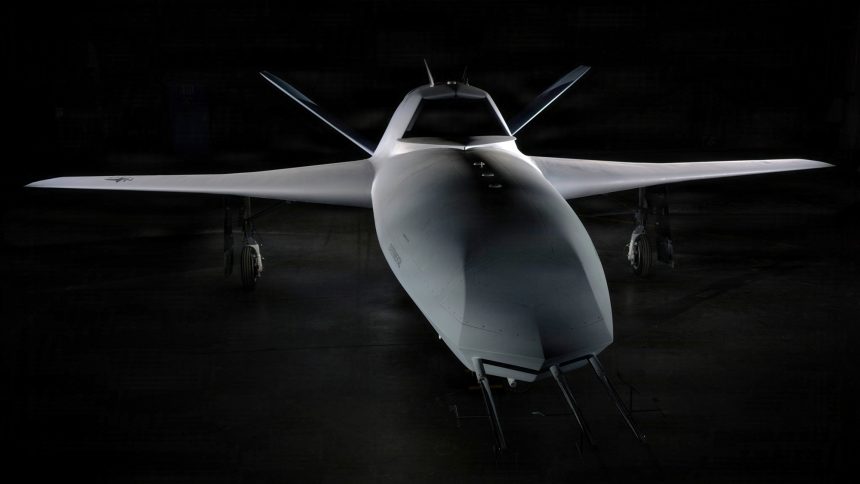
The U.S. Air Force has announced that it has assigned the Mission Design Series (MDS) YFQ-48A to the Northrop Grumman Project Talon Collaborative Combat Aircraft on Dec. 22, 2025. The company unveiled the new unmanned platform on Dec. 3 at the Mojave Air and Space Port, after developing it largely in secrecy.
YFQ-48A
The YFQ-48A’s designation marks a key step forward in the Collaborative Combat Aircraft program, as the Air Force prepares to select designs for the Increment 2. The service says the designation “highlights the ongoing partnership between the Air Force and Northrop Grumman and acknowledges the continued progress of the YFQ-48A as a strong contender in the CCA program.”
As previously explained, this MDS defines the semi-autonomous aircraft as an unmanned fighter. In fact, YFQ means prototypes (as indicated by the ‘Y’ status prefix) of UAVs (as denoted by the ‘Q’ vehicle type code) with the intended role as a fighter (indicated by the ‘F’ basic mission).
The YFQ-48A now joins the two other CCAs, the YFQ-42A and YFQ-44A, which received the same unmanned fighter prototype designation in March 2025. These two aircraft, currently in flight testing, are part of the CCA’s program Increment 1.
“We are encouraged by Northrop Grumman’s continued investment in developing advanced semi-autonomous capabilities,” said Brig. Gen. Jason Voorheis, program executive officer for Fighters and Advanced Aircraft. “Their approach aligns with our strategy to foster competition, drive industry innovation, and deliver cutting-edge technology at speed and scale.”
In the press release, the Air Force explained “the CCA program’s acquisition strategy emphasizes continuous competition, providing multiple on-ramps for industry participation.” In turn, this allows the service to “leverage the most innovative solutions from across the defense industrial base to meet the evolving demands of modern warfare.”
“Northrop Grumman’s commitment to innovation, low-cost manufacturing, and calculated risk-taking aligns perfectly with the CCA acquisition strategy and the Secretary of War’s Acquisition Transformation Strategy,” said Col. Timothy Helfrich, director of the Agile Development Office. “Project Talon is a testament to their ability to push boundaries and experiment with new technologies, ultimately advancing solutions that could enhance the future of airpower.”
CCA Increment 2
Recently, Breaking Defense reported about the award of early contracts to nine unnamed companies for the Collaborative Combat Aircraft program’s Increment 2. The development, disclosed by an Air Force spokesperson to the publication, will see the nine companies compete for a prototyping contract.
According to the spokesperson, the contracts are part of the “Concept Refinement” phase. These will include a “broad spectrum” of concepts, “ranging from more affordable, attritable concepts to higher-end, more exquisite designs.”
Project Talon
Northrop Grumman has formally unveiled “Project Talon” on Dec. 3, 2025. The company defined it as a new autonomous aircraft demonstrator built to validate faster and more affordable manufacturing methods for large uncrewed platforms.
The company described the program as a response to lessons learned from its unsuccessful bid for the U.S. Air Force’s Collaborative Combat Aircraft (CCA) Increment 1. According to statements made during the unveiling, reported by multiple outlets, the company’s previous CCA proposal performed well technically but was considered too costly and thus not affordable.
Talon aimed to find the right balance between capability and cost, with Tom Jones, president of Northrop’s aeronautics systems division, saying the result was a design that is both cheaper and more capable. However, it appears the aircraft was created less as a direct competitor for future CCA increments and more as a proof-of-concept for a different production philosophy, with faster development, fewer parts, and a lower cost.
Project Talon is here. This next-gen autonomous aircraft is made to adapt fast.
➡️ Modular by design
➡️ Mission-ready
➡️ Built for the challenges ahead pic.twitter.com/6UOhLSBHKn
— Northrop Grumman (@northropgrumman) December 4, 2025
“The idea was to see if we could build an aircraft that had all the same capability of our original offering, and do it faster,” said Jones. “So the outcome was an aircraft, but the [more important] outcome we’re shooting for was the process. How do we design and build things that perform at a high level, but that we can build quickly now and can do affordably?”
Among the key development milestones and objectives, Greg Morris, president of Scaled Composites, noted around 50% fewer parts compared to the original design and structure fully made of composite materials. This led to a 1,000-pound reduction in weight and a roughly 30% faster assembly of the aircraft.
The aircraft
Talon is not a missionized combat drone and has not yet flown, however the demonstrator provides insight into Northrop Grumman’s evolving approach to attritable systems and rapid prototyping. Jones further added that the aircraft is not specifically targeted for the follow-on CCA Increment 2 or other international programs, although he didn’t rule out a submission of the design to the Air Force.
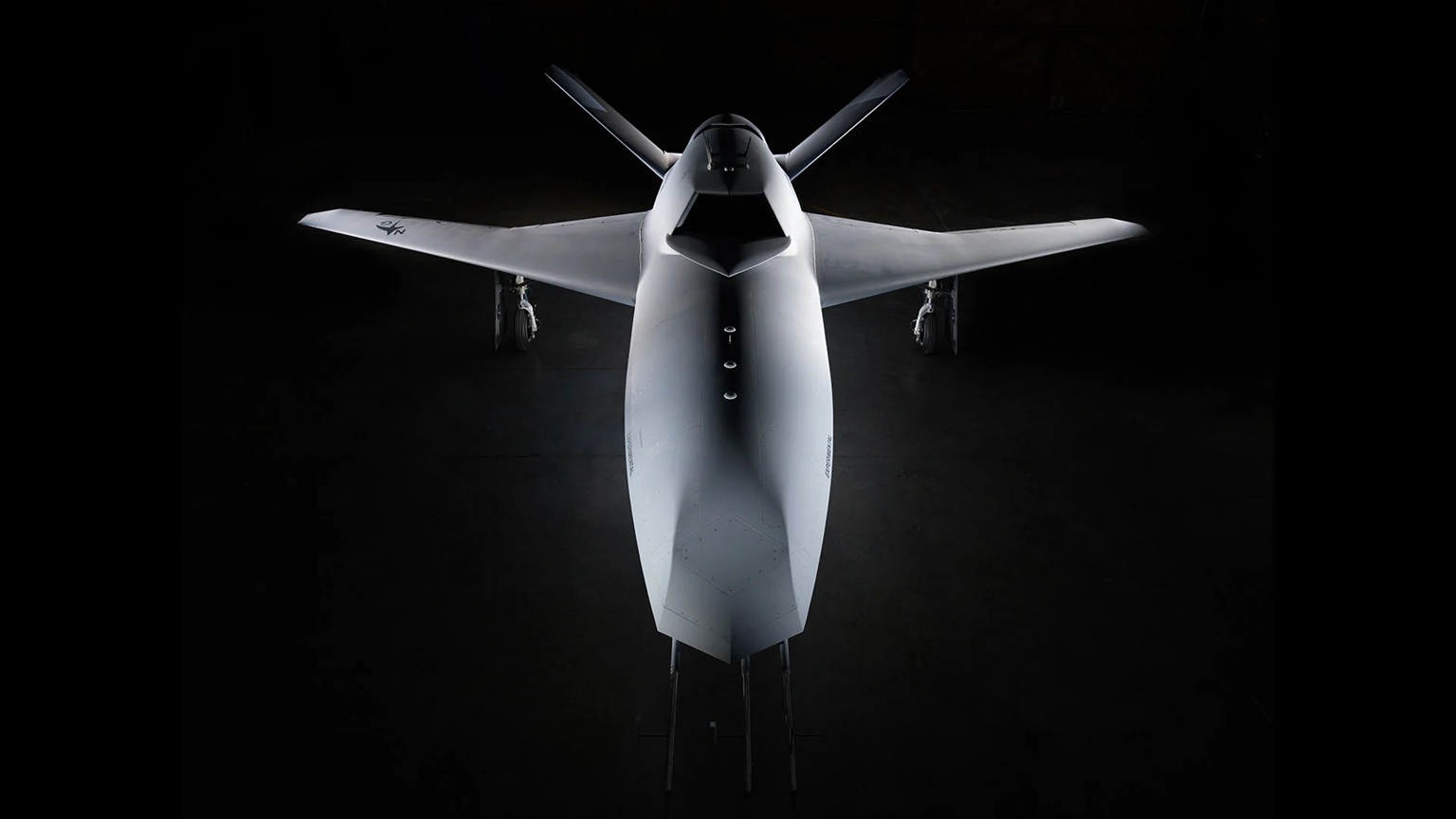
Regarding the general configuration, it is largely the same mentioned by Aviation Week in the report about Project Lotus, the program’s initial name, featuring a shovel-shaped nose, long slender fuselage, low aspect ratio lambda wing planform, top mounted engine air inlet and exhaust, and canted twin tails.
The design appears optimized for high performance and agility, with low-observable characteristics also visible. Aviation Week and The War Zone also noted that the aircraft carried FAA registration “N444LX,” associated with a Scaled Composites aircraft designated as “Model 444.”
Regarding the powerplant, Northrop Grumman confirmed only that Talon uses a single turbofan engine, but declined to identify the manufacturer or thrust class. The engine is supplied air by a trapezoidal dorsal inlet mounted above the aft fuselage, while the exhaust is positioned between the canted tail surfaces.
The nose section features test instrumentation typical of early flight-test articles, including three air data probes extending forward of the radome. The War Zone further noted the presence of a small aperture under the nose, possibly for a camera or sensor during testing.
The War Zone also observed a large trapezoidal panel on the underside of the fuselage, possibly indicating space for an internal bay. The company did not comment on whether the demonstrator is intended to carry stores internally, though a weapons or sensor bay would be consistent with CCA-type architecture.