On Dec. 15, 2010, sixteen Harriers took off from RAF Cottesmore for a farewell formation flight marking the end to 41 years of British Harrier operations.
Originally scheduled to remain in service until 2018 or beyond, ideally overlapping with the introduction of the F-35B Lightning II, budget cuts instituted by the 2010 Strategic Defence and Security Review (SDSR) saw the joint Royal Air Force/Fleet Air Arm Joint Strike Wing stand down with only a few months of notice. Three squadrons – 1(F) Squadron RAF, 4(F) Squadron RAF, and 800 Naval Air Squadron were the remaining operational users of the Harrier airframe in British service, all eventually disbanding on Jan. 28, 2011.
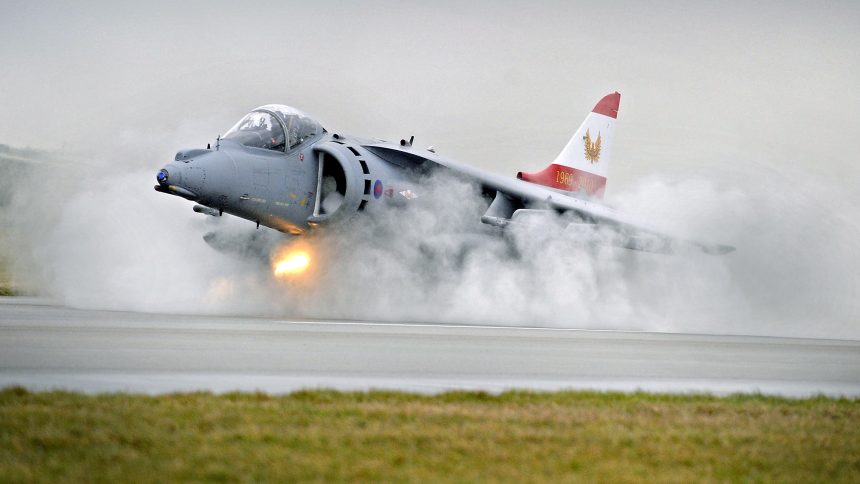
After several weather delays, the final operational flight was arranged for Dec. 15, 2010. It featured a formation of 13 Harrier GR9s and 3 Harrier T12 twin-stick trainers led by a specially painted jet in a retro camouflage scheme reminiscent of ones worn by earlier generations of Harrier. Other aircraft in the formation featured commemorative tail artwork. The aircraft would, in formation, commence a tour of Royal Air Force bases across central and eastern England.
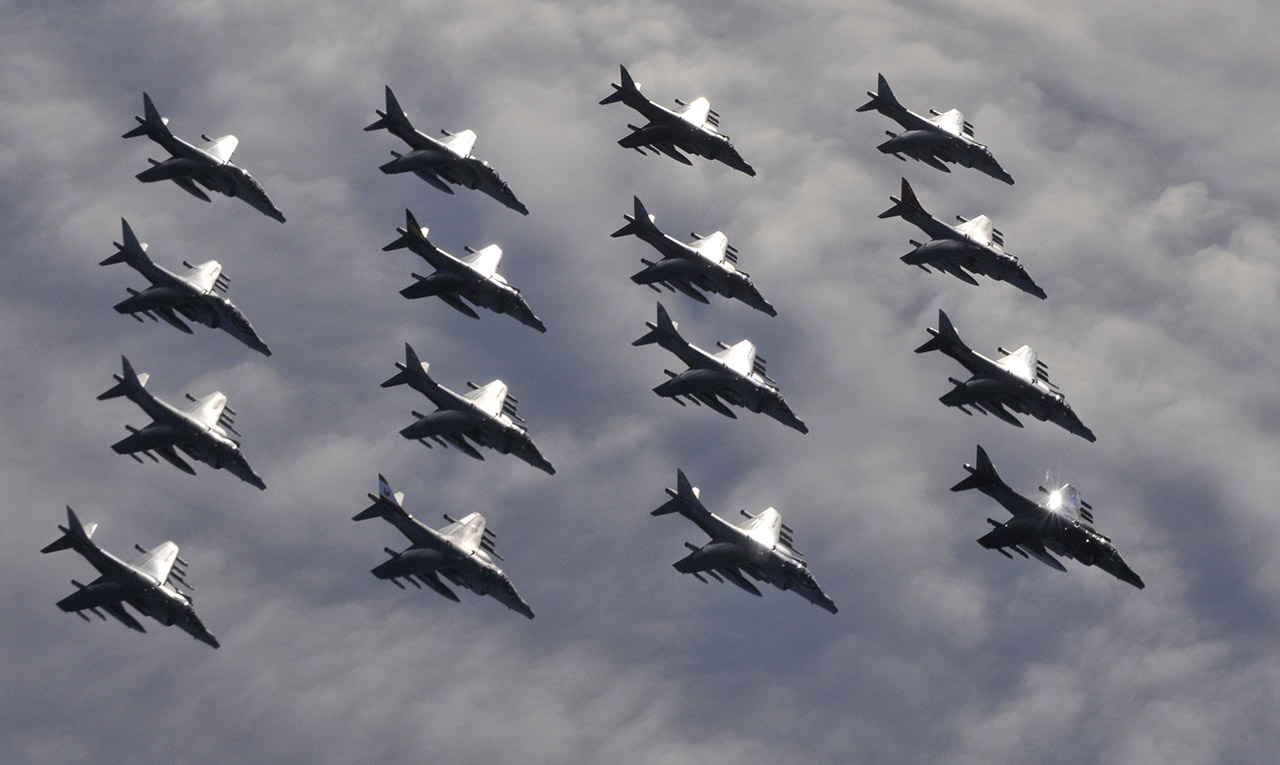
Though only 16 aircraft took part in the final flypasts, a significant number more were still on the ground at Cottesmore both in serviceable and unserviceable states. The last Harrier GR9s returned from their final combat deployment on Operation Herrick in Afghanistan in July 2009, having been replaced in theater by the Tornado GR4 after a five year stint involving 8,500 sorties and 22,000 flying hours.
Carrier capability was maintained until the very last days, and the last Harriers departed HMS Ark Royal’s ski-jump on Nov. 24. The SDSR not only retired the Harrier force, but also mandated the early withdrawal of HMS Ark Royal – leaving sister ship HMS Illustrious alone to serve until 2014 as a helicopter carrier. This decision was lamented by some only months after the Harriers left service as the British military prepared for Operation Ellamy in Libya.
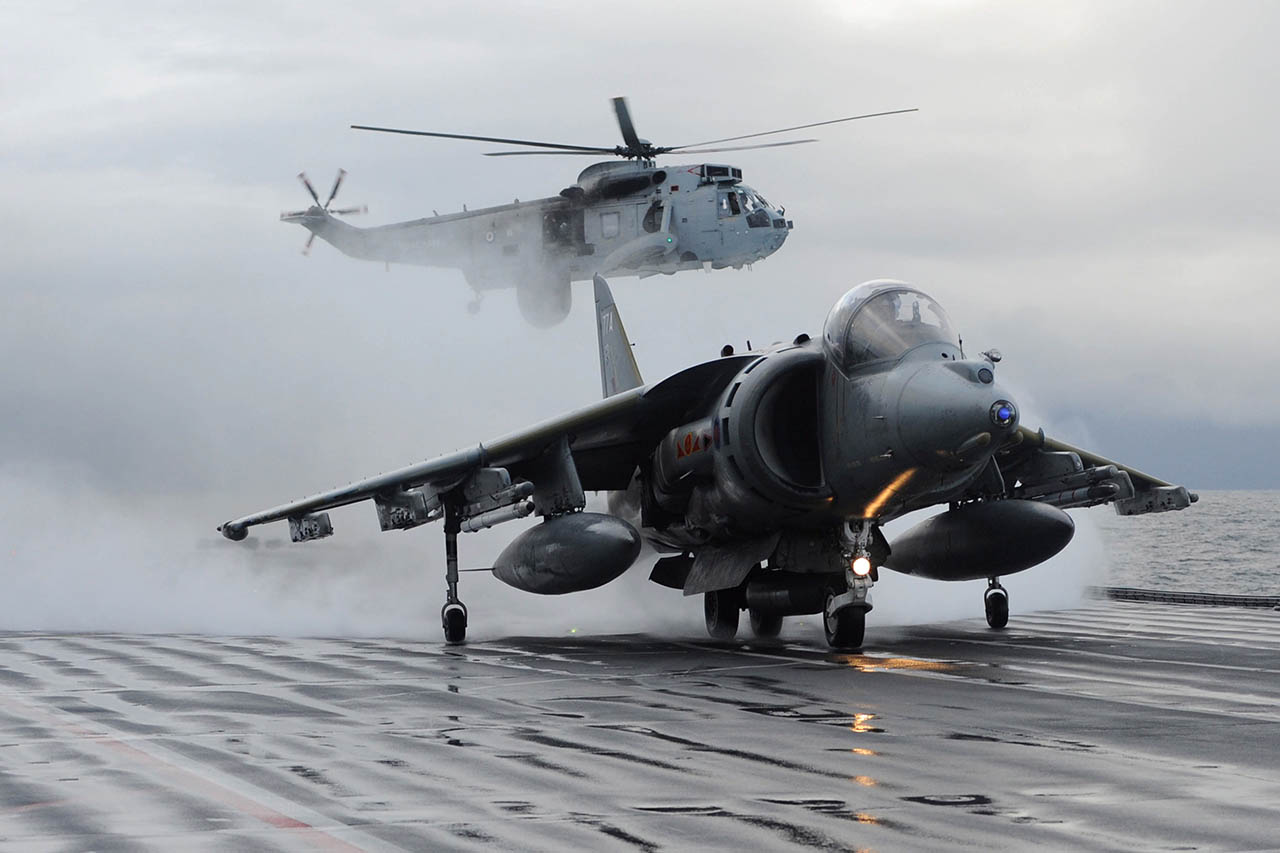
Though many pointed to the U.S. Marine Corps’ use of their own Harriers over Libya as an example of how the UK could have utilised carrier-based Harriers for its contribution, it should nonetheless be noted that the Harrier GR9 configuration featured no radar, which made potential air to air engagements a more difficult prospect. In addition, the Tornado GR4s which provided the bulk of Operation Ellamy’s airpower were quickly forward deployed to allied airbases in Italy, mostly negating the advantage of being able to forward deploy the carrier.
The Tornado GR4 was the aircraft with which the Harrier had to contend in the decision-making process that led to the SDSR in 2010. Whether rightly or wrongly, it had been decided that the UK could financially only support two simultaneous lines of combat jet aircraft. The Typhoon force, still in its infancy, was an obvious keeper, leading to a Harrier vs Tornado showdown. Although the Harrier boasted the carrier capability, as well as more flexible deployment options on land, the aircraft’s lesser capabilities in range and weapon/sensor payloads compared to the swing-wing strike aircraft did not help its chances. The earlier mentioned deployment of Tornado GR4s to Afghanistan in 2009 was another factor – the money and resources having already been spent sending the jets there and returning the well-used Harriers and all support equipment.
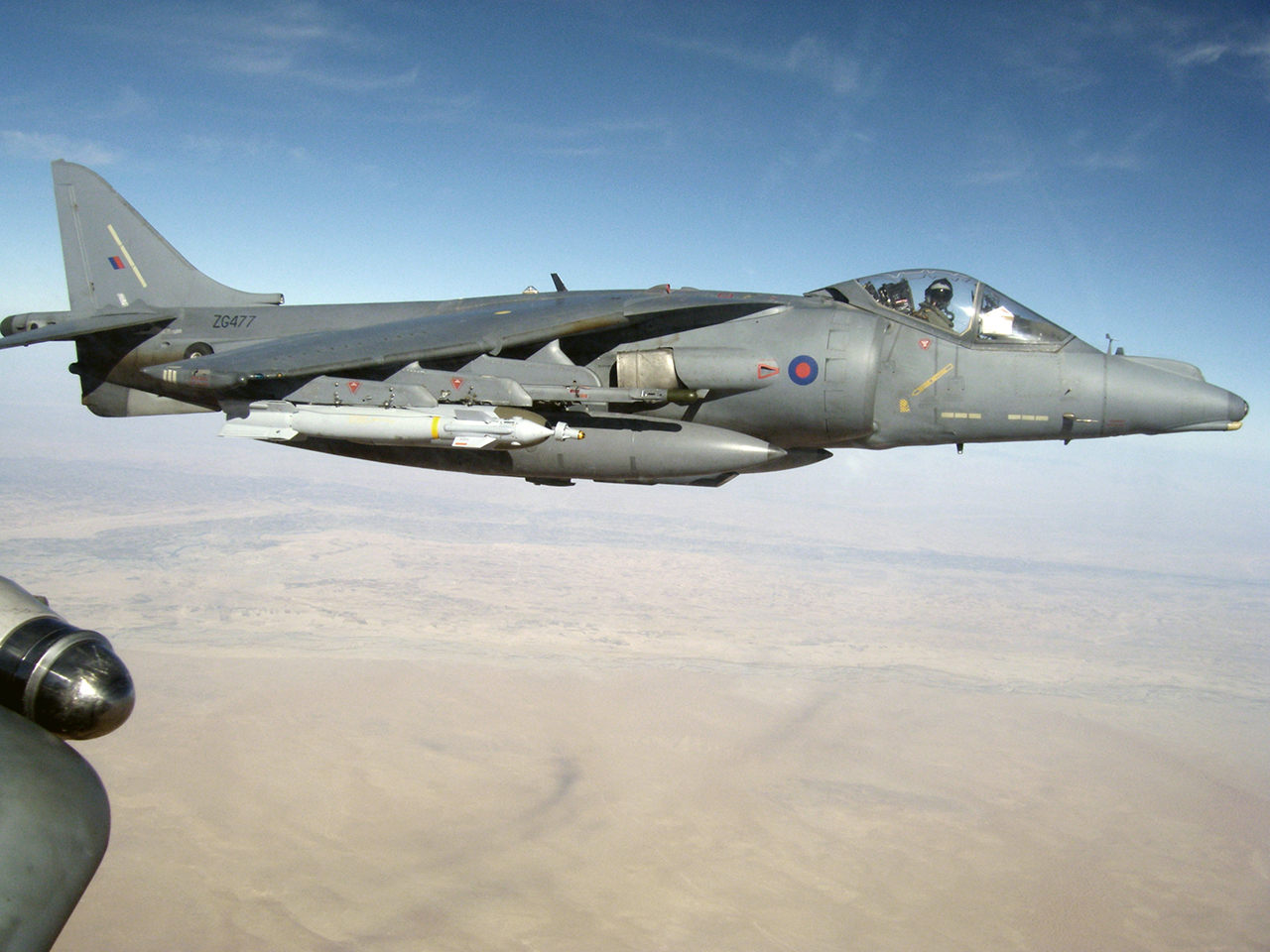
Of course, the carrier-based Harrier still had its use cases, though the earlier withdrawal of the Fleet Air Arm’s Sea Harrier FA2 in 2006 – an air to air combat specialist which would operate in tandem with the ground-attack GR series aircraft – heavily hit the Harrier force’s potency. The last frontline sorties flown by Harriers from the UK’s Invincible class aircraft carriers were reconnaissance patrols over Sierra Leone in 2000. Subsequent operations in Iraq and Afghanistan were all flown from land bases, in the former case with HMS Ark Royal instead being used by helicopters.
At the time of the SDSR in 2010, it was expected that the Queen Elizabeth class aircraft carriers would enter service from 2014. The SDSR decided to convert the two carriers to catapult assisted take-off/arrested recovery (CATOBAR) configuration, and switch the UK’s order from the F-35B to the F-35C Lightning II. This was reversed again 2011. As we now know today, it eventually took until 2025 for the new carrier strike capability to reach the milestones needed for the declaration of full operating capability (FOC) although the F-35B still lacks standoff strike weapons in UK service.
What happened to the Harriers?
As is often repeated online, towards the end of 2011 the British government decided to offload the majority of its remaining Harrier GR9s and T12s to the U.S. Marine Corps for a total of $180 million. The aircraft were subsequently shipped to the ‘boneyard’ at Davis-Monthan Air Force Base, Arizona, to be used as spare parts donors for the U.S. fleet of AV-8B Harrier IIs. They remained safe there until 2023 when the process of scrapping what was left of the airframes began ahead of the AV-8B’s drawdown.
Eight Harrier GR7s and GR9s were kept for preservation and display at various locations across the UK. The Royal Navy additionally kept a number of its Sea Harriers in running condition until recent years to assist with realistic flight deck training.
The aircraft that took part in the final flypast, and their subsequent fates, are listed below:
- Harrier GR9A ZG506 – specially marked retro scheme jet, delivered to Davis-Monthan AFB
- Harrier GR9 ZG857 – delivered to Davis-Monthan AFB
- Harrier GR9 ZD397 – delivered to Davis-Monthan AFB
- Harrier GR9A ZD467 – delivered to Davis-Monthan AFB
- Harrier GR9 ZG477 – special fin, preserved at Royal Air Force Museum London, Hendon
- Harrier GR9A ZD433 – preserved at the Fleet Air Arm Museum, RNAS Yeovilton
- Harrier GR9A ZG472 – delivered to Davis-Monthan AFB
- Harrier GR9A ZG479 – delivered to Davis-Monthan AFB
- Harrier GR9A ZD351 – special fin, delivered to Davis-Monthan AFB
- Harrier GR9A ZD347 – delivered to Davis-Monthan AFB
- Harrier GR9 ZG862 – delivered to Davis-Monthan AFB
- Harrier GR9 ZG502 – delivered to Davis-Monthan AFB
- Harrier GR9 ZG858 – special fin, delivered to Davis-Monthan AFB
- Harrier T12A ZH665 – delivered to Davis-Monthan AFB
- Harrier T12 ZH659 – delivered to Davis-Monthan AFB
- Harrier T12 ZH664 – delivered to Davis-Monthan AFB
The ‘A’ variants of the GR9 and T12, as well as the legacy GR7 and T10 aircraft, featured the Mk 107 Rolls-Royce Pegasus engine, rather than the regular Mk 105. The Mk 107 was more powerful, which proved especially useful in the warmer climates and higher altitudes of mountainous Afghanistan.
15 Years On
The early retirement of the Harrier will likely long-remain one of the most hotly contested topics relating to the UK’s defence policy of the early 21st century. In many conversations it overshadows what were, arguably, more devastating cuts, like the withdrawal without replacement of the Nimrod MR2 maritime patrol aircraft and the cancellation of its troubled Nimrod MRA4 successor. The signals intelligence (SIGINT) Nimrod R1s were replaced within a few years by RC-135 Rivet Joints – in a way demonstrating the importance of SIGINT collection to the UK’s defence – but despite being an island nation with a notable prowess in anti-submarine warfare (ASW) it was not until 2019 when the RAF received its first P-8A Poseidon MRA1.
Among the British public, the Harrier maintains its symbolic status alongside Concorde, the Supermarine Spitfire, and the Avro Vulcan. With the latter, the Harrier’s key role in the Falklands War of 1982 permanently granted the aircraft a legendary status. No flying examples of a Harrier remain in the UK, though efforts have long been planned to restore a Sea Harrier FA2 to flight for display purposes.
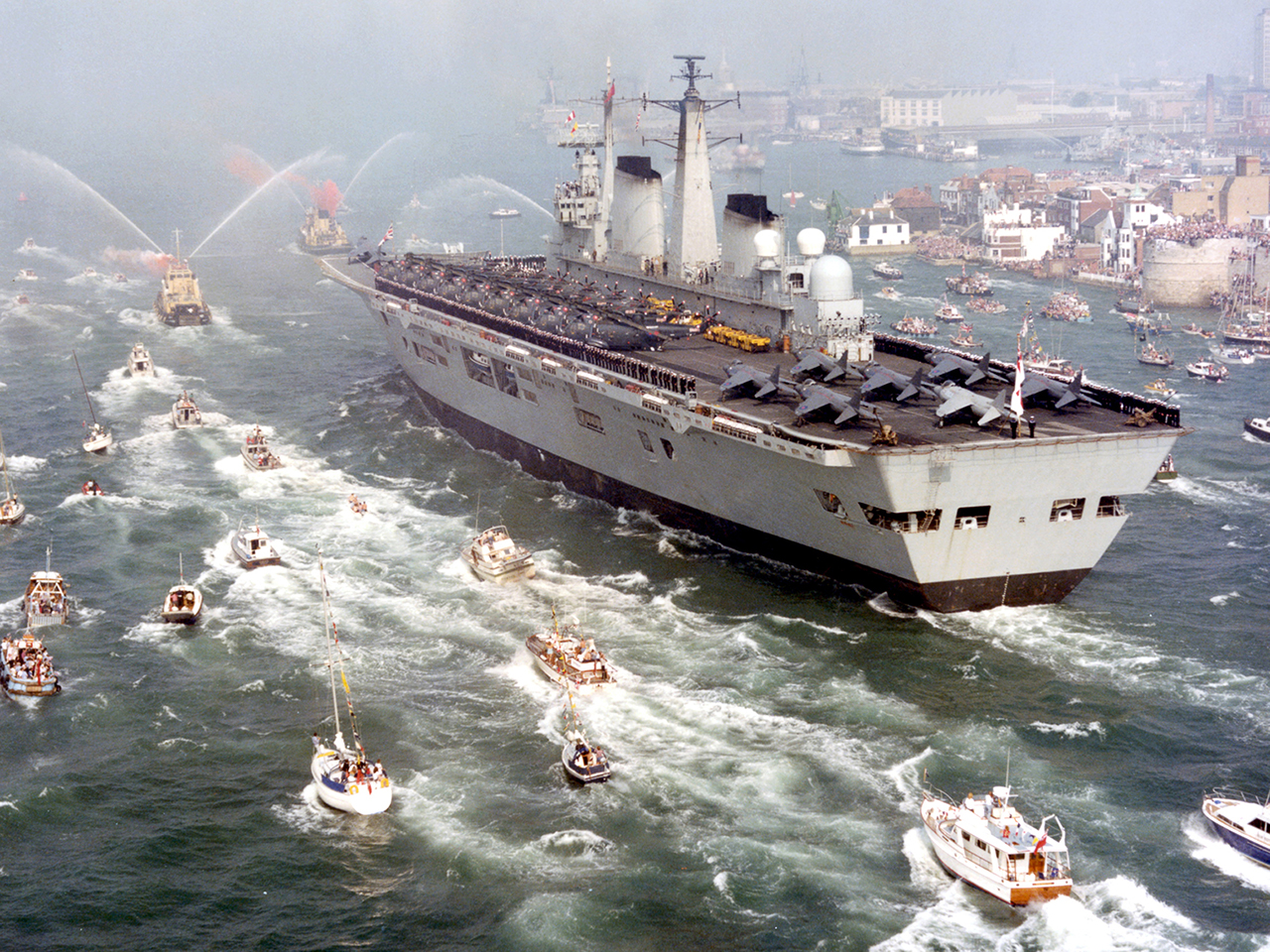
Worldwide, the number of Harriers remaining in service continues to dwindle. The U.S. Marine Corps, though still flying the AV-8B in frontline service, intends to retire its last jets over the next two years. Italian AV-8Bs, which are supposed to soldier on until 2030, may be forced into an early retirement once the USMC draws its Harrier operations to a close. Unlike the U.S. and Italy, who have both procured the F-35B Lightning II as a replacement, Spain has still yet to decide on replacing its Harriers, known locally as Matadors – also theoretically due to retire in 2030. Talks on the purchase of F-35s stalled amid diplomatic disputes between Spain and the incumbent U.S. administration.
Though we still don’t know for sure when the Harrier’s last day in operational service will be, it is certain to be rapidly approaching.