While reports have identified the Jiutian as a “general-purpose drone,” concepts have shown it releasing drone swarms with a range of surface and maritime strike munitions.
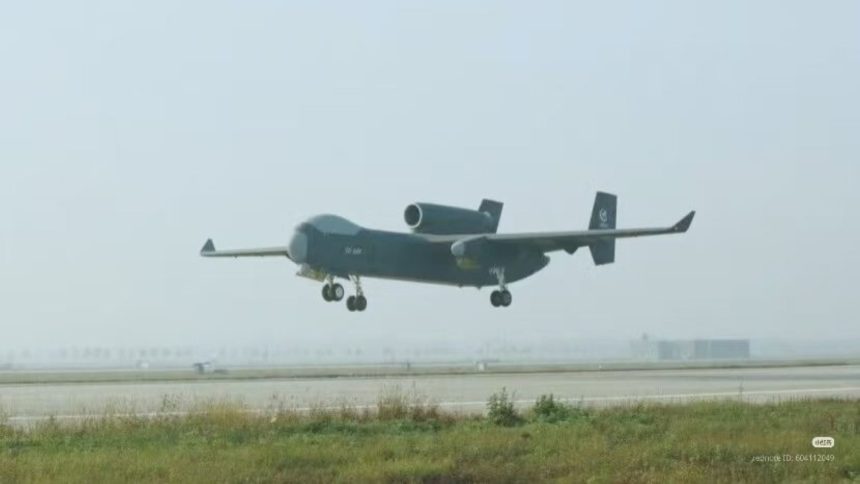
A massive drone-carrying mothership developed by China’s Aviation Industry Corporation of China (AVIC), called Jiutian, flew for the first time on Dec. 11, 2025, from Pucheng, in northwestern China’s Shaanxi Province. Notably, the drone has a 6 ton payload capacity for either munitions, drone swarms and humanitarian relief material.
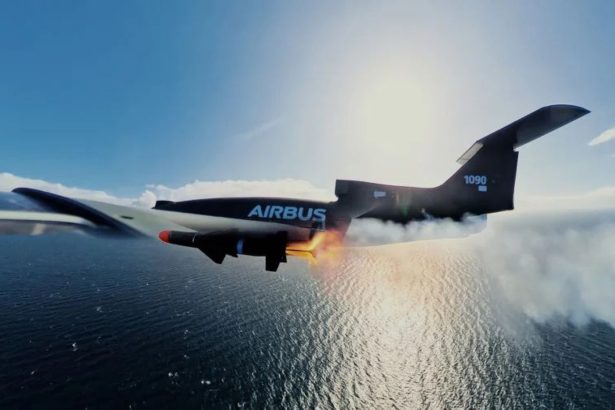
A concept video on CCTV 14 from May 2025 shows a group of Jiutians releasing swarms of hundreds of smart quadcopter-like systems and other winged attack drones. These were then shown coordinating and overwhelming the U.S. Navy’s aircraft carriers and supporting battleships, clearing the way for anti-ship ballistic, cruise and surface strike missiles.
Footage in the same clip also showed the ability to carry a range of air-to-air and air-to-ground missiles, two of which could be identified as the PL-12AE and the PL-15. Clips from the exhibition showing military payload have existed since November 2024.
— Hûrin (@Hurin92) December 11, 2025
The same operational concept could, at least theoretically, be utilized for land warfare. The drone swarms undertaking anti-infantry roles – validated on the Ukrainian front with both sides using cheap UAVs for hunting individual soldiers, fortified bunkers, machine gun nests and even counter-drone missions – can mutually support other air-to-ground weapons launched from the Jiutian on large tactical targets.
China’s Jiutian super-high altitude, long endurance drone.
With an flight ceiling of 15km, this drone can fly ABOVE the operation ceiling of pretty much all air defense systems.
Which means, once the PLA air force gains air superiority over an area, this drone will be able to… pic.twitter.com/iQea6GA9b0
— China Perspective (@China_Fact) May 18, 2025
Jiutian
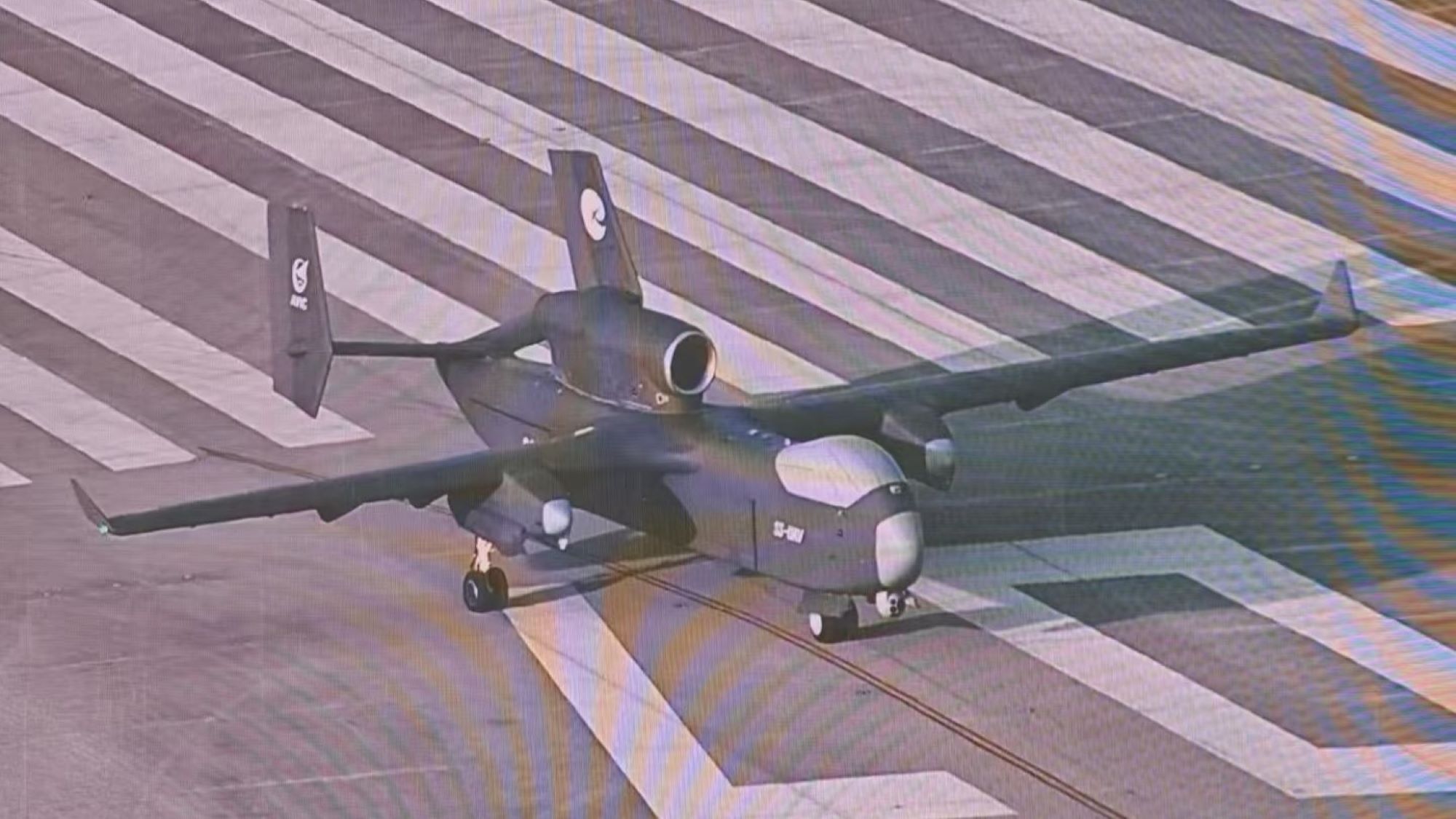
The drone has an H-tail configuration and large straight wings, suitable for greater aerodynamic lift and high-altitude flight. An electro-optical ball turret on the chin is consistent in both the renditions and the actual flying example. It is propelled by a large external air-breathing jet engine mounted on the top.
The concept video shows the side fuselage encased by top-hinged side doors for releasing the drone swarm payload. This same module can be identified from the sectioned lines in another image of the Jiutian on the runway.
For scale purpose
The mega uav at bottom is Jiutian pic.twitter.com/SA7FZ1m24p
— Hûrin (@Hurin92) December 11, 2025
Various reports on CGTN and Xinhua have identified the Jiutian as a “general-purpose drone,” with a length of 16.35 meters and a wingspan of 25 meters, a maximum takeoff weight of 16 tonnes and a payload of up to 6,000 kg (6 tonnes). It can remain airborne for up to 12 hours and has a ferry range of 7,000 kilometers.
It should be noted these reports unusually stressed about the civilian and emergency situations role in hard-to-reach regions during natural disasters.
“Designed with a high operational ceiling, a wide speed range and short takeoff and landing performance, the drone is equipped to perform a variety of civilian missions that require heavy payload capacity and high operational flexibility,” CGTN said, quoting AVIC officials. “Its modular payload system enables a range of roles, including precise delivery of heavy cargo to remote areas, emergency communications and disaster relief, as well as geographic surveying and resource mapping,” Xinhua added.
Jiutian is the J16 of UAVs
A2A, A2G,drone swarms,kamikaze
Look at that loadout just under the right wing alone, 🙄 https://t.co/1km5EhOiY7 pic.twitter.com/PPLnmM2ary
— Hûrin (@Hurin92) November 10, 2024
Impact on future warfare
The clip from the exhibition labels this section as the “Immersion Hive Module,” which could refer to an autonomous, possibly AI-enabled, drone software, similar to Shield AI’s Hivemind. Unmanned systems scanning, detecting, tracking and commencing attack runs on land targets, enabled by AI code and perfected by Machine Learning training, has tremendous benefits in electronic warfare and jamming-heavy environments while fighting peer Western rival, the United States.
It is possible the Jiutian seen in the exhibition with various surface strike munitions as a part of its payload could be a full-sized mock-up. AVIC might also have primarily an export goal, given it has been shown in an expo, and there is little information about the PLA (People’s Liberation Army) showing interest in such a platform.
🇨🇳 China’s 16-Tonne “Jiutian” UAV Completes Maiden Flight
A large unmanned aerial vehicle (UAV) named “Jiutian” successfully completed its maiden flight on December 11, 2025, the Aviation Industry Corporation of China (AVIC) announced. The domestically developed, general-purpose… pic.twitter.com/y4HKFpuvKk
— Global Defense Insight (@Defense_Talks) December 11, 2025
As we had noted in previous reports about the plethora of next-generation unmanned and manned Chinese systems, PLA commanders would not bank on such uncrewed or crewed aircraft for their operations, given they have other conventional, symmetric and asymmetric capabilities. However, the induction of unmanned systems specifically, does offer redundancy and flexibility by making up for limitations posed by human endurance, and maintenance constraints, especially for the United States struggling with its own industrial supply chain issues, exacerbated after the Covid-19 pandemic.
In an earlier story about an infrared seeker version of the APKWS II being introduced following the experience in fighting Houthi projectile swarms, we placed that warfare trend in the upcoming war with Beijing: “A large manufacturing power like China could undertake a combined asymmetric and conventional projectile attack from both land, air and sea, with an intensity even higher than the one of the Houthis’ attacks.”
The Jiutian’s concept video embodies this very same tactic. Drone swarms and anti-ship missiles launched from the Jiutian could act in concert with land and ship-strike missile barrages from the PLA Rocket Force, PLA Air Force, and PLA Navy. Whether the PLA decides to acquire the capability remains to be seen. But merely displaying such a system has deterrence goals, while also serving as propaganda that exhibits technology and industrial achievements.