jump to navigation

Stealth Yanshuf: the Israeli top secret radar-evading chopper used to drop spies in Iran May 17, 2012

Posted by David Cenciotti in Stealth Black Hawk.
Tags: , , , , , , , , , , , ,
add a comment

According to F. Michael Maloof, a former Pentagon senior policy analyst the Israeli Air Force is equipped with the same Stealth Black Hawk helicopter used by the U.S. Navy SEALs to kill Osama Bin Laden last year.

Believed to be an exclusive U.S. “black project”, the radar-evading chopper (most probably a quiet one, rather than an actual helicopter invisible to radars), such helos would be used by the IAF to drop Iranian dissidents into Iran to gather intelligence on the Tehran’s nuclear program, according to a report written by Maloof for G2 bulletin, a global intelligence newsletter.

This is the first time someone reports about radar-evading choppers in the hands of Israel.

Even if it’s quite unlikely that the Washington shared the secrets of its most advanced helicopter with Jerusalem, considered that the American Stealth Hawk is probably based on 1978 study freely available on the Internet, we can’t rule out the possibility that the Israeli industry has found a way to modify the IAF Black Hawks (nicknamed “Yanshuf”, English for “Owl”) to make them stealthy.

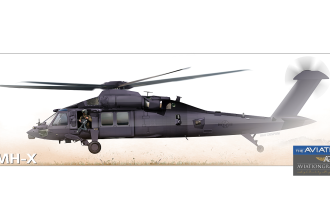
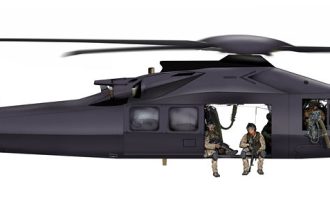
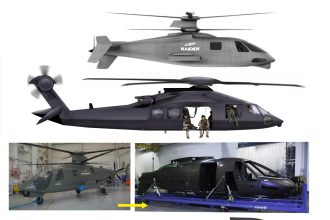
Provided a Stealth Yanshuf really exists, this is what it would look like in two updated versions of the renderings I conceived with AviationGraphic.com‘s Ugo Crisponi: above, the famous highly modified version with retractable landing gear MH-X (please remember this is not the actual designation), whose shape reminds the one of an S-76; below, the more likely slightly-modified Stealth Black Hawk (described here).

Here’s the (updated) shape of the badass Stealth Black Hawk chopper revealed one year ago by the Osama Bin Laden raid May 1, 2012

Posted by David Cenciotti in Stealth Black Hawk.
Tags: , , , , , , , , ,
8 comments

As many readers of this blog already know, I’ve begun studying the possible shape of the so-called “Stealth Black Hawk” or “Silent Hawk” since the first pictures of the helicopter that had crash landed at Abbottabad, in Pakistan, during the Osama Bin Laden raid (officially named “Operation Neptune’s Spear“), appeared on line.

Based on the remains of the tail section, I asked Ugo Crisponi, an artist at AviationGraphic.com, to create a sketch of what the full stealthy chopper would have looked like after applying some upgrades needed to make it, if not radar-evading, at least a bit quieter.

With some imagination, “grain of salt”, engine shields, rotor covers, an extra main rotor blade (to slow down the rotor speed making blades quieter), some straight lines and what had survived to the attempt of the U.S. Navy Seals Team 6 to destroy the chopper, we created a realistic shape of the “black”, never seen before, helicopter.

Here’s the old version.

Although fairly inaccurate (for obvious reasons…) and resembling an S-76 more than an MH-60 Black Hawk, our Stealth Black Hawk  became a worlwide de facto standard: model kits, documentaries, videogames, articles feature the stealthy chopper I conceived with Crisponi as the actual helicopter secretly serving with the 160th SOAR (Special Operations Aviation Regiment).

Furthermore, since we named the rendering  “MH-X” (because we thought it was an upgraded MH-60) everybody has though that “MH-X” was the official designation of the chopper, even if it is only a fictional designation I used to manage the file versioning with Ugo.

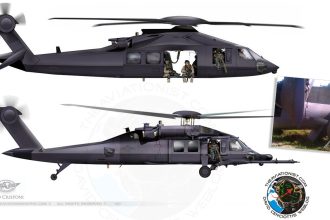
Anyway, during the last year, we have continued to receive hints, corrections, official and unofficial comments and we have revised the original rendering to prepare a much more accurate profile of the Stealth Black Hawk that you can find in the image below.

Here it is:

The new version of the radar-evading chopper is much more similar to the MH-60: since the stealthy helicopter is an upgraded version of a standard Black Hawk (even according to official sources), it must have the some basic airframe and dimensions.

Along with many minor details we have fixed, here are the most important modifications:

  1. landing gear: the “new” version has a landing gear as a retractable undercarriage would require an extensive redesign of the whole airframe that is quite unlikely for a retrofit work.
  2. retractable refueling probe: we put it in the very first version, we removed it in the revised. However, as any other special ops helicopter, the Stealth Black Hawk is probably equipped with a retractable probe needed to perform aerial refueling and to extend the range.
  3. chaff and flare dispensers: the helicopter is believed to be equipped with passive countermeasures released through tail section dispensers like those on both sides of the U.S. Navy’s MH-60S “Armed Helo”.

As always, if you have any suggestion, send me an email or leave a comment.

An interesting combat chopper profile officially cleared for publication: MH-60S “Armed Helo” November 21, 2011

Posted by David Cenciotti in Military Aviation, Stealth Black Hawk.
Tags: , , , , , , , , ,
add a comment

On May 3, 2011, in the aftermath of the Osama Bin Laden raid that disclosed the existence of a stealth helicopter based on the UH-60 “Black Hawk”, I’ve started thinking about the secret chopper used to carry the Navy SEALs to Abbottabad. Which noise reduction technologies does the chopper embed? Which upgrades render it radar-evading?  The answer to these questions can be found in the digital mock up of the Stealth Black Hawk that has become so widely known in books, documentaries and videogames to be considered “almost official” rather than fictional.

Unfortunately, even if since May I’ve received hundred alternative sketches and comments about the stealth helicopter (known also as “Silent Hawk” or MH-X, with the latter being a fake designation) and I’ve also learned of a low cost stealth retrofit for obsolete choppers, I’ve never had any evidence that the shape that I’ve hypothesized with Ugo Crisponi is really anywhere near the actual one.

Hence, I’m particularly glad to publish a rendering of an existing somehow rare weapon system based on the MH-60S helicopter, designated “Armed Helo” (and not Knighthawk or Seahawk as sometimes referred to), officially cleared for publication by the U.S. Navy. Therefore an exact copy of the MH-60S BuNo.167818  armed with 8 AGM-114 Hellfire missiles, 2 cal. 50 and 2 FN machine guns.

The Armed Helo Mission Kit, provides the base MH-60S with the capability to extend the HH-60H Seahawk’s typical Combat Search and Rescue/Personnel Recovery (CSAR/PR) role with Special Warfare Support (SOF), Maritime Interdiction Operations (MIO), Intelligence, Surveillance and Reconnaissance Operations (ISR), and Anti-Surface Warfare (ASUW) missions.

The one depicted in the rendering is dubbed “Dark Knight” and belongs to the HSC-22 a squadron providing helicopter detachments for Littoral Combat Ships, Amphibious Ready Groups and Combat Logistic Ships, and able to perform wide variety of missions: Naval Special Warfare, Amphibious Search and Rescue, Theater Security Cooperation, Strike Coordination and Reconnaissance, Anti-Surface Warfare, Humanitarian Assistance and Disaster Relief and Utility missions in support of the Fleet and National Defense.

Updated: Mysterious Stealth Helicopter photographed in California is a retrofitted obsolete chopper turned into gunship November 18, 2011

Posted by David Cenciotti in Aviation, Military Aviation, Stealth Black Hawk.
Tags: , , , , ,
6 comments

Helikopter Hysterie blog’s editor Axel M. Vollmer, who posted my Stealth Black Hawk digital mock up in May,  has recently taken the following pictures of a mysterious Stealth Helicopter sitting out in the open at Torrance Airport / Zamperini field, home of Robinson Helicopters, in California.

Although Alex wonders whether he has stumbled upon a next-gen US military helicopter or has just seen a new experimental chopper, he admits that the black helo parked at Torrance airport must be some kind of fake stealth used for a movie.

Obviously, I don’t think the above chopper has anything in common with the Stealth Black Hawk involved in the Osama Bin Laden raid either. It hasn’t anything you’d expect in a real stealthy chopper: rotor shape, type of blades, noise reduction covers, etc. (without considering that unrealistic AIM-9L Sidewinder carried on the right wing….). Furthermore, not even it would be sitting without armed guards in case of an emergency landing.

However I’d be curious to know if anybody know something more about this helicopter or is able to understand which basic model was so heavily modified and for what purpose (movie, documentary, TV drama series, ).

Update: thanks to Thorsten, a visitor of this site, I’ve discovered that the above aircraft is a derivative of the American Aircraft Penetrator, a proposed gunship conversion of the famous Bell UH-1 Huey, whose name is Stealth Star. According to the official website the Stealth Star is the result of a retrofit of an existing helicopter performed by AEROCRAFT Corp under AEROCRAFT Strategic Advantage Program (ASAP).

AEROCRAFT mission seems to be addressed to government agencies rather than private owners:

“Countries must now defend themselves against the growing threats of small-scale conflicts. These elusive threats, from terrorism to border incursion, drug wars and insurgency, have forced the defense to take the high ground. And the best weapons for this new battlefield is specialized, highly advanced helicopters, designed to penetrate the new combat arena and withstand small arms fire.

Many government agencies cannot compete effectively in this new combat arena because their Vietnam-vintage helicopters are too old. These helicopters share obsolescence, redundancy, and poor aerodynamics, ballistics vulnerability and often carry outmoded weaponry. Aluminum exteriors and blind spots make them vulnerable to small arms attack. The high heat signature from the helicopter’s turbo shaft is an easy target for heat seeking ground missiles. History has shown that 90% of helicopters were downed by small arms fire and 80% of these never saw their attacker.

The cost of purchasing new, advanced helicopter systems is astronomical. And the process can take years of negotiation. AEROCRAFT can help you eliminate these obstacles.

[...]

“Through ASAP, an existing helicopter can be reconfigured into a powerful Penetrator gunship within 18 months. This is a significantly shorter time frame than the three to five-year schedule required purchasing a new helicopter. And, depending on the options required, up to three Penetrator gun ships could be purchased for the cost of one new helicopter.”

Dealing with the tech embedded in this alleged stealth chopper:

A KEVLAR all-composite monococque exterior provides ten times the ballistic resiliency of aluminum. The high-visibility cockpit design improves peripheral sight and eliminates blind spots. A heat-suppressing device on the turbo shaft brings the heat signature below the threshold of heat-seeking missiles. The engine is isolated for increased survivability. Fifty caliber machine guns are stored inside. And, new sophisticated aerodynamics are unmatched by any other Western helicopter.

So, provided that you trust AEROCRAFT Corp. and their ability to modify an helicopter without affecting its airworthiness and flight safety, maybe you can turn your chopper into a real (…) gunship.

Stealth Helicopter’s “MH-X” designation comes from a temporary filename – on this computer August 18, 2011

Posted by David Cenciotti in Military Aviation, Osama Bin Laden raid, Stealth Black Hawk.
Tags: , , , , , , , , , , , , , , , , ,
add a comment

Although it’s hard to believe, I’m almost sure that the Stealth Black Hawk that crashed during the Osama Bin Laden raid has never been officially or unofficially named “MH-X”. Still, if you google “MH-X” you’ll find thousands articles that give it as the designation of the Stealth chopper project.

Even the prestiogious GlobalSecurity.org has a page dedicated to the “MH-X”: http://www.globalsecurity.org/military/systems/aircraft/mh-x.htm

So, how’s this weird designation become so widely known? Simple: it was derived from the file name I and Ugo gave to very first version of the rendering of the Black Helicopter. We named it MH-X because we thought it was an upgraded MH-60 but since we didn’t know which could be the exact desigantion we used the “X” meaning a mysterious number.  So all the files with the renderings of the helicopter that I’ve uploaded to this website were all named mh-x.jpg or mhx-2B.jpg or mhx-2011 (sometimes with numbers used to identify the different revision: for example mh-x3.jpg, mh-x4.jpg, mh-x4 new2, etc.).

Noteworthy, even for the artwork prepared for AviationGraphic.com website we used the designation MH-X even if it was clearly fictional!

By the way, the last one is named MH-X-2011_I and, unlike the F-35I, the “I” suffix doesnt identify any special version developed for Israel….

Hence, unless some of my readers will be able to prove that the MH-X project existed before we used it (in fact, I can’t completely rule out the possibility that we used the correct designation by accident) I’m becoming increasingly convinced I should write it MH-X™ :)

In the meanwhile, since you may be interested, here’s the “story” of the MH-X concept since the beginning.

“Pakistan let China examine Stealth Black Hawk helicopter”: so what? August 15, 2011

Posted by David Cenciotti in China, Military Aviation, Osama Bin Laden raid, Stealth Black Hawk.
Tags: , , , , , , , , , , , , , , , ,
add a comment

On Aug. 14, the Financial Times and the NYT, followed by other media all around the world, published the news that in the days after Operation Neptune’s Spear Pakistan’s intelligence gave China the opportunity to examine the remains of the Stealth Black Hawk that crash landed during the raid that killed Osama bin Laden.

Is this really a front page news? In my opinion, it is not, as it was quite predictable. We have already seen videos and pictures of chunks of the top secret radar-evading helicopter, being moved from the Bin Laden’s compound at Abbottabad. Not only the tail rotor section, that had remained almost intact and whose shape indicated that the one involved in the incident was not a common MH-60, but even smaller parts, like the one collected by Adam Roberts of the Economist on May 3, 2011, that had also a Part Number on it.

Furthermore, China is Pakistan’s main military equipment supplier and ties among both nations are extremely tough and, to let things even simpler, Islamabad has never accepted that the US carried out the raid without Pakistan’s prior approval.

That’s why, ironically, on May 31 I wrote a blog post titled “China has already reverse-engineered the Stealth Black Hawk”.

Hence, it was quite obvious that Chinese would soon be able to have parts of the Stealth technology used to make a “Silent Black Hawk”. How long does it take for China to have its chopper capable to elude radar? Not so much. Most probably, one or two years, considering the number of Stealth fighters being developed by Beijing and the ability of Chinese engineers to copy classified Western technologies.

However, a big help could come also from the US. An interesting freely available document, issued in 1978 by Sikorsky Aircraft Division for the US Army Research and Technology Laboratories and titled “STRUCTURAL CONCEPTS AND AERODYNAMIC ANALYSIS FOR LOW RADAR CROSS SECTION (LRCS) FUSELAGE CONFIGURATIONS” shows the first attempts to give the UH-60 some stealth capabilities.

Although they can’t be considered as a handbook for Stealth choppers, the fuselage concepts for low radar cross section aircraft configurations designed at the end of the ’70s still apply today and the concepts behind them could be still useful to imagine the real shape of the Stealth Black Hawk.

That’s why I’ve used them to create the famous Stealth Black Hawk concept that will appears in today’s newspapers until the real modified “Silent Hawk” will be disclosed or until China will announce its first Stealth chopper….

A video game revealed the shapes of the Stealth Black Hawk of Osama Bin Laden raid well before pictures were taken at Abbottabad June 9, 2011

Posted by David Cenciotti in Military Aviation, Osama Bin Laden raid, Stealth Black Hawk.
Tags: , , , , , , , , , , , , , , , , , , , , , , , , , , , , , , , , , ,
3 comments

Have a look at the following screenshots:

Don’t you think that the above helicopter recalls the possible shape of the Stealth Black Hawk (at least of the modified MH-60 that I imagined with Ugo Crisponi)? The funny thing this time is that, unlike the famous Dragon Models Limited kit that will be available from July 2011 and whose box cover artwork was released at the end of May, the above screenshots are from a videogame that was released on Mar. 11, 2011, more or less two months before the doomed stealth helicopter involved in Operation Neptune’s Spear crash landed in the Osama Bin Laden compound at Abbottabad.

Even the crash landing scene depicted above could be similar (althought it should be set at night) to the one of Abbottabad on May 2 before the Navy Seals put the explosive in the remains of the helicopter to destroy it.

The name of the video game is “Homefront”. According to Wikipedia it is “a first-person shooter video game developed by Kaos Studios and published by THQ, in which players play as members of a resistance movement fighting against a near-future Korean military occupation of the United States. The story was written by John Milius, who co-wrote Apocalypse Now and wrote/directed Red Dawn. It was released for Xbox 360, PlayStation 3, and Microsoft Windows, and also made available through OnLive on March 15, 2011 in North America, March 17, 2011 in Australia, March 18, 2011 in Europe,[5] and April 14, 2011 in Japan. Its tagline is: “Home is where the war is.”

Kudos to those who, envisaging the existence of a black stealth helicopters in the near future (Homefront is set in 2025), have designed, by coincidence or not, a helicopter whose shapes resemble those of our famous “Silent Hawk” (and much thanks to Marco Olimpio for the heads up).

The video below provides some information about the plot of Homefront:


China has already reverse-engineered the Stealth Black Hawk May 31, 2011

Posted by David Cenciotti in China, Military Aviation, Osama Bin Laden raid, Stealth Black Hawk.
Tags: , , , , , , , , , , , , , , , , , , , , , , , , , , , , , , , , , , , , , ,
8 comments

Those who were worried that China could get its hands on some pieces of the ill-fated chopper that crashed in the Osama Bin Laden compound to reverse-engineer the Stealth helicopter have to accept the unpleasant reality that the Chinese have already copied it. As a matter of fact, on May 23, 2011, Dragon Models (based in Hong Kong, China) announced a new model (to be released in July): the 1/144 scale Stealth Helicopter “Operation Geronimo” (Twin Pack).

Image: Dragon Model Limited

If you look at the artwork on the box, you’ll notice that the one created so quickly by DML is quite similar to the concept I developed with Ugo Crisponi. It has the same (fictional) intakes and exhausts, and the overall shape is almost identical. To be honest it also includes some of the inaccuracies of our famous MH-60X rendering (dated May 5) that we fixed in a subsequent “release” (published on May 17) and a few more (based on the artwork, the blades seem quite unrealistic while the horizontal stabilizers are different from what the pictures suggest).

Anyway, here below you can find the May 5 sketch and if you compare it to the above image, you’ll see that, most probably, I and Ugo had the same ideas about the Stealth Black Hawk as the Dragon graphic designers. Noteworthy, the model comes with the unofficial/unconfirmed raid’s codename, since the official one is Operation Neptune’s Spear and not Operation Geronimo (“Geronimo” was the codeword for Bin Laden’s capture or death).

Above: the Stealth Black Hawk rendering I published on this site on May 5. Below the new version issued today (May 31, 2011).


Here’s an excerpt of how Dragon introduces its new model:

[...] Looking like a mixture of MH-60 Black Hawk and F-117 Stealth Fighter, this mysterious helicopter from the 160th Special Operations Aviation Regiment (SOAR) has distinctive edges and angles. The fuselage, nose and tail were all modified to reduce the craft’s radar cross-section.

[...]Befitting the innovative and ultra-secretive shape of the helicopter, this model is newly tooled in every aspect. All the low-observable features such as the angled surfaces are carefully rendered. [...]

To be or not to be [Stealth]: that is the question

If Drangon dared to venture into a Stealth model about which we still know very little (even if a 1/144 scale is small enough to “hide” some unknown details), Italian model manufacturer Italeri, took a different approach. Instead of producing a small kit of the Stealth Black Hawk basing on few pictures or artworks they announced a larger 1:48 UH-60/MH-60 Black Hawk “Night Raid”. The model box in this case is depicted performing a “generic” Special Forces operation inside a compound in Afghanistan (or Iraq).

Italeri told me that they have decided not to launch a product that, most likely, would have been quite different from the real Stealth Black Hawk, given the few images and known facts available to date. So they released a “normal” Black Hawk even if they are ready to work on a realistic “Silent Hawk” as soon as new details about the modified MH-60 used in the OBL raid will surface.

Whatever the choice (stealth or not stealth), such a quick reaction by both Dragon Models and Italeri shows how fast the response to a news story (and to the subsequent market demand) can be.

Dealing with the daily updates about the OBL raid and the Stealth helicopter, here’s an interesting news: on May 30 some media reported the (unconfirmed) news that two helicopters crossed the border between Afghanistan and Pakistan to take five Taliban members in North Waziristan, and bring them back across the border into Afghanistan. This article provides an interesting analysis of the episode. Obviously, I’m not suggesting Stealth Black Hawks were involved again; however, given that the targets were high-value ones and that this kind of mission (once again in “enemy territory”), if confirmed, would be probably carried out by Special Forces, who knows?

Introducing the Stealth Little Bird (based on a true story about the silent “black” OH-6 used during the Vietnam War) May 25, 2011

Posted by David Cenciotti in Aviation, Military Aviation, Osama Bin Laden raid, Stealth Black Hawk.
Tags: , , , , , , , , , , , , , , , , , , , , , , , , , , , , , , , , , , , , , , , ,
4 comments

I’ve already written a lot about the Stealth Black Hawk, whose existence is proven by pictures taken at Abbottabad the day after Osama Bin Laden raid, and about a Stealth Chinook theoretically taking part in Operation Neptune’s Spear. However I hadn’t thought about another stealth helicopter possibly flying in Pakistan during the OBL raid until I saw a video of a 160th SOAR rescue mission in Iraq that reminded me that the Night Stalkers often fly mixed formations of Black Hawks and MH-6 Little Birds, smaller choppers conducting, for example, rooftop insertions of Special Forces. The 160th SOAR is equipped with both MH-6s and AH-6s, the attack version of the Little Bird, aircraft that were used in almost all US (special) operations: from Op. Urgent Fury (1983, Grenada) to Just Cause (1989, Panama) to Gothic Serpent (1992, Somalia) to Iraqi Freedom (since 2003) the MH-6s have been a constant presence within some of the most difficult operations involving Delta Force and Navy Seals. In 2009, AH-6s took part in the helicopter assault (involving Navy Seals) to kill wanted terrorist Saleh Ali Saleh Nabha in Baraawe, Somalia, taking off from a US vessel. Having imagined the possible shape of a Stealth Black Hawk and Chinook, why not consider the possibility that even a modified, quieter, stealth MH-6X took part in the OBL raid flying with the 160th SOAR? I know that there’s almost nothing that can give some credence to this theory especially because another Stealth helicopter on the scene would make the air space over Abbottabad too crowded. However, I wanted to give it a try and hear what my readers think about a Stealth Little Bird. So, once again, I’ve asked Ugo Crisponi to help me with a rendering of a fictional “Black” MH-6 (6-bladed main rotor and 4-bladed tail rotor) that could be obtained with some modification of the original Little Bird:

I’ve just said that there is “ALMOST” nothing to give credence to the new theory of a Black fleet made by Stealth Black Hawk, Chinook and Little Bird. In fact, a highly modified “Black” Hughes 500s, was used by the CIA in 1972 from a Laos base. An extremely interesting article published in 2008 by Air & Space recalls the story of two OH-6As which were modified to fly with Air America and “to quietly drop off and pick up agents in enemy territory”. Dubbed “Quiet One”, the somehow stealth helicopters conducted their secret mission, on Dec. 5 and 6, 1972, when they carried in N. Vietnam commandos to place a wiretap and a solar-powered relay station that enabled Americans to eavesdrop communications on a telephone line used by the enemy commanders.

The article, written by James R. Chiles, provides some interesting details about the “Quiet One”:

The slapping noise that some helicopters produce, which can be heard two miles away or more, is caused by “blade vortex interaction,” in which the tip of each whirling rotor blade makes tiny tornadoes that are then struck by oncoming blades. The Quiet One’s modifications included an extra main rotor blade, changes to the tips on the main blades, and engine adjustments that allowed the pilot to slow the main rotor speed, making the blades quieter [...]. The helicopter also had extra fuel tanks in the rear passenger compartment, an alcohol-water injection system to boost the Allison engine’s power output for short periods, an engine exhaust muffler, lead-vinyl pads to deaden skin noise, and even a baffle to block noise slipping out the air intake.

The extensive alterations did not blank out all noise, Taylor says. Rather, they damped the kinds of noise that people associate with a helicopter. “Noise is very subjective,” he says. “You can reduce the overall noise signature and an observer will still say, ‘I can hear it as well as before.’ It’s related to the human ability to discriminate different sounds. You don’t hear the lawnmower next door, but a model airplane is easily heard. It has a higher frequency and seems irritating.”

It also explains that some Quite One’s modifications can be found on later choppers:

“The agency got rid of it because they thought they had no more use for it,” says Glerum. At least one of the ex-Quiet Ones surfaced years later at the Army’s Night Vision & Electronic Sensors Directorate in Fort Belvoir, Virginia.

But according to the participants, no more were built. It’s puzzling why the CIA did not keep a stable of Quiet Ones, at least while the technology remained under wraps. And it remained a secret for more than two decades, until Ken Conboy and James Morrison told the story in their 1995 book Shadow War.

But there were valid reasons for dropping the Quiet One from the spymasters’ catalog.

“In the long run, the 500P was not the best for setting wiretaps,” says Casterlin. “It was not good for high-altitude work.” It was a light helicopter and had to be loaded with gear that cut into its payload capability and operating altitude. The Twin Pack was much louder but also simpler to run and more powerful, so Air America used it for later wiretap missions in North Vietnam. At least one tap, placed on the night of March 12-13, 1973, was successful.

Some of the Quiet One’s innovations did show up on later helicopters, including the Hughes AH-64 Apache, which has a scissor-style tail rotor. And Hughes engineers’ interest in modifying the tips of the main rotor blades to cut the slapping noise caused by blade vortices has been taken up by other experts. Aerospace engineer Gordon Leishman and his team at the University of Maryland, for example, are developing a blade with curved tubes at the tip to divert the air, thereby countering vortex formation. But, thanks to its many unusual modifications, the 500P still holds the title that Hughes gave it in April 1971: “the world’s quietest helicopter.”

Stealth Black Hawk crash landing in Abbottabad could be (alarmingly) similar to a tail strike episode occurred to 160th SOAR in Iraq May 19, 2011

Posted by David Cenciotti in Military Aviation, Osama Bin Laden raid, Stealth Black Hawk.
Tags: , , , , , , , , , , , , , , , , , , , , , , , , , , , , , , , , ,
6 comments

Take a look at the following screenshots taken from a Youtube video taken with a helmet-mounted camera by US Special Forces (Delta Force’s A Sqn) rescuing Italian and Polish contractors from a hideout in Iraq with the help, once again of the 160th SOAR, on Jun. 8, 2004.

The first thing  I thought when I saw the footage is that sometimes history repeats itself.

Here the full video. The impact is clearly visible at mins 1.23 and 1.49:

Contractors had been abducted in Baghdad on Apr. 13, 2004 along with another Italian citizen, Fabrizio Quattrocchi, who was killed by kidnappers on Apr. 14.
A daring rescue operation was put into action as soon as coalition forces gathered reliable information on the location where the hostages were being held. As the footage shows, the 4 MH-60s (using c/s “Prince 61 – 64″) along with 4 escorting AH-6s (“Granite 71 – 74″) flew  over Baghdad then approached fast and low the compound where the workers were held.
While the third MH-60K (“Prince 63″) was flaring before touch down (with a dust cloud raised by the preceeding choppers) it hit the comp0und’s wall with its tail rotor beam/stabilizer. Fortunately, unlike what happened in Afghanistan during Operation Neptune’s Spear, the Black Hawk did not break apart and it was able to land allowing the SOF operators to leap out and to rescue hostages. The operation was successful (as the OBL raid was) and the helicopter was (probably) able to return to its base (the video doesn’t show this phase so we can’t be completely sure it didn’t suffer some structural damage).

Anyway, what happened during the 2004 rescue in daylight conditions, seems like a confirmation to what I’ve already suggested yesterday (pt1) describing the possible root causes of the crash landing of the Stealth Black Hawk during the OBL raid: the helicopter might have hit the compound’s wall on fast approach for landing at night with NVG in a particularly long and exhausting mission. A lesson to be learned for future special ops involving low level approaches to compounds surrounded by walls?