.
jump to navigation

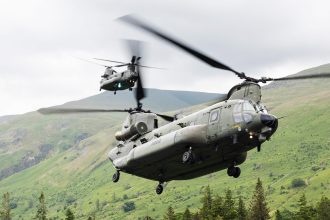
Special colored CH-47 Chinook helicopter to celebrate the 40th anniversary of “Cino” May 24, 2013

Posted by David Cenciotti in : Helicopters , add a comment

On May 17, the Italian Army celebrated the 40th anniversary of the CH-47 Chinook (“Cino” as it is nicknamed in Italy) helicopter with a ceremony held at Viterbo airport.

CH-47 40 years

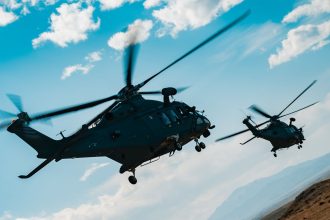
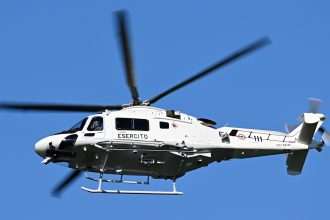
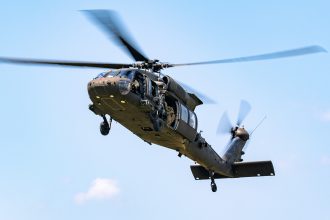
Along with the Chinook in a special color scheme, the ceremony featured a tactical event involving other assets of the Italian Army Air Cavalry: the A-129 attack helicopter and the NH-90, as the following images, taken by The Aviationist’s photographer Giovanni Maduli show.

A-129

The NH-90 on the ground, boarding special forces.

NH-90

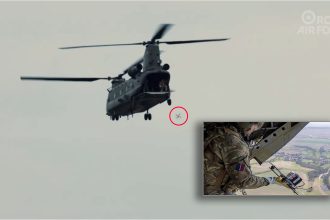
Here below, the CH-47 with a Bambi Bucket.

CH-47 40 Bambi

Image credit: The Aviationist’s Giovanni Maduli

Enhanced by Zemanta

Kaman K-Max Drone – Supplier for Afghan Bases April 16, 2013

Posted by Jacek Siminski in : Drones, Helicopters, Military Aviation , 3comments

Afghanistan is an extremely dangerous war theater.

Threats include IEDs, and the Afghan rebels have Stinger ground-to-air missiles, remains of the Soviet-Afghan war, at their disposal. It is not a surprise then, that the Americans have been looking for a way which would make the logistic support easier, faster and first and foremost – safer.

Risking a loss of a helicopter in the war means not only that the expensive aircraft would end up in a scrapyard, it also means that the pilot, whose training costs a lot of money, would probably also lose their lives.

Image Credit: US Marine Corps

The risk of losing a pilot / aircraft should be minimized. This was the main idea that led to the development of UAVs, unmanned aerial vehicles which allow the armed forces to carry out recon or even combat operations with minimum risk of losing human lives.

When it comes to supplying Forward Operating Bases in the Afghan theater, convoys used to be the main means of support. Nevertheless, extensive use of IEDs and assymetrical methods of fighting on the side of Taliban forces made this tactical approach unsafe. Here is where the K-Max drone provides a solution; a pretty clever one.

The main aim of the K-Max programme was to create an autonomous cargo system for the Afghan theatre. K-Max drone, developed on Yuma proving grounds, is a solution that lets the Marine Corps, that are the main user, receive the supplies in many remote areas without risking losses in personnel.

K-Max

Image credit: Lockheed Martin

It must be remembered though, that K-Max was a manned aircraft, which was basically converted into a drone. It still features a cockpit and may be flown manually if needed.

The helicopter is a single purposed aircraft, whose main task is to lift and transport heavy cargo. The drone is able to carry up to 6000 lbs. of external load, what with the mass of 6000 lbs. is an outstanding achievement.

The design of the helicopter includes a counter-rotating rotor system, eliminating the need for a tail rotor, that simplifies the drivetrain complexity. Steering is achieved with the use of flaps mounted on the rotors. The peculiarity of these stems is that they are servo-mechanic, non-hydraulic system.

The drone was nominated for the 2012 Collier Trophy, considered to be the greatest benchmark in aviation. What is more, it won prestigous awards from Popular Science and Aviation Week magazines.

Here is a video which presents the K-Max’s practical application in the Afghan Theatre:

The concept has been proven so useful that the Marines extended the use of it in cooperation with Lockheed-Martin for an indefinite period of time on Mar. 18. 2013. Two aircraft of this type are currently stationed in Afghanistan.

Jacek Siminski for TheAviationist

Enhanced by Zemanta

Have you ever wondered why the AH-64 is called “Apache”? The American Indian tribes tradition March 13, 2013

Posted by Jacek Siminski in : Helicopters , 5comments

All of the American Army helicopters are named after either Indian Tribe names, or Indian Tribe Chiefs’ names (Apache, Comanche, Chinook etc). This regularity is nowhere near accidental.

The most interesting finding I came across trying to find out where it comes from is a fragment of the American Army’s Aviation Digest from March 1977.

The last two pages of this issue contained a contest form for naming the UH-60 Helicopter known today as Black Hawk.

namethatbird

Image Credit: US Army

Here is the most interesting bit of the text of that issue, regarding the contest to give the UH-60A a name:

All recommended names must be received no later than 30 April 1977 to be eligible for consideration. All names are not acceptable. AR 70-28, dated 18 June 1976, specifies that Army aircraft should be given the names of American Indian tribes or chiefs or terms. The name should appeal to the imagination without sacrifice of dignity, and should suggest an aggressive spirit and confidence in the capabilities of the aircraft. The name also should suggest mobility, agility, flexibility, firepower and endurance.For brevity, it is suggested the name consist of only one word. The names given Army aircraft are primarily for use in public releases and other documents as a ready reference but have proven popular among Army personnel. In the past some Army aircraft, such as the 0-1 Bird Dog and OH-23 Raven were not given Indian names. In most cases, such aircraft were given their names before the present policy went into effect. These names have not been changed. The last aircraft introduced into the Army without an Indian name is the AH-1G HueyCobra. This aircraft, an outgrowth of the UH-1 Iroquois (Huey), was named by its maker before it was purchased by the Army. When the Army started buying the helicopter the name quickly was shortened by common usage to ” Cobra,” which is descriptive of its impressive fighting ability. The names of fixed and rotary wing Army aircraft are listed below.

[...]
ROTARY WING
AH-1 HueyCobra
OH-13 Sioux
CH-21 Shawnee
OH-23 Raven
CH-34 Choctaw
OH-58 Kiowa
CH-37 Mojave
TH-55 Osage
CH-47 Chinook
UH-1 Iroquois
CH-54 Tarhe
UH-19 Chickasaw
OH-6 Cayuse
AH-56 Cheyene

The original text of the Army Resolution mentioned above could not be found, but the journal text just summarizes its contents. If you ever wonder why the AH-64 is called Apache – well, here is the answer.

Jacek Siminski for TheAviationist.com

Failure or Omen? White smoke escaped from the Pope’s helicopter just after Benedict XVI’s final flight March 5, 2013

Posted by David Cenciotti in : Helicopters, Military Aviation , 10comments

White smoke escaping through a small chimney visible from St. Peter’s Square is traditionally used to announce the world the election of a new pope following a successful vote by the conclave.

Let’s see it from this point of view and let’s believe it is a good premoniotion but, as some readers have noticed, the white helicopter used by Benedict XVI’s on his final flight from Vatican City to the papal summer residence sent some white smoke from the right hand engine just after landing at Castel Gandolfo, at 17.24 LT on Feb. 28, 2013.

Look at the following video.

It shows the white Italian Air Force VH139 (a VIP version of the AgustaWestland AW139 used during the London 2012 Olympic Games opener) landing on the helipad of the papal summer villa located 15 miles to the southeast of Rome, after the 19-minute ride.

As the chopper blades come to a stop, white smoke shortly comes out from the engine 1 area.

Pope AW139 smoke

What may have caused the smoke?

Even if white smoke is usually caused by oil leaks in engine, sources familiar with AW.139 procedures say smoke can be caused by some fuel burning after a quick engine shut-down executed without a prior cool-down procedure.

“A normal procedure that can be used in certain conditions to accelerate the engine shut-down,” that could have been used on Feb. 28 to stop the rotor as some cars had entered the Castel Gandolfo helipad coming a bit too close to the papal chopper.

Nothing special then, unless we think to the lightning that struck the top of the Vatican’s St Peter’s Basilica, just hours after Pope Benedict XVI resigned…. :-)

Enhanced by Zemanta

[Photo] French Tigre attack helicopter supports armored column in Mali flying at ultra low level February 13, 2013

Posted by David Cenciotti in : Helicopters, Mali , 1 comment so far

The following image shows a French Army Tigre helicopter supporting an armored column on its way to Tessalit, the northernmost location reached so far by the French troops involved in Operation Serval.

The attack chopper supports the convoy in proximity and at ultra-low level, ready to engage any suspect vehicle along the route.

Tigre helicopter

Image credit: ECPAD / EMA

Tessalit in northern Mali was taken in the morning of Feb. 08, by the French paratroopers that seized the runway for the arrival of a C-160 Transall airlifter that carried special forces.

Enhanced by Zemanta


Switch to our mobile site