jump to navigation

Airspace violations – Episode 8 January 30, 2012

Posted by David Cenciotti in Airspace violations.
Tags: , , , , , , , ,
2 comments

Previous episodes: Archive

The following episode took place about 24 years ago. However, it occurred  in the Strait of Hormuz, saw the direct involvement of U.S. warships operating in the 5th Fleet Area Of Operations amid heightened tensions, and involved also an Iranian F-14 (one of those has recently crashed during a mysterious night scramble).

Hence it is also quite topical since it gives an idea of what the above mentioned contributing factors can produce.

U.S. – Iran war games…24 years ago

(Iran Air Flight 655 shot down by USS Vincennes)

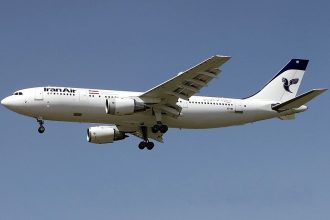
On Jul. 3, 1988, an Airbus A-300 (registration EP-IBU) operating as Iran Air Flight 655 from Tehran Bandar Abbas to Dubai was shot down by two ground-to-air missiles fired by the USS Vincennes, a Ticonderoga-class warship that was cruising in the Persian Gulf waters to keep a closer eye on the bloody and consuming war that involved Iraqi and Iranian armed forces.

Both missiles struck the fuselage, breaking off part of the tail and one wing and causing the death of all 290 people on board.

Background

During the Iran-Iraq war in the ’80s, the U.S. presence in the region was significant in order to protect oil tankers threatened by both countries. Just one year before this incident, in May 1987, the guided missile frigate USS Stark was attacked by an Iraqi Mirage F-1 jet and 37 American sailors perished during the clash. Further  investigation led Captain Glenn Brindel to be blamed not to have defended its frigate against the attack.

Therefore, the U.S. Navy agreed that new and more strict rules of engagement (ROE) were needed in order to allow Captains to get a more powerful right to defend themselves and “fire before being fired upon”.

These premises constitute the roots which gave birth to the root causes of the tragedy.

The event

On Jul. 3, 1988, three U.S. ships were patrolling the Persian Gulf: USS Vincennes, USS Montgomery and USS Sides. Suddenly, the second one reported enemy fire coming from small boats belonging of theIRGC (Iranian Revolutionary Guard Corps).

Responding the request of support from the USS Montgomery, the Captain of USS Vincennes ordered to step in the battlescene and engaged some IRGC boats for half an hour.

In a few minutes, some missiles were also launched and shortly after an Iranian F-14 was shot down in a great ball of fire.

In the meantime, in the more peaceful but busy environment of the Bandar Abbas airport, the doomed Airbus A-300 was ready for a short flight to Dubai, United Arab Emirates.

After take-off, flight 655 was instructed by the ATC to activate the transponder (on the Airbus, the transponder ‘squawks Mode III’ identified the aircraft as neutral and civilian) and was requested to reach an altitude from 7,000 to 12,000 feet.
At the same time the USS naval ships in the Strait of Hormuz got another warning signal on their radar devices and identified it as a possible and serious threat.

During the seven minutes between take-off of of flight 655 and the launch of missiles, the U.S. naval units made several attempts to get in contact with the Iran Air A300: USS Vincennes tried to use the military radio channel of frequency 243.00 MHz used for emergency purposes and four other attempts on the civil channel at 121.5 MHz.

So how this incident occurred if many attempts to communicate were made?

First of all ICAO final investigation report proved that the A-300 was not able to receive communication on the military emergency frequency 243MHz with onboard radio equipment.

Instead, dealing with the attempts made on the civilian radio frequency 121.5MHz, the board of inquiry ascertained that the Iran Air crew did not pay the due attention during the first phases of the flight or did not realize to be a possible target of naval units.

The crew was in continuous communication with ATC and was therefore unable to hear the warnings issued on the civil aviation distress radio frequency. ICAO also determined that of the four warnings issued on this distress frequency, only one was considered clear enough to be recognizable by the flight crew as directed to them.

Forty seconds past this last recognizable transmission, the USS Vincennes crew fired the missile.

More in details ICAO stated that:

  1. The aircraft weather radar was probably not operating during the flight nor would normal procedures have required its operation in the prevailing weather conditions.
  2. The radio altimeters were probably functioning throughout the flight;
  3. Apart from the capability to communicate on the emergency frequency 121.5MHz, United States warships were not equipped to monitor civil ATC frequencies for flight identification purposes.
  4. Four challenges addressed to an unidentified aircraft (IR655) were transmitted by United States ships on frequency 121.5MHz.
  5. There was no response to the four challenges made on 121.5MHz, either by radio or by a change of course. This indicated that the flight crew of IR655 either was not monitoring 121.5MHz in the early stages of flight, or did not identify their flight as being challenged.
  6.  The aircraft was not equipped to receive communications on the military air distress frequency 243MHz. There was not coordination between United States warships and the civil ATS units responsible for the provision of air traffic services within the various flight information regions in the Gulf area.

Final statement summarised that: “The aircraft was perceived as a military aircraft with hostile intentions and was destroyed by two surface-to-air missiles.

After stating that the environment on board the civilian plane contributed to the incident, the ICAO inquiry led to a more bewildering truth on the chaos and strain that reigned onboard the US naval units.

During the seven minutes between the take-off and the shot down of flight 655, excited communcation were made among the Captains of US naval units in the area, clearly stating the doubtfulness of identifying the approaching aircraft.

The US Department of Defense admitted that “…there was growing excitement and shouting in the Combat Information Centre of the USS Sides about a commercial flight.”

In the very first moments the radar operator of USS Vincennes identified the radar track as “unknown-assumed enemy” as the “Combat Information Center” of the same unit identified it as an enemy F-14 fighter jet.

Two minutes later the Captain of USS Sides, assumed the non-threating nature of the aircraft but a minute later USS Vincennes Captain ordered the shot down.

The Aftermath

The US Navy never blamed its crew for the incident and excused it with the need of defending the crew itself and their ships from any possible threats.  On the same day of the incident, US President Ronald Reagan stated that USS Vincennes followed all the requirements for the interception of foreign aircraft and that the Captain on duty ordered the launch of missiles only for defense purposes.

On Jul. 13, 1988, Vice-Secretary Williamson declared before the ICAO Counsel how high the level of danger was during the event. He noted that on Jul. 3 all the US naval units were engaged on a large operation of pursuit against Iranian vessels and it could have been considered a real war theatre.

On the extraordinary session of ICAO Counsel (Jul. 13-14, 1988), the ICAO President stated that: “…fundamental principle that States must refrain from resorting to the use of weapons against civil aircraft must be respected by each State”.

Representatives agreed to blame the U.S. act and some pushed for a rapid approval of Article 3bis of Chicago Convention – at that time not yet ratified. In particular, USSR and Nigeria blamed the US to lead a barbaric and brutal campaign against free and innocent people.

At the end of the technical investigation, on Mar. 17, 1989 the ICAO Counsel adopted the following Resolution:

“THE COUNCIL…
Having considered the report of the fact-finding investigation instituted by the Secretary General…and the subsequent study by the Air Navigation Commission of the safety recommendations presented in that report;
Recalling that the 25th Session (Extraordinary) of the Assembly in 1984 unanimously recognized the duty of States to refrain from the use of weapons against civil aircraft in flight;
Reaffirming its policy to condemn the use of weapons against civil aircraft in flight without prejudice to the provisions of the Charter of the United Nations;
Deeply deplores the tragic incident which occurred as a consequence of events and errors in identification of the aircraft which resulted in the accidental destruction of an Iran airliner and the loss of 290 lives;
Notes the report of the fact-finding investigation instituted by the Secretary General and endorses the conclusions of the Air Navigation Commission on the safety recommendations contained therein;
Urges States to take all necessary measures to safeguard the safety of air navigation, particularly by assuring effective co-ordination of civil and military activities and the proper identification of civil aircraft.”

“Deplores”, “Notes”, “Urges”: nothing really effective to avoid repeating the incident.

24 years later the tension between US and Iran is at its highest peak ever. Let’s hope we are not going to witness another similar episode in the Persian Gulf. For sure, we would not feel very comfortable flying across the Strait of Hormuz these days.

© David Cenciotti & Simone Bovi

Above image credit: Irandefense.net

Airspace violations – Episode 7 January 7, 2011

Posted by David Cenciotti in Airspace violations, Aviation Safety, Military Aviation, non-military aviation.
Tags: , , , , , , , , , , , ,
add a comment

Tragedy on the way home

(Korean Airlines B-747 vs. Soviet Sukhoi Su-15)

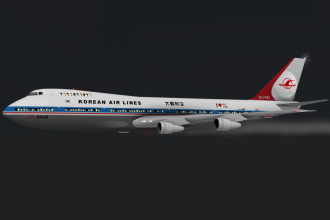
On Sept. 1, 1983, a civilian B-747 flying with registration HL7442 as Korean Air Lines Flight 007 (KAL 007, KE 007) was shot down by Soviet fighters over the Sea of Japan, in an area located west of the Sakhalin Island. All the 269 people on board (crew comprised) were killed. The plane was enroute from New York to Seoul via Anchorage when it flew into the Soviet airspace due to a navigational error and was fatally intercepted by the local fighters. Initially the Soviets denied the episode and their involvement but, following the international pressures, they admitted they had shot down the liner, suspecting it was conducting spying activities on a prohibited territory under the umbrella of a civil plane. It is worth pointing out how this incident brought to a common anti-Soviet sentiment that spread out all over the world, but also led to dozens of hypothesis, some of them bound to conspiracy theories, more or less based upon real facts and figures. But how could such a tragedy happen?

The analysis conducted by the ICAO stated that the reason that brought the KAL 007 many miles off course was a crew error that failed to set and check correctly the navigational route. However, as underlined each time we discuss an aviation accident, there a long list of factors that contributed to the mishap.
After take off from Anchorage (Alaska), the B747 was instructed by the ATC (Air Traffic Control), to turn and maintain a heading of 220 degrees and thereafter proceed to BETHEL, a waypoint located approximately between the Alaskan and Japanese coasts. In order to better understand the type of navigational error, it is worth explaining how the Boeing 747-200 autopilot works. It is equipped with four basic control modes: HEADING, ILS, INS and VOR-LOC. The HEADING mode maintains the plane flying at a constant nose-pointing direction regardless of geographical start or end points. The VOR/LOC mode maintains the plane flying over a given straight ground course relative to a fixed radio beacon ground station. The ILS mode is similar to the VOR/LOC mode but includes additional vertical guidance for landings. Finally, the INS mode has the capability of maintaining a given route without external aids or references, by continuously calculating the aircraft’s ground track since it begins moving away from an arbitrary start fix. When the INS navigation systems are properly programmed with the filed flight plan waypoints, the pilot can turn the autopilot mode selector switch to the INS position and the plane will then automatically track the programmed INS course line, provided that the plane is headed in the proper direction and within 7.5 nautical miles of the INS course line. Since the Wikipedia page dedicated to Korean Air Lines Flight 007 is quite detailed and, unlike some other Airspace Violations we have already commented on this site, there are many documents available, the in-depth description of the flight that follows is an abstract of the above mentioned Wiki page:

At the time of the incident, Anchorage VOR beacon was out of service because of maintenance. The crew had been properly informed by means of a NOTAM (Notice to Airmen), which was not seen as a problem, as the captain could still check his position at the next VORTAC beacon at Bethel, 346 miles (557 km) away. However, the aircraft required to maintain the assigned heading of 220 degrees, until it could receive the signals from Bethel, then it could fly direct to Bethel, as instructed by ATC, by centering the VOR “to” course deviation indicator (CDI) and then engaging the auto pilot in the VOR/LOC mode. Then, when over the Bethel beacon, the flight could start using INS mode to follow the waypoints comprising route Romeo-20 around the coast of the U.S.S.R. to Seoul. The INS mode was necessary for this route as after Bethel the plane would be mostly out of range from VOR stations. About 10 minutes after take-off, KAL 007, flying on a heading of 245 degrees, began deviating to the right (north) of its assigned route to Bethel; it would continue flying with this heading for the next five and a half hours. International Civil Aviation Organization (ICAO) simulation and analysis of the flight data recorder determined that this deviation was probably caused by the aircraft’s autopilot system operating in HEADING mode past the point where it should have been switched to the INS mode. According to the ICAO, the autopilot was not operating in the INS mode for one of two reasons: either the crew did not switch the autopilot to the INS mode (shortly after Carin Mountain) or they did select the INS mode, but it did not activate as the aircraft had already deviated off track by more than the 7.5 nautical miles (13.9 km) tolerance permitted by the inertial navigation computer. In both scenarios, the autopilot remained in the HEADING mode, and the problem was not detected by the crew. At 1551 UTC, according to Soviet sources, KAL 007 entered the restricted airspace of Kamchatka Peninsula. The buffer zone extended 200 kilometres (120 miles) off Kamchatka’s coast and is known as a Flight Information Region (FIR). The nearest to Soviet territory – 100 kilometre (62 mi) radius part of the buffer zone had the additional designation of prohibited airspace. When KAL 007 was about 80 miles (130 km) from the Kamchatka coast, one MiG-23 and three Su-15 Flagon fighters were scrambled to intercept the Boeing 747. Significant command and control problems were experienced trying to vector the fast military jets onto the Boeing before they ran out of fuel. In addition, pursuit was made more difficult, according to Soviet Air Force Captain Alexander Zuyev, who defected to the West in 1989, because Arctic gales had knocked out Soviet radar ten days before. The unidentified jetliner therefore crossed over the Kamchatka Peninsula back into international airspace over the Sea of Okhotsk without being intercepted.
The Commander of the Soviet Far East District Air Defense Forces, General Valeri Kamensky, was adamant that KAL 007 had to be destroyed (even if it was overflying neutral waters) provided it could positively identified as not being a passenger plane. His subordinate, General Anatoly Kornukov, commander of Sokol Air base (later, to become commander of the Russian Air Force), was adamant that there was no need to make positive identification as “the intruder” had already flown over Kamchatka.

Soviet Air Defence Force units that had been tracking the Korean aircraft for more than 1 hour while it entered and left Soviet airspace considered the aircraft as a military target when it re-entered their airspace over Sakhalin Island. After the protracted ground-controlled interception, the three Su-15 fighters (from nearby Dolinsk-Sokol airbase) and the MiG-23 (from Smirnykh Air Base) managed to make visual contact with the Boeing.
In a 1991 interview with Izvestia, Major Gennadi Osipovich, pilot of the Su-15 interceptor that shot the 747 down, spoke about his recollections of the events leading up to the shootdown.
Contrary to official Soviet statements at the time, he recalled telling ground controllers that there were blinking lights….” He continued, saying that “I saw two rows of windows and knew that this was a Boeing. I knew this was a civilian plane. But for me this meant nothing. It is easy to turn a civilian type of plane into one for military use…” He furthermore did not provide a detailed description of the aircraft to his ground controllers: “I did not tell the ground that it was a Boeing-type plane; they did not ask me.”
Commenting on the moment that KAL 007 slowed as it ascended from flight level 330 to flight level 350, and then on his maneuvering for missile launch, Osipovich said: “They [KAL 007] quickly lowered their speed. They were flying at 400 kilometers per hour. My speed was more than 400. I was simply unable to fly slower. In my opinion, the intruder’s intentions were plain. If I did not want to go into a stall, I would be forced to overshoot them. That’s exactly what happened. We had already flown over the island [Sakhalin]. It is narrow at that point, the target was about to get away… Then the ground [controller] gave the command: ‘Destroy the target…!’ That was easy to say. But how? With shells? I had already expended 243 rounds. Ram it? I had always thought of that as poor taste. Ramming is the last resort. Just in case, I had already completed my turn and was coming down on top of him. Then, I had an idea. I dropped below him about 2,000 meters… afterburners. Switched on the missiles and brought the nose up sharply. Success! I have a lock on.”
“We shot down the plane legally… Later we began to lie about small details: the plane was supposedly flying without running lights or strobe light, that tracer bullets were fired, or that I had radio contact with them on the emergency frequency of 121.5 megahertz.” At the time of the attack, the plane was cruising at an altitude of about 35,000 feet. Tapes recovered from the airliner’s cockpit voice recorder demonstrate that the crew were unaware that they were off course and violating Soviet airspace. Immediately after missile detonation, the airliner began a 113-second arc upward because of a damaged cross-over cable between the left inboard and right outboard elevators. At 18:26:46 UTC, at the apex of the arc at altitude 38,250 feet, either the pilot was able to turn off the autopilot or the autopilot tripped and the plane began to descend to 35,000 feet. From 18:27:01 until 18:27:09, the flight crew reports to Tokyo Radio informing that KAL 007 to “descend to 10,000″ [feet]. At 18:27:20, ICAO graphing of Digital Flight Data Recorder tapes shows that after a descent phase and a 10 second “nose-up”, KAL 007 leveled out at pre-missile detonation altitude of 35,000 ft. Yaw (oscillations), begun at the time of missile detonation, continued decreasing until the end of the minute 44 second portion of the tape. The Boeing did not break up, explode or plummet immediately after the attack; it continued its gradual descent for four minutes, then leveled off at 16,424 feet, rather than continue descending to 10,000 as previously reported to Tokyo Radio, continuing at this altitude for almost five more minutes. The last cockpit voice recorder entry occurred at 18:27:46 while descending. At 18:28 UTC, the aircraft was reported turning to the north. ICAO analysis concluded that the flight crew “retained limited control” of the aircraft. Finally, the aircraft began to descend in spirals over Moneron Island before coming down 2.6 miles (4.2 km) , killing all 269 on board. The aircraft was last seen visually by Osipovich, “somehow descending slowly” over Moneron Island. The aircraft disappeared off long range military radar at Wakkanai, Japan at a height of 1,000 feet
.

The ICAO report, after months of harsh investigation, often obstructed by several attempts of red herring, published his final conclusions:

1) The crew inadvertently flew virtually the entire flight on a constant magnetic heading (in the heading mode) due to its unawareness of the fact that ‘heading’ had been selected as the mode of navigation rather the ‘inertial navigation system’ (INS).
2) An undetected 10 degree longitudinal error was made in inserting the ‘present position’ co-ordinates of the Anchorage gate position into one or more of the INS units.
3) Interceptions of KE 007 were attempted by USSR military interceptor aircraft, over Kamchatka Peninsula and in the vicinity of Sakhalin Island.
4) The USSR authorities assumed that KE 007 was an ‘intelligence aircraft’ and, therefore, they did not make exhaustive efforts to identify the aircraft through in-flight visual observations.
5) ICAO was not provided any radar recordings, recorded communications or transcripts associated with the first intercept attempt or for the ground-to-interceptor portion of the second attempt, therefore, it was not possible to fully assess the comprehensiveness or otherwise of the application of intercept procedures, signaling and communications.
6) In the absence of any indication that the flight crew of KE 007 was aware of the two interception attempts, it was concluded that they were not.

On Mar. 10, 1986, two years and half after the tragedy, the ICAO Council adopted the Amendment 27 of the Annex 2 of the Chicago Convention. In particular, some intercepting rules measures were enhanced regarding the visual signals, the intercepting maneuvers, the coordination with ground units and most important the principle of the interdiction of the use of force against civil aerial intruders was strengthened.

On the operations side, as a result of the incident, the interface of the autopilot used on airliners was redesigned to make it more ergonomic.

© David Cenciotti & Simone Bovi

Airspace violations – Episode 6 July 12, 2010

Posted by David Cenciotti in Airspace violations, Aviation, Military Aviation.
Tags: , , , , , , , , , ,
1 comment so far

Shot down over Sinai

(Lybian Arab Airlines B727 vs. Israeli F-4s Phantom)

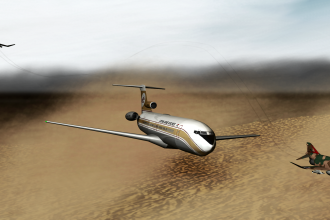
On Feb. 21, 1973, the B-727 “5A-DAH” belonging to the Libyan Arab Airlines regularly scheduled as Flight 114 from Tripoli to Cairo via Benghazi was shot down by two Israeli F-4 Phantoms over the Sinai Peninsula. Of the 113 people on board, there were only 5 survivors, including the co-pilot.
After a technical stopover in Benghazi – Eastern Libya – the airliner continued its route to Cairo. As the aircraft started to overfly Northern Egypt, it seems that a large sandstorm forced the crew (mostly of French nationality under a partnership contract between Air France and Libyan Airlines) to navigate only by relying on the on-board instruments. The situation was also worsened by the inefficiency of the Egyptian radio navigation system: in other words, the whole VOR system of the Cairo area and its radar surveillance were out of service. At around 13:44 LT the crew started to suspect that they had made a navigational error since they could not find any navigation beacon and they could not establish the aircraft position. Actually, the aircraft was flying over the Sinai Peninsula, (at that time militarily occupied by Israel since the Six Days War of 1967) and, unfortunately, it was in bound to Bir Gafgafa Israeli airbase. The Israeli Defense Forces were on high alert at that time as Israel was in a state of war with Egypt since the Six Days War (the Yom Kippur war was a few month away). At 13:54, the Libyan 727 entered airspace over the Sinai desert at 20,000 feet. A few minutes later two Israeli Air Force (IAF) F-4s Phanthom Kurnas (in Hebrew “Sledgehammer”) were scrambled to intercept the intruder. The direct evidence from the surviving co-pilot seems to confirm how the Israeli fighters followed the international rules on the intercepting of civil aerial intruders: the Israeli pilots, in fact, attempted many times to make visual contact with the airliner’s crew and tried to communicate with them by waving their hands, dipping the wings and finally by firing warning cannon shots close to the wingtips. The 727’s crew, maybe because being under extreme pressure and space disorientation, did not give much importance to the fighters’ behavior and decided to turn back to the West. No worse decision could have been taken, since Israeli pilots interpreted this as an attempt to flee. Aiming directly at the airliner’s wingtips in order to damage but not destroy the plane, the couple of Phantoms fired short bursts with their 20mm cannon damaging the control surfaces, the wing structure and the hydraulic systems. The amount of damage suffered was instead higher than expected by the fighter pilots, and such to force the airliner to attempt an emergency landing in an area covered with sand dunes. During the emergency landing there was an explosion near the right main landing gear, causing the destruction of most of the airframe and the subsequent death of 108 people of the 113 on board. The surviving co-pilot, later stated that the entire crew knew the Israeli jets wanted to follow them but since relations between Israel and Libya were not very smooth, they decided to turn back despite the several warnings. From his words we can understand the situation: “When we spotted the fighters the Captain contacted Cairo approach frequency and communicated to have orientation troubles and of being intercepted by fighter jets. Then he lowered down the landing gear and slowed down the speed. At that time one of the jets put itself in front of us dipping its wings but we were so busy and concerned that our main and only goal was to reach Cairo airport. From now on it is very difficult to me to remember well since our right wing was in flames and we started our descend until crash down on a sandy terrain about 20 km east of Suez Channel”.
On the Extraordinary Session of ICAO held on Feb. 27, 1973, many Delegations fully condemned the Israeli action stating how Israel Government “had violated the fundamental legal norms and standards of international civil aviation which did not permit the use of armed force against a foreign civil aircraft clearly identified as such”.
But, on the other hand, Tel Aviv stated clearly how the fighters put every effort to minimize the use of force but the action had become necessary only because of the irresponsible behavior of the airliner crew: “…and for seven minutes (the Israeli fighters) flew around it, signalling to it in a clear and correct manner, with internationally agreed signs, to follow them so as to land…Since the Boeing aircraft did not comply with these instructions, suspicious grew concerning its mission. At this point, demonstratively and in full view of the crew, warning shots were fired…but the Libyan plane ignored them. The assumption therefore was that the plane had entered the area on a hostile mission…At this stage accordingly decided that the aircraft must be compelled to land by firing upon it…”.
The ICAO Assembly later with 105 favorable votes condemned Israel for such incident. Hereby the text of the Resolution:
THE COUNCIL,
RECALLING that the United Nations Security Council in its Resolution 262 in 1969 condemned Israel for its premeditated action against Beirut Civil Airport which resulted in the destruction of thirteen commercial aircraft, and recalling that the Assembly of ICAO in its Resolution A19-1 condemned the Israeli action which resulted in the loss of 108 innocent lives and directed the Council to instruct the Secretary General to institute an investigation and report to the Council;
CONVINCED that such actions constitute a serious danger against the safety of international civil aviation;
RECOGNIZING that such attitude is a flagrant violation of the principles enshrined in the Chicago Convention;
HAVING CONSIDERED the report of the investigation team…and finding from it no justification for the shooting down of the Libyan civil aircraft;
1) STRONGLY CONDEMNS the Israeli action which resulted in the destruction of the Libyan civil aircraft and the loss of 108 innocent lives;
2) URGES Israel to comply with the aims and objectives of the Chicago Convention
”.
During the course of this Session, many delegates called for a deep change of the rules on the intercepting of civil foreign aircraft in order to minimize the risk of being shot down but this proposal was not considered too much by the States.

The following F-4 profiles are a courtesy of Ugo Crisponi, AviationGraphic.com.

Another incident took place years later, with the loss of B747 Korean Airlines in 1983; this drew again the focus on changing the interception rules.

© David Cenciotti & Simone Bovi

Airspace violations – Episode 5 March 2, 2010

Posted by David Cenciotti in Airspace violations, Aviation, Military Aviation.
Tags: , , , , , , , , , , , , , , , , , , , ,
add a comment

“Dragon Lady 360 missing”

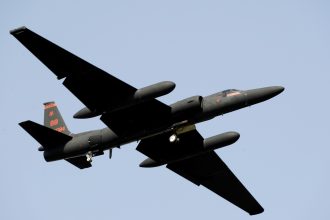
On May 1, 1960, an American U-2 spy plane was shot down over the Soviet Union, near the city of Sverdlovsk. This episode is remembered as the most famous aerial incident of Cold War, since it created a large debate all over the world and a great embarrassment for the United States and Eisenhower’s Presidency. At first Washington Government denied the episode but was forced to admit both its responsibility and the purpose of the mission when the Soviet Government showed the remains of the wreckage and the survivor, pilot Francis Gary Powers.

The Plane

The involved plane was a Lockheed U-2, a single engine reconnaissance aircraft mainly used during Cold War for night and day high-altitude reconnaissance missions. It could fly at 70,000 feet since it had been built with the specific purpose of flying well above any fighter or missile. However, the aircraft could be reached by SAM (Surface-to-Air Missiles) as the episode described in this article shows, and even by interceptors: in 1984, during a NATO exercise, Flight Lieutenant Mike Hale of the RAF (Royal Air Force), flying with a Lightning F3 intercepted a U-2 flying at 66,000 feet. Anyway, the aircraft was more or less safe at stratospheric altitudes and it allowed CIA and US Air Force to perform flights over a country’s airspace to take aerial photographs with fewer risks than any other asset. The unique design, similar to a glider, brought it to be nicknamed “Dragon Lady” but on the other hand its remarkable performance also made it a difficult aircraft to fly with. For its purposes, it also carried a variety of sensors on the nose, Q-bay (behind the cockpit, also known as the camera bay), or wing pods. The U-2 was simultaneously able to collect signals, imagery intelligence and air samples. Imagery intelligence sensors included either wet film photo, electro-optic or radar imagery – the latter from the ASARS-2 system.

The Incident

During the late 50s, with the approval of Pakistani Government, the US President D. Eisenhower established a secret intelligence facility in Badaber (Peshawar Airbase), equipped with a runway that allowed U-2 spy planes to perform secret missions over the majority of the Soviet airspace.

On May 1st, 1960, fifteen days before the scheduled opening of an East-West summit conference in Paris, pilot Francis Gary Powers left the US base in Badaber on board its “Dragon Lady” Item 360 for a mission over the Soviet Union, photographing ICBM (Inter Continental Ballistic Missiles) sites in and around Sverdlovsk and Plesetsk and then, as by schedule, landing onto Bodo, Norway.

The flight was expected, since Soviet defenses were pre-alerted by the U-2 unit “10-10” piloted by Bob Ericson: some weeks before he had overflown some of the top secret military installations such as the Semipalatinsk Test Site, the  SAM test site, the Tyuratam missile range and the Dolon airbase with its Tu-95 strategic bombers.

According to some Russian sources, just after the U-2 was detected, Lieutenant General of the Air Force Yevgeniy Savitskiy ordered all the air unit commanders on duty “to attack the violator by all alert flights located in the area of foreign plane’s course, and to ram if necessary (see for details: http://www.webslivki.com/u11.html – Russian language only).

Some fighters took off immediately but like the previous alerts all the attempts to intercept the foreign plane failed. Eventually the U-2 was hit and shot down by the first of three S-75 Divna surface to air missiles fired by a defense battery.

According to Russian sources, it is interesting to know how Pilot Gary Powers, after successfully bailing out from the plane, was soon captured by the Russians and was found with a modified silver coin which contained a lethal saxitoxin- tipped needle…to be used in case of being captured!

After the event, the whole Soviet air defense system was obviously in red code but the lack of coordination brought to a curious incident often hidden by the ordinary tale of facts. The SAM command center was unaware that the foreign plane had been destroyed for more than half so that at least 13 further anti-aircraft missiles were fired, one of them shooting down a Mig-19 and killing his pilot, Sergei Safronov.

The episode became of an outstanding relevance among the international community and represented one of the higher peaks of the face off between the two nuclear superpowers.

Aftermath

On a juridical basis, the incident became notorious for the arising problem related to the limits permitted by the international law to the use of the high altitude flights in foreign airspace.

At the time of facts, US were bounded by the Chicago Convention, therefore the whole chart contents were applicable, particularly article 3 stating that: “No State aircraft of a contracting State shall fly over the territory of another State or land thereon without authorization by special agreement or otherwise, and in accordance with the terms thereof.”

Obviously the U-2 involved had to be considered as a State aircraft, although not having a military code it was operated by US intelligence agency and armed forces for secret military flights (the US never doubted the nature of the aircraft and admitted the activity was part of a long term activity started four years before).

Another relevant debate was related to the altitude the U-2 was flying and the applicability or not of the principle of the sovereignty above the air space. In other terms, where the point of separation between the national airspace and the outer space is located? (since the latter is out of the State’s sovereignty)

This problem arose since the U-2 was flying at around 27,000 metres and according to many analysts all the flight activities at this altitude were to be considered as space operations, where sovereignty of the States is null. The debate is still open and no written charts resolve the doubt, even if the practice adopted by the States in the course of history seems to confirm that flights conducted by common aircraft within the atmosphere limit has to be considered as a fly that, when operated without permission, commits a violation of foreign airspace.

The Pilot

And which were the consequences for Gary Powers? He was pleaded guilty and therefore convicted of espionage and convicted to 3 years prison and 7 years hard labour. One year after being sentenced, in February 1962, he was exchanged for Rudolf Abel.

Living U-2s

If you are a buff for this aircraft, a number of retired U-2s are currently on display all around US and United Kingdom (Laughlin AFB TX, Davis-Monthan AFB Arizona, Imperial War Museum Duxford UK, just to mention some).

At the “Museo de l’Aire” in Havana (Cuba) you can also make a real visit of the wreckage of Major Rudolf Anderson Jr’s U-2, shot down and killed during the Cuban Missile Crisis in 1962. Also relics from Cold War can be found at Central Armed Forces Museum in Moscow where the wreckages of Gary Powers’U-2 are displayed.

However, many are still flying after 55 years since its first flight within Area 51. The aircraft was used to provide aerial imagery following the Haiti earthquake. U-2s belonging to the 9th Reconnaissance Wing (RW), based in Beale AFB, Ca, are common visitors of RAF Fairford, in UK. A derivative of the U-2 known as the ER-2 (Earth Resources -2) is based at the Dryden Flight Research Center and is used by NASA for high-altitude civilian research including Earth resources, celestial observations, atmospheric chemistry, etc. Before, during and after the war in Serbia and Kosovo, in 1999, U-2 detachments were also based in Aviano airbase, Italy, and Istres, France.

© David Cenciotti & Simone Bovi

Airspace violations – Episode 4 January 8, 2010

Posted by David Cenciotti in Airspace violations, Aviation, Military Aviation.
Tags: , , , , , , , , , , , ,
1 comment so far

The Lost Constellation

(El Al Constellation vs. Bulgarian Mig-15s)

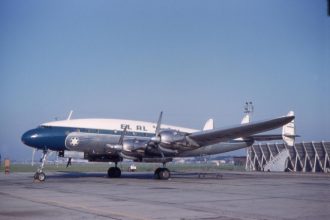
On 27 July 1955 an El Al Lockheed L-049 Constellation (with registration 4X-AKC, similar to the example shown below) was flying the London – Tel Aviv route via Wien when it strayed into Bulgarian airspace and was shot down by two Bulgarian Mig-15s. After being attacked the plane exploded in mid-air and crashed near the village of Petrich, killing the seven crew members and 51 passengers on board.

The El Al flight 402 had departed from Wien-Schwechat International Airport at 02:53LT and after leveling off it encountered a severe thunderstorm activity enroute to Israel.

Using old NDB (Non-Directional Beacon) navigation aids, the crew believed they were overflying the Skopje radio beacon so they turned the course and inadvertently entered the Bulgarian territory, where the airliner was intercepted at around 5.000 meters and shot down by the fighters.

The accident was investigated by an international commission and the following statement was issued as the main cause of the incident: “The aircraft sustained a hit or hits which caused loss of pressurization and a fire in the heater compartment. The aircraft broke up in mid-air due to explosion caused by bullets hitting the right wing and probably the left wing together with a bullet or bullets of large calibre in the rear end of the fuselage.”

In order to prevent similar incidents in the future, a safety action was issued by the commission after the end of its work, recommending that more VOR navigation aids (or VHF Omnidirectional Range) should be used on airway Amber 10 (the airway entered by the Constellation) instead of just one as it was when the shot down occurred.

At the time of the incident the NDB navigation was largely used by the airliners but as we known nowadays it was and still is subject to a series of limitations that can induce the systems to a false interpretation of the signals and therefore lead the crew to navigation mistakes.

The so-called “thunderstorm effect” happens when an electrical storm is nearby, the ADF (Automatic Direction Finder) needle points to the source of lighting rather than to the selected station because the thunderstorm sends out radio waves. The pilot should notice the flashes and not use their indications. Small aircraft flying as GAT use the ADF extensively, not only for navigation purposes, but also to determine the position of thunderstorm cells, in order to avoid them (they are not equipped with weather radars and need to detect the bad weather mainly visually). Nevertheless, the instrument still equips many airports and it is used for non-precision approaches or as a reporting point or fix of instrument approach procedures. Obviously, like VORs (VHF Omnidirectional Range), NDBs can be located both at an airport or at a remote location: for example, aircraft arriving in Rome Ciampino airport, points to the URB radio beacon (located at Urbe airpot) to start the ILS procedure for runway 15. Like VORs, NDBs can be located either on the airport or at a remote location.

Back to the airspace violation and subsequent shot down, the response from the Israeli government was immediate and firm, blaming the People’s Republic of Bulgaria of “being responsible for the destruction of the Israeli aircraft and for the loss of life and property and all other damage….”

The counterpart, instead, admitted since the beginning the complete responsibility for the fact, advancing many times a proposal of compensation to families of the involved victims.

Although the Israelis never doubted the principle according to which each sovereign state can adopt defensive measures that imply the use of force for the protection of its own territorial integrity, but stated such measures should be balanced with a fair regard of humanity of the foreign aircraft, as Article 51 of the United Nations Chart implies.

The Government of Tel Aviv did not claim anythingh or generate any dispute for the fact that its plane violated the Bulgarian airspace and confirmed the full Bulgarian legitimacy to adopt adequate measures for the defense and control of its territory (As stated in Article 1 of the Chicago Convention “every State has complete and exclusive sovereignty over the airspace above its territory”).

Furthermore, according to Article 6 of the same Convention, it is also sustained that “No scheduled international air service may be operated over or into the territory of a contracting State, except with the special permission or other authorization of that State, and in accordance with the terms of such permission or authorization”

Before the International Court of Justice (which at the end will declare its lack of jurisdiction upon Bulgaria), Israelis would also show some historical data being taken from previous airspace violation occurred over the years worldwide.

In most of the analyzed cases , the State whose airspace was violated used to respond only by performing a radio contact with the intruder and of course by a real interception, that could be followed by a request to land or to return to the initial course. All of this without jeopardizing the integrity of the civil intruder and its passengers.

Israel also blamed the counterpart to giving contradictory press releases after the happenings, since the Bulgarian Government initially recounted that the foreign intruder was instructed to land immediately after being intercepted; only when these requests were not followed, the fighters decided to employ the use of force.

On the other hand, on a statement dated Jul. 28, 1955, this report was not mentioned anymore and the happenings were described as if the fighters after being unable to establish a visual contact of the intruder decided to shot down the unidentified enemy plane. Bulgaria was in a corner.

All its statements were not sustained by firm and truthful facts and were often contradictory. The armed forces for instance only managed to pronounce that at the time of the incident the intercepting fighters adopted some generic “international rules” and “specific signs established by international code” without indicating which source they were referring to.

The case was brought before the International Court of Justice, which at the end asserted its lack of jurisdiction for the matter.

At the end the quibbles of the legal rules did not allow to sentence the awful act perpetrated by Bulgaria but now, after almost sixty years, no one tries to deny the irresponsible and hasty interception strategy adopted at the time of incident.

The lack of well-known procedures and maybe also the political climate at that time caused the loss of 58 innocent lives.

Unfortunately it did not stop happening.

© David Cenciotti & Simone Bovi

Airspace violations – Episode 3 November 13, 2009

Posted by David Cenciotti in Airspace violations, Aviation, Military Aviation.
Tags: , , , , , , , , , , , , , ,
1 comment so far

Swedish Affair

(Swedish Catalina vs. Soviet Mig-15s)

Are you sure that neutral countries have never been involved in military clashes?

In the years following the end of WW2, despite the long-standing neutrality, Sweden began to undertake reconnaissance activity along the Baltic Sea, in order to minimize the possible threat posed by the Russians.

The early sorties began in the autumn of 1945 and were flown primarily by SAAB B18B, a local version of the well known Junkers Ju-86.

Reconnaissance planes usually took off during the night so that they could focus on their targets at dawn. Once they reached the Baltic coast, the planes would climb to 200-300 meters to take photos of any vessels they encountered and frequently they had “face to face” encounters with Soviet fighters.

In 1946, it was reported about some rockets flying through Swedish airspace, so it was promptly decided to set-up a reconnaissance mission towards the Penemunde peninsula where it was suspected that Soviet rockets research centre was based.

This mission was assigned to a SAAB B17 single engine dive bomber converted into a recce aircraft when on August 1946 it made the first attempt to make aerial photos of the facility but on its way to the target it had to turn back after being intercepted by a bunch of Soviet fighters.

After several other unsuccessful missions, it was therefore decided to devolve upon a higher performance aircraft so to chose a single Swedish P-51D equipped with a high number of reconnaissance cameras borrowed by the US.

These last missions were operated by the Mustang were known as “Operation Falun” and began on July 1948, and results were given and shared with the US Government.

During the following years the sorties did not stop and Swedish Air Force dedicated specific aircrafts to carry on several important and high-risk missions.

Between 1948 and 1949 around 15 reconnaissance missions were flown along the Soviet Baltic coast but avoiding major centers.

Unfortunately, not all the sorties had a happy end.

It was June 13th, 1952 when a Swedish military DC-3 carrying out a radio surveillance flight over the Baltic Sea disappeared East of the Isle of Gotland.

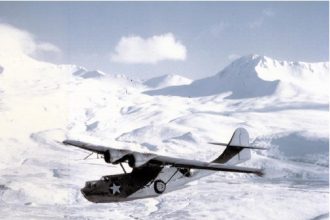
Three days later, a couple of PBY Catalina were sent to search the lost DC-3 when they got intercepted by Soviet Mig-15s and one of them was shot down. The seven crew members managed to ditch near the West German freighter “Munsterland” and were rescued immediately. PBY-5A_VP-61_Aleutians_Mar_1943

But how did these events really happen?

Once again what we are going to explain is only the description reported by both opponents, since it is really difficult to piece together the truth after many years, especially when you get involved in matters often hidden by military secret.

It seems that, due to bad weather, the Catalina accidentally entered the Soviet airspace through the Estonian island of Dago, when it was intercepted by a couple of fast Mig-15s jets; it was pushed west under continued firing and was finally forced to land.

The transmission reported by the Catalina crew is clear and give no doubts of what happened that day on the sky:

-“…Feigned attack by two Mig planes…” and two minutes later:

“We are being fired upon with tracers, 20mm…it’s hitting to the right”.

Six minutes later the Swedish Air Command received such a message: “I have been fired upon and hit several times!”

In the post-fact analysis of the events, the crew members reported that before being forced to make the emergency splashdown, the Soviet planes made several attacks as by following details:

- under the first two attacks, the Catalina plane took no hits;

- under the third attack, the fuselage and the left wing were hit;

- the fourth attack came straight from behind and damaged heavily the elevator;

- the fifth and the sixth attacks damaged the left engine and by hitting the cockpit they wounded the pilot and the navigator.

The crew managed to perform a successful ditching and while the life boats were being lowered into the water, the couple of Mig made another attack, but did not fire again.

MiG-15_front

Picture by: Radomił Binek

After ten minutes the damaged plane sunk into the deep waters, as the crew members were going to be picked up by the German ship “Munsterland”.

The reaction by the Soviets was similar to those related to the previous incidents involving their own Air Force: the foreign plane – this time a Swedish aircraft – had violated Soviet airspace and after being intercepted 40 kilometers inside the territorial waters it was fired upon by the Mig-15s, compelling the Soviet pilots to fire back and shot down the threat. MiG-15_351IAP

On the other side, the Swedish Government denied this statement and claimed the Catalina was unarmed and was flying around 15 miles off the Soviet Baltic coastline.

The Stockholm Government also pointed out how the rules of interception were substantially different between the involved countries, giving the public opinion the common impression how Soviet rules were out of the common wisdom and practice:

“…In fact, there are fundamental differences. While the orders of the Swedish Air Force are to turn off foreign aircraft by means of a warning, the Soviet Air Force has, according to its orders, to try to force the foreign aircraft to land. While the instructions of the Swedish Air Force mean that the foreign aircraft is not fired upon if it changes its course and flies away, the Soviet instructions seem to imply that the foreign aircraft is fired upon if it flies away instead of landing”.

But the international right for all the nations’ aircrafts to fly over the high sea was once more admitted by the involved Governments.

On a Soviet diplomatic reply of July 1952 to a Swedish note it was stated that:

“The Ministry of Foreign Affaire of the URSS does not deem it necessary to begin discussing the Swedish Government’s statement that Swedish military planes have full freedom to fly over the open sea and will, in future as hitherto, make use of this right, since the USSR…has never disputed this.”

Even this time the main diplomatic dispute lays upon the exact location of the intercepted plane at the time of the incident. No one called into question the widespread principle of freedom above the high sea; indeed, this statement will be strengthened later in 1960, when a US RB-47 will be shot down by Soviet warplanes.

This incident brought the matter before none of the members of the UN Security Council – included US and USSR – tried to justify the shooting down of a plane flying over the high sea, even if close to the territorial waters and engaged in reconnaissance activities or espionage.

A few months later the Catalina incident, the Soviets were involved into another similar incident, when an American B-29 was shot down by fighters in the North eastern part of Japan, into a sector that embraces the islands of Habomai, Yuri and Akiyuri, making the reconstruction of the facts more difficult than usual, since it was a long time that USSR was claiming its territorial sovereignty above Akiyuri.

© David Cenciotti & Simone Bovi

Airspace violations – Episode 2 September 28, 2009

Posted by David Cenciotti in Airspace violations, Military Aviation.
Tags: , , , , , , , ,
1 comment so far

Cold Baltic Sea, hot Baltic skies

(U.S. PB4Y-2 Privateer vs. Soviet La-11s)

In the years of Cold War, the usual crossroads of the International spying was the Baltic Sea, a narrow part of sea overlooking the Soviet Union, DDR and Poland for Warsaw’s Pact side, West Germany, Denmark and Norway for the NATO side and some neutral countries like Finland and Sweden.

On 8 April 1950, a four engine US Navy Consolidated PB4Y-2 Privateer left Wiesbaden Air Base in West Germany at 10:31am LT for a surveillance flight aimed at spying the Soviet submarines operating in the Baltic Sea. The “Privateer”, a World War II era patrol bomber derived from the Consolidated B-24 Liberator, carried a crew of ten people when it was intercepted by four Soviet “La-11” fighters at about sixteen kilometers off the coast of Latvia, south of Liepäja.

After refusing the “follow me” signals from the fighters, the US Navy plane was immediately shot down and ten men of the crew was presumed dead and never found.

Search and rescue efforts started almost immediately after the plane was reported missing but were abandoned on 16 April, since no survivors or rests were found.

But a halo of mystery soon pervaded the days following the incident. On 15 April a search plane spotted an inflated life raft so that Capt. D. J. Klinger, commander of the U.S. Air Rescue Mission stated right away the rafts supply pockets had been opened manually. Days later two Swedish fishing boats recovered another damaged life raft and a nose wheel with a bullet hole.

Like the majority of biggest incidents (not only those involving planes), rumors and unbelievable stories started to spread out everywhere: a Soviet gulag survivor named John Noble, after coming back to the USA having experienced ten years of prison in various concentration camps, stated he had met two witnesses who claimed they had seen eight survivors of the “Privateer” crash.

Anatolij Gerassimov, one of the four pilots who had intercepted the US plane, several years after the incident, is believed to have reported to a Lithuanian newspaper a statement assuming that the crew had been taken prisoner.

He stated that after intercepting the “Privateer”, the formation composed by four Lavochkin 11 fighters ordered the US pilot to follow them. They used internationally recognized signals like rocking the wings and turning to the new heading in front and left of the US plane.

After that Gerassimov noticed the US pilot smiled at him, waved “good-bye” and turned to a western heading. Therefore the soviet pilots informed the ground control, which issued the “green light” to attack and shoot to kill.

After the attack, according to Gerassimov, the plane started to burn in the center and he saw ten parachutes coming out from the plane, then the “Privateer” exploded.

PB4Y-2 Privateer in flight

Regarding the rests of the plane, in 1993, retired Soviet General Fyodor Shinkarenko stated that he believed the wreckage was secretly salvaged and sent to Moscow.

Leaving aside the various beliefs about the fate of the crew, even this incident brought to two opposite theories by both the competitors.

In a note dated 18 April 1950, the US Government stated the full responsibility of the incident to be attributed to the Soviets and asked for the need to start immediately a deep investigation on the incident.

The results of the US investigation come to the conclusion that the crew followed the order to avoid flying any enemy territory and therefore the plane was on the airspace above the high sea at the time it was shot down.

The response by the Soviets was instantaneous: they maintained that at the time of the incident the US plane was armed, was flying 21 kilometers inside the Soviet airspace and was shot down only after refusing the request for an immediate landing at the nearest available airfield.

It is hilarious to note how the focal point of the legal and diplomatic debate after the incident was not focused at all on the legitimacy of the activities of flying spying.
Again the point of rupture between the competitors was the exact location of the intruder plane at the time of the facts. Indeed, if it could have been possible to demonstrate that the US plane was unquestionably inside the Soviet airspace, the use of force could have been regarded as legitimate (this only if the Soviet government could demonstrate that the enemy plane refused to land upon request).

Therefore, the activity of air surveillance and spying above the high sea could not have been blamed by anyone.

Apart the political and military security implications, this principle has been considered a milestone by most of the international law jurists on the matter.

In any case, the main doctrine recognizes that even in such events like the one analysed in this episode involving military aircraft, the use of force against the enemy intruder will result legitimate only if following some specific requisites.

Here I indicate three cases in which the intruder starts to perform high risk maneuvres after being intercepted:

* if the intercepted plane starts to fire against the defense fighters without any apparent explanations;
* after all the necessary warnings (request of landing, immediate change of course and so on) have been ignored voluntarily;
* when its purposes are clearly opposing the ones of the enemy.

This theory is followed by Browlie in the treaty “International Law and the Use of Force by States”, according to which the hostile action has to be related to the speed and course kept by the intruder aircraft on enemy territory:

“[…]in general the practice seems to be that there is no right to shoot down trespassers unless they refuse or appear to refuse to land. However, if the penetration is by unidentified fast aircraft which persist in a deliberate and deep penetration of airspace, it may be that, in view of the destructive power of even a single nuclear weapon carried by an aircraft, the territorial sovereign is justified in taking without any warning violent and immediate preventive measures.”

The use of force as legitimate defense has been used several times by the countries and has not been limited to aerial intrusions only.

As an example, after a long series of submarines incidents on its territorial waters, the Swedish government sets a trap by sealing off the marine area of Harsfjarden with mines and sensors.

A comparable event involved Italian Navy warships on the same year in the waters of the Gulf of Taranto.

© David Cenciotti & Simone Bovi

Airspace violations – Episode 1 September 4, 2009

Posted by David Cenciotti in Airspace violations, Military Aviation.
Tags: , , , , , , , , , , ,
4 comments

The USAAF faces Yugoslavian Yak-3s

The years following the end of WWII were very controversial and did not bring to a real peace for those territories claimed by two or more parts.

Just to remain in the old continent, the political tension between Italy and Yugoslavia for the brand-new border was followed by a deployment of military forces and by the continue use of them as a way of threat.

The modeling of borders under the control of the new world superpowers was on the way and the aim to reach the maximum sphere of influence on the satellite countries brought to some inevitable incidents.

After the end of World War II many C-47s remained in the USAAF, participating in the Berlin airlift and in other flights to bring supplies to the allied countries.

In particular, since 1946, the USAAF C-47As made some regular transport flights between Wien and Udine and, in order to avoid lengthening their route, it was a habit for the crews to fly through a portion of the Yugoslavian airspace.

Alarmed by the continuous intrusions of foreign planes, Dictator Tito ordered a reinforcement of the new born air force (Jugoslovensko Ratno Vazduhoplovstvo or JRV) on the Lubiana-Polje airport, deploying the 3rd Aerial Division equipped with Russian Yak-3 aircrafts.

Yak 3, Belgrade Aviation Museum, Serbia. Author: Marko M.

Yak 3, Belgrade Aviation Museum, Serbia. Author: Marko M.

The incidents did not wait too long to occur. One of the most significant ones occurred in July, 1946 when two fighters of the 254° Regiment intercepted an American transport C-47 that managed to avoid the contact by disappearing in the thick clouds. Another USAAF Douglas C-47 (Registration marks 43-15376) had not the same lucky destiny the following Aug. 9. The plane was shot down over the actual Slovenian airspace by pilot Dragomir Zacevic, who although fortunately survived and performed an emergency landing at the Belgrade airport. Onboard there were four American crewmembers (including William Crombie, the pilot) and four passengers – three Americans, two Hungarians, and a Turkish officer. Everybody onboard survived and after ten days was released – and could take possess again of their plane – by the Yugoslavian authorities. The Turkish officer was badly injured in the incident and was released after everybody else.

Ten days later the worse occurred.

Lieutenants Mirolad Knezev and Vladimir Vodopivec were on duty on the Radovljca airfield that late morning, when the air siren rang over the ghostly sound of war.

They pitched their Yak-3 fighters at maximum speed on the runway and shortly they intercepted the intruder, another USAAF Douglas C-47, which was shot down in flames, killing all the crew onboard: Harold Schreiber, Glen Freestone, Richard Claeys, Matthew Comko and Chester L. Lower.

In the Western world the reaction was unanimous against the ruthless act perpetrated by the Yugoslavian air force but Tito’s dictatorship soon justified their action providing some figures: during the months of July and August 1946 alone, more than 170 violations of his airspace had occurred!

This statement encountered the complete disagreement of the counterpart.

The United States asserted the plane had received by the authorities before the flight a specific order to avoid the Yugoslavian airspace;  the unintended violation happened only because the crew – due to very bad weather conditions – diverted the course from the one they previously planned.

The United States criticised how the Yugoslavian fighters attacked the transport plane with repeated gun shots without any request of immediate landing. C-47s at Tempelhof Airport Berlin 1948

This is the statement made by the Department of State following the incident:

“[The Yugoslavian fighters]…made no signal which could be interpreted as a landing signal but had merely wobbled their wings – which, according to United States practice, was the accepted signal to attract attention; and that the plane was again fired on while rapidly descending in an effort to land.”

This incident was interpreted by the United States and most of the international community as a clear and evident violation of international rules, regardless of the exact territory over which the plane was flying at the time of the incident.

Through the words of their Ambassador in Belgrade, the United States highlighted the gravity of the situation by stating how the incident represented a specific violation to article 51 of the Chart of the United Nations:

“…Regardless of whether the planes were a short distance within or without the corridor, they were unarmed passenger planes en route to Udine, in Italy. Their flight in no way constituted a threat to the sovereignty of Yugoslavia. The use of force by Yugoslavia under the circumstances was without the slightest justification in international law, was clearly inconsistent with relations between friendly states, and was a plain violation of the obligations resting upon Yugoslavia under the Charter of the United Nations not to use force except in self-defence. At no time did the Yugoslav government advise the United States Government that if one of its planes should, because of weather conditions, be forced a mile or two outside of the corridor or, because of mechanical troubles, should find itself outside of that corridor, the Yugoslavian Government would shoot to death the occupants of the plane. The deliberate firing without warning on the unarmed passenger plane of a friendly nation is in the judgment of the United States an offence against the law of nations and the principles of humanity.”

Yugoslavian Government never challenged the US thesis regarding the need to protect the safety of the aircrafts – both civilian and military – flying over a foreign territory on a situation of distress due to bad weather conditions, engine failures or space disorientation.

Nevertheless, the Yugoslavian Ambassador in Washington declared that during the period of time from July to August 1946, more than two 278 non-authorized flights took place over the Yugoslavian territory and, in most of the cases, they were flights made with the purpose of violating Yugoslavian sovereignty.

On August, 31th 1946, Marshall Tito wrote a note to the US ambassador, asserting the complete disposal of its government to cease any military activities that could prejudice the safety of flight crews over the Yugoslavian territory; at the same time, he kept on refusing the responsibility for the event.

C-47Incidents did not stop completely in the following years. At the end of 1948 the situation slowly calmed down, but only in appearance: it was time to shift the range of operations in a larger theater.

Cold war had just started and the whole world, from the Alaskan border to the far South east of Asia was the playing scenario for the two nuclear superpowers.

The era of countless secret air battles through the skies of the world had just begun, often needing the efforts and the sacrifices of unknown and forgotten heroes.

© David Cenciotti & Simone Bovi

Airspace violations – Prologue August 31, 2009

Posted by David Cenciotti in Airspace violations, Aviation, Military Aviation, non-military aviation.
Tags:
add a comment

This is the first of a series of articles, written with Simone Bovi, about military and civilian airspace violations.

Simone is was born in Novara (Italy) in 1978 and he graduated in law at the “Università degli Studi di Milano”, introducing a thesis regarding the use of force against aerial intruders and international law. He’s an aviation enthusiast, who makes research on the Italian Air Force during WWII and Cold War incidents and he currently works for an Italian airline, in the security and ground operations field.

As you will discover by reading the various episodes, even if the first recorded violation dates back to the “dawn of flight”, this kind of event is among the “most current” in the modern scenarios when airspace violations (actual or presumed) periodically cause close encounters between fighters, bombers, reconnaissance aircraft and civil planes belonging to friendly and unfriendly nations with subsequent increased tension between countries and various types of diplomatic reactions.

Just to have an idea of how frequent these events are, you can browse through the pages of this website where you will find the description of many interceptions performed by the Italian Air Force fighters in the Cold War era and nowadays (have a look at the articles published at this page: http://theaviationist.com/tag/scramble/).

The various episodes that will follow this Prologue will provide a more detailed view of some of the most famous airspace violations recorded all around the world.

All the episodes of the Airspace Violations series will be also available at the following link: Airspace Violations.


Prologue

The first article of the Chicago Convention on International Civil Aviation (Signed in Chicago, on 7 December 1944) states that:
“The contracting States recognize that every State has complete and exclusive sovereignty over the airspace above its territory”.
Similarly, the United Nations Convention on the Law of the Sea declares that:
“The sovereignty of a coastal State extends, beyond its land territory and internal waters and, in the case of an archipelagic State, its archipelagic waters, to an adjacent belt of sea, described as the territorial sea. This sovereignty extends to the air space over the territorial sea as well as to its bed and subsoil”.
Every State has the right to establish the breadth of its territorial sea up to a limit not exceeding 12 nautical miles, measured from baselines

Example of the legal status of the Sea facing the coast.

Example of the legal status of the Sea facing the coast. Source: www.absoluteastronomy.com

A practical example of the UK Sovereignty above it territorial sea and its airspace (respectively in light blue and grey color).

A practical example of the UK Sovereignty above it territorial sea and its airspace (respectively in light blue and grey color). Source: http://www.jncc.gov.uk/

Like many human principles, even the theory of the sovereignty of the State on its air space takes many decades to be created and to become refined.
Several aerial incidents and diplomatic clashes among States have occurred and, even nowadays, we are witnesses of some Powers showing up their muscles: Russian Bears violating UK air space, Norway and Iceland, US reconnaissance planes performing surveillance and spy activities near the Chinese border, Turkish-Greek struggles above the Aegean Sea, only to mention a few examples.
But how this theory of sovereignty over the air space was born and developed?
At the beginning of the aerial navigation, the prevalent doctrine was oriented on affirming the theory that stated the legal status of the air space as a result of the postulate of the air freedom. Therefore, the air space was firstly excluded from the exercise of the sovereignty by the States.
Nevertheless, in the international practice – after some initial uncertainties – many episodes exist and were interpreted as unambiguous claims of the States on affirming their power on the air space above their land areas and territorial waters.
The very first aerial incident related by the supposed (or true?) violation of the national air space occurred in 1904, when some Imperial Russian soldiers shot down a German aerostat: an incident that caused a long and controversial diplomatic clash between the two States.
At the outbreak of the World War I, the non-belligerent States adopted some measures to deny the flyover of the neutral territory by the States engaged on the air battles.
During the war several aerial intrusions were perpetrated mostly by German and British planes over the Swiss territory and some weak attempts to preserve the neutrality of its air space were made, even if Swiss aircrafts were armed only with carbines and flechettes and the organization of the new air force was rudimentary.
Because of this, the nominal commander of the Swiss air arm, cavalry captain Theodor Real, resigned his post in November 1916 when the army refrained from using its rudimentary air force to defend Swiss airspace against frequent German intrusions, even after Porrentruy was bombed by German aircraft on October, 1916.
The explicit recognition of the complete and exclusive sovereignty of the States on the air space above the land areas and the territorial sea was internationally declared only through international Conventions on the aerial navigation.
The Convention signed in Paris in 1919, in Madrid in 1926, in Havana in 1928 and – still now in force – on the article 1 of the Convention on Internationl Civil Aviation signed in Chicago, on 7 December 1944.