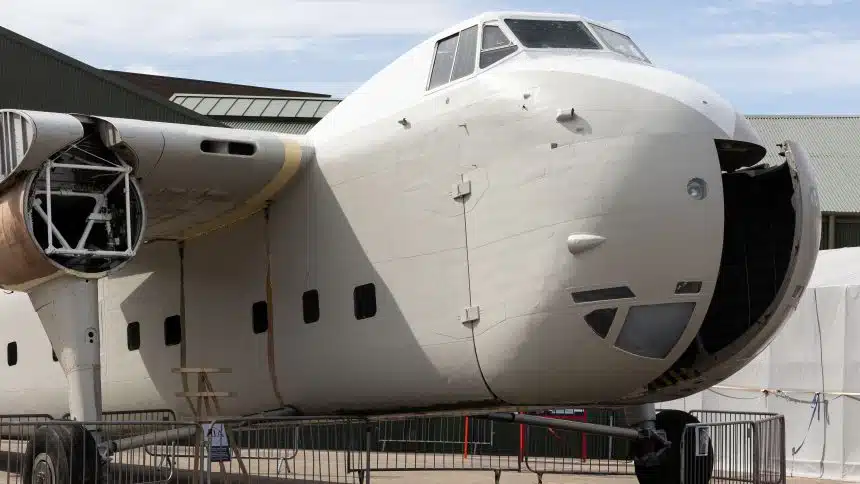
Now back on its own wheels ready for the next phase of restoration, the Bristol Type 170 Freighter, built in Britain but now the only surviving example in the whole of Europe, is due to eventually take pride of place in Aerospace Bristol’s new outdoor exhibit area.
Aerospace Bristol, a rapidly growing aviation museum founded in 2017 on the site of Bristol Filton Airport, is most well known for being the home of G-BOAF, the last Concorde built and the last to ever fly, but has taken on diverse range of aircraft as part of its ambition to showcase British aviation history.
The Bristol Freighter, developed by the legendary manufacturer that was proudly headquartered at Filton, taking its name from the nearby city, was one of the largest and last projects delivered by the firm before its amalgamation into the British Aircraft Corporation (BAC) conglomerate in 1960. The prototype Freighter first flew in December 1945, and the last ever flight by a Freighter took place in Canada in 2004.
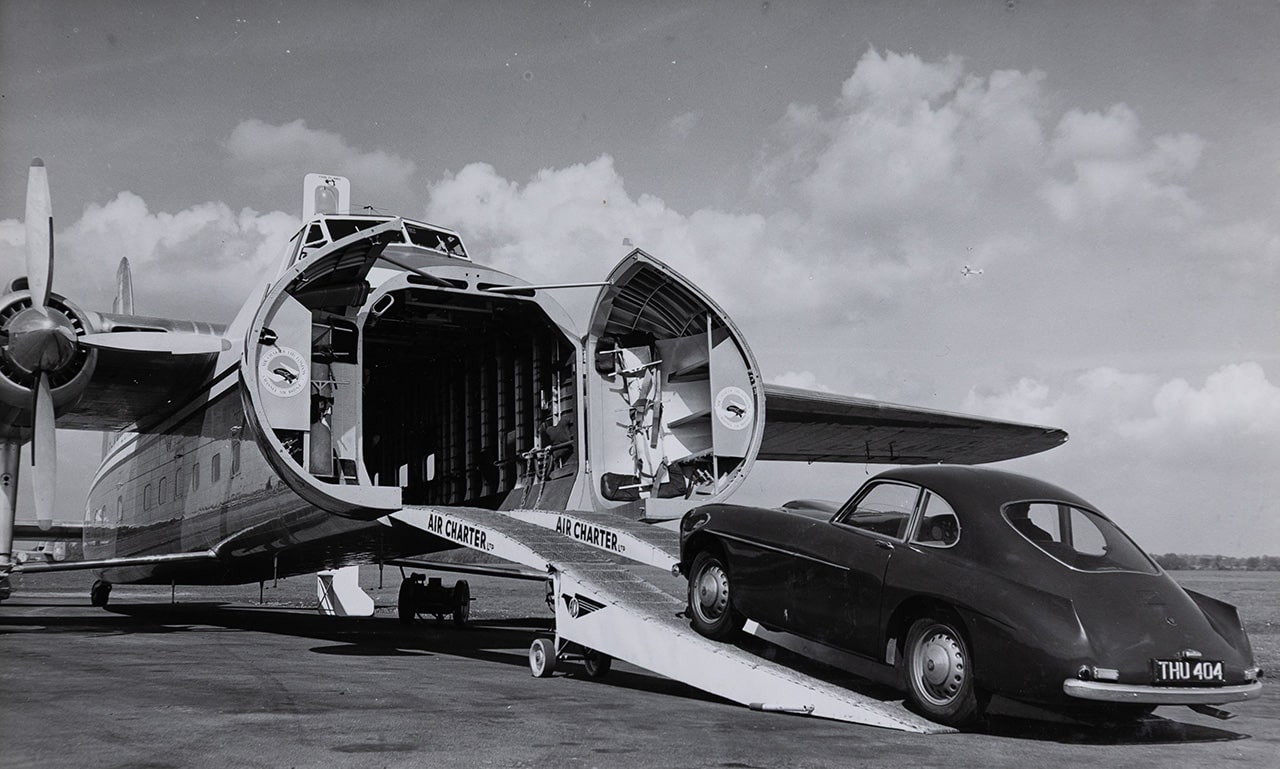
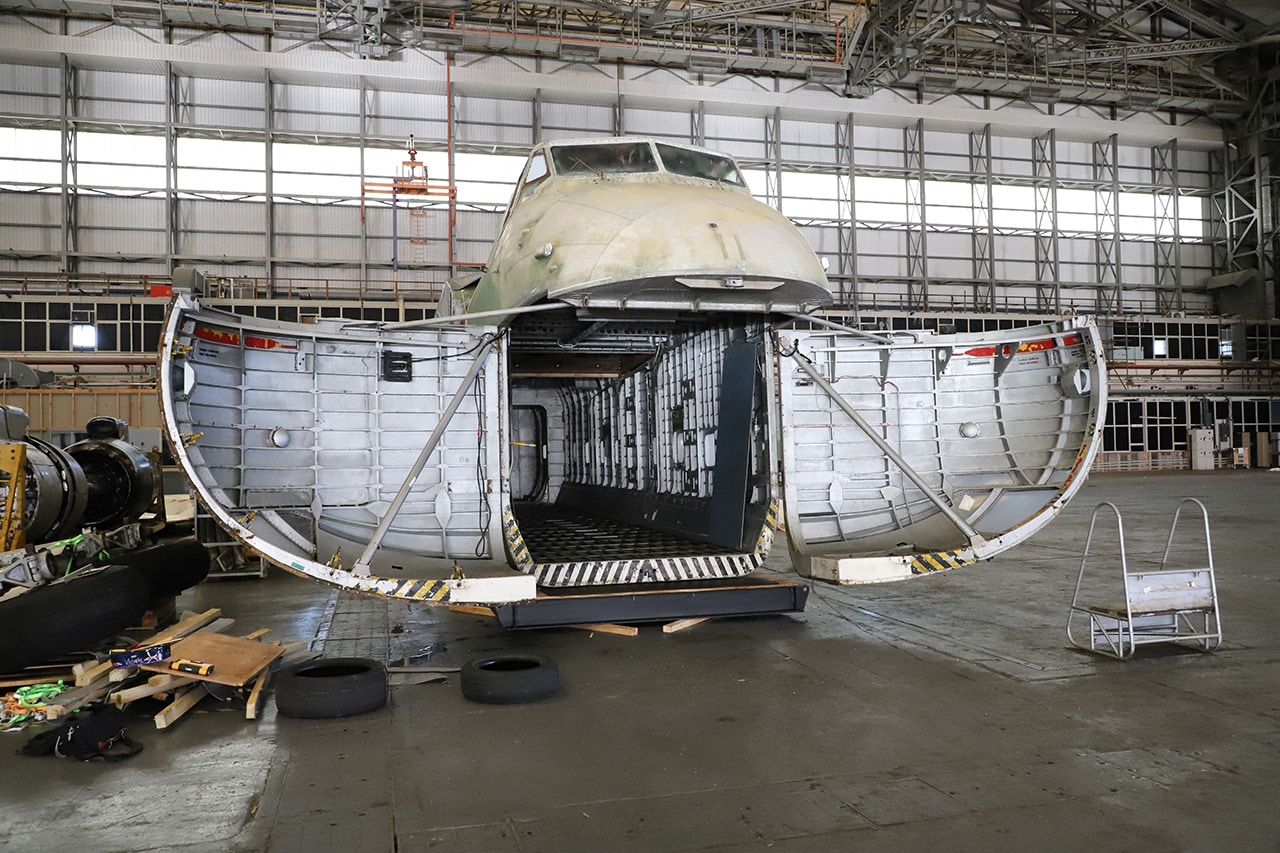
With the cockpit mounted high, a nose cargo door allowed excellent access for loading and unloading freight, and the Type 170 became particularly well known as a vehicle transporter. Over 200 of these aircraft were built, but fewer than ten percent of these survive, and Aerospace Bristol’s example became the only survivor in Europe after its delivery from New Zealand in 2018.
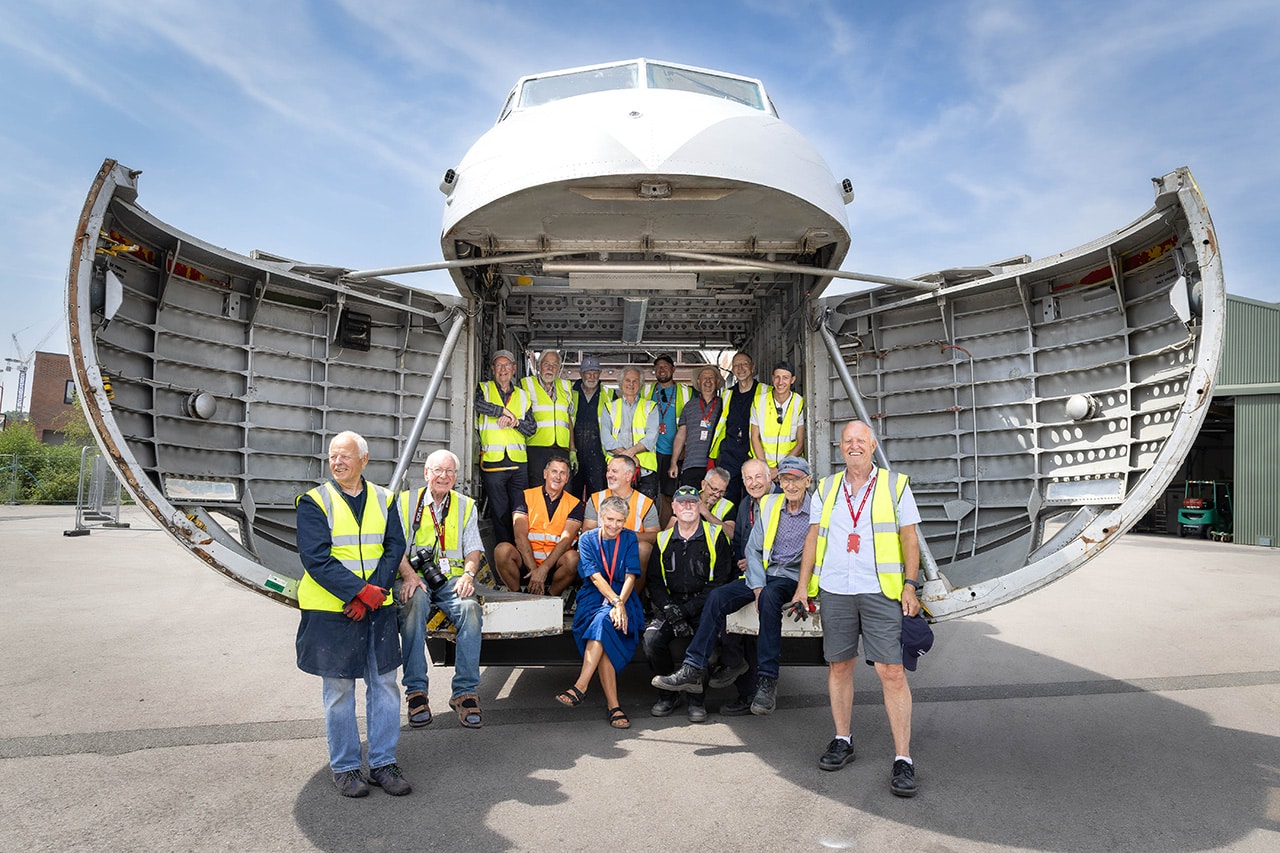
“Seeing our Freighter standing tall is a truly special moment for everyone who has contributed to this project. It is a testament to the skill, dedication and sheer number of hours of work that our team has put into bringing this beautiful aircraft back to life,” said Sally Cordwell, CEO of Aerospace Bristol.
“The Freighter has already come along extraordinarily since returning to Bristol in 2018, having only left its conservation hangar last month. There’s more to do, but seeing this project becoming a display that truly allows visitors to experience a remarkable piece of Bristol’s aviation heritage up close is incredibly rewarding for us.”
NZ5911 was built at Filton in 1953 for the Royal New Zealand Air Force, remaining in service until 1977 and even flying missions during the Vietnam War. Sold to the civilian market, the aircraft saw little further use and was grounded from 1978 and stored externally for decades before its acquisition by the museum.
The full restoration now being planned for the coming years aims to see the Freighter restored to a complete, static display standard. Up to 50 specialist volunteers, former aerospace engineers and ex-Bristol Aeroplane Company employees – including a 90 year old former apprentice – will spend an expected total of 10,000 hours preserving the airframe to be seen for generations to come.
When fully reassembled, the Bristol Freighter will have a wingspan of 108 feet (32.9 metres). The wings are currently stored separate from the aircraft, and are undergoing their own restoration process.
The undertaking is the largest restoration ever attempted by Aerospace Bristol, and one which – unusually – will be completed largely in public view, allowing museum visitors over the years to watch and see progress being made in real time.
Post-War Bristol
Bristol’s post-war aircraft designs – like the Type 170 Freighter, and its Wayfarer passenger variant – are often overlooked by history despite making a strong mark in the aviation world in their day. The Freighter alone saw civilian service in no fewer than 22 countries across 6 continents. The type additionally flew with the military or state aviation operators of 8 countries.
Bristol’s Superfreighter, a stretched variant, upped the load capacity and was specialised in the ‘air ferry’ role transporting cars and their passengers to holiday destinations.
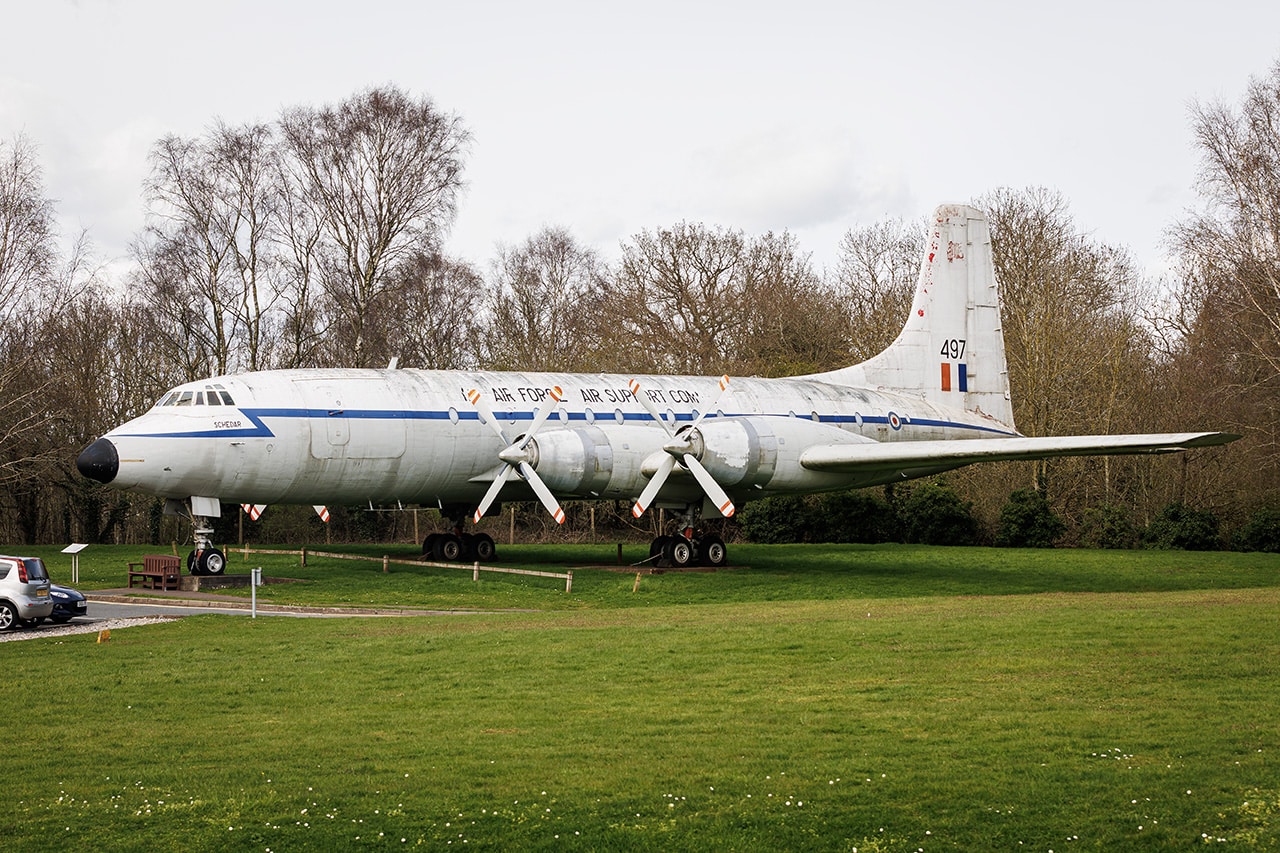
After the freighter came the Britannia, an early turboprop airliner which struggled to compete against emerging jet airliners but managed to reach 85 production airframes. Britannias served with British Overseas Airways Corporation (BOAC), Cubana, and Monarch Airlines. Notably, in service with Israeli flag carrier El Al, a Britannia was used to secretly extradite Adolf Eichmann to stand trial in Jerusalem for his role in perpetrating the Holocaust.
The crowning achievement in Bristol’s lineup was hoped to be the Brabazon, a mammoth piston airliner developed in the mid to late 1940s for transatlantic service. Unfortunately for Bristol, technology caught up with the Brabazon before it could ever enter service, and no customers placed an order for the expensive, luxurious behemoth. The only example ever built was reduced to scrap just years after completion.
#OnThisDay 1950: Newsreel showed footage of a behemoth of the skies, the Bristol Brabazon, as it touched down in London for the first time. pic.twitter.com/nktcVP2ciQ
— BBC Archive (@BBCArchive) June 19, 2024
The last aircraft to bear the Bristol name, developed just as the firm was absorbed by BAC, was also one of its most distinctive. Some have labelled the Bristol Type 188 as Britain’s answer to the Lockheed SR-71, despite being built for a very different purpose. Aesthetically, though, it is sort of easy to see why, though as a purely experimental aircraft the Type 188 eschewed the signature matte black Blackbird look in favor of bare stainless steel. It also fell short in terms of speed, reaching a maximum of ‘just’ Mach 1.88 at a fairly average altitude of 36,000 feet.
The Bristol Type 188 was the world’s first stainless steel supersonic aircraft. Two were built for experimental research. In April 1966 both 188 fuselages were sent to the Proof & Experimental Est. at #Shoebury Garrison for target practice. XF926 was later scrapped at #Foulness. pic.twitter.com/3kzU3YKyW6
— Southend & South Essex History (@HistorySouthend) December 17, 2021
Nonetheless, the Type 188 served its purpose in experimenting with different aircraft design techniques, manufacturing practices, and materials, informing the development of Concorde as well as the TSR-2 strike aircraft.
Aerospace Bristol proudly displays a variety of Bristol’s aircraft types alongside its centrepiece Concorde, as well as a few examples of aircraft developed by its successor firms, including a Sea Harrier and a BAe 146 airliner.