Leonardo will provide Indonesia with 12 M-346F Block 20 light fighter aircraft and negotiate a contract for AW149 helicopter, while looking at a potential cooperation with the Ukrainian drone industry.
Leonardo and PT ESystem Solutions announced on July 21, 2026, two new aircraft procurements for the Indonesian Ministry of Defense (MoD). These will see two of Leonardo’s current flagship programs, the M-346F Block 20 and the AW149, join the diverse aircraft fleet of the Indonesian military. The partnership with Indonesia was confirmed on Tuesday by CEO and General Manager of the company, Lorenzo Mariani, who spoke to the press during a media briefing held at the Farnborough International Airshow, underway near London, UK.
Indonesia and the M-346F
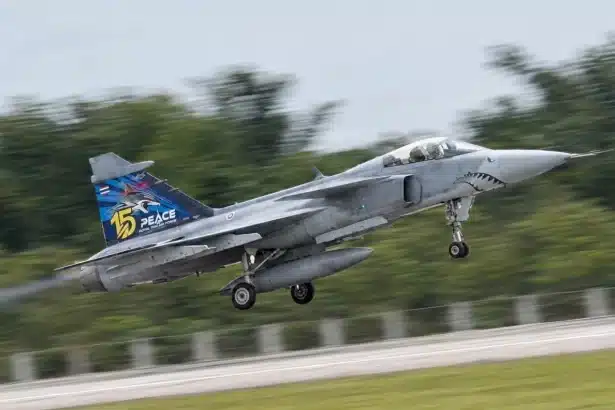
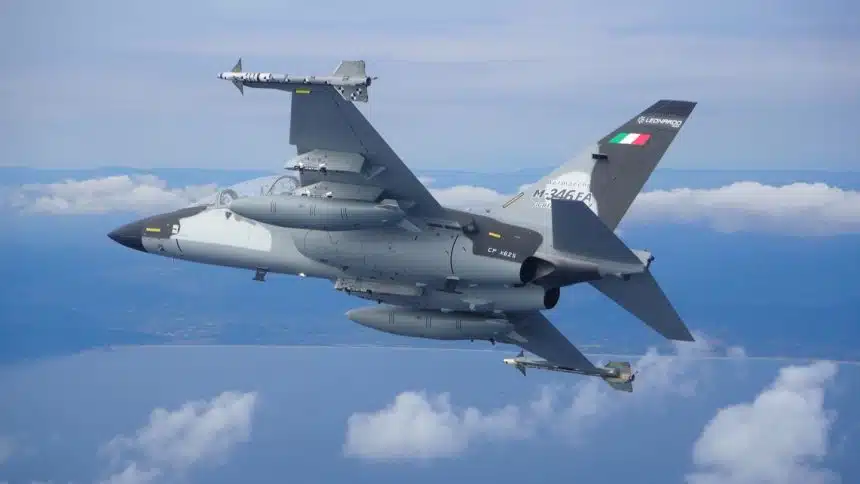
The Indonesian Air Force will get 12 M-346F Block 20 aircraft, the light fighter variant of the M-346 trainer. The contract follows a Letter of Intents (LOI) announced in February 2026.
🔴#LDO_PR #Leonardo and PT ESystem Solutions Indonesia today announced, at @FIAFarnborough, the signing of a contract to provide the Ministry of Defence (MoD) of the Republic of Indonesia with 12 Leonardo #M346F #Block20 multirole light fighter aircraft to meet Indonesian Air… pic.twitter.com/4QfkHYdOPl
— Leonardo (@Leonardo_live) July 21, 2026
The deal includes the localization of a range of support, maintenance, overhaul and training capabilities as well as human capital development, says the press release. Deliveries are expected to start in 2030.
Leonardo says the M-346 F Block 20 will provide multirole combat capabilities and enable advanced training for Indonesian pilots, as part of the Indonesian MoD’s modernization plan. The country is currently renovating its aircraft fleet, with the latest platform to be delivered being the Dassault Rafale.
The contract marks the introduction of the Block 20 in the South East Asia region, with the country being the 23rd operator of the M-346 globally. To date, the M-346 has logged over 170,000 hours in flight with over 170 aircraft ordered.
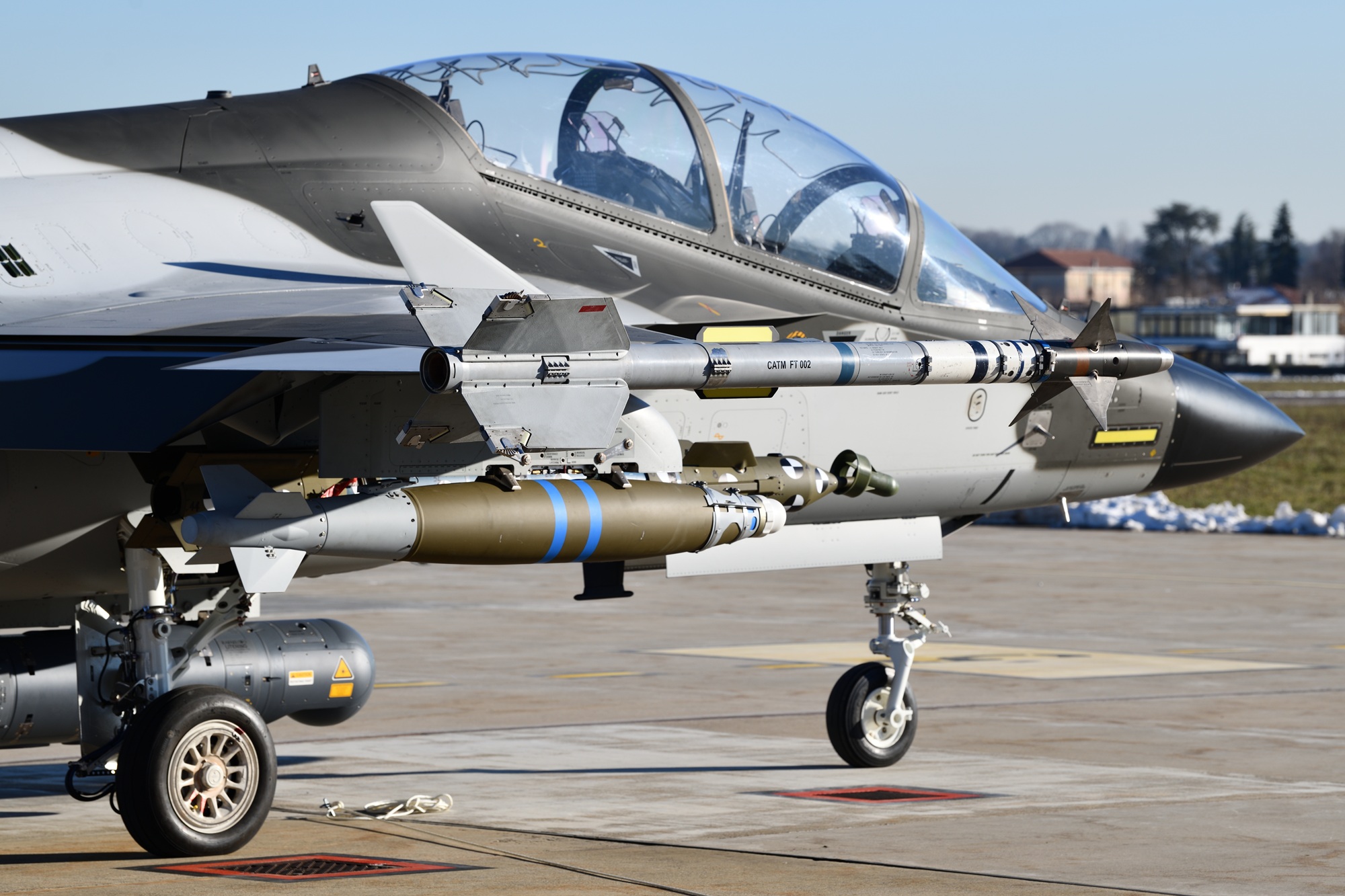
“The introduction of the M-346 F in Indonesia provides clear evidence not only of the aircraft system’s inherent quality but also of the country’s continued and yet growing trust in our capabilities across domains,” said Lorenzo Mariani, Leonardo CEO and General Manager. “We’re here to stay and further expand our contribution and engagement, in both established and new sectors, to deliver the level of technology the country requires in its long-term aerospace and defense development roadmap.”
Indonesia and the AW149
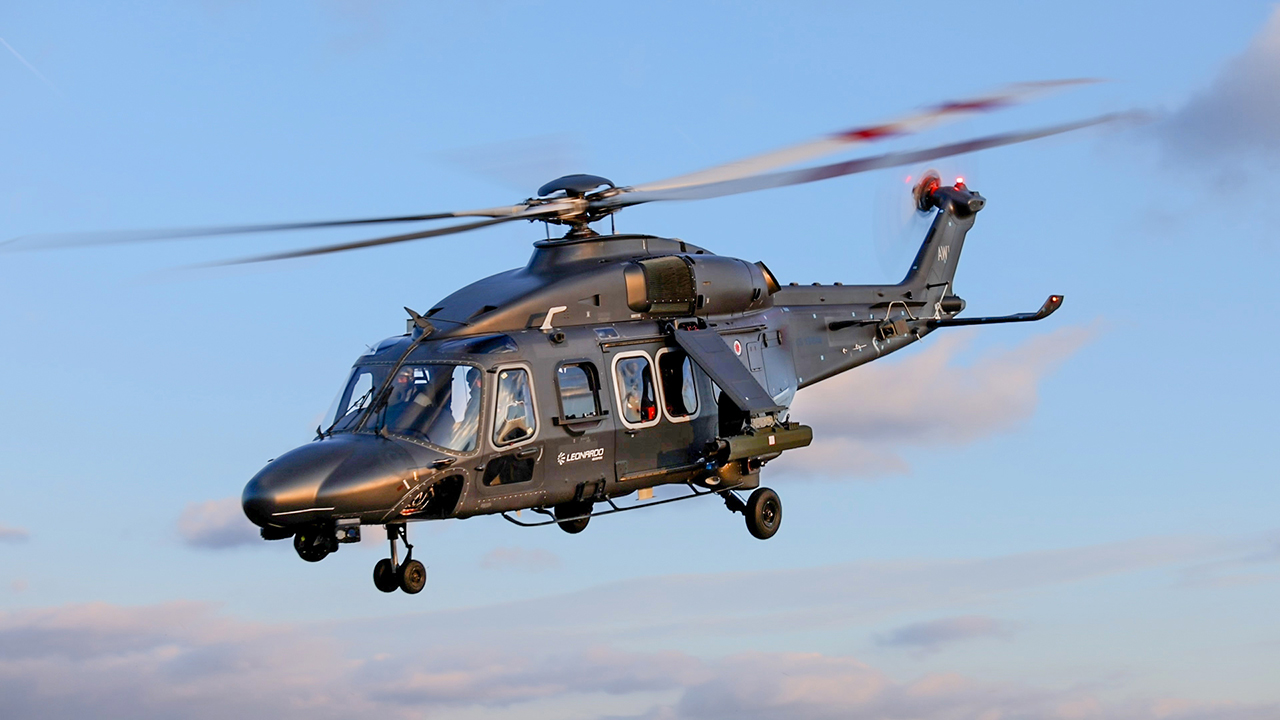
After the M-346F contract, a Letter of Intents (LOI) was signed for the possible procurement of AW149 helicopters for the Indonesian Navy. The agreement also includes plans to develop local technical assistance, maintenance, completion and training capabilities.
🔴#LDO_PR #Leonardo, PT ESystem Solutions and the Ministry of Defence of the Republic of Indonesia (MoD) today announced the signing of a Letter of Intent (#LOI) for the supply and support of naval helicopters for the Indonesian Navy. The agreement also includes plans to develop… pic.twitter.com/50Ua2AmqVx
— Leonardo (@Leonardo_live) July 21, 2026
Leonardo says the AW149 helicopters would be used for search and rescue and disaster relief, for both land-based and embarked operations. This would support both Indonesia’s naval modernization and emergency response capabilities.
“The LOI highlights the growing partnership between Leonardo and PT ESystem Solutions, following the launch of the Indonesia’s M-346 F Block 20 light fighter programme,” says the company in the press release. “It shows continued confidence by Indonesia’s MoD in Leonardo’s products and technologies as well as in the company’s commitment to providing a major contribution to the growth of the country’s national aerospace and defence industry.”
M-346 Block 20
Leonardo announced at the 2024 Farnborough International Air Show the launch of a comprehensive capability enhancement package for the M-346. This major upgrade comes as the M-346 fleet surpassed 100,000 flight hours as well as ten years of service.
Both M-346 AJT (Advanced Jet Trainer) training and M-346 LFFA (Light Fighter Family of Aircraft) fighter variants will benefit from these enhancements for a wide spectrum of applications, while implying significant margin for further developments in the future. Leonardo said that ‘M-346 T Block 20’ and ‘M-346 F Block 20’ are the designations for the new standard of both aircraft.
The Block 20 standard cockpit will be completely renewed, featuring two Large Area Displays (LAD), one per each seat, replacing the existing six Multi-Functional Displays (MFD), plus a low-profile Head-Up Display (HUD). These will be combined with a new digital video and data recorder and a new augmented reality Helmet Mounted Display (HMD).
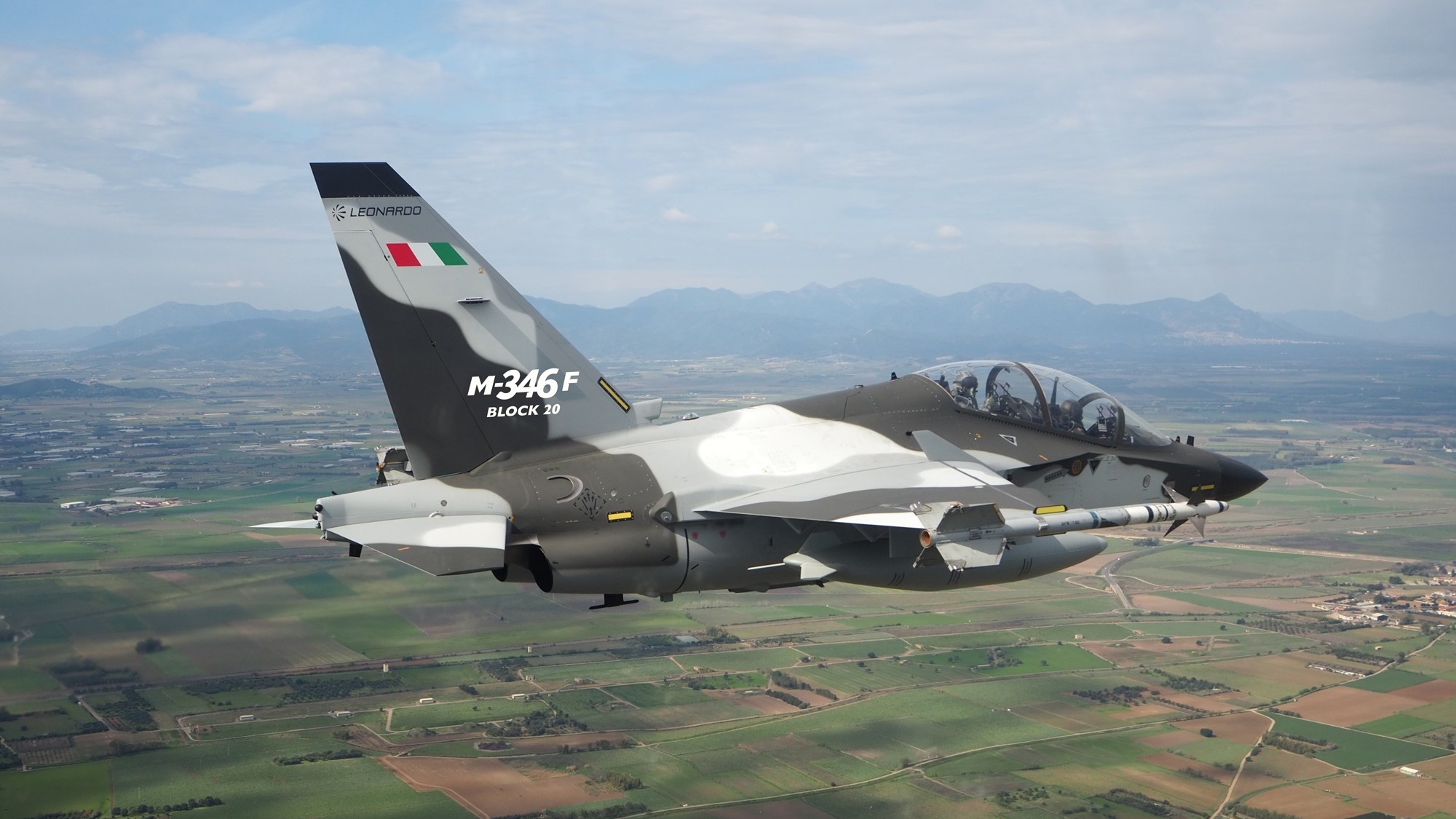
The M-346 Block 20 will also benefit from new navigation, weapon management, flight management system, IFF (Identification of Friend or Foe) transponder. Specifically for the M-346 F variant, further critical capability enhancements include an AESA (Active Electronically Scanned Array) radar featuring fire control radar capability, integration of new weapons for both air-to-air and air-to-ground roles in addition to a built-in missile datalink.
The most visible differences of M-346F from the standard configuration are the two wingtip missile rails, that bring the total hardpoints to seven, new antennas and the Defensive Aid Sub System (DASS). The aircraft, which is being proposed for Homeland Defence/Air Policing, Slow Mover Intercept, Close Air Support (CAS), Counter INsurgency (COIN), Forward Air Controller – Airborne (FAC-A), Combat Search And Rescue (CSAR), Interdiction, Battlefield Air Interdiction (BAI), Tactical Air Support for Maritime Operations (TASMO) and Tactical Reconnaissance roles, can carry more than 2,000 kg of weapons.
AW149
The AW149 is a medium helicopter, which can be employed in different tactical scenarios based on the latest military requirements. At the same time, the AW149 follows design and engineering philosophies which allow the helicopter to be interoperable with all assets involved in today’s rapidly evolving scenarios, with a forward-looking focus on multi domain operations.
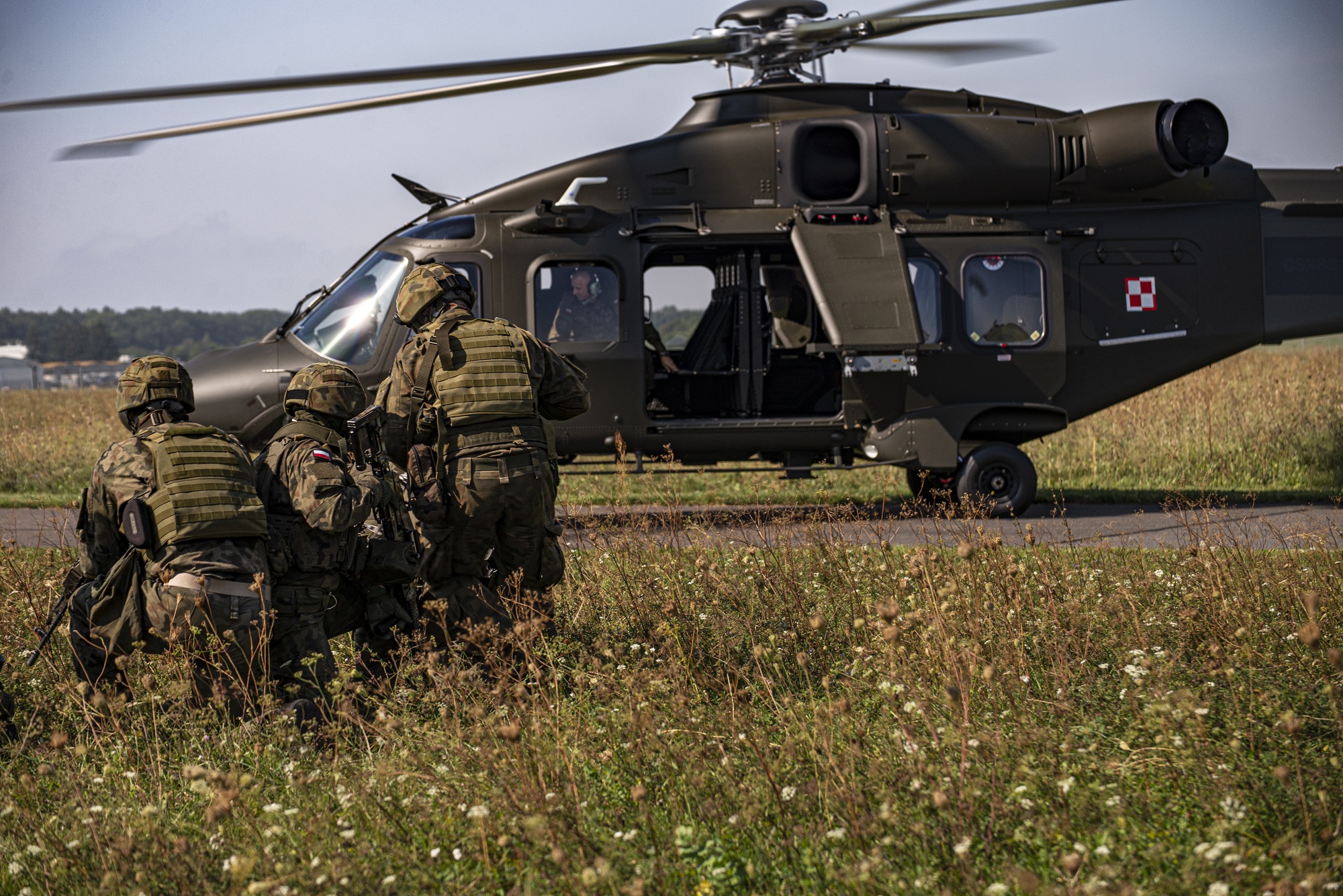
The AW149 was born with the multi-role capability in mind, especially with a large unobstructed cabin which can be rapidly and easily reconfigured to support different roles. Avionics and communications, including Situational awareness and tactical scenario representation, are also another focus, with potential for continuous growth as technology and requirements changes.
The helicopter completes Leonardo’s military medium helicopter offer, joining the lighter AW169M and AW139M. The AW149 obtained an important commercial success in recent times, with orders and interest demonstrated around the world.
The AW149 has a maximum take-off of 8,600 kg, with a large 11.2 cubic meters cabin which can carry 16 fully kitted troops. The helicopter is rated for both single and dual pilot operation in VFR and IFR conditions, day and night.
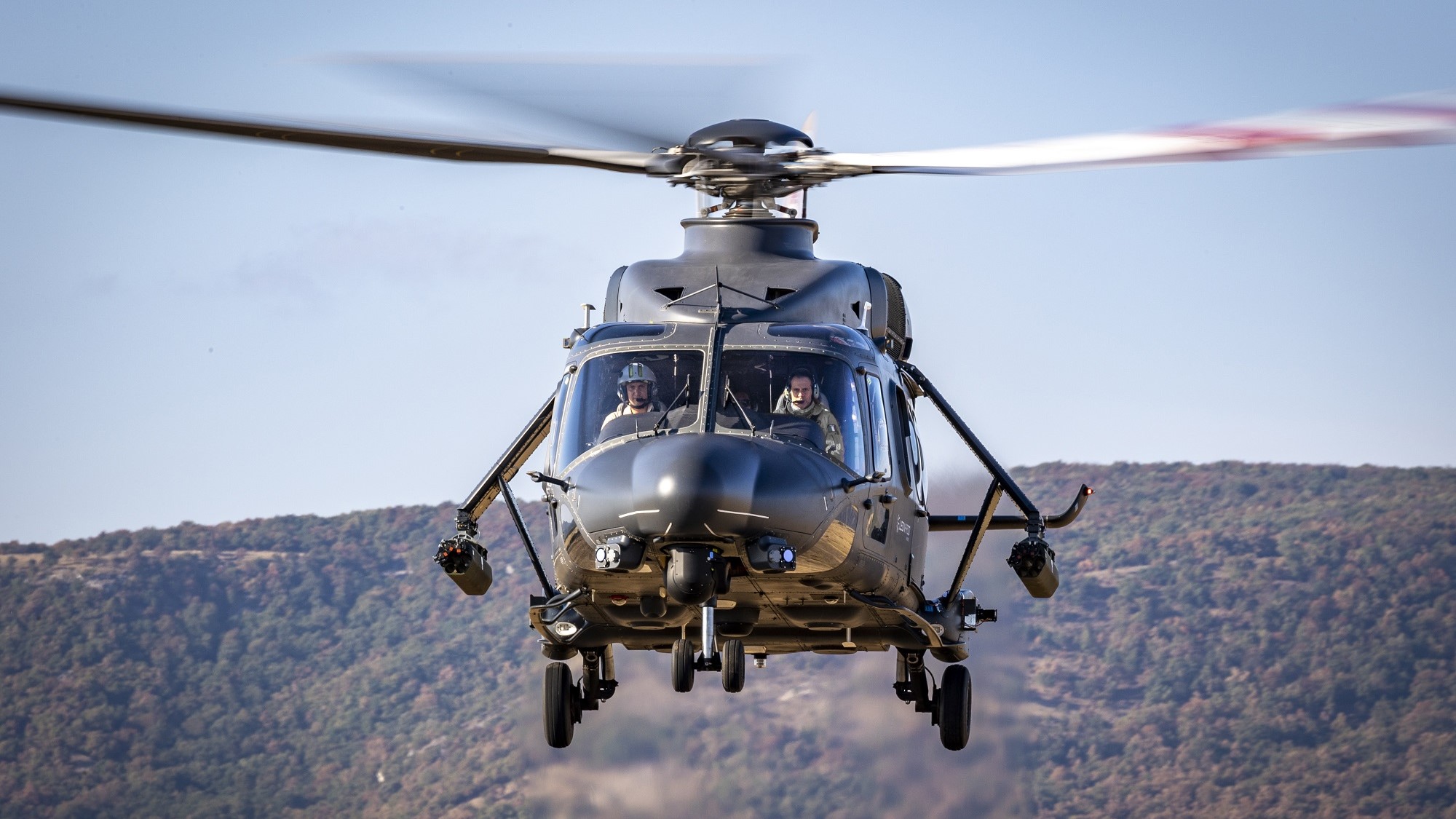
As for most military helicopters, the AW149 is NVG-ready (Night Vision Googles) and equipped with IR formation light for night tactical operations. Similarly, the helicopter is all-weather and can work in desert conditions, with filters for the air intakes, and icing conditions, thanks to an ice protection system, optionally available in a limited and full protection variant.
Aerial mission profiles for the AW149 span tactical transport for both regular troops and Special Operations Forces, Search and Rescue (SAR) and Combat SAR, medical evacuation (MEDEVAC) and casualty evacuation (CASEVAC), Close Air Support (CAS), Intelligence, Surveillance and Reconnaissance (ISR), aerial resupply, and Head of State transport.
The helicopter can employ a barycentric cargo hook with a 2.8 tons capability. The hook has two cameras which provide a visual of the load, the hook and the landing gear, which also allow to check the landing gear while landing on unprepared surfaces.
The design enables rapid reconfiguration via mission kits including EO/IR turret, rescue hoist, stretchers, cargo hooks, searchlights, crew served machine guns, and precision armaments like rocket pods and air-to-ground missiles. A dedicated mission console can also be installed in the cabin, able to interface with the systems installed on the helicopter, as well as transmitting data to and receiving data from other assets.
Other updates
The media briefing at FIA 2026 was also an opportunity for Mariani to answer the questions from the media representatives, about several initiatives currently underway in multiple areas.
Among the most interesting thing the CEO of Leonardo said during the meeting is that the company is looking with interest at a cooperation with the Ukrainian industry following that has built up operational experience that no one else could have gained previously. “There is no specific objective I can communicate today, but I am firmly convinced that a successful collaboration, like the one between Leonardo and Baykar, should also include forms of cooperation with Ukraine’s industry in the area of drones.’
“The Aerostructures JV [joint venture] project is progressing,” Mariani also confirmed.
“Initially,” he explained, “my predecessor had expected to sign a preliminary memorandum of understanding by June this year. However, the difficulties resulting from the conflict in the Middle East have made face-to-face meetings more challenging. Some of the work required to define the project has therefore been slightly delayed, but both sides still aim to finalize the process by the end of the year. It is a complex undertaking, not only because it depends on the willingness of the parties involved, but also because of the form and structure the final agreement will ultimately take.”