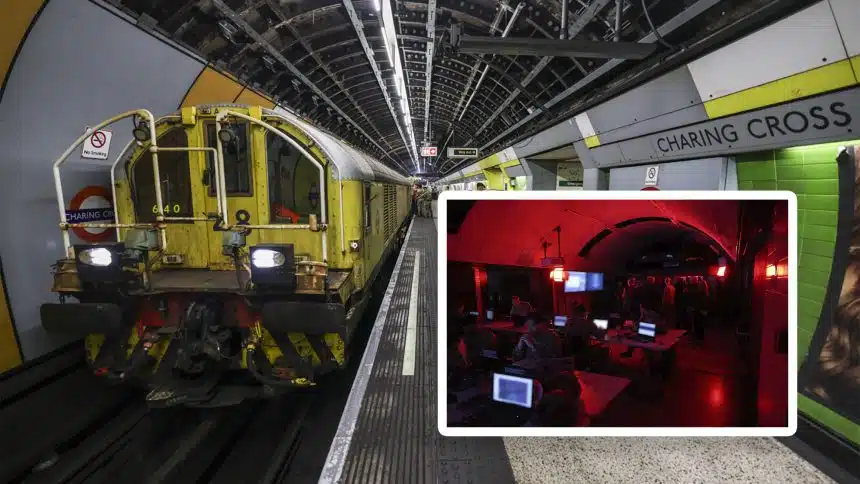
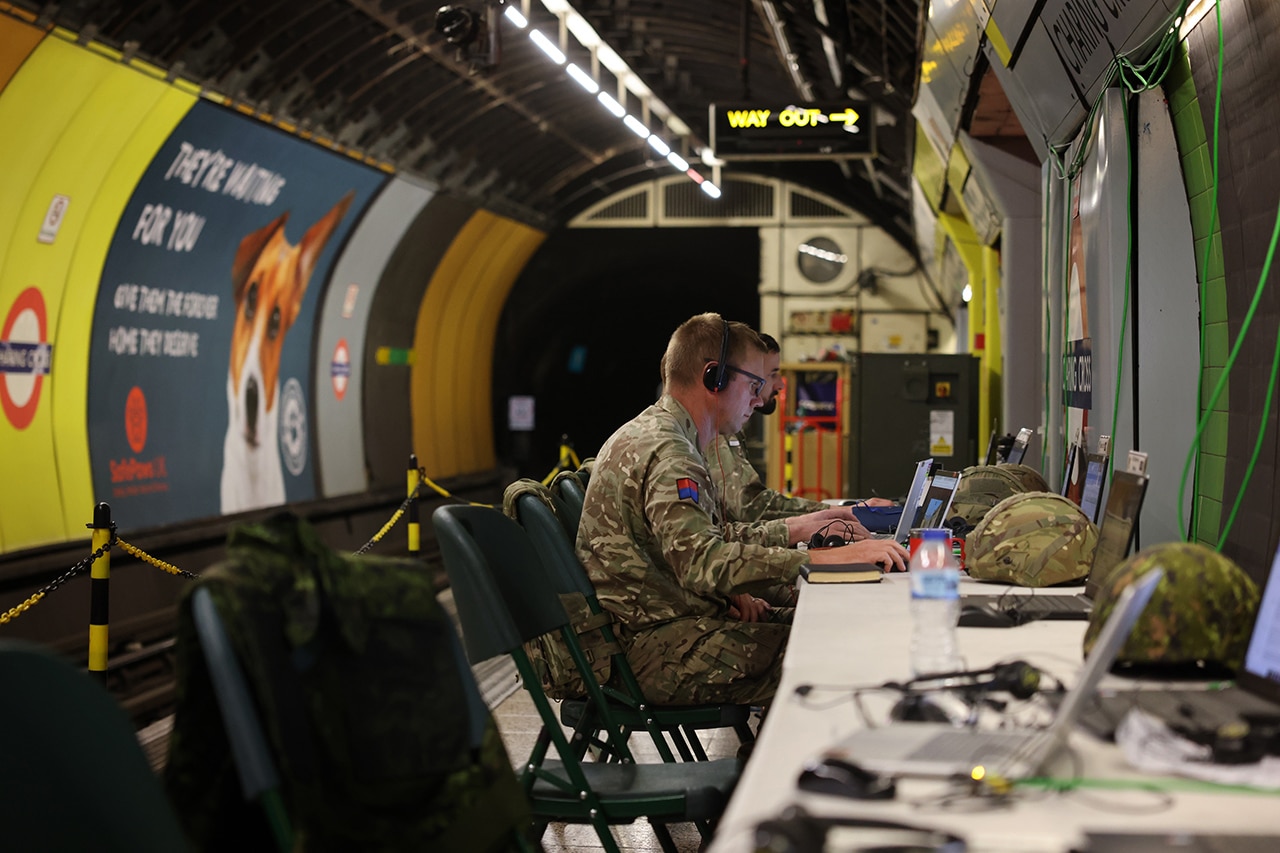
The British Army, leading NATO’s Allied Rapid Reaction Corps, transformed the former Jubilee line platforms at Charing Cross Station – 86 feet below the streets of central London – into an operations nerve centre staffed by five hundred personnel.
Exercise Arrcade Strike, the latest in a long line of exercises testing the readiness of the Allied Rapid Reaction Corps (ARRC), NATO’s premier deployable corps headquarters, has been in full swing under the city of London this week. The ARRC is headed by the British Army, headquartered at Imjin Barracks, Gloucestershire, but is staffed by personnel from 21 NATO member states.
Previous exercises have seen the ARRC establish deployed command centres at various sites across the UK, including a number of times at RAF St Mawgan, Cornwall, as well as further afield across Europe.
2200 pers deploy to St Mawgan in prep for largest ARRC NATO exercise in SW of UK since WWII: http://t.co/bgwT5uXht1 pic.twitter.com/xalwOjsVxs
— Royal Air Force (@RoyalAirForce) November 15, 2013
Arrcade Strike, billed as ‘one of the most ambitious military exercises in a generation’, eschews the traditional use of dispersed military bases in favor of the heart of one of the world’s busiest capital cities. Using London’s existing network of subterranean infrastructure, the command centre would be protected from all but the most devastating aerial attacks, and remain completely hidden from any aerial surveillance.
From deep underground, the ARRC tested their ability to plan and command large-scale military operations involving over 100,000 personnel from across NATO on land, on and under the sea, in the air, and in space. A fictional scenario was drawn up for the exercise, set in 2030. This is when planners consider the military threat from Russia could be at its most potent.
We’ve been conducting a major @NATO exercise in London this week – and no one above ground suspected a thing.
Hundreds of soldiers have been testing how they would run a major NATO command post, hidden deep beneath one of the busiest cities on earth.
Read more ⬇️… pic.twitter.com/SL3HdTXQxI
— British Army 🇬🇧 (@BritishArmy) May 22, 2026
“Arrcade Strike is not a conceptual exercise. It is a rehearsal of the plans we already have and a demonstration of our ability to fight and therefore to deter,” a senior commander noted.
“We have moved from operating in tents and open environments, to commercial buildings, to aircraft hangars, and now to underground locations,” explained another commander during the exercise. “Operating below ground significantly reduces our signature, makes us harder to find, and improves our chances of surviving attack.”
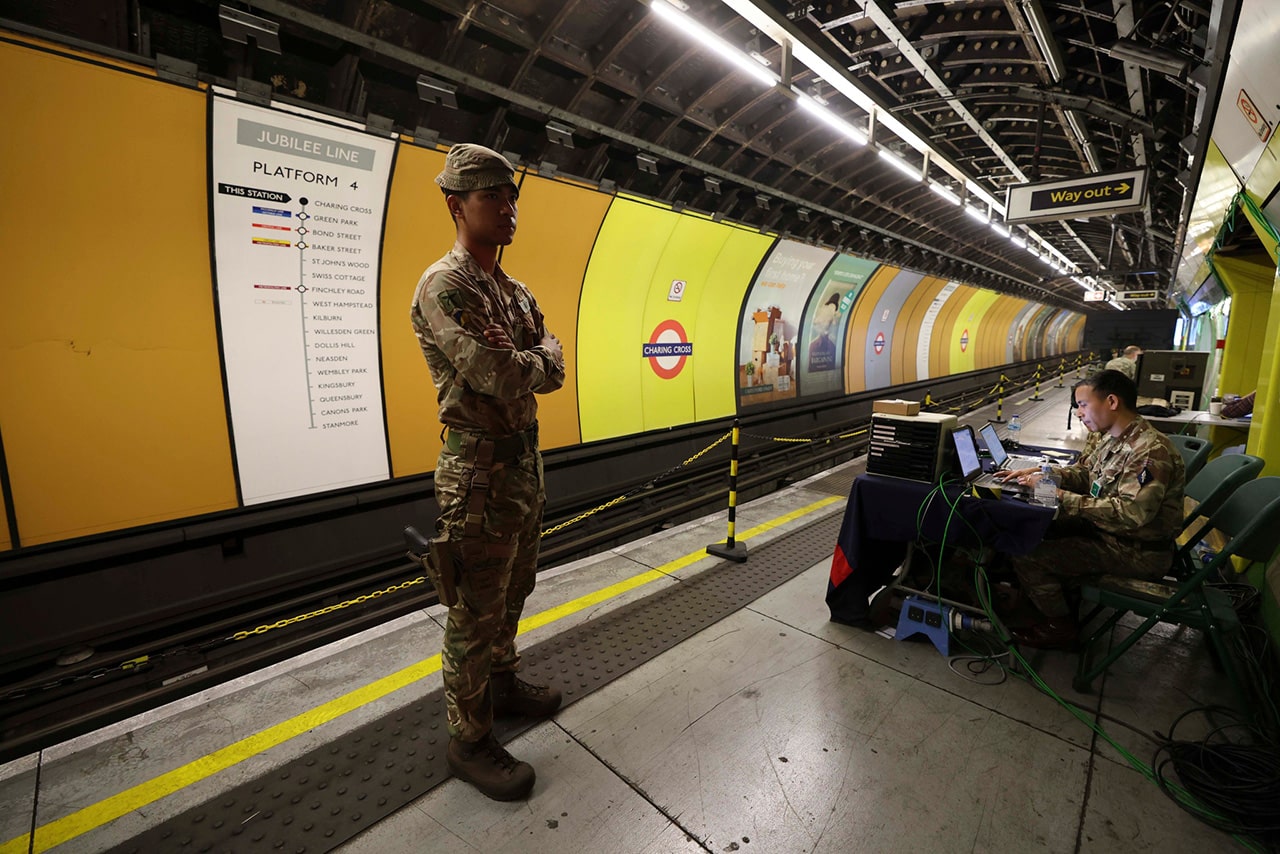
Charing Cross is a national rail and London Underground (also known as ‘the Tube’) station located a stone’s throw from Trafalgar Square. 19 million passengers enter or exit the national rail station every year, while 16 million utilize the underground connections to the Northern line and the Bakerloo line.
NELSONS COLUMN – CHARING CROSS
Nelson’s Column peeps out from behind the underground roundel at the subway entrance to Charing Cross station in Trafalgar Square.
📸 https://t.co/TBKiAODjeJ#london #photography pic.twitter.com/5jkCChGBtg
— Tube Mapper – Luke Agbaimoni (@tubemapper) September 9, 2021
Directly beneath Trafalgar Square itself, two disused but otherwise fully operational London Underground platforms previously connected the station to the Jubilee line. These platforms were closed to the public in 1999 when the Jubilee line was extended, with the new route bypassing Charing Cross in favour of a stop at Westminster.
These platforms, previously used for filming the James Bond film Skyfall, are where the ARRC command centre was established. Five hundred personnel, working just a few corridors and closed doors away from the crowds using the station, operated a hive of computers processing more than ten terabytes of data every single day.
👀 ❌ Who knew the sights and secrets of Charing Cross go even further than what meets the eye?
Our Hidden London tour at Charing Cross Underground station shows you this real–life secret lair as seen in Bond, Killing Eve and even Thor. https://t.co/OWrthPFB9s pic.twitter.com/M18G5vNcQN
— London Transport Museum (@ltmuseum) September 30, 2023
“We will receive terabytes of data and will rely on data analytics and AI to ingest, fuse and visualise that data so the staff and I can make good decisions, at the pace of relevance,” said the Corps commander.
One of the AI systems mentioned by the commander is the digital targeting web known as ASGARD, which was first deployed as a prototype capability to Estonia in the first half of 2025. Chief of the General Staff General Sir Roland Walker, the professional head of the British Army, previously noted: “Project Asgard proves we can do things differently. It’s not just a pathfinder for transformation; it’s a transformation in how we find, fund, and fight with cutting-edge capabilities.”
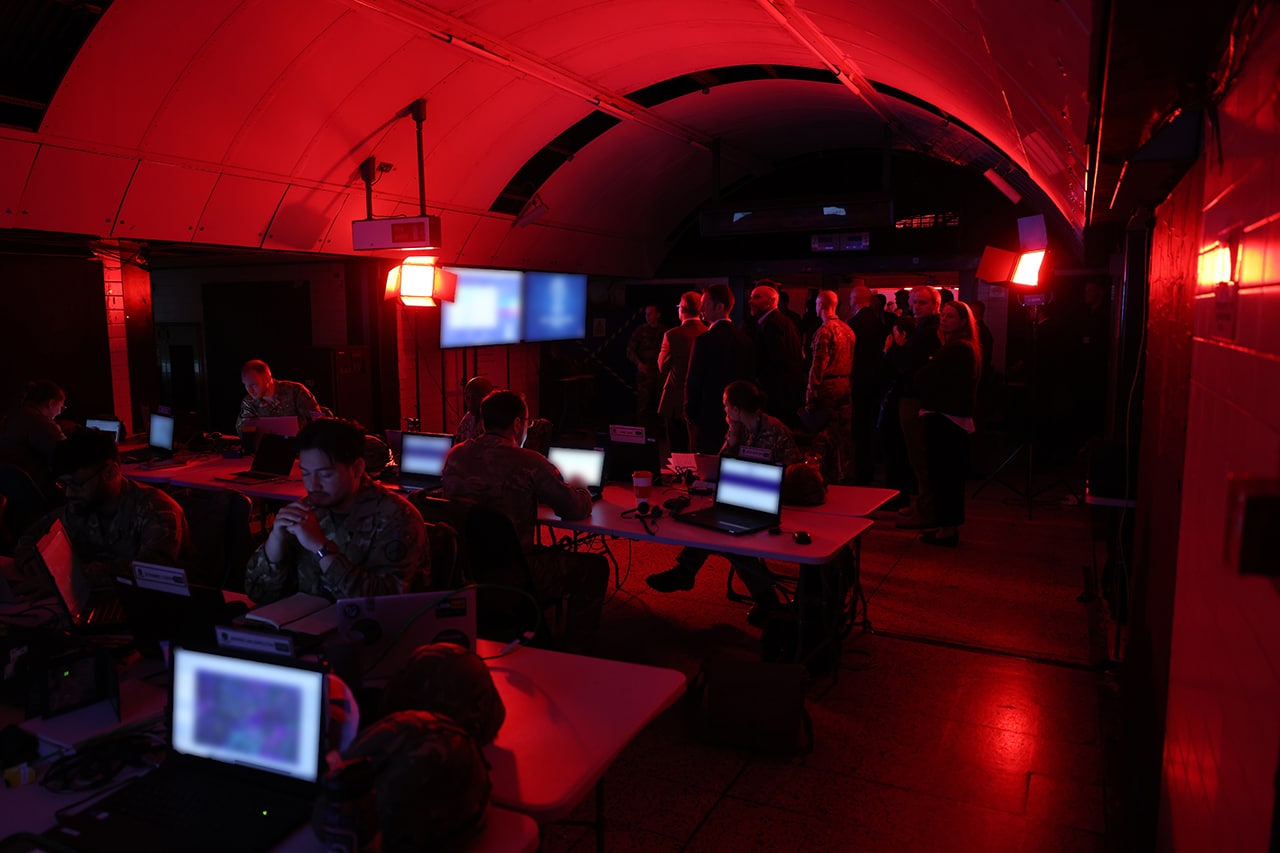
“Asgard helps double our lethality and exponentially reduces the time to see, decide, and strike. What took hours, now takes minutes. Today, the UK possesses a similar Recce-Strike system to the one used by Ukraine to maul Russian forces in the Donbas. That system now sits at the heart of our Forward Land Forces in Estonia.”
Going Underground
The platforms at Charing Cross are, at least above ground, only a few minutes walk away from the buried war rooms where Prime Minister Winston Churchill directed much of the Second World War. “Winston Churchill was hidden underground in London in the Second World War, so it’s nothing new. It worked for him!” said Corporal Ismaila Ceesay, an Information Management Specialist and born-and-bred Londoner who was among those taking part in the exercise.
Personnel on their way to and from the ARRC field HQ had to act as if they were taking part in a real world mission, unable to risk any chance that the underground command centre’s location could be discovered. “I’ve reached into my London roots and adopted a London look to blend in like a local, so no one can suspect I’m anything but a commuter going to work,” Ceesay said. “I’ve got my hoody on, changed my gait and I try to blend in.”
Just down Whitehall, too, is the Ministry of Defence’s HQ building and, across the road, 10 Downing Street – home of the British Prime Minister. These too have underground complexes, the most notable of which is known as the Defence Crisis Management Centre or ‘Pindar’. This nuclear-hardened bunker was declared operational in 1992 and is linked to Downing Street and the Cabinet Office by an underground passageway.
There is also Q-Whitehall, a communications tunnel that links – to some degree – with almost all of the Government buildings in the area, including the Ministry of Defence as well as the Admiralty Citadel, a concrete fortress on Horse Guards Parade with a 20 feet thick ceiling now used for communications equipment but originally built as a last redoubt for military commanders during the Second World War.
Admiralty Citadel – Horse Guards, Whitehall, London pic.twitter.com/2cNvoZUHMK
— Clive Holden (@cliveinkent) July 14, 2024
Long-standing claims suggest that this secretive network of tunnels links up with Charing Cross at their northern end – perhaps this choice of venue for the exercise was not a coincidence?

“The London Underground has proved itself to be a really good facility. Underground offers good protection and is very adaptable, so we are able to deliver our frontline from a range of locations. It doesn’t matter where we are based to achieve effect,” said Major Jess Wood, Chief of the Joint Air Ground Integration Centre (JAGIC). “It’s a very impressive set up behind a pretty nondescript grey door in the tube corridor. Someone stopped me on my way into work and asked how to get to Heathrow yesterday!”

Setting up the HQ
To maintain the veil of secrecy, equipment for the command centre was transported by unmarked civilian vans to Ruislip, North London, in the early hours of the morning. From there, it was loaded onto an engineering train operated by Transport for London, usually used to transport equipment for repairs, maintenance, and upgrades to the tube network. Constructing the HQ at Charing Cross took one week, with 22 Signal Regiment providing their expertise with the high tech communications equipment.
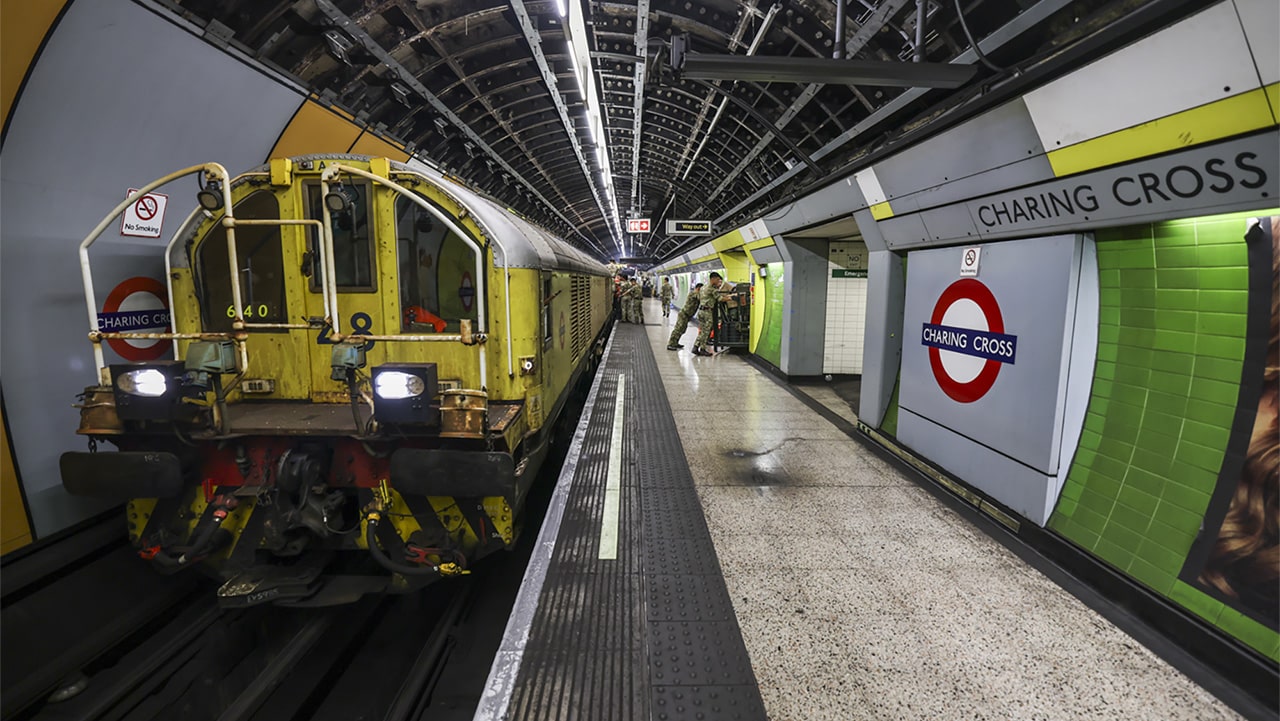
“The difference between being here and in an old warehouse, which would be our usual location, is that a warehouse would be a wide-open rectangular space, and this is a constrained layout with a warren of tunnels and train platforms,” said Major Joe Harris, Officer Commanding 14 Squadron, Royal Logistics Corps. “We’ve got to get out of the mindset of Afghanistan, where we move in and create a space from scratch. Now we need to find a ready-made safe space and set ourselves up accordingly.”
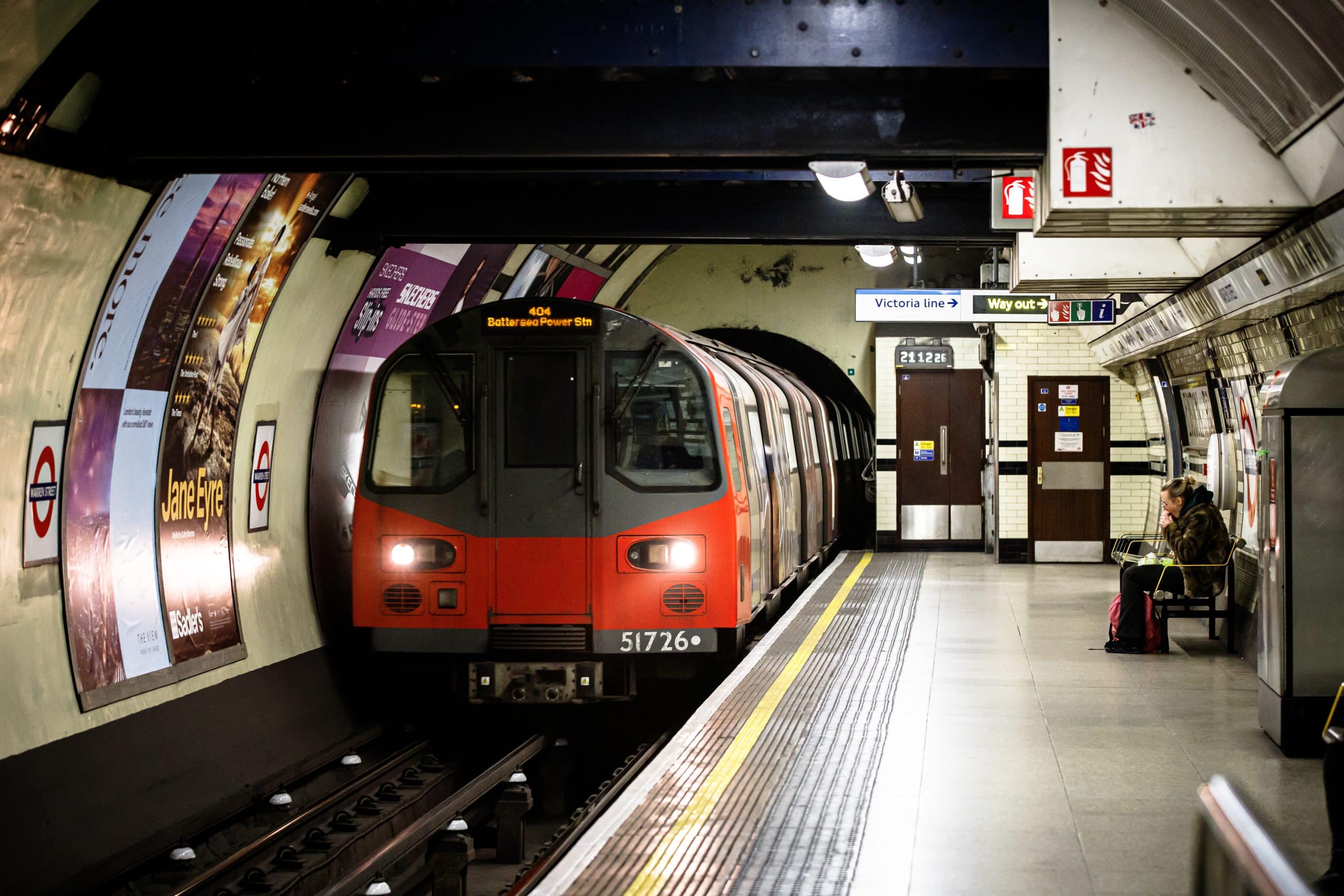
A barcode system was developed to keep tabs on which personnel were present underground at any given time, all while just a few minutes away a fully operational tube station continued to run with trains full of passengers calling up to every 90 seconds.
Ongoing Deterrence
The British Army’s official press release makes clear that this exercise was not a one-off. The ‘underground model’ will continue to be rehearsed and developed in the UK and in Europe over the next two years, working towards the goal of establishing a mission-capable Strategic Reserves Corps by 2030.
“As the exercise’s message makes clear, deterrence is not passive. It has to be demonstrated, exercised, and believed by allies and adversaries alike,” the press release notes. “Somewhere beneath the streets of London, hundreds of soldiers are making sure it is. When they finish and head back up to the surface, no one will ever know they were there. But the message they’ve sent will have been heard.”