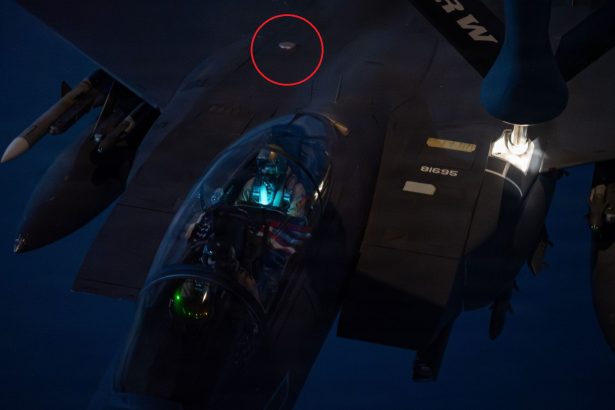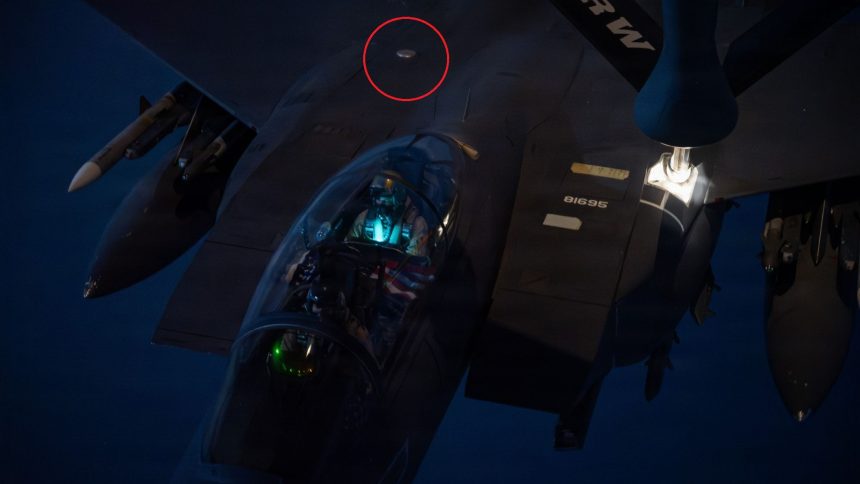
The new Controlled Reception Pattern Antenna (CRPA) is part of the Digital GPS Anti-jam Receiver (DIGAR) system installed in the F-15E Strike Eagle following a contract to BAE Systems in 2022.
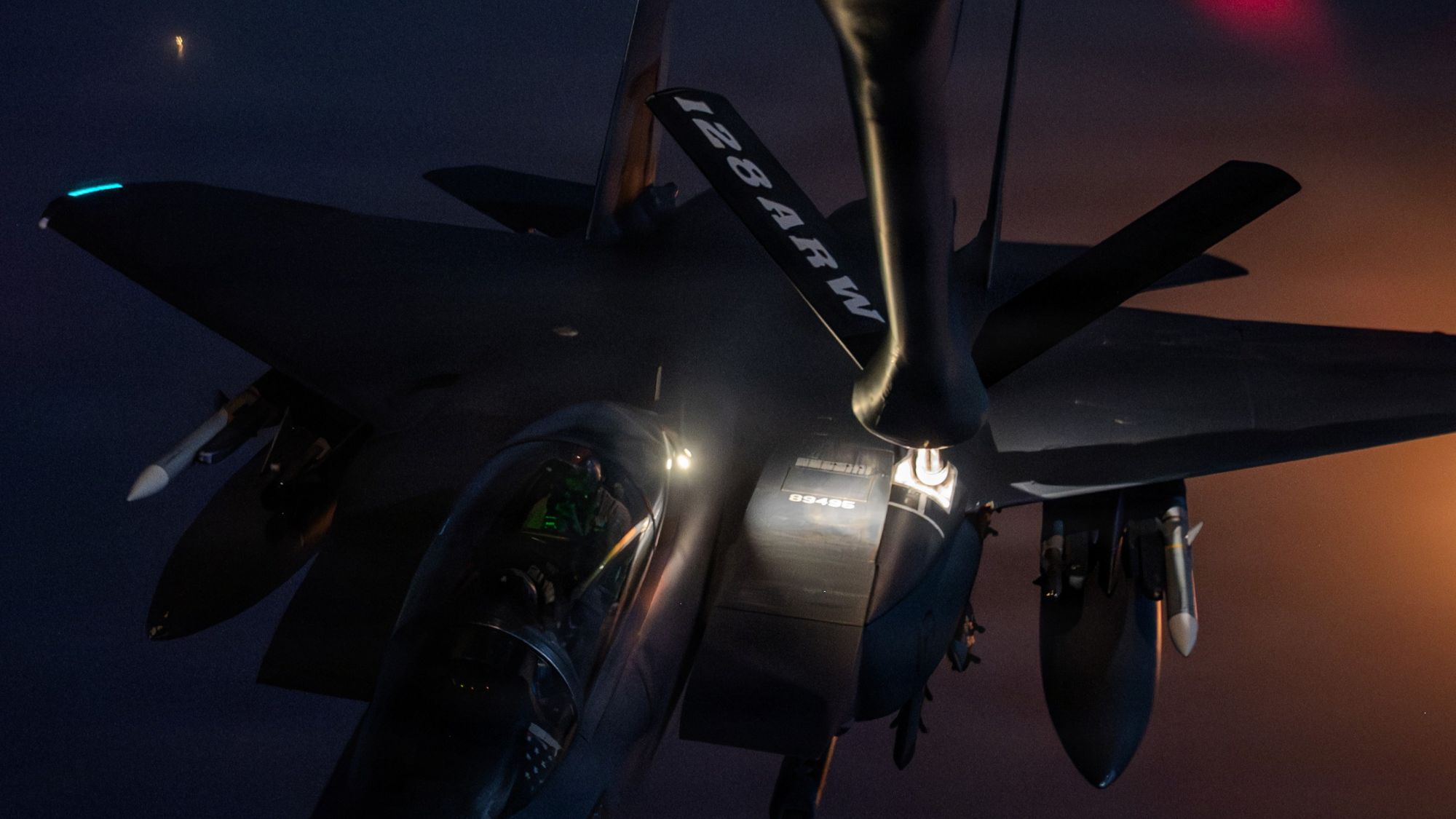
Defense observers have noted the appearance of a new Controlled Reception Pattern Antenna (CRPA) on U.S. Air Force F-15E Strike Eagles photographed during Operation Epic Fury. The circular array is visible on top of the fuselage, on the starboard (right-side) right next to the speed brake.
‘Abd’, a popular military aviation analyst on X, said the CRPA is connected to the Digital GPS Anti-jam Receiver (DIGAR) system, “which is an ongoing upgrade alongside RMP and MUOS/SATURN.” The DIGAR upgrade emerged in September 2022, when BAE Systems received a $13 million contract to install the system on F-15Es at its facility in Cedar Rapids, Iowa.
RMP stands for the Radar Modernization Program, which involves replacing the F-15E’s older APG-70 with the APG-82(V)1 Active Electronically Scanned Array (AESA) radar, while MUOS and SATURN stand for Mobile User Objective System and Second Generation Anti-Jam UHF Radio for NATO, respectively.
The official images capturing the F-15E with the new system were taken on Apr. 5, 2026, and published on DVIDS on Apr. 7. These are part of a gallery showing the F-15E and an F-35A Lightning II receiving fuel from a KC-135 Stratotanker in the U.S. Central Command (CENTCOM) Area of Responsibility (AOR).
Should be similar in purpose/function to IAI ADA GNSS anti-jam modules fitted to Israeli F-15s and F-16s among other platforms. Both use CRPA beamforming to harden military GNSS/GPS (including SAASM/M-Code) against jamming while feeding protected PNT to the existing receiver. pic.twitter.com/QuFbY6qMHm
— Abd (@blocksixtynine) April 9, 2026
CRPA uses multiple antennas to withstand jamming and ‘spoofing’ of Satellite Navigation (SATNAV) signals from the U.S. GPS and other constellations like Russia’s GLONASS, European Galileo and China’s BeiDou. The emergence of CRPA comes as EW jamming and the electromagnetic spectrum took center stage in the war in Ukraine, and just before a U.S. Navy MQ-4C Triton ISR UAV disappeared from flight tracking websites over the Persian Gulf on Apr. 9.
RMP, DIGAR and EPAWSS upgrades for F-15Es
Abd identified the aircraft in the photo as assigned to Seymour Johnson AFB, North Carolina. “I’ve seen it on a handful of F-15Es so far, most of them LN tails but the deployed MO/SJs seem to have the mod,” Abd explained.
For clarity, the LN, MO and SJ tail flashes correspond to the 48th Fighter Wing at RAF Lakenheath, UK, the 366th Fighter Wing at Mountain Home AFB, Idaho, and the 4th Fighter Wing at Seymour Johnson AFB, North Carolina, respectively. We had reported in mid-February that 14 MO and SJ F-15Es transited through RAF Lakenheath, along with 12 F-22s and 12 F-35A, as a part of the buildup prior to Operation Epic Fury.
After the DIGAR contract, BAE Systems had said on Sep. 8, 2022, that USAF F-16 Fighting Falcons were the first platforms to receive DIGAR systems. “DIGAR uses advanced antenna electronics, high-performance signal-processing, and digital beamforming – a capability that combines 16 steered beams – for better GPS signal reception and superior jamming immunity,” BAE’s statement said.
SATURN is a next-generation UHF communications standard, designed to allow secure, reliable voice and data transmission while resisting jamming and interference. Because of the capabilities it can provide, SATURN is considered the successor to the Have Quick ECM-resistant radios and the current NATO standard for secure military communications.
The next-generation Ultra High Frequency SATCOM Mobile User Objective System (MUOS) has been chosen to replace the legacy Ultra High Frequency Follow-On (UFO) satellite communications system. MUOS is said to provide a capacity 16 times greater than UFO SATCOM, with near global beyond line of sight communication capabilities.

The MUOS and SATURN upgraded might possibly be installed alongside the Eagle Passive/Active Warning and Survivability System (EPAWSS), designated the AN/ALQ-250 in the United States. A March 2024 pre-solicitation notice by the Air Force Materiel Command (AFMC), in fact, noted that the service was looking to integrate more upgrades on the same aircraft modification lines.
The notice scoured the market for potential sources to provide “touch labor and support to integrate the Mobile User Objective System/Second Generation Anti-Jam UHF Radio for NATO (MUOS/SATURN) into the F-15 Eagle Passive/Active Warning and Survivability System (EPAWSS) modification line.” Notably, BAE Systems is also the primary contractor for the EPAWSS program.
It is unclear if the DIGAR upgrade is a standalone program, independent of the EPAWSS, MUOS and SATURN lines.
A total of 99 F-15E Strike Eagles are due to receive the EPAWSS modification, and it will be standard equipment for the new F-15EX Eagle II. The protection suite is also intended to be integrated with Japanese and South Korean F-15s.
The first two operational EPAWSS F-15E Strike Eagles were delivered to the 48th Fighter Wing at RAF Lakenheath in January 2025. The aircraft returned there two years after the upgrade modification began in May 2023.
The first F-15E equipped with the advanced EPAWSS Electronic Warfare system takes off from San Antonio and heads home to the @48FighterWing.
This next-gen tech enhances pilot situational awareness and ensures the F-15 can tackle modern threats. pic.twitter.com/QG8hXi5ba8
— Boeing Defense (@BoeingDefense) January 17, 2025
Additional F-15s EPAWSS-configured F-15Es would have been delivered in the intervening time.
These aircraft already underwent the RMP upgrade, transitioning to the APG-82(V)1. In fact, the RMP was completed in 2024, with over 200 F-15Es receiving the new radar.
The 389th Fighter Squadron (389th FS) from Mountain Home AFB, Idaho, was the first to receive an F-15E Strike Eagle with the new radar in June 2014. The service said at the time that the MO jets would complete their transition to the new radar by 2017, followed by the remaining bases.
The RMP with the new APG-81 would be fundamental to support any future upgrades to the rest of defensive, EW and mission systems.