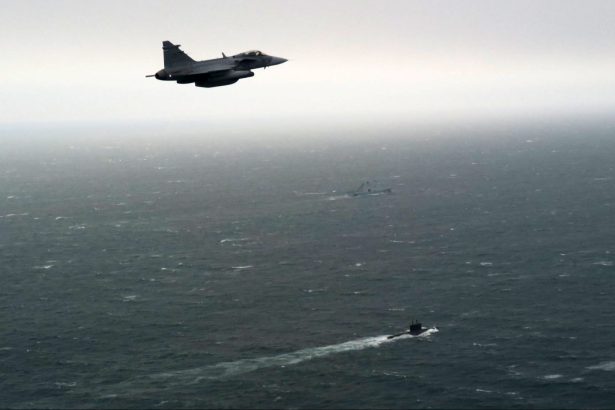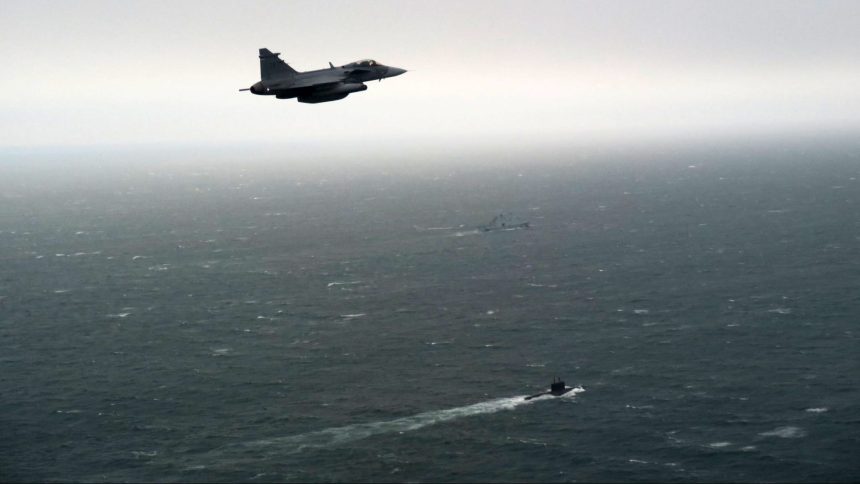
The Russian submarine shadowed by the Swedish Gripens was transiting the Kattegat, a strategic waterway linking the Baltic approaches with the North Sea system.
Although the spotlight is currently on Iran, the Russian military activity in the Baltic region continues to draw scrutiny. The Swedish Armed Forces have just released some interesting images showing JAS 39 Gripens escorting a Russian Kilo-class submarine as it transited the Kattegat. The photos emerge at a time of growing concern over the scale and regularity of Russian undersea operations in Northern Europe, which Swedish naval officials say have become an almost weekly occurrence.
Swedish fighter jets tracking Russian submarine in the Kattegat.
On Friday, Swedish JAS 39 Gripen intercepted a Russian Kilo-class submarine in the Kattegat. Together with allies, we are now monitoring the submarine’s continued route into the Baltic Sea.https://t.co/BrIU6SD4AS pic.twitter.com/XBcwTPQ1bS
— Försvarsmakten (@Forsvarsmakten) April 10, 2026
The encounter is far from being isolated. A broader pattern of persistent monitoring and rapid-response activity in the Kattegat, a strategic waterway linking the Baltic approaches to the North Sea, has been observed recently with several reported transits of Kilo-class submarines, dutifully intercepted by the Swedish fighters.
Warships with the Swedish Navy and Coast Guard, alongside JAS-39 Gripens with the Swedish Air Force, are currently shadowing the Russian Kilo-class diesel-electric submarine, Novorossiysk (B-261), in the Baltic Sea, after it passed eastbound yesterday through the Great Belt near… pic.twitter.com/1lUH7rxIcq
— OSINTdefender (@sentdefender) October 15, 2025
On Dec. 6, 2025, Capt. Marko Petkovic, chief of operations for the Swedish navy, revealed that encounters with Russian submarines in the Baltic Sea had become an “almost weekly” occurrence, highlighting how such contacts are no longer viewed as rare or exceptional events but rather as part of the routine operating activities for Swedish forces. As reported by The Guardian, Petkovic said Russian submarine activity in the region had increased noticeably in recent years, to the point that sightings were now “very common,” reflecting what he described as Moscow’s continuous effort to reinforce its military presence in the Baltic. He also pointed to Russia’s ongoing naval modernization, including the production of one Kilo-class submarine per year, as evidence that this is not a temporary surge but part of a broader and deliberate long-term buildup.
The Swedish “team” dispatched to monitor the Russian Kilo-class submarine activity in the Kattegat waters is the same as observed in similar intercept missions relying on a layered package combining JAS 39 Gripen fighters, providing airborne overwatch, with Visby-class corvettes at sea.
The latter, is a class of Swedish corvettes optimized for stealthy operations close to shore. Built with a composite hull and designed to minimize radar and infrared signatures, the Visby class is intended to operate in the kind of shallow, complex maritime environment found in the Baltic, where it can combine speed, sensors and multirole capability to hunt submarines, monitor surface traffic and defend key sea lanes.
The Kilo class is a family of Russian diesel-electric low acoustic signature attack submarines designed for stealthy operations in coastal and enclosed seas. These boats are armed with six 533 mm torpedo tubes and, in later variants, can also launch Kalibr cruise missiles. They are considered a credible threat to surface ships, land targets and maritime traffic in confined waters such as the Baltic.
Although surfacing may be required for several different reasons (ventilation, communications, navigation updates, or to deal with technical issues), the diesel-electric submarines, unlike nuclear ones, need to surface or, at least, come up to snorkel depth, from time to time: when submerged, the boat relies on batteries, which allow it to remain quiet but only for a limited period. Once those batteries are depleted, the submarine must raise a snorkel mast or surface to bring in oxygen, run its diesel engines, and recharge them.
When they surface, they are easier to detect and track, and become more vulnerable to Swedish Gripen C fighters and Visby corvettes. At the same time, their presence above the surface can provide a rare opportunity to capture interesting imagery, such as the photos released today by the Swedish Armed Forces.
What makes the Swedish approach particularly interesting is the fact that it appears to rely for the anti-submarine warfare mission on a combination of assets, the JAS 39 Gripens and Visby-class corvettes, rather than on dedicated maritime patrol and ASW (Anti-Submarine Warfare) aircraft like the P-8 Poseidon. In that sense, it also seems to reflect a workaround imposed, at least in part, by the lack of a specialized fixed-wing ASW platform. Aircraft like the P-8 (and P-72) are specifically designed for the maritime patrol role, combining long endurance, wide-area search capability, sonobuoy deployment and onboard acoustic processing. They are also equipped with various ESM (Electronic Support Measure) sensors, that make them ISR (Intelligence Surveillance Reconnaissance) platforms too.
By contrast, the use of fighters and corvettes points to a different approach, one that may still work in the Baltic’s confined environment, but remains significantly different from the more conventional ASW model built around purpose-designed patrol aircraft.