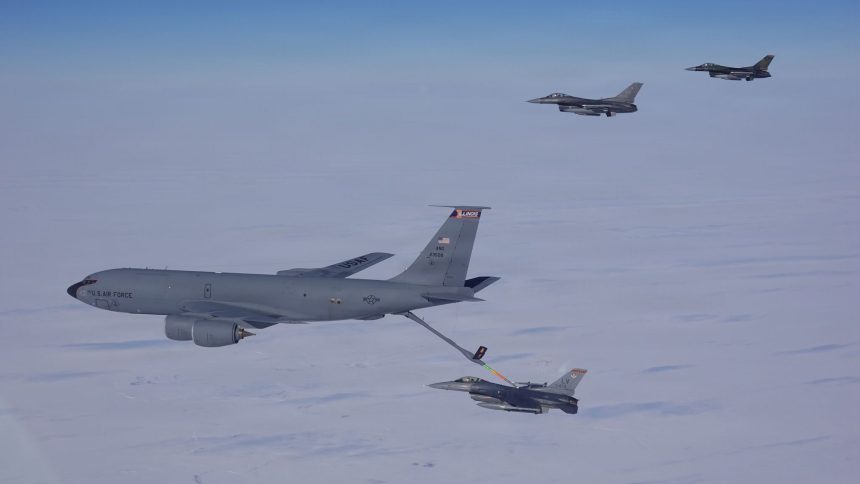
F-16s of the 18th Fighter Interceptor Squadron were deployed to the remote King Salmon airport to demonstrate NORAD’s readiness to respond to potential threats throughout Alaska.
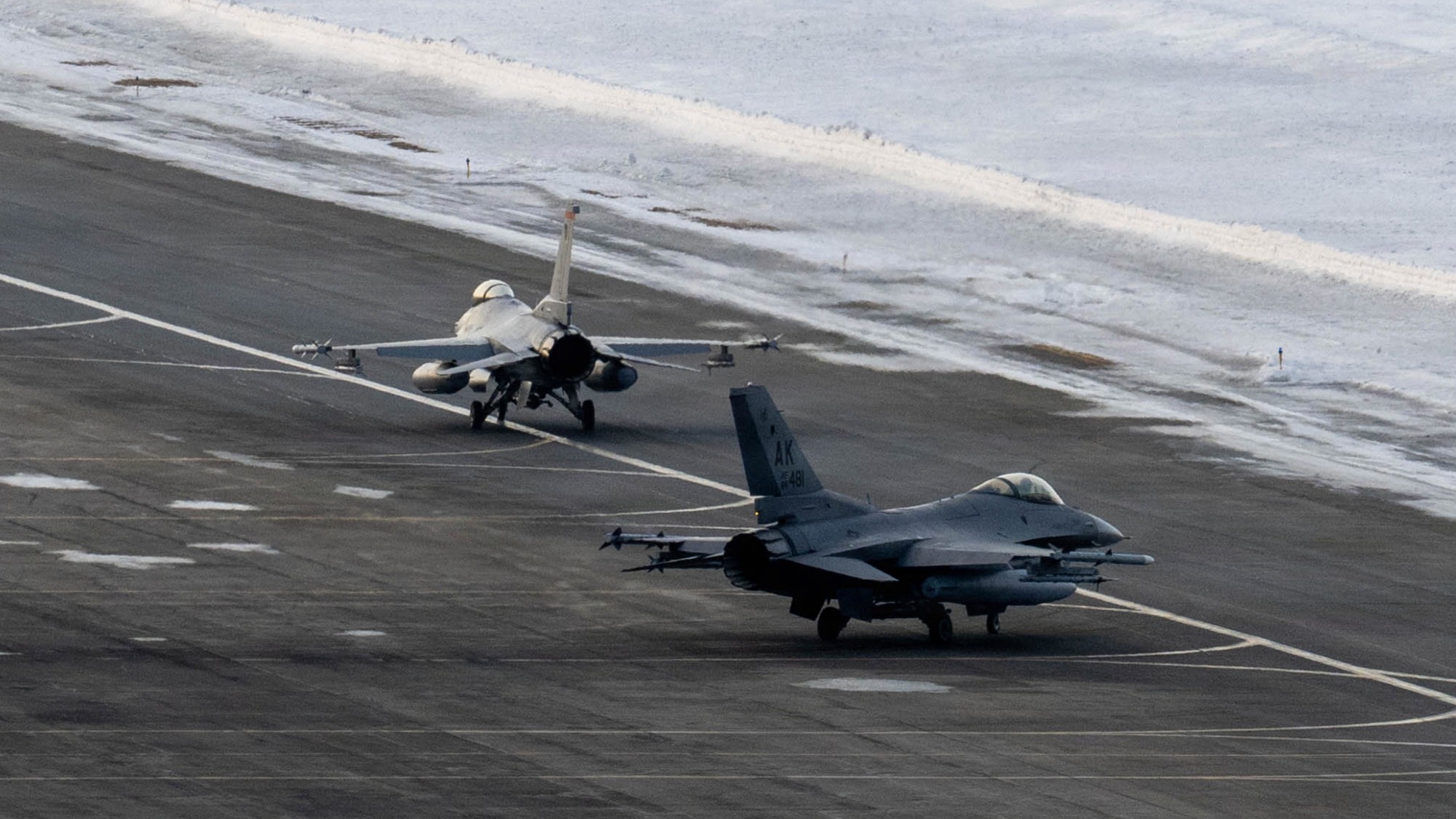
U.S. Air Force F-16 Fighting Falcons assigned to the 18th Fighter Interceptor Squadron (18th FIS) were deployed by the North American Aerospace Defense Command (NORAD) from Eielson AFB to King Salmon Airport, Alaska, announced the command on Apr. 7, 2026. According to the captions on the DVIDS network, the exercise took place on Apr. 2.
The operation saw the deployment of two F-16s to King Salmon Airport, from where the fighters were launched for a practice scramble. King Salmon airport, on the southwestern coast of Alaska off the Bering Sea, is over 750 km away from Eielson AFB in central Alaska.
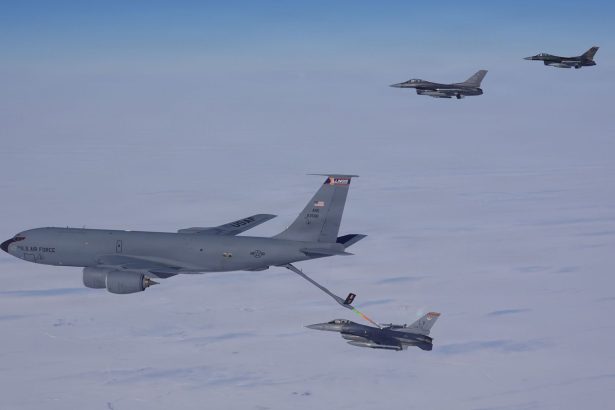
The F-16s practiced intercepting a friendly KC-135 Stratotanker along other fighter aircraft, including at least another F-16. The KC-135 then refueled the Vipers (as the F-16 is named by its crews) on the return journey to Eielson AFB.
The deployment demonstrated “how Alaskan NORAD Region maintains a variety of response options throughout the Alaskan Theater of Operations to detect, deter, and defeat potential threats to the U.S. and Canadian airspace 24/7/365,” explained the statement.
F-16 Fighting Falcons from the Alaskan NORAD Region recently operated from remote locations in Alaska, maintaining NORAD’s readiness to respond to potential threats to North America. https://t.co/Yu3Sgv7cGh
— North American Aerospace Defense Command (@NORADCommand) April 6, 2026
Aircraft
Four different F-16s can be seen in the photos of the operation, with two being the ones flying the practice scramble and the other two being intercepted together with the KC-135 Stratotanker. It is unclear if other assets were also involved.
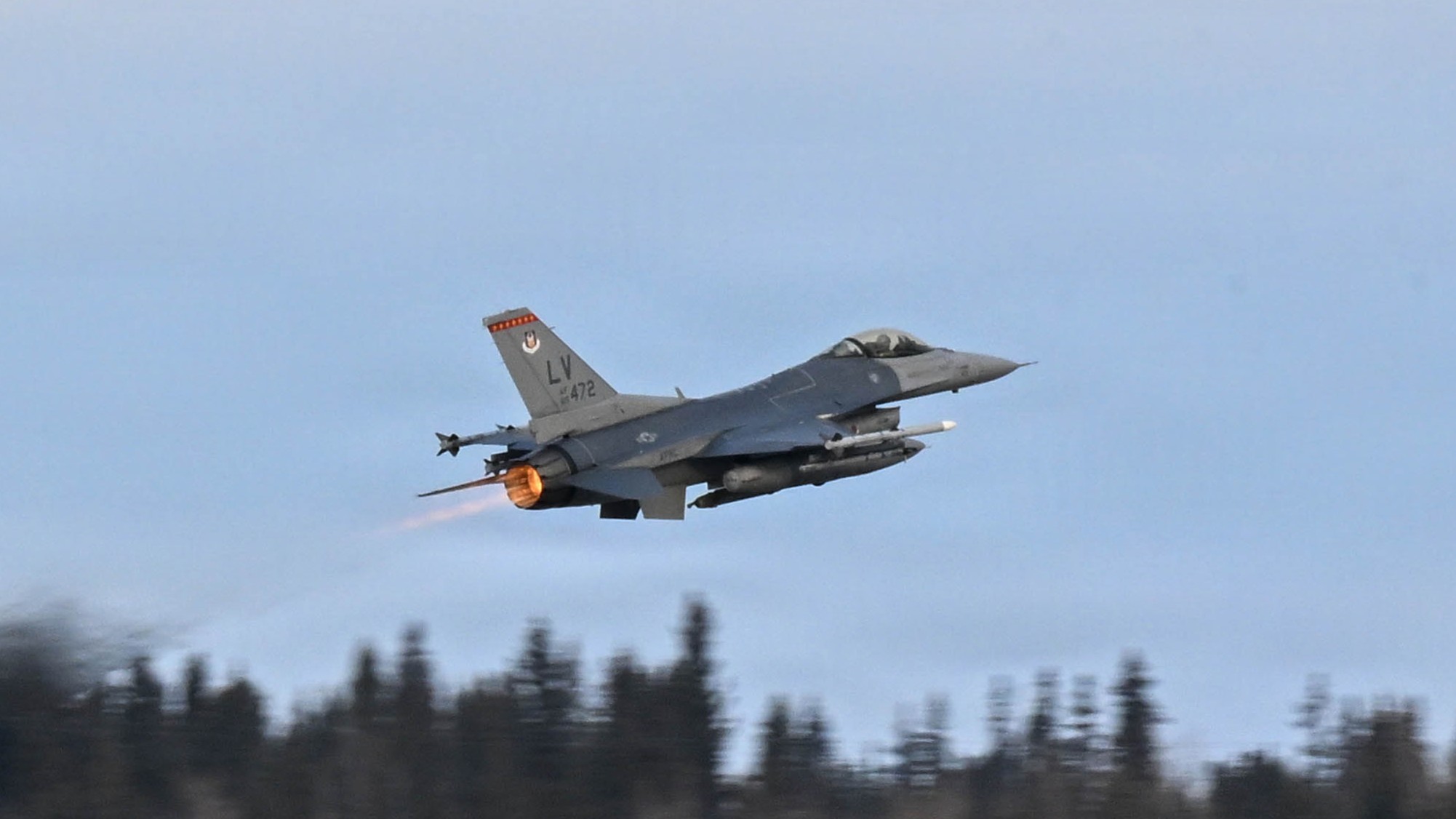
Notably, one of the aircraft is flying with the markings of the 706th Aggressor Squadron “Cajuns” of the Air Force Reserve Command (AFRC), based at Nellis AFB, Nevada. In fact, since its redesignation from 18th Aggressor Squadron to 18th Fighter Interceptor Squadron in 2024, the unit has been receiving upgraded Block 30 jets from multiple units.
Interestingly, in the air refueling photos, an aircraft which immediately reconnects the 18th FIS to its earlier Aggressor mission is the F-16C Block 30 with the green, tan and black “BDU Splinter” camo scheme unveiled in 2017. Some of these specially painted F-16s are still flying and sometimes used in quick reaction alert (QRA) missions, such as in May 2024 when they intercepted Russian aircraft, including a Tu-95, Su-35S and Su-30SM, off Alaska.
The KC-135 Stratotanker, going by the tail flash, is assigned to the Illinois Air National Guard’s (ANG) 126th Air Refueling Wing (126th ARW).
Payloads
Interestingly, all F-16s are carrying the Angry Kitten Electronic Warfare (EW) pod, a system that had been in use for a while. The pod also made its combat debut in the ongoing campaign against Iran.
It is not clear if this is the first time the Angry Kitten pods have been found on NORAD’s F-16s used in QRA missions. It must be noted that the Russian Ilyushin Il-20 COOT-A Signals Intelligence (SIGINT) aircraft, which is frequently seen over the Baltic Sea, also began emerging in NORAD’s airspace when it was intercepted four times between Aug. 20 and 26, 2025.
It is not known if the addition of the Angry Kitten’s EW capability on NORAD’s F-16s is related to the Russian Il-20. However, it also cannot be detached from a broader emphasis on electromagnetic spectrum warfare capability across frontline combat platforms.
The rest of the payload on the F-16s include both inert and live weapons. Specifically, the two F-16s which were deployed to King Salmon airport were loaded with inert (blue bands) CATM-120Cs and CATM-9Xs as well as an ACMI pod, with the other two F-16s seen in formation with the KC-135 carried live (yellow bands) AIM-120Cs and AIM-9Ms.
Mar. 4 Russian Tu-142 intercept
On Mar. 12, the Alaskan NORAD Region and Alaskan Command also released images of one of the two Russian Tupolev Tu-142 anti-submarine and maritime surveillance aircraft that U.S. and Canadian fighter aircraft had intercepted on Mar. 4. The images showed two Royal Canadian Air Force (RCAF) CF-18s (Canadian designation for the F/A-18C/D Hornets) and one F-35A Lightning II, in addition to another fighter – likely a second F-35 – which captured the images.
On Mar. 4, 2026, @NORADCommand U.S. and Canadian aircraft positively identified, tracked, and intercepted Russian military aircraft through the Alaskan ADIZ in international airspace north of Alaska.#WeHaveTheWatch pic.twitter.com/AyO5l3p2ZT
— Alaskan NORAD Region and Alaskan Command (@ANRALCOM) March 11, 2026
The official release at the time had reported 12 U.S. and Canadian jets involved in the intercept, including two F-35As, two F-22 Raptors, two CF-18s, four KC-135 Stratotankers, one E-3 Sentry Airborne Warning and Control System (AWACS).
No need for F-35s in NORAD region
The dynamics of the security situation in the NORAD region around Canada, Alaska and Arctics has also generated a curious opinion of the Northern Command (NORTHCOM) and NORAD commander, Gen. Gregory M. Guillot. Appearing before the Senate Armed Services Committee (SASC) on Mar. 19, Guillot said this theater does not need a higher-end jet like the F-35, which can be diverted to other flashpoints with more pressing needs.
Two nations. One command. One mission. 🇨🇦🇺🇸
Today during Senate Armed Services Committee Testimony, #NORAD Commander General Gregory Guillot highlighted the enduring binational mission across diverse climates, from the Arctic to the southern United States, in defense of North… pic.twitter.com/7tYDWHLTsH
— North American Aerospace Defense Command (@NORADCommand) March 19, 2026
Guillot was responding to a question by Senator Tom Cotton, who asked: “Today’s fighter fleet is some of the smallest and oldest it’s ever been. The Air Force also struggles with low readiness rates for its fighters. Do you think NORTHCOM and NORAD would benefit from an expanded fighter force?”
To this, Guillot responded:
“Yes. I would like to see continued modernization of 4th Gen fighters. Frankly, we don’t need 5th Gen to defend our borders. Those capabilities are better used overseas where […] stealth and air-to-ground weapons, penetration capabilities are needed. So revamped and modernized 4th Gen to include F-15EX in select locations would meet all of our requirements.”