Artemis II is NASA’s first mission with crew aboard the Space Launch System (SLS) rocket and Orion spacecraft, and the first beyond low Earth orbit since Apollo 17 in 1972.
After a first launch attempt was scrubbed in February 2026, the Artemis II mission launched from Kennedy Space Center’s Launch Complex 39B on Apr. 1, 2026. NASA astronauts Reid Wiseman, Victor Glover, and Christina Koch, and Canadian Space Agency astronaut Jeremy Hansen, are now flying the first crewed Lunar flyby in 50 years.
The #Artemis II crew departed the Operations and Checkout building to head to Launch Complex 39B to board their Orion spacecraft atop NASA’s Space Launch System (SLS) rocket @NASAKennedy in preparation for their launch to the Moon later today!
📷: https://t.co/0AEy2WWeQo pic.twitter.com/S4T4cLTaoZ
— NASA HQ PHOTO (@nasahqphoto) April 1, 2026
The mission is still considered a test flight, as it is the first time the new Space Launch System (SLS) rocket and Orion spacecraft are flying with a crew aboard, after the uncrewed November 2022 Artemis I mission. Moreover, the mission is also the first time humans have been beyond low Earth orbit (LEO), with the last time being Apollo 17 in 1972.
We’re going around the Moon. Come watch with us. Artemis II’s four-astronaut crew is lifting off from @NASAKennedy on an approximately 10-day mission that will bring us closer to living on the Moon and Mars. The launch window opens at 6:24pm ET (2224 UTC). https://t.co/X27QJejNDt
— NASA (@NASA) April 1, 2026
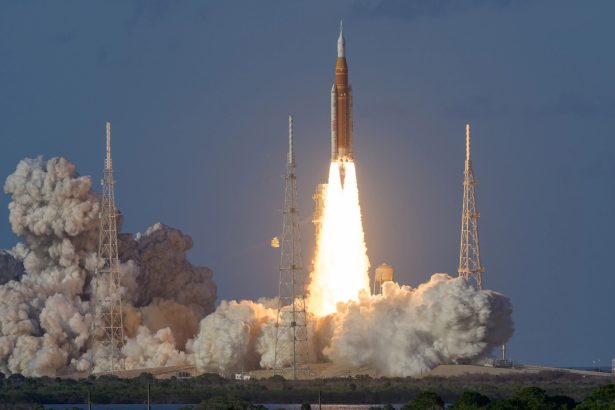
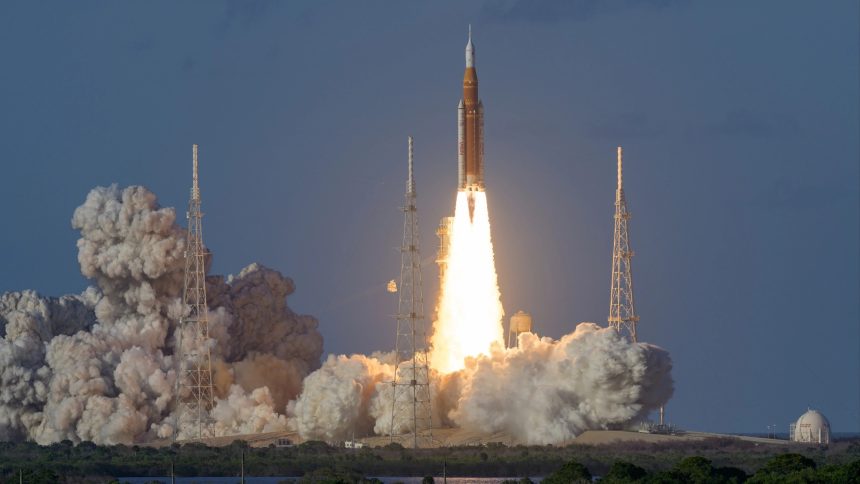
Artemis II lifted off at 6:35pm ET (2235 UTC), after a brief pause at T-10 minutes for further checks on telemetry systems. The launch window was open from 6:24pm ET (22:24 UTC) to 8:24pm ET (0:24 UTC).
Liftoff.
The Artemis II mission launched from @NASAKennedy at 6:35pm ET (2235 UTC), propelling four astronauts on a journey around the Moon.
Artemis II will pave the way for future Moon landings, as well as the next giant leap — astronauts on Mars. pic.twitter.com/ENQA4RTqAc
— NASA (@NASA) April 1, 2026
“This flight is another step toward crewed missions to the lunar surface and helping the agency prepare for future astronaut missions to Mars,” previously said NASA describing Artemis II.
Check out images the #Artemis II crew with SLS and Orion at Launch Complex 39B as well as other images as final preparations for launch continue at @NASAKennedy 📷: https://t.co/0AEy2WWeQo pic.twitter.com/bw93jSJ6gu
— NASA HQ PHOTO (@nasahqphoto) March 31, 2026
The Mission
The approximately 10-day Artemis II mission, initially designated Exploration Mission-2 (EM-2), will send the four astronauts around the Moon and back aboard the Orion spacecraft, which has been named Integrity. The mission will feature multiple milestones.
The first will see the crew performing initial checkouts of Orion’s systems and manually testing the spacecraft’s handling near Earth, including manual attitude control and proximity operations to simulate a rendezvous. This will be done over the first two days of the mission, before heading toward the Moon.
The European Service Module (ESM) will provide the push needed for the translunar injection (TLI) burn, as the maneuver is technically called, allowing Integrity to depart Earth orbit. The maneuver will see the astronauts going on a four-day outbound journey.
The 7 m-long solar arrays provide enough electricity to power two households. 🏠
Built in the Netherlands by @AirbusSpace, they will keep computers and experiments running. pic.twitter.com/IqGihEU05Z
— Human Spaceflight (@esaspaceflight) April 1, 2026
The new orbit, which will take them around the far side of the Moon, will feature in a free-return, figure-eight trajectory which will get Orion over 230,000 miles from Earth. At maximum distance, Artemis II will fly approximately 4,600 miles beyond the Moon.
Our Artemis II crew will be going around the Moon, but they’ll always find their way back home 🌎
During this complex journey, the four astronauts will travel ~685,000 miles on a trajectory around the Moon and back to Earth.
See their daily agenda: https://t.co/172PVtri2Z pic.twitter.com/zsK5i6pirj
— NASA Artemis (@NASAArtemis) March 25, 2026
After the flyby, Orion will continue flying the free-return trajectory set with the TLI for a high-speed reentry at approximately 25,000 mph (11 km/s) through Earth’s atmosphere. While the speed will be comparable to Apollo lunar-return velocities, Orion will use a skip reentry profile which improves the precision landing capabilities and reduces the thermal load on the heat shield and the g-load on the crew.
The spacecraft is scheduled to splash down in the Pacific Ocean off the coast of San Diego, where a NASA and Department of Defense recovery team will be ready. The USS Somerset (LPD 25), a San Antonio-class amphibious transport dock, will be part of the effort.
Throughout the mission, the crew will continue evaluating spacecraft systems. Additionally, several payloads will fly aboard Artemis II to study space radiation, human health and behavior, and space communications.