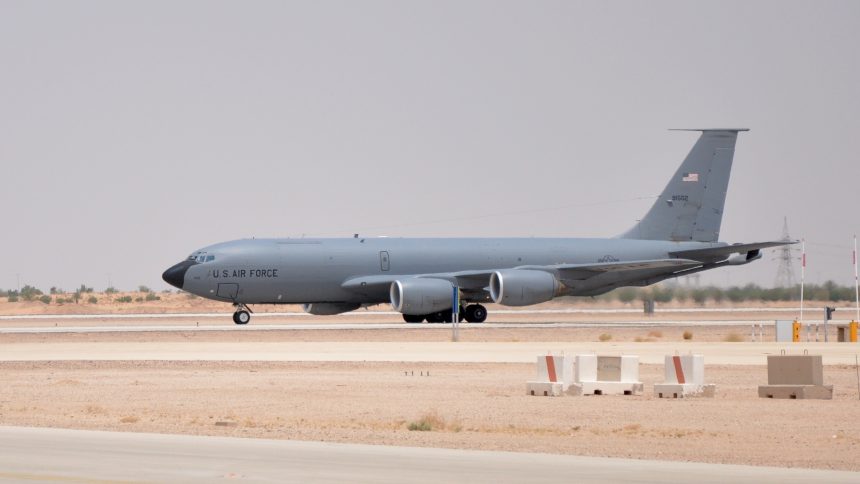
Satellite images show signs of an attack at Prince Sultan Air Base, Saudi Arabia, with The Wall Street Journal now reporting that an Iranian missile damaged “several U.S. refueling aircraft.”
Satellite images emerged on Mar. 27, 2026, appeared to show signs of damage on an apron used by U.S. aircraft at Prince Sultan Air Base, in Saudi Arabia. The images were initially thought to be linked to an attack which damaged KC-135 Stratotankers aerial refueling aircraft two weeks earlier.
However, the European satellite Sentinel-2, using Short-Wave Infra-Red (SWIR) imagery, showed a heat signature at the same location on Mar. 27. The heat signature might have been possibly caused by flames and the hot gases in the smoke towering from the area.
Satellite imagery appears to confirm a U.S. Air Force KC-135 Stratotanker has been destroyed and several others possibly damaged, as a result of an Iranian attack earlier today, utilizing ballistic missiles and drones, against Prince Sultan Air Base in Saudi Arabia.
Image… pic.twitter.com/o7x32UjUOb
— OSINTdefender (@sentdefender) March 27, 2026
SWIR data from a Sentinel-2 pass earlier today confirms at least one large, open fire burning on the apron. pic.twitter.com/kC1DokTHCf
— OSINTtechnical (@Osinttechnical) March 27, 2026
Now, The Wall Street Journal, quoting U.S. and Saudi officials familiar with the matter, reports that Prince Sultan Air Base was hit by an Iranian missile, “damaging several U.S. refueling aircraft.” The unnamed officials also noted the use of drones in the strike.
An Iranian missile and drone attack on Prince Sultan Airbase today damaged multiple aerial refueling tankers -U.S. and Saudi officials to the WSJ https://t.co/Mcdk0rZYxF pic.twitter.com/EZTLokB0UT
— OSINTtechnical (@Osinttechnical) March 27, 2026
The damage is currently unclear. Although previous satellite photos showed multiple tankers stacked closely in the open on the same apron, the images available are in low-resolution and do not allow to visually confirm the presence and amount of damage to airframes.
According to an article published by Air&Space Forces, an E-3 Sentry AWACS plane was also damaged.
In fact, photos later posted by Air Force amn/nco/snco show the extent of the damage to US Air Force E-3G Sentry 81-0005 following the drone and missile attack at Prince Sultan Air Base, Saudi Arabia. The attack also damaged several KC-135s. As for the E-3, the term “damaged” was clearly an understatement, as the valuable aircraft is basically destroyed.
Second angle. pic.twitter.com/NUupdRkdm9
— OSINTtechnical (@Osinttechnical) March 29, 2026
The U.S. Central Command has not yet commented on the matter. U.S. media outlets are reporting 10-12 U.S. service members were injured in the attack.
According to the Wall Street Journal, citing U.S. and Saudi officials with knowledge on the matter, several U.S. servicemembers were injured in an Iranian ballistic missile strike on Prince Sultan Air Base in Saudi Arabia earlier today. The Pentagon has yet to respond with a… pic.twitter.com/Lph9x5KdTZ
— OSINTdefender (@sentdefender) March 27, 2026
Previous attack
Earlier in the month, The Wall Street Journal, quoting U.S. officials, reported that five U.S. Air Force refueling planes on the ground at Prince Sultan Air Base were damaged in an Iranian missile strike. The publication mentioned at the time that the aircraft were already being repaired and none was destroyed.
U.S. President Donald Trump disputed the reports, saying that “four of the five had virtually no damage,” while “one had slightly more damage.” At the time, a statement from CENTCOM was not available.
The type of aerial refuelers damaged in the Iranian attack was disclosed. However, satellite imagery showed only KC-135s deployed at the base, although we can’t rule out some KC-46s were also there due to the delay between the acquisition and the publication of the images.
An Iranian ballistic missile scored a direct hit on Prince Sultan Air Base (PSAB) in Saudi Arabia 🇸🇦🇺🇸.
PSAB is a key U.S. Air Force hub, hosting E-3 Sentry AWACS, E-11A BACNs, tankers, and fighter aircraft. pic.twitter.com/cRzGP4rXXn
— Egypt’s Intel Observer (@EGYOSINT) March 6, 2026
Prince Sultan Air Base
Prince Sultan Air Base is a strategic forward operating base that is located in the Saudi interior some 600 km from the Iranian coast. Because of its strategic position, the base regularly hosts U.S. assets, such as tankers, AWACS (Airborne Warning and Control System) and SIGINT (Signal Intelligence) aircraft.
Due to the U.S. presence, the base has been targeted by Iranian air strikes multiple times recently. The attacks also caused the death of U.S. service members deployed there.
Attacks on parked aircraft
The series of attacks on Saudi Arabia and the Gulf States has already damaged or destroyed several U.S. and allied aircraft. The question is whether the Pentagon underestimated the lessons of Ukrainian war and, in particular, the operation that last year destroyed a significant portion of Russia’s strategic aviation. Certainly, the war in Ukraine and the emerging threat posed by various kinds of drones, including FPV (First Person View) ones, have made dispersal and the sheltered recovery of the most critical assets a renewed priority for all air arms, marking a return to the Cold War doctrine that called for the use of HAS (Hardened Aircraft Shelters) for tactical jets dispersed across airbases. Obviously, such shelters are not suitable for large aircraft like tankers, transport aircraft, or strategic bombers, which for this reason need to be based beyond the reach of Iranian missiles or drones. In this case, U.S. planners must have assumed they could still keep aircraft parked in the open, even though the previous attacks should have served as a significant warning.
This is a developing story, we will update it as soon as new details emerge.