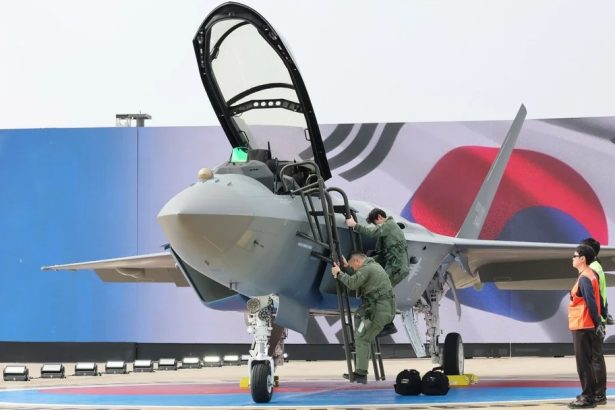
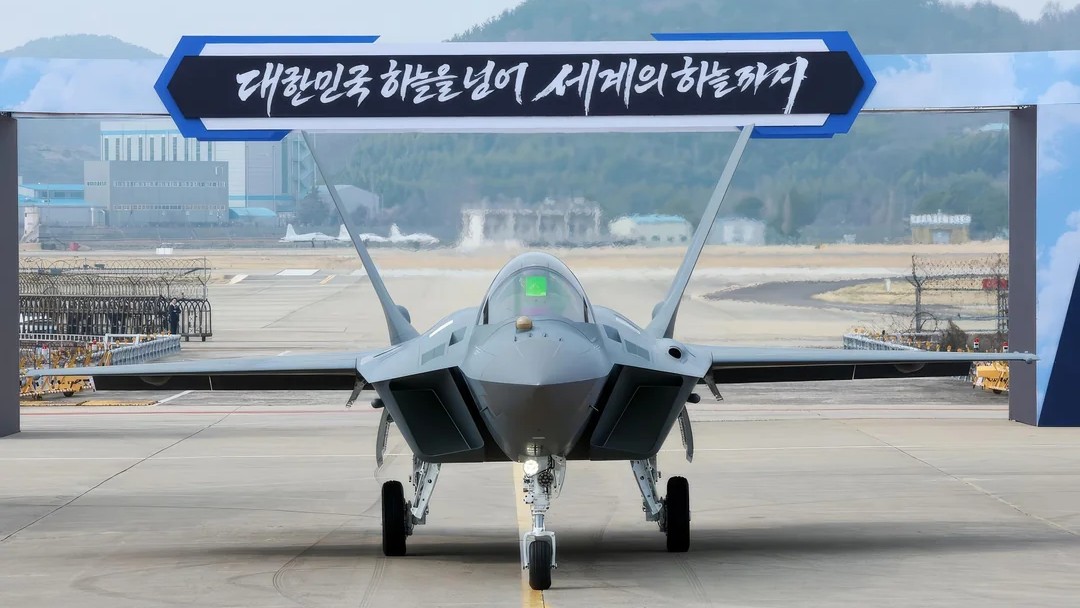
The first serial production KF-21 Boramae fighter jet has rolled out of the Korea Aerospace Industries (KAI) factory in a major milestone for the program.
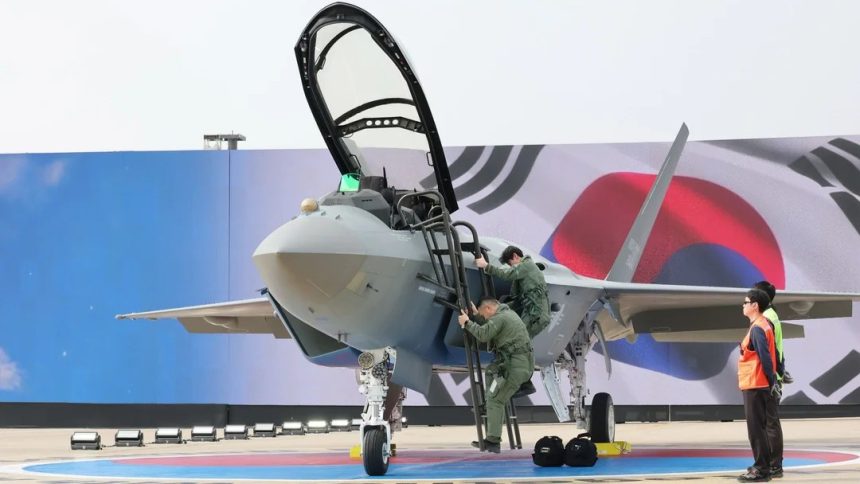
The first of 40 serial production KF-21 Boramae fighter jets has rolled out of the Korea Aerospace Industries (KAI) factory, marking a major milestone for the South Korean aerospace industry as well as South Korea’s military independence. Unveiled on March 25th, 2026, the first production KF-21 Boramae left its factory in Sancheon and arrived at the ceremony stage under its own power, just a short distance away from the assembly hall.
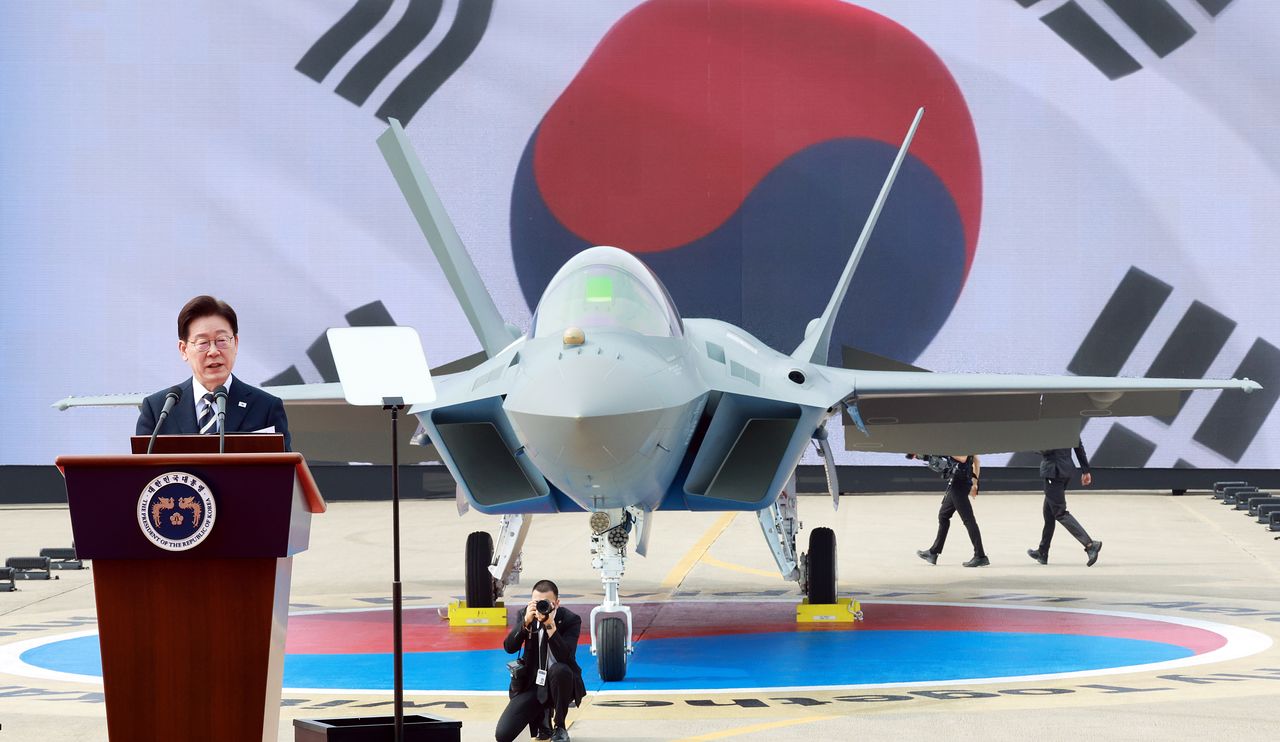
Two aircrew were then seen exiting the aircraft before the crowd was addressed by President Lee Jae Myung, who discussed the aircraft and its importance to Korean national pride and defence sovereignty.
President Lee stated:
“Finally, South Korea has become a nation that possesses weapons to safeguard peace through its own technology and willpower—not only on land and sea but also in the skies – thereby demonstrating the might of self-reliant national defense.
The fighter jet standing proudly before you embodies the fervent aspiration for self-reliant national defense that our people have dreamed of for over half a century… As president, I sincerely celebrate this historic moment with 52 million citizens, filled with boundless pride.”
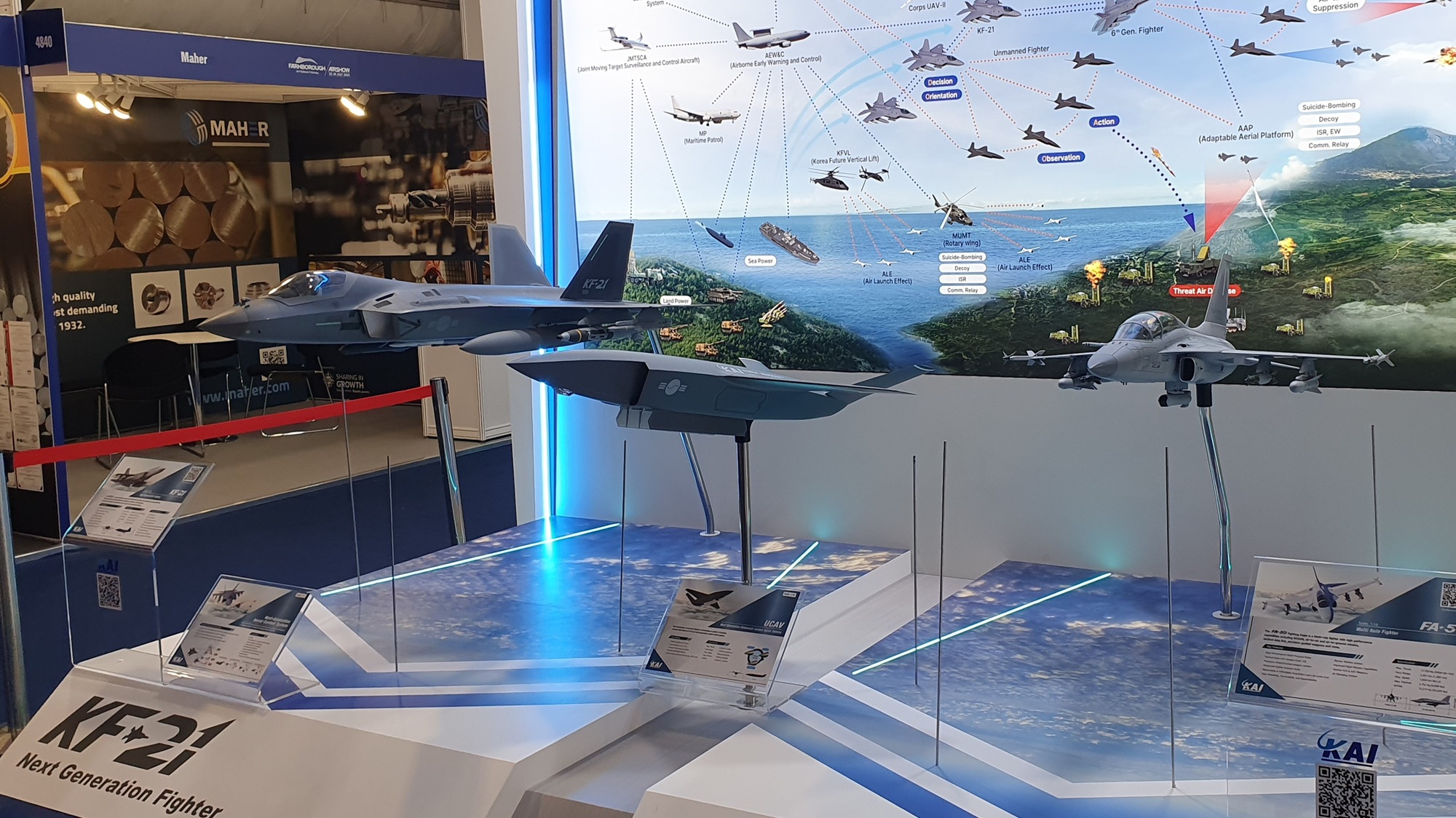
The President also pointed to the potential for the KF-21 to expand South Korea’s growing position as a defence exporter, with his desire that the aircraft’s success could push South Korea into becoming one of the world’s “top four defense powers.” KAI has already achieved export success with the FA-50 light fighter and T-50 advanced jet trainer being delivered across six nations.
President Lee Jae-myung attended the roll-out ceremony for the first mass-produced Korean fighter jet, KF-21, on 25th, for the ROKAF 🇰🇷. Defense officials said on 25th, that the Philippines 🇵🇭 is among the countries that will buy the KF-21s. Expected to be signed before mid-year. pic.twitter.com/TxTeCtw7Om
— Para Bellum (@ReHorizon3) March 25, 2026
The KF-21 will help to secure more of the aerospace market, with Indonesia likely to order 16 airframes following on from their role as a junior partner in the development of the aircraft. Other nations, such as the Philippines, are also expected to make orders for the KF-21, expanding South Korea’s international influence ever further.
On this point, President Lee commented directly on the success of the K9 Howitzer and the Cheongung surface-to-air missile (SAM) in the export market. The latter has recently seen its combat debut in Emirati service, shooting down Iranian drones attacking the UAE.
All 40 Block I aircraft are set to be delivered by 2028, with a further 80 Block II aircraft, integrating air-to-ground capabilities, to be delivered to the ROKAF by 2032. It is not currently known how foreign orders would fit into the production schedule for KAI aircraft.
Eight KF-21s are already set to be delivered this year. This is alongside 19 FA-50s also due for completion that will be delivered to the ROKAF and various other partners.
Both aircraft types are produced in the Fixed-Wing Building owned by KAI which spans 21,000 m^2, the equivalent to three football fields in length. The production facility is co-located with Sacheon airport, which serves commercial domestic flights as well as the Sacheon Air Base used for advanced flying training by the ROKAF, flying the T-50 trainer.
KAI plans to massively expand its current production rate alongside requests for international orders. The company hopes to deliver 31 aircraft in 2027 and 47 aircraft overall in 2028.
The KF-21 Boramae completed 42 months of flight testing without incident since its first flight in July 2022, with around 1,600 sorties logged by the six test aircraft. By all means, the aircraft is ahead of schedule in its production, likely due to the high number of foreign components in the airframe, allowing for rapid research and development and lower overall costs.
The KF-21 Boramae (Fighting Hawk)
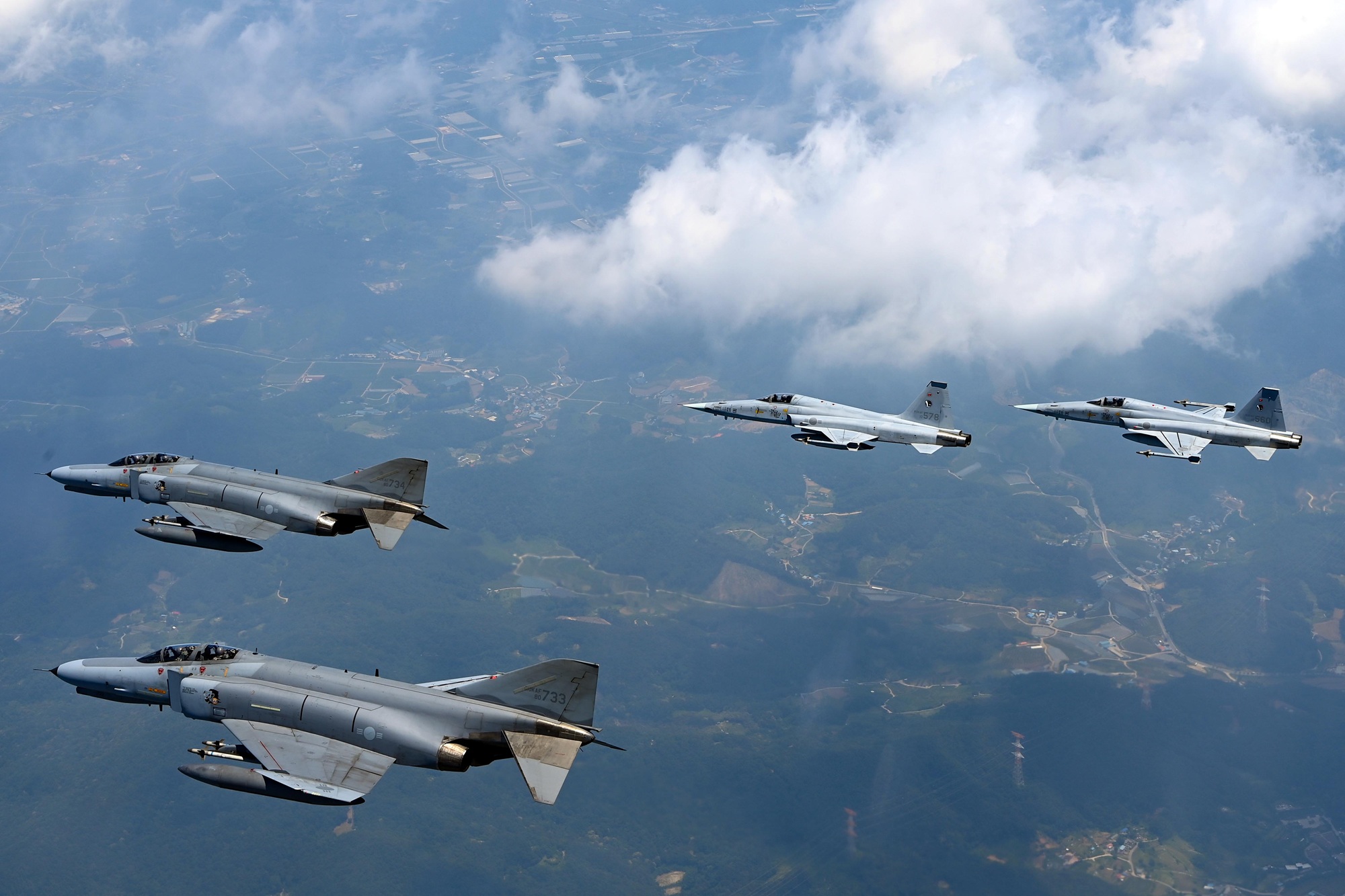
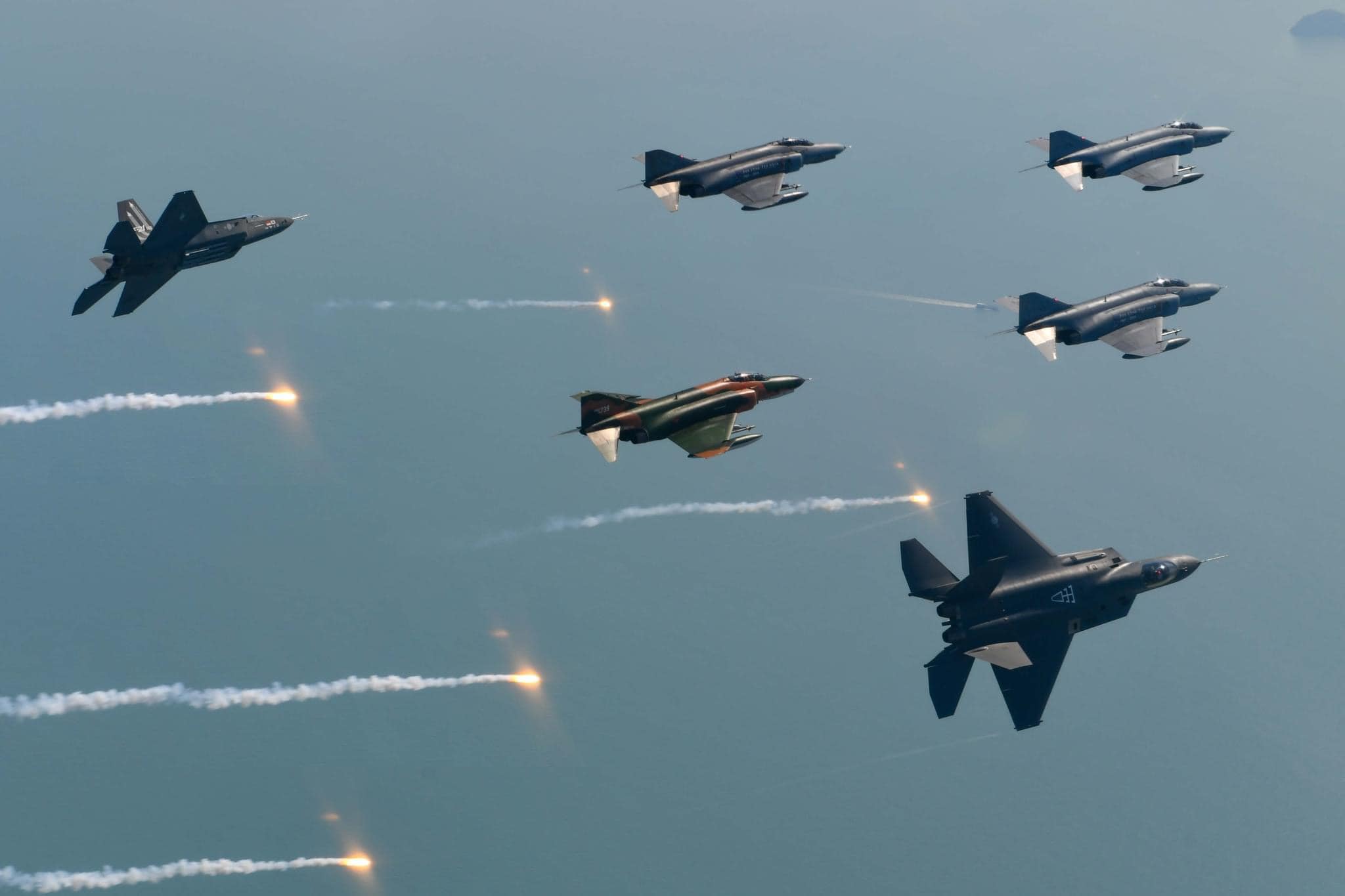
First proposed in 2001 by then President Kim Dae-jung, the KF-21 intends to replace both the F-4 Phantom II and the KF-5E Tiger II in ROKAF service, allowing for the modernisation of the force. The KF-21 incorporates some features of fifth generation aircraft, including their stealthy design, making them a significant upgrade over the aircraft they intend to replace.
The stealth design, whilst lacking many of the features seen on the F-35, will make the KF-21 low observable. In turn, this will allow the aircraft to be more survivable than the fourth generation aircraft which make up the bulk of the ROKAF’s fighter force.
Subsequently, the KF-21 is classified as a generation 4.5+ aircraft due to its lack of Radar Absorbent Material (RAM) coating, internal weapons bay (in favour of recessed missile attachment points) and supercruise capability (achieving supersonic speeds without using afterburners), as well as its lack of many of the sensors seen on the F-35 Lightning II and F-22 Raptor. However, the design of the aircraft allows for it to be spiral upgraded over time, with Blocks 2 and 3 models enabling closer comparisons with the fifth generation fighters.
Its current form, Block I primarily enables air-to-air missions, with the inclusion of the four recessed missile attachment points on the aircraft’s central fuselage allowing for the deployment of four MBDA Meteor missiles, which will be the Boramae’s primary weapon. It will also carry the IRIS-T infrared homing missile for within visual range encounters, as well as the Joint Direct Attack Munition (JDAM) for limited air-to-ground operations.
The Boramae does intend to also utilise the AIM-120 AMRAAM and AIM-9X Sidewinder, as well as various indigenous missile systems, however only the Meteor and the IRIS-T have been fully integrated so far. The large pool of missile types gives the aircraft more resilience in the face of a possible hot conflict, with the broad stockpile allowing for multiple re-armament options.
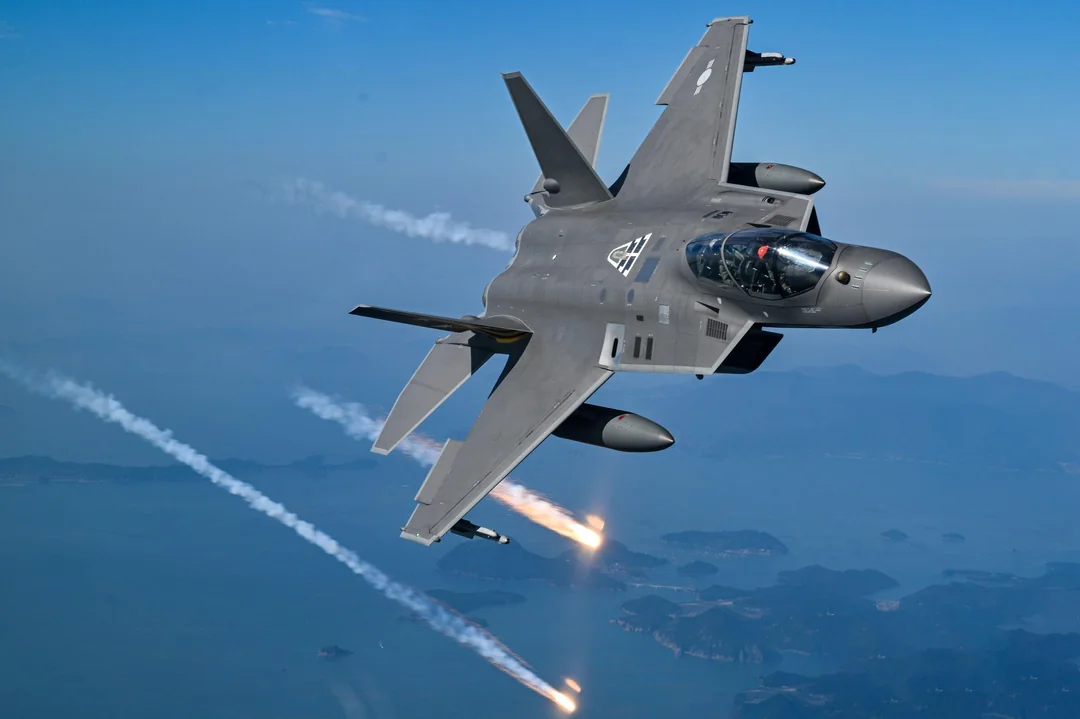
There is space for a chin mounted hardpoint below the right engine’s air intake for an indigenous targeting pod (EO TGP), and a total of six wing hardpoints carrying the munitions previously mentioned. The KF-21 with the Meteor will be an extremely effective air dominance platform, being more stealthy than its compatriot fighters – the F-15 Slam Eagle and KF-16 – with a missile that can outrange anything the Korean People’s Army Air Force (KPAAF) could throw at it.
The aircraft will also carry the APY-016K Active Electronically Scanned Array (AESA) radar that was domestically produced alongside the EO TGP by Hanwha Systems.
KF-21 005
ソサンで飛実中の機体です。😎 pic.twitter.com/IkYDlz5noC
— Hornet (@hornetysfs) September 21, 2025
Block II will see expanded air-to-ground capabilities allowing for the operation of more advanced ground attack munitions. These include the 500 lb GBU-12 Laser-Guided Bomb (LGB), 2,000 lb GBU-56 Laser Joint Direct Attack Munition (LJDAM) and Korean Air-Launched Cruise Missile (KALCM).
The KF-21 has a maximum payload capacity of approximately 17,000 lb (7,700 kg), allowing for a broad range of weapons and stores beyond those addressed here. Block II upgrades will be applied to Block I aircraft through software updates, allowing for a single fleet of aircraft with the same capabilities across the board.
The Defense Acquisition Program Administration (DAPA), which controls the budget for acquisitions within the Korean Ministry of Defence (MoD), has moved the air-to-ground weapons tests to the first half of 2027, from the old target of 2028, showing how fast the program is advancing in such a short space of time.
The final Block III model aircraft will contain more advanced fifth generation features such as the currently absent RAM coating, weapons bay, sensor fusion and the ability to supercruise. To do this, South Korea is developing an indigenous engine that should put out 16,000 lb of dry thrust and 24,000 pounds of thrust with afterburners.
The new engines will be replacing the current dual General Electric F414s also used on the SAAB JAS-39C Gripen and the Boeing F/A-18E/F Super Hornet. The aircraft will also be able to control Collaborative Combat Aircraft (CCA), with the backseater position controlling these midflight.
🇰🇷 South Korea commits $3.4 BILLION to develop an indigenous 106.75 kN fighter engine for the KF‑21 Block 3.
Targeted for 2040, this engine will end reliance on foreign powerplants and supercharge Korea’s aerospace independence.
KF‑21 Block 3 is shaping up as a regional… pic.twitter.com/b4UOAuXTL4
— Defence Index (@Defence_Index) December 28, 2025
The ROKAF will operate 120 KF-21s by 2032, complementing the current fleet of in service KF-16 Fighting Falcons, F-15K Slam Eagles and F-35A Lightning IIs. The KF-16 and F-15K will receive upgrades to modernise these platforms alongside to the same standard as their American counterparts, making the ROKAF one of the most powerful air combat fleets in Asia.