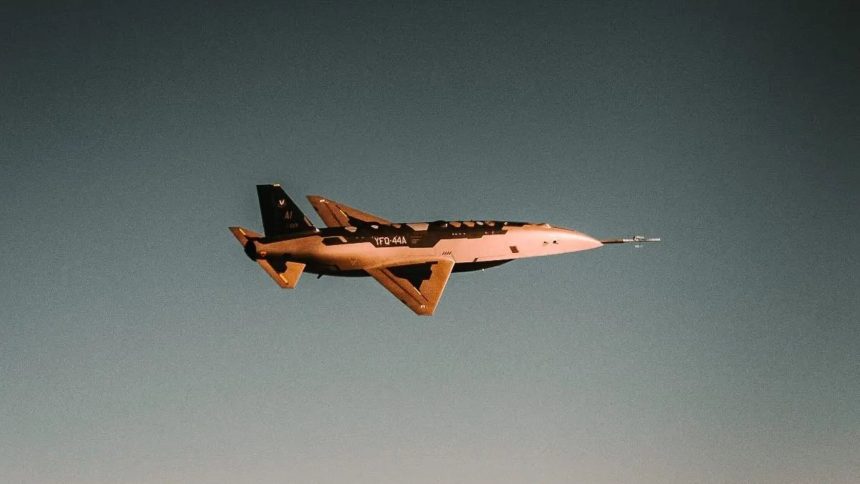
Anduril announced the start of the YFQ-44A’s production at its Arsenal-1 factory, with new manufacturing processes allowing to supply a large number of drones to the U.S. Air Force.
Anduril’s YFQ-44A Fury Collaborative Combat Aircraft (CCA) has entered serial production at the firm’s much touted Arsenal-1 factory in Ohio, the company and its founder Palmer Luckey announced on Mar. 24, 2026 on their social media platforms. The single line update did not provide details other than an image of the loyal wingman drone in flight.
The announcement follows recent reports about the imminent start of the production, which quoted company officials, three months ahead of schedule. The development further highlights the U.S. Air Force’s steady execution of the CCA program, as it aims to supplement a historically low aircraft fleet, with the lowest numbers since the Cold War, with a fresh procurement doctrine that consciously avoids the mistakes of previous defense programs – checking the outsized technological and logistical influence of primary contractors.
View this post on Instagram
Most importantly, the milestone also heralds a new era in corporate America. Luckey, unlike other senior defense executives, has been vocal about defense CEOs hollowing out American manufacturing, not investing in factories at home, and creating the acute supply chain problems afflicting U.S. defense projects.
He himself has vowed not to repeat those mistakes, repeatedly highlighting how Anduril has delivered on its contracts on time, and within budget.
We have started production of YFQ-44A Collaborative Combat Aircraft at Arsenal-1.
— Anduril Industries (@anduriltech) March 23, 2026
Fury’s progress so far
Since the Fury’s first flight on Oct. 31, 2025, the program has already recorded key milestones. The first was flying with an AIM-120 Advanced Medium Range Air-to-Air Missile (AMRAAM), followed by the drone being controlled by Shield AI’s Hivemind and Anduril’s own Lattice autonomous flight programs.
While GA-ASI’s YFQ-42A Dark Merlin has three confirmed prototype airframes, there are currently only two known Fury units – tail numbers ‘25-1001’ and ‘25-1003’. It is unclear if other airframes have already been produced but not photographed.
Following the test with Hivemind, Anduril’s senior vice-president of engineering Jason Levin said that the flight with the two AI agents was made possible by the “early implementation” of the Autonomous-Government Reference Architecture (A-GRA) on both the YFQ-44A and the mission autonomy software stack. The emphasis on and rapid development of the A-GRA, Modular Open Systems Architecture (MOSA) and the participation of third party AI-enabled flight autonomous software on the Hivemind and Collins Aerospace Sidekick reflects the U.S. government’s desire to avoid “vendor locks” on the product’s technological evolution.
Hivemind just flew @anduriltech‘s YFQ-44A.
Hivemind completed its first flight test aboard Anduril’s YFQ-44A aircraft for the @usairforce’s Collaborative Combat Aircraft (CCA) program. During the flight test over the Mojave Desert, Hivemind passed all required test points,… pic.twitter.com/q3GTCesciH
— Shield AI (@shieldaitech) February 26, 2026
Features on production variant and future Increments
A rollout of the production example will reveal what lessons Anduril and the Air Force have learnt from the test flights so far. The aircraft is not equipped with an internal weapons bay, as demonstrated by the flight with the AMRAAM, and thus these first tests would allow to understand how to improve the performance with external loads.
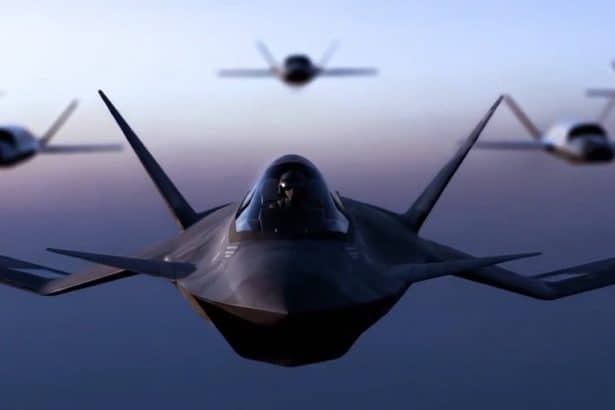
External stores are not uncommon in the first generation of CCAs, as seen also on the Turkish Kizilelma and Australia’s MQ-28A Ghost Bat Block II. The third U.S. CCA, the YFQ-48A Talon Blue, and Lockheed Martin’s pure stealth UCAV Vectis, both meant for Increment 2, will build on the lessons from Increment 1, and are expected to have internal weapons bays.
We are moving with urgency & purpose to deliver game-changing capabilities to our warfighters. CCA inert captive carry testing is a deliberate step in our plan to build a more lethal & integrated @usairforce.https://t.co/S1zR1jMO1f pic.twitter.com/2OQDKd9A2n
— General Ken Wilsbach (@OfficialCSAF) February 24, 2026
The closest hint of what Air Force planners expect in the future Increment 2 of CCAs was seen in Lockheed Martin testing an AI-agent’s ability to carry out missile evasion while piloting the X-62 VISTA.
As we wrote at the time, “higher order tasks like evading missiles autonomously are also part of the subsequent evolution the next generation of CCAs would be expected to have. The current ones would freeze the elementary hardware, design, networking technology and most importantly logistics, tactics, concepts and command tasking procedures.”
Fight Unfair. https://t.co/y4ZGSjVxaG pic.twitter.com/Jnzk6i3W1m
— Anduril Industries (@anduriltech) February 23, 2026
Semi-autonomous maneuvering is a staple capability seen across U.S. and foreign drones, which also reflects the expectations from the current crop of collaborative UCAVs. All these aircraft are capable of autonomous taxing, take-off, patrolling along set waypoints, returning to base and landing.
Stealth and internal weapons bays therefore appear to be not a priority right now. In fact, the main priority is to unburden manned fighters of routine tasks and put mass in a fight.
View this post on Instagram
Planners are now working to fix the tactics, operating concepts, and logistical procedures for using CCAs, rather than have the exquisite capabilities from the get go. Lockheed’s Vectis and Shield AI’s X-Bat buck this trend, and appear to inject themselves for the more sophisticated and exotic roles that would be expected in the future Increments.
Government, Air Force and Anduril’s emphasis on scalability
Anduril has often highlighted how the YFQ-44A went from a clean sheet design to its first flight in 556 days. The Air Force has previously lamented how the development of new aircraft has been taking increasingly longer timelines compared to the past.
View this post on Instagram
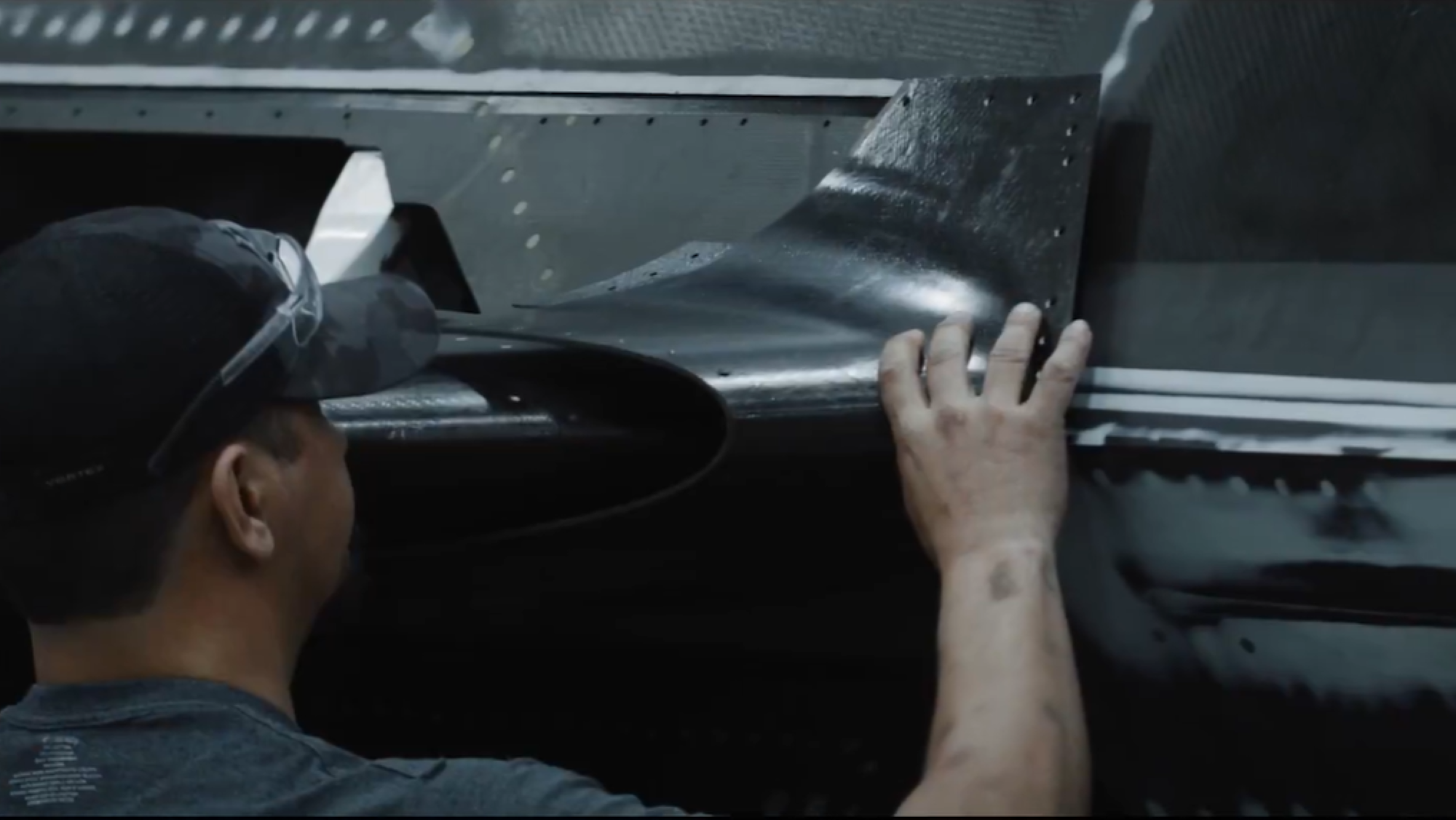
A Feb. 24, 2026, video by Shield AI showed the first airframe under production with the wings, spars, control surfaces and panels being attached. A lot of processes are expected to take place on automated assembly lines.
Arsenal-1 is located in Pickaway County, Ohio, and Anduril has spent nearly $1 billion in setting it up to also manufacture the Roadrunner killer drone and Barracuda-series of missiles. The company has repeatedly pledged to set itself apart from other legacy defense companies.
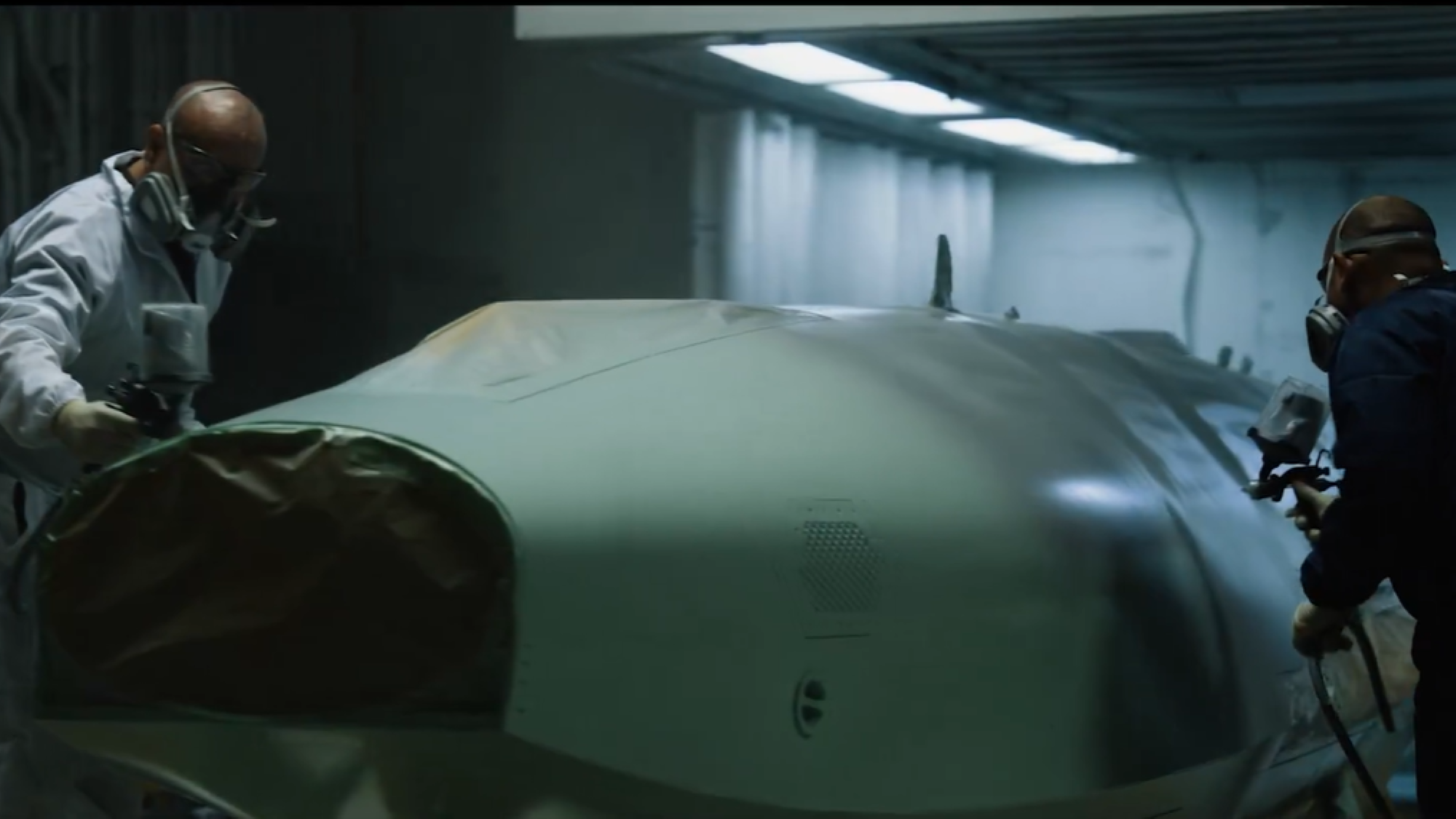
This includes simplicity in component selection, design, engineering, materials and reconfigurable production lines and processes that allow for affordable rapid scaling, rather than exquisiteness – reflecting the U.S. military’s own experience and vision on its future fighter and combat drone fleet.