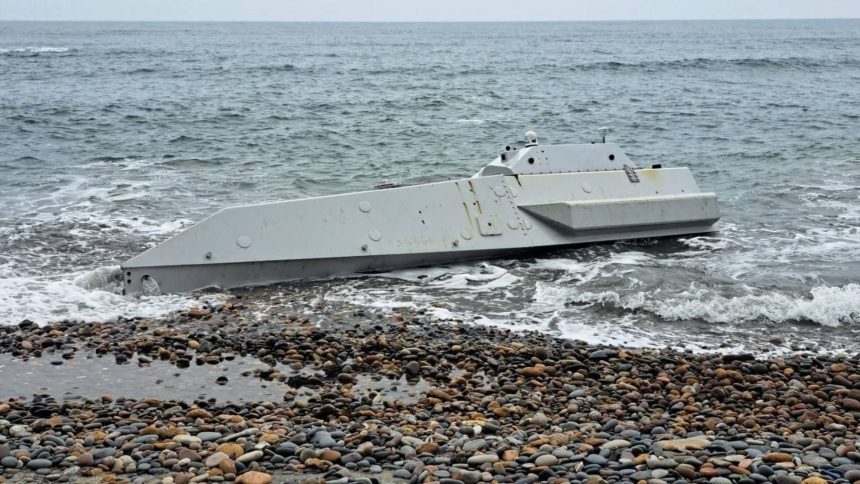
The AEGIR-W Unmanned Surface Vessel mysteriously ran aground on the Black Sea Coast in northeastern Turkey and was later blown up by Turkish authorities.
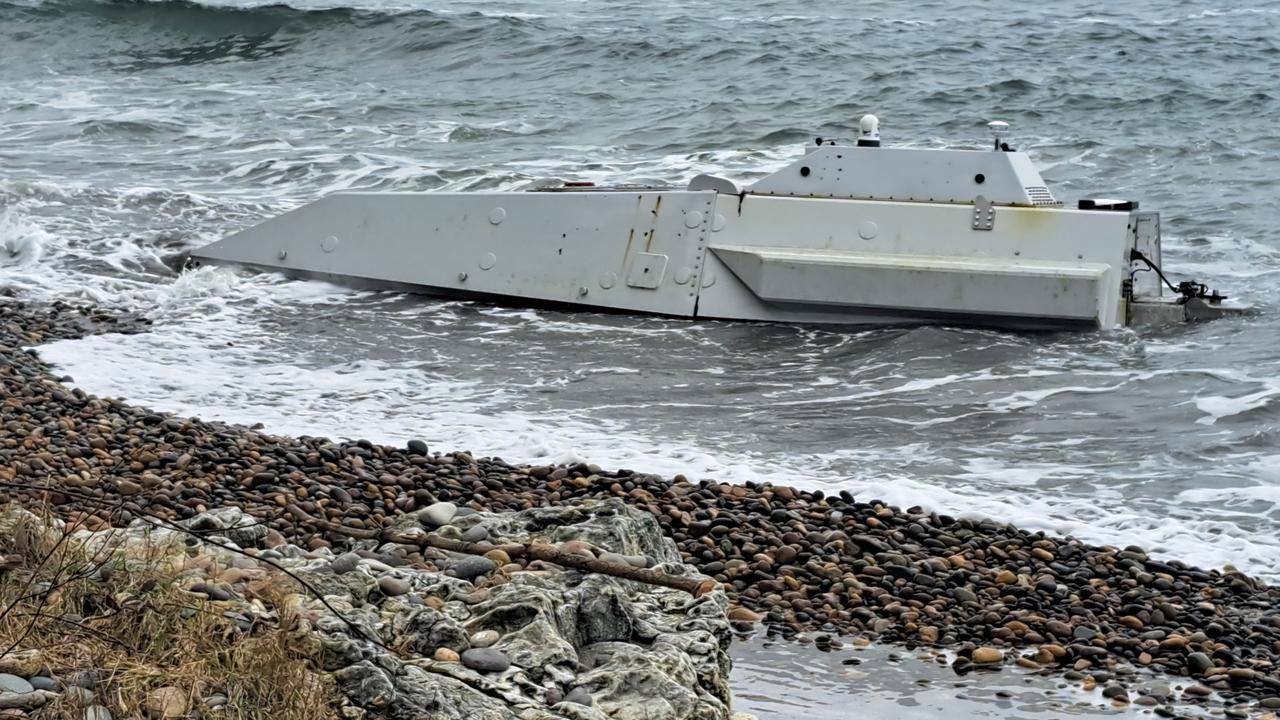
An Unmanned Surface Vessel (USV) was found washed ashore on northeastern Turkey’s Black Sea coast in the Ordu region early in the afternoon of Mar. 21, 2026. Images emerged online showed what has been identified as an AEGIR-W USV made by U.S. defense company Sierra Nevada Corporation.
Accounts on X and Telegram were able to match the actual image with the renderings from SNC’s product brochures for the AEGIR family of multi-purpose, attritable USVs. It is still unclear how the USV showed up in Turkey.
Görseller üzerinden yapılan incelemelerde, bahsi geçen İDA’nın, AEGIR ailesinin AEGIR-W adlı üyesi olduğu görülüyor.
Yaklaşık 10 metre uzunluğundaki AEGIR-W, azami 900 kilometre menzile sahip ve 25+ knot sürate ulaşabiliyor. Otonom olarak görev icra edebilen İDA’nın faydalı yük… https://t.co/Uqdb24Z73G pic.twitter.com/jZ3DjBbdx0
— SavunmaSanayiST.com (@SavunmaSanayiST) March 21, 2026
Turkish media outlet Türkiye Today, which identified the USV by the same designation and origin, said the Turkish Navy’s Explosive Ordnance Disposal (EOD) unit later destroyed the drone in a “controlled detonation.” A photo by Anadolu Ajansi shows the AEGIR-W following the explosion, which was triggered after the USV was towed at a safe distance from the shore.
Claims have ranged from the drone being lost during testing to being actually involved in an operation in Ukraine. We have not been able to independently verify the circumstances surrounding its running aground.
/3. The AEGIR-W is a U.S.-made unmanned surface vessel by Sierra Nevada Corporation, a ~10 m modular naval drone designed for long-range autonomous operations.
It can reach speeds over 25 knots with a range of around 900 km and is intended for reconnaissance, surveillance,… pic.twitter.com/IpI70orG9y
— Special Kherson Cat 🐈🇺🇦 (@bayraktar_1love) March 21, 2026
However, the reason for the decision to blow up the AEGIR-W was the presence of an explosive charge onboard, which is rarely used in trial runs. It is worth noting that the AEGIR-W is not included in any of the publicly acknowledged weapon transfers to Ukraine.
Moreover, any trial of such a system off the Odessa coast is unlikely to go unnoticed by Russian reconnaissance, especially when carried out in daylight hours. Most of Ukraine’s menacing USV strikes on Russia’s Black Sea Fleet (BSF) have taken place in low daylight hours, between late evening to post-midnight.
The most likely explanation at the moment could be that Ukraine was operating the USV and, for some reason, lost control of it and went astray until it turned up on the Turkish coast. Ukraine has been prominently using USV in its was efforts against Russia.
It is unclear if Russian military action was involved in disabling the drone, although it appears unlikely. The incident did not figure in any of the daily updates over the last two days by the Russian Ministry of Defense at the time of filing this report.
Turkish SAS commandos towed it 2 km off the coast and destroyed it safely. However, the blast was massive; there was a significant amount of explosives involved. pic.twitter.com/ZP78Pa1UeD
— ALi BaKır (@ALiBakr53) March 22, 2026
USV washes ashore on Turkey’s Black Sea coast
Quoting the local Ordu Governor’s officer, Türkiye Today said:
“Civilians who noticed the unidentified object alerted authorities, and gendarmerie teams were dispatched to secure a perimeter around the site. Specialists from Istanbul’s S.A.S. Group Command examined the vessel on Saturday and concluded around 2:00 p.m. local time that it remained operational and was carrying munitions, according to the governor’s statement. The craft was towed approximately four kilometers offshore and destroyed in a controlled blast. Nearby homes were evacuated as a precaution during the operation.”
The drone has a USS Zumwalt-like inverted bow and inward-facing hull sides, similar to the American ship’s tumblehome design. There is a hatch in the front and a small Electro-Optical sensor turret on the bridge.
A U.S.-made AEGIR-W sea drone washed ashore near Ordu, Türkiye, on the Black Sea coast.
The drone, built by Sierra Nevada, can carry up to 300 kg over a range of about 900 km.
It was likely being tested or deployed in the Black Sea. pic.twitter.com/FdiERHwEEw
— Clash Report (@clashreport) March 21, 2026
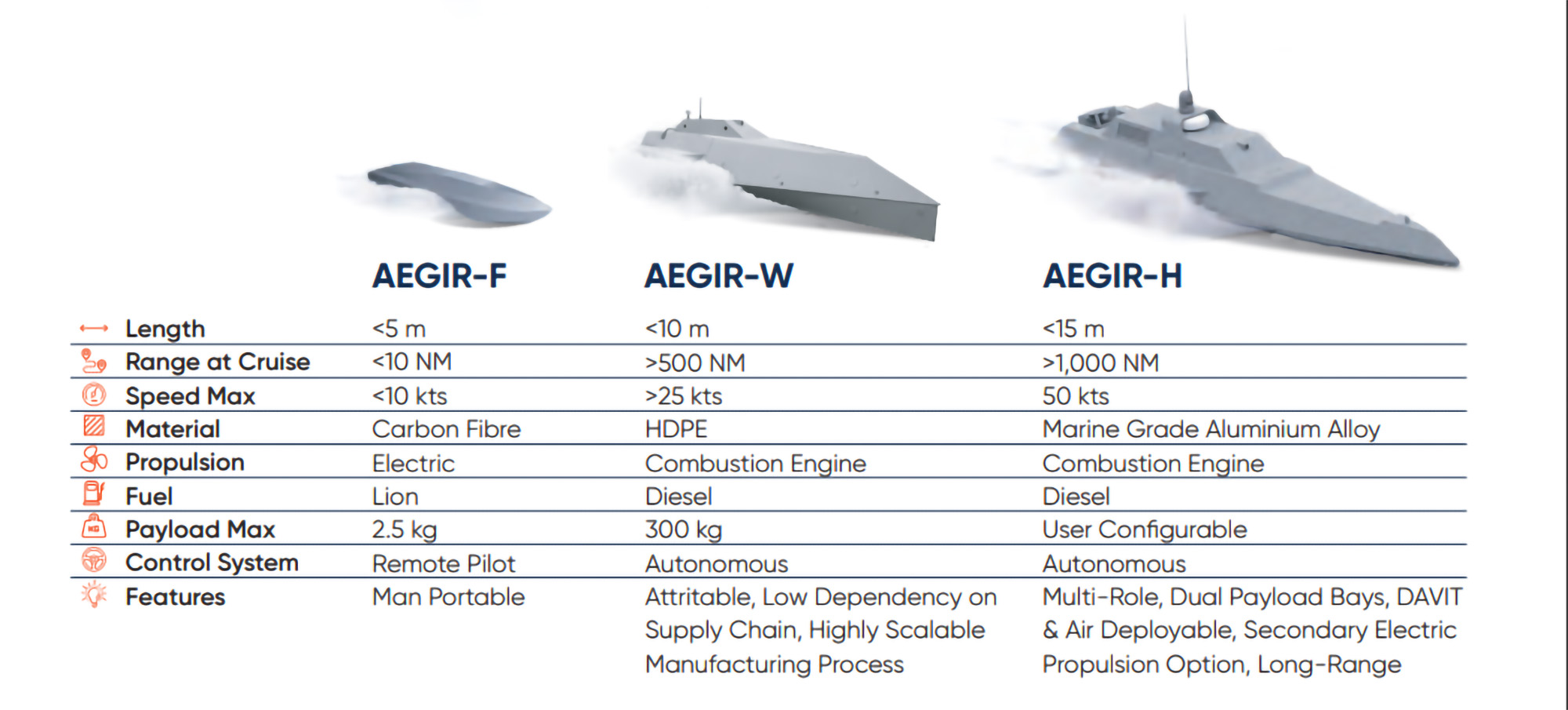
Sierra Nevada Corporation’s (SNC) product page describes the AEGIR-W as part of a family of systems meant for conducting Intelligence, Surveillance and Reconnaissance (ISR), Electronic Warfare (EW), offensive operations and autonomous resupply in high-threat and contested environments. The drones are described as “affordable and scalable,” manufactured through proven and reliable supply chains, suggesting attritability in their use.
The AEGIR-W is less than 10 meters long, with a cruise range of more than 500 nautical miles and a speed over 25 kts, powered by a diesel engine. The USV can carry a payload of 300 kg, and has both autonomous and man-in-the-loop control features.
The other USVs in the family are the smaller AEGIR-F and the larger AEGIR-H. The former is “specifically designed for single use, kinetic missions in the final operational mile,” suggesting a use as a kamikaze USV.
We do not know if Ukraine has officially purchased the drone, and eventually how many units. However, the Ukrainian battlefield has so far served as a ready proving ground for many Western technology, AI and defense companies to test their wares.
Russia vs Ukraine in the Black Sea
Russia’s countermeasures against the Ukrainian USV threat in the Black Sea largely remain symmetric, outsized and costly, with Ukraine still holding the overall asymmetric advantage. Kyiv’s naval operations in the Black Sea with USVs have been known to be overseen by its Main Intelligence Directorate (GUR), with the Magura V5 and the Sea Baby being two of its most successful platforms.
Russia’s Black Sea Fleet (BSF) has employed Project 22160 patrol vessel and the heavily armed Project 22800 corvettes, equipped with the Pantsir-M, the naval variant of the standard Pantsir, as a gun/missile hybrid CIWS (Close-In Weapons System) to combat Ukrainian USVs. Late in May 2024, a Project 22800 vessel was reported to have sunk following a strike by an ATACMS (Army Tactical Missile System).
High-quality photos of a Ukrainian Magura V7 unmanned surface vessel (USV) equipped with two US-made AIM-9 Sidewinder anti-aircraft missiles.
Such vessels are employed for combating Russian aviation assets in the Black Sea theater. pic.twitter.com/X7D3ra9mHx
— Status-6 (War & Military News) (@Archer83Able) December 6, 2025
Other assets used to counter USVs include Su-30 and MiG-29 fighters performing strafing runs; First-Person View (FPV) drones; Mi-8 and Kamov Ka-27 helicopters with onboard guns. Notably, Russia has also lost some of these very platforms, an Su-30SM and an Mi-8 helicopter, to AIM-9M Sidewinder-armed Magura V7 and R-73 short-range infrared AAM-carrying Magura V5, respectively.