The U.S. Army will put the H-60Mx and Sikorsky’s MATRIX flight autonomy software through a rigorous operational testing campaign with real world logistics in contested scenarios.
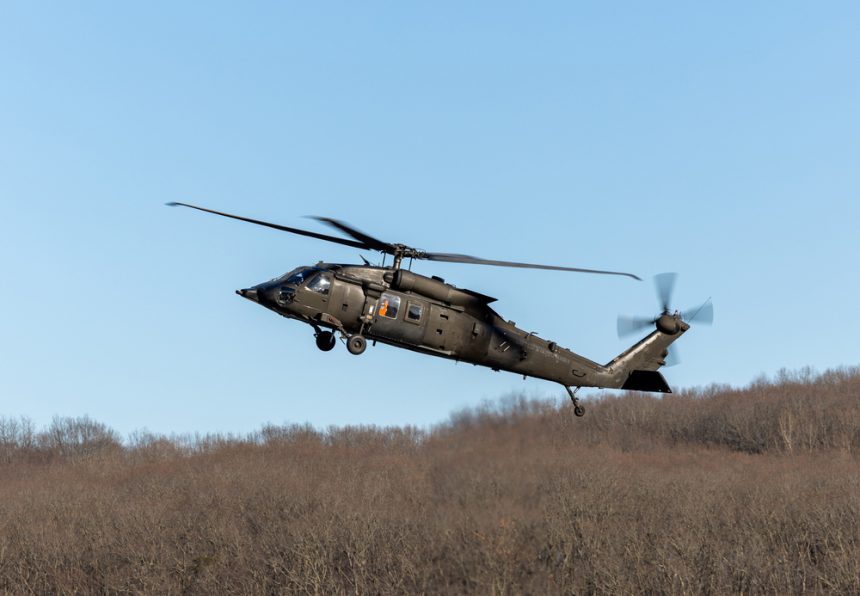
The U.S. Army received on Mar. 19, 2026, the H-60Mx Black Hawk Optionally Piloted Vehicle (OPV) at Fort Eustis, Virginia, the service announced. This comes a little more than a year after the Defense Advanced Research Projects Agency (DARPA) contracted Sikorsky to equip an experimental fly-by-wire UH-60 Black Hawk with MATRIX, the company’s flight autonomy software.
This new development will now further advance DARPA’s Aircrew Labor In-cockpit Automation System (ALIAS) program being in the works since 2020. As part of the program, Sikorsky has been testing and demonstrating another tablet-controlled UH-60A OPV Black Hawk, and even unveiled a purpose-built fully unmanned S-70UAS U-Hawk.
The upcoming operational testing campaign, according to DARPA, will see the technology and concept being refined and matured, with the Army Combat Capabilities Development Command (DEVCOM) working with DARPA and Sikorsky to identify new mission systems. The goal mentioned is a safer and smarter helicopter fleet.
Autonomous aviation milestone! 🚁
Our ALIAS flight system has transitioned to the U.S. Army. An optionally piloted H-60Mx Black Hawk with Sikorsky MATRIX™ autonomy is advancing to operational testing — a pivotal moment for a safer and smarter helicopter fleet. @jblenews pic.twitter.com/H451EmBQDf
— DARPA (@DARPA) March 20, 2026
In fact, the ALIAS program aims to alleviate crew workload during logistical cargo missions in contested, high-risk battlespaces by eliminating the constraints of human endurance. This would help reduce operating and maintenance costs, while also offering a range of civilian applications.
New milestone
The U.S. Army statement said that the rigorous testing phase is aimed at building a safer, smarter, and more versatile helicopter fleet. The decade-old ALIAS program envisaged a removable kit to allow a high degree of automation for existing aircraft, aimed at easing complex flying tasks for the pilots to focus on higher-level mission tasks.
The operational testing campaign will see Army test pilots and engineers putting the OPV Black Hawk through its paces “to validate how seamlessly the aircraft can be controlled from the ground, how it performs in complex, real-world mission scenarios on its own,” with the ultimate goal of keeping soldiers effective and safer.
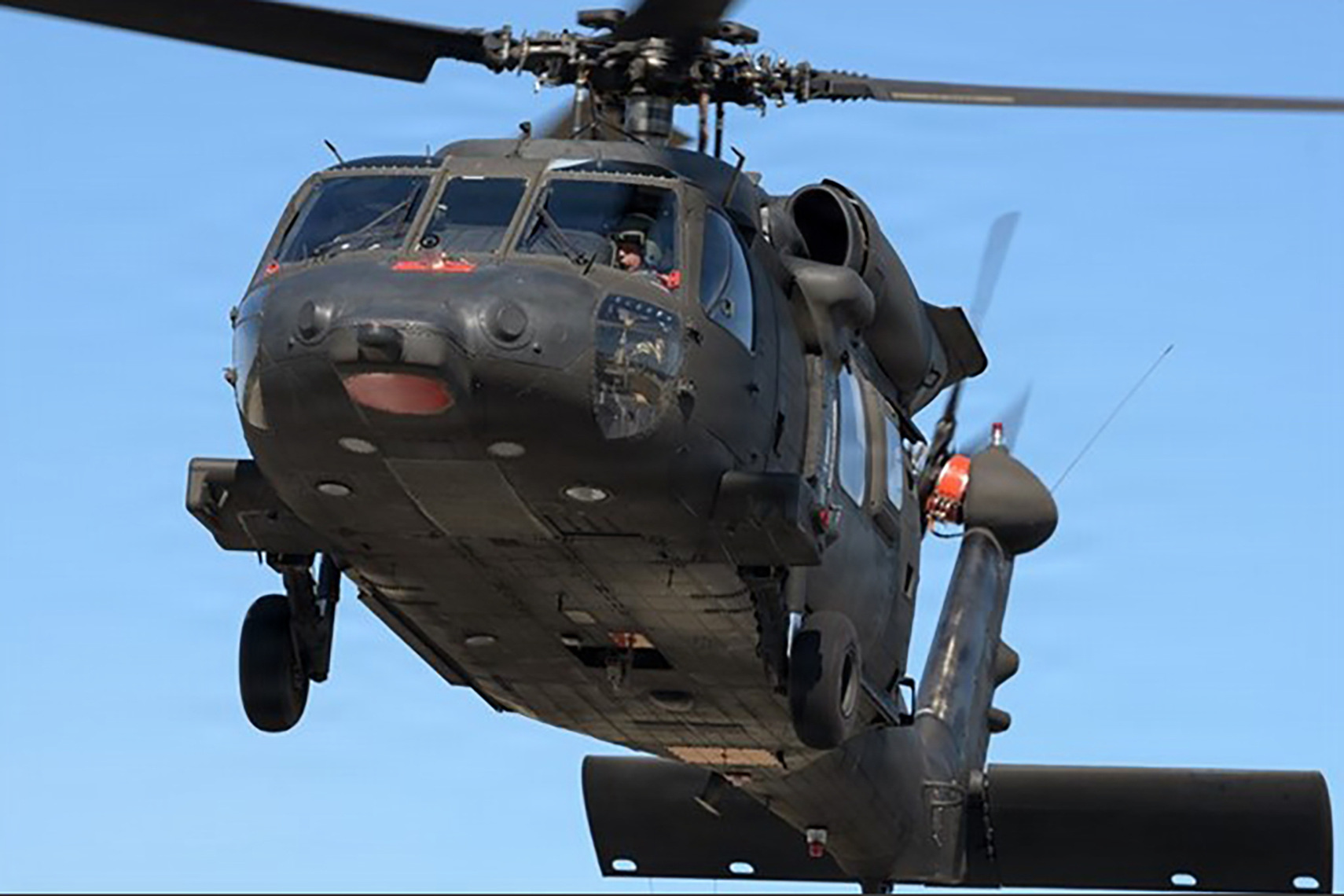
This single helicopter testbed will also lay the foundation for the Army’s much broader Strategic Autonomy Flight Enabler (SAFE) program, envisioning a universal and scalable autonomy kit installed “across the Army’s entire fleet of hundreds of Black Hawk helicopters and integrated into the designs of future aircraft,” the statement added.
The Army also touched upon the civilian applications by naming the Texas A&M University’s Bush Combat Development Complex. The cooperative effort will “use modified UH-60Ls to determine the value of autonomous aircraft to wildland firefighting and associated state missions.”
As per DARPA’s statement, the Army Combat Capabilities Development Command (DEVCOM) will now use the “experimental helicopter as a flying laboratory” to mature and expand the technology. It will focus on “integrating advanced mission-specific sensors and exploring the unprecedented operational flexibility afforded by reduced-crew and fully autonomous flight.”
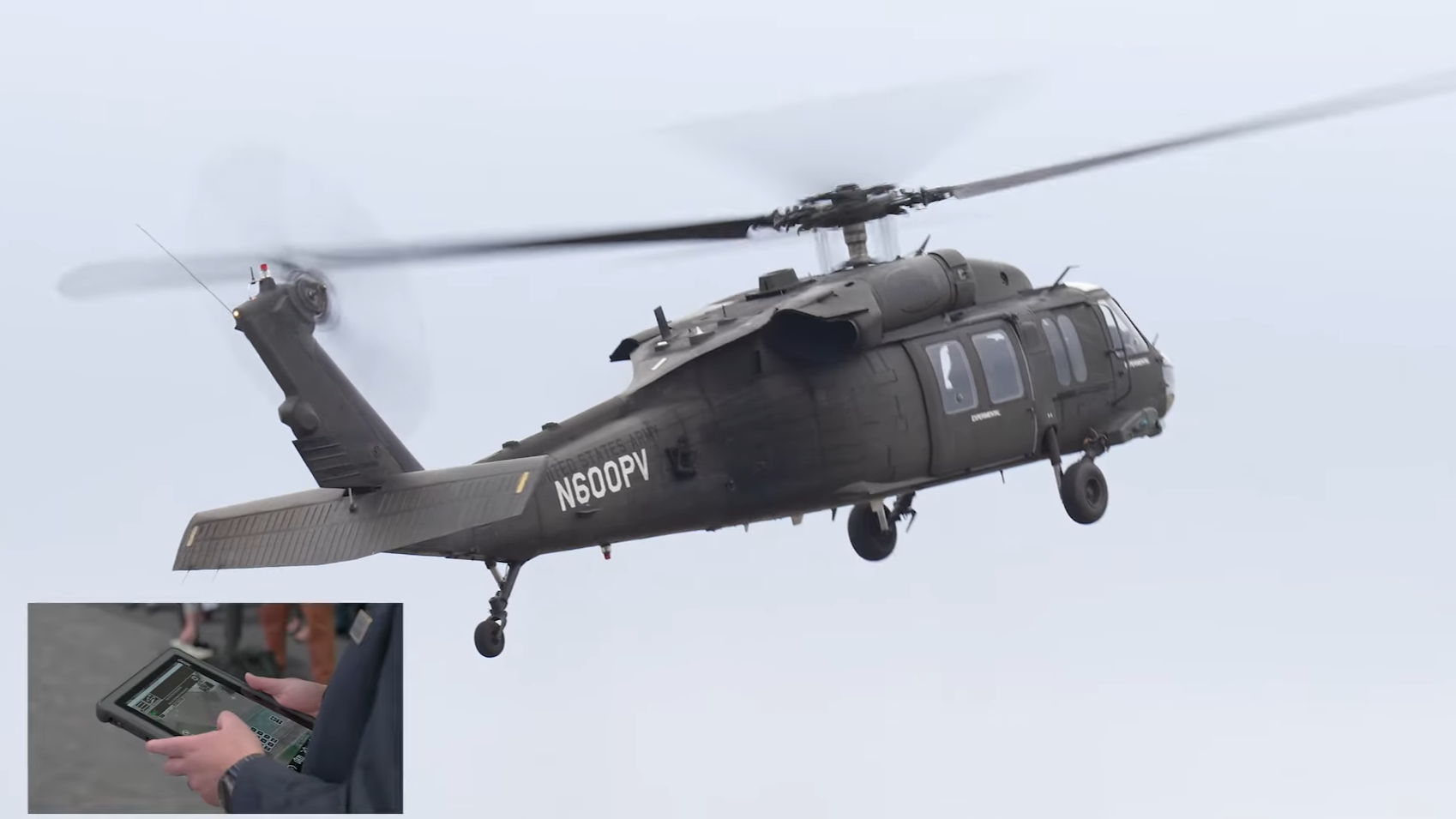
“The ALIAS program has successfully developed and demonstrated a powerful, flexible automation architecture that is now poised to provide the U.S. Army with a significant operational edge,” said Stuart Young, the ALIAS program manager in DARPA’s Tactical Technology Office. “This transition is a testament to the power of government and industry partnership to advance technology. It will allow the Army to build on a solid foundation of technical-risk reduction, enabling them to explore new warfighting concepts and push the boundaries of what’s possible in aviation.”
DARPA and Sikorsky’s Unmanned Black Hawk program
As mentioned earlier, MATRIX, which Sikorsky has developed since 2020, is the technological foundation for DARPA’s ALIAS (Aircrew Labor In-cockpit Automation System) program. The Aviationist had previously reported how the software powers a UH-60A Optionally Piloted Black Hawk which has performed supervised autonomous and full-autonomous unmanned flights in 2021 and 2022.
Then, in October 2024, DARPA contracted Sikorsky to equip the U.S. Army’s experimental fly-by-wire UH-60 Black Hawk helicopter with MATRIX. This is the helicopter that has now been delivered under the designation H-60Mx Black Hawk.
Also, on Oct. 17, 2024, the company demonstrated the technology at the AUSA (Association of the United States Army) symposium in Washington D.C. by remotely controlling a UH-60 Black Hawk from 300 miles away.
A year later, on Oct. 13, 2025, at the latest edition of the AUSA symposium, Sikorsky announced the new prototype of an unmanned Black Hawk, dubbed S-70UAS U-Hawk. The U-Hawk replaces the Black Hawk’s cockpit with actuated clamshell doors and a forward loading ramp, resulting in 25 percent more cargo space than a conventional UH-60L.
The clamshell nose opens upward and outward, exposing a flat cargo bay for vehicles or supplies to be loaded from the front. The ramp can be lowered for drive-on operations or sealed for flight, giving the aircraft a clean, aerodynamic profile.
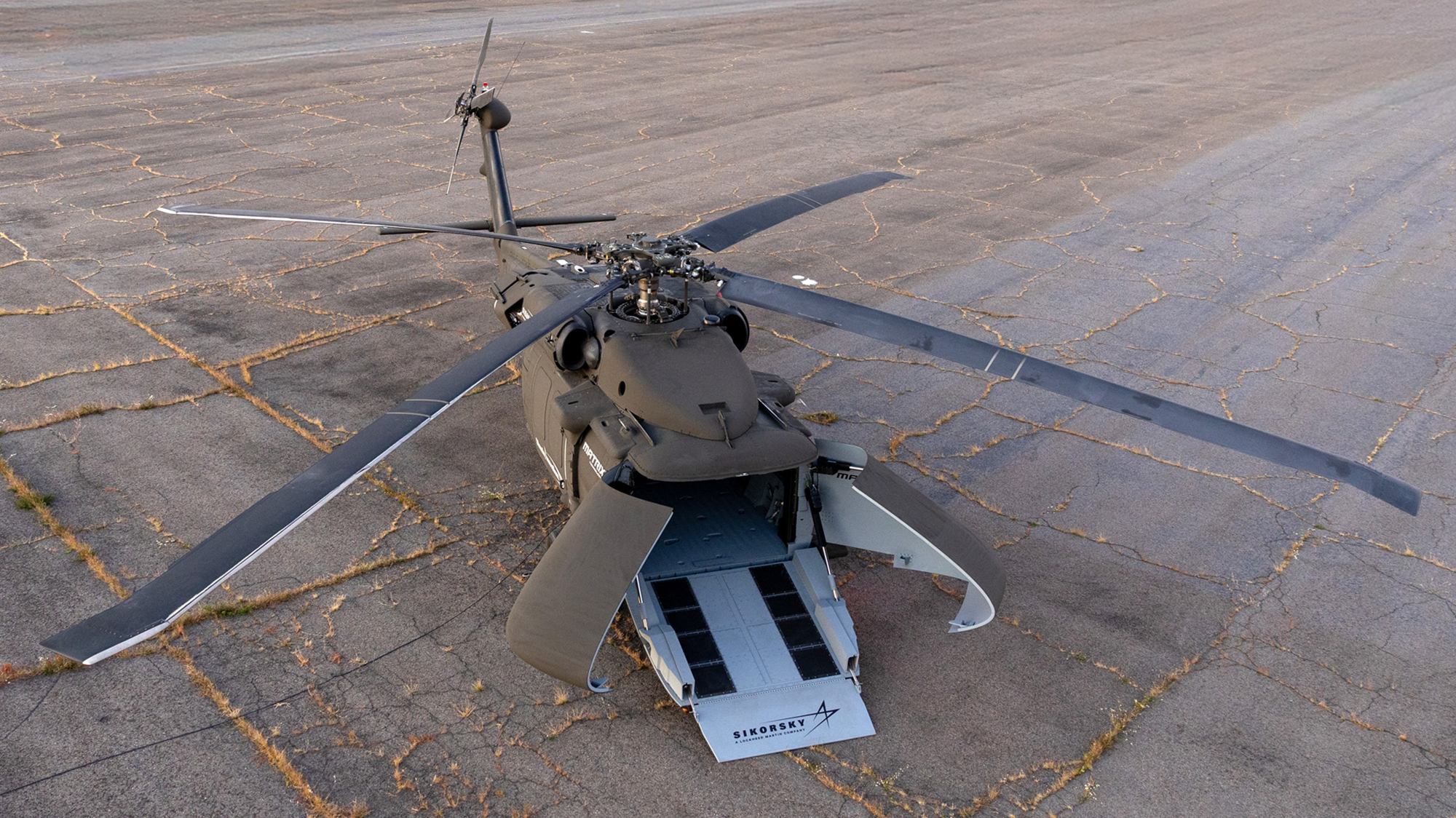
Prior to the S-70UAS U-Hawk’s unveiling, the OPV Black Hawk was controlled via a tablet by a U.S. Army National Guard soldier, instead of a trained aviator or engineer, during the Northern Strike 25-2 exercise in Michigan. In the August exercise, with possibly pilots on board for safety precaution, the helicopter conducted three types of cargo missions: internal carry; external sling load and precision parachute drop; and a MEDEVAC (medical evacuation) drill.