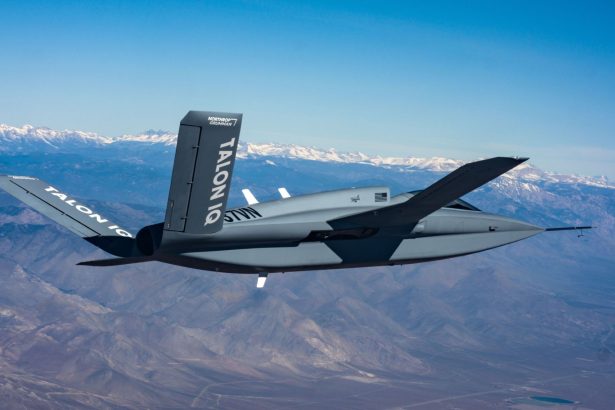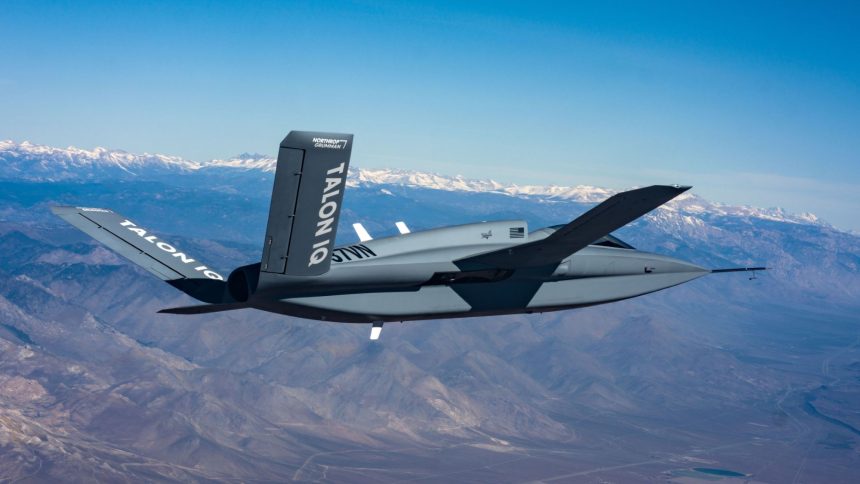
The Talon IQ testbed conducted combat air patrol and target engagement maneuvers controlled by ShieldAI’s Hivemind AI, before switching back to Northrop Grumman’s Prism AI.
Northrop Grumman and Shield AI announced on Mar. 19, 2026, that the Talon IQ autonomy testbed aircraft, based on the Model 437 Vanguard developed by the former’s subsidiary Scaled Composites, flew for the first time with Shield’s Hivemind AI autonomy software and Northrop’s own Prism autonomous flight code.
In a statement, both companies said that the Talon IQ executed “combat air patrol and target engagement maneuvers,” while being piloted by Hivemind, and then “seamlessly swapped back to […] Prism.” This validated its “plug-and-play […] modular, open architecture design,” while meeting the U.S. government’s Autonomy-Government Reference Architecture (A-GRA) standards.
Northrop and Shield AI added in their joint statement that the Model 437/Talon IQ had flown with Prism before, “establishing Talon IQ as a flight‑proven platform.” They also stressed upon Hivemind’s ability to be integrated upon aircraft with “minimal modification,” with the test flight coming just “after a single‑day hardware‑in‑the‑loop test.”
We flew @ShieldAITech’s Hivemind software on Talon IQ — a plug-and-play platform that cuts development time and speeds AI deployment.
Learn more: https://t.co/CcJEiQ5Kv8 pic.twitter.com/KsFg3R4HjN
— Northrop Grumman (@NGCNews) March 19, 2026
Shield AI’s Hivemind is now associated directly with two of the leading unmanned aircraft of the Air Force’s Collaborative Combat Aircraft’s (CCA) Increment 1 phase – Anduril’s YFQ-44A Fury and GA-ASI’s YFQ-42A Dark Merlin. Northrop’s own YFQ-48A Talon Blue CCA might join the Increment 2 stage, and trials on the Talon IQ will inform its evolution.
Model 437 flies with Hivemind and Prism
The companies’ joint statement said Hivemind was integrated and flown on Model 437/Talon IQ after “a single‑day hardware‑in‑the‑loop test, demonstrating the rapid transition from lab to actual flight, while conforming to A-GRA interfaces. Hivemind “successfully commanded” the Talon IQ to “execute combat air patrol and target engagement maneuvers,” before seamlessly switching back to Prism.
Autonomy moving from lab to flight faster than ever.
Hivemind completed the first partner mission autonomy flight within @northropgrumman‘s Talon IQ ecosystem, integrating onto the Model 437 autonomous test aircraft used in the program’s flight test environment.
After just one… pic.twitter.com/f1dlv62nNq
— Shield AI (@shieldaitech) March 19, 2026
“We are accelerating autonomous flight innovation with Talon IQ,” said Tom Jones, corporate vice president and president, Northrop Grumman Aeronautics Systems. “By integrating Shield AI’s Hivemind into our testbed, we’ve demonstrated an open architecture platform that propels plug and play mission autonomy forward at unprecedented speed.”
Christian Gutierrez, vice president of Hivemind Solutions at Shield AI, said the Talon IQ helped mature mission autonomy, with the integration showing “how Hivemind can transition onto new aircraft with minimal modification.”
From Model 437 Vanguard to Talon IQ
The Model 437 Vanguard, which flew for the first time on Aug. 29, 2024, from Scaled Composites’ facility at the Mojave Air and Space Port, California, was subsequently named “Beacon”. The Beacon autonomy testbed ecosystem allowed third party technology companies to rapidly test their autonomous flight programs. This helps speed up maturation efforts and reduce risks before operational fielding.
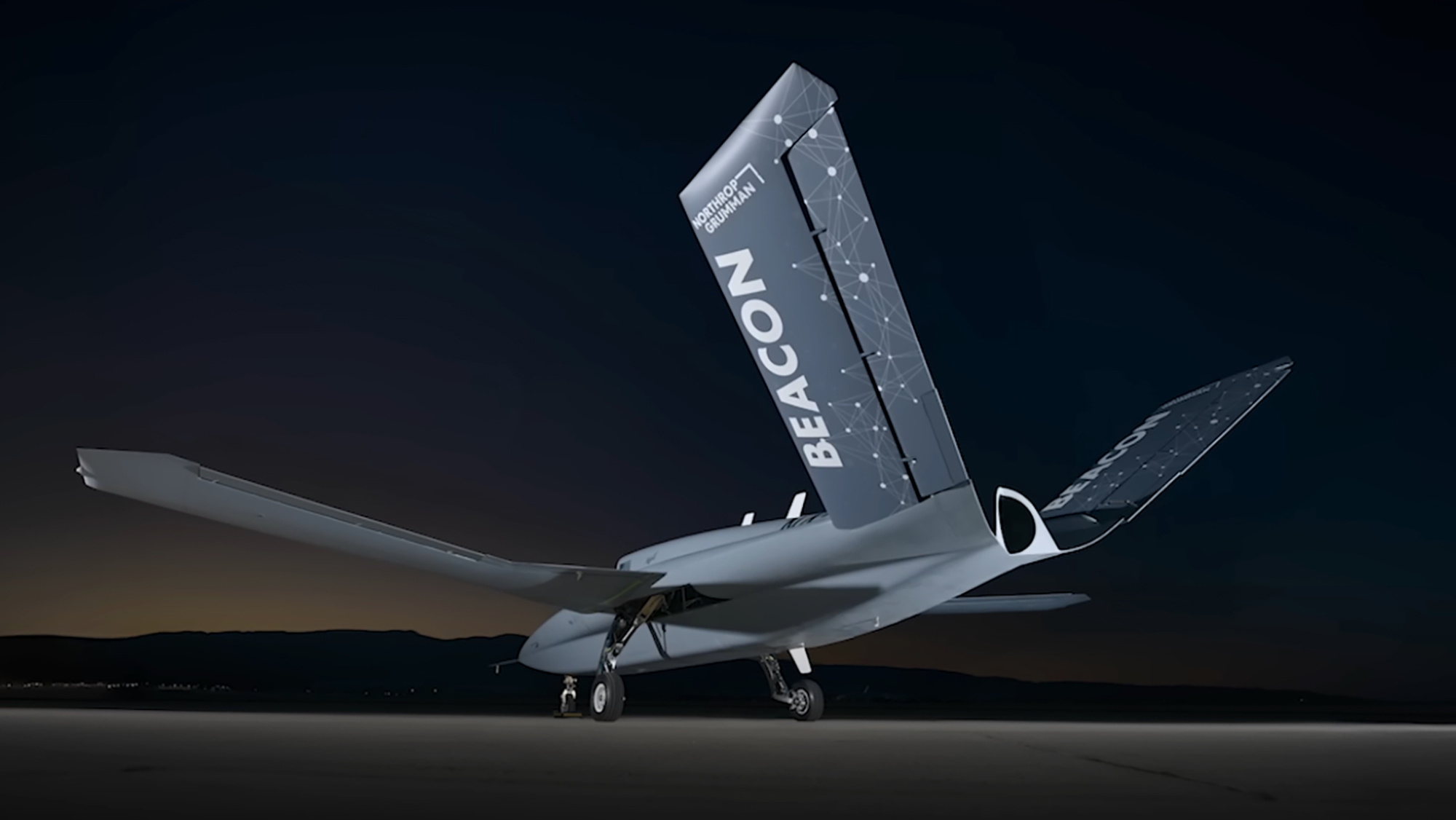
The Model 437 was subsequently seen outside Scaled Composites’ hangar with the “Beacon” marking on its V-tail in a video Northrop Grumman released on Jul. 22, 2025. Then, on Sep. 20, 2025, Scaled Composites announced the Model 437 Vanguard/Beacon would resume flight testing at Mojave in a new phase of envelope expansion flights.
Now, the Talon IQ name can be said to have been assigned as Northrop Grumman introduced its YFQ-48A Talon Blue Collaborative Combat Aircraft (CCA), meant for the program’s Increment 2 phase. The aircraft retained the original Model 437 Vanguard’ registration ‘N437VN,’ and received a new “Talon IQ” marking on the tail.
The optionally manned Talon IQ will now most likely support and inform the testing, verification, refinement and future development of AI-enabled autonomous flight software, before trialing them on the YF-48A Talon Blue. This would take place as Northrop Grumman observes how the Increment 1 phase, with Anduril’s YFQ-44A Fury and GA-ASI’s YFQ-42A Dark Merlin, progresses.
It is unclear if the latest flight of the platform was manned or unmanned. It is possible that a pilot was still on board as a safety measure to take control in case of an emergency.
Scaled is excited to share that this morning we conducted the first flight of the Model 437 Vanguard, demonstrating @northropgrumman‘s Digital Pathfinder wings with test pilot Brian Maisler in command. Learn more at https://t.co/fUqOQUD34V#FirstFlight #FlightTest #M437Vanguard pic.twitter.com/0w4HkJtN9c
— Scaled Composites (@ScaledC) August 29, 2024
Hivemind and USAF’s CCA program
Anduril’s YFQ-44A Fury has flown with Shield AI’s Hivemind and Anduril’s own Lattice autonomous flight program late in February 2026, switching between the two mid-flight. This came after Fury had flown with an AIM-120 Advanced Medium-Range Air-to-Air Missile (AMRAAM) under its wing.
Then, in mid-February, the U.S. Air Force announced the successful integration of A-GRA with mission autonomy software like Collins Aerospace’s Sidekick and Shield’s Hivemind on the YFQ-44A Fury and YFQ-42A Dark Merlin. On the Dark Merlin, Shield AI had confirmed its selection as a mission autonomy provider following a competitive Technology Maturity and Risk Reduction (TMRR) evaluation.
At least two prototypes of the Fury have been photographed, while the YFQ-42A Dark Merlin has three confirmed airframes.
Hivemind just flew @anduriltech‘s YFQ-44A.
Hivemind completed its first flight test aboard Anduril’s YFQ-44A aircraft for the @usairforce’s Collaborative Combat Aircraft (CCA) program. During the flight test over the Mojave Desert, Hivemind passed all required test points,… pic.twitter.com/q3GTCesciH
— Shield AI (@shieldaitech) February 26, 2026
The Hivemind autonomous flight software has previously flown the U.S. Navy’s BQM-177A and Airbus’ DT25 target drones, and the Airbus MQ-72C Lakota unmanned rotary-wing platform.
As a part of the CCA program, the AI agent has also flown GA-ASI’s MQ-20 Avenger in February 2025, June 2025 and July 2025, validating the Hivemind and Autonomy-Government Reference Architecture (A-GRA) interfaces and achieving simulated air-to-air kills. The MQ-20 feeds GA-ASI’s broader CCA effort, along with the company’s XQ-67A Off-Board Sensing Station (OBSS).
YFQ-48A Talon Blue.
The autonomous wingman for the @usairforce. pic.twitter.com/wFmZvd1vG4
— Northrop Grumman (@northropgrumman) February 23, 2026
The presence of several CCA vendors, supported by their own trial drones as feeder programs developed through MOSA standards, in-house and external flight autonomy software and an overarching compliance with A-GRA, underscores a new Air Force procurement, engineering and logistical doctrine. The service aims to avoid “vendor locks” and retain control on both hardware and software, which otherwise has heavy cost and operational readiness implications.