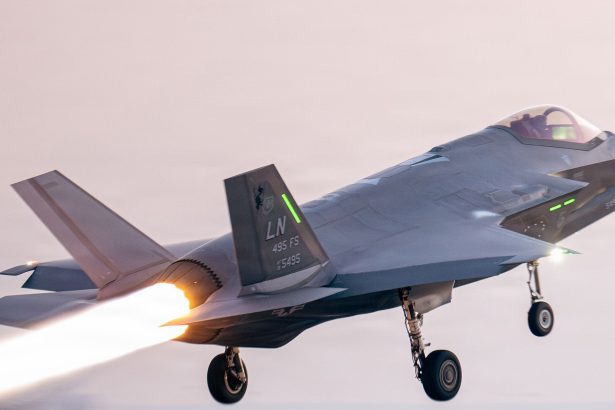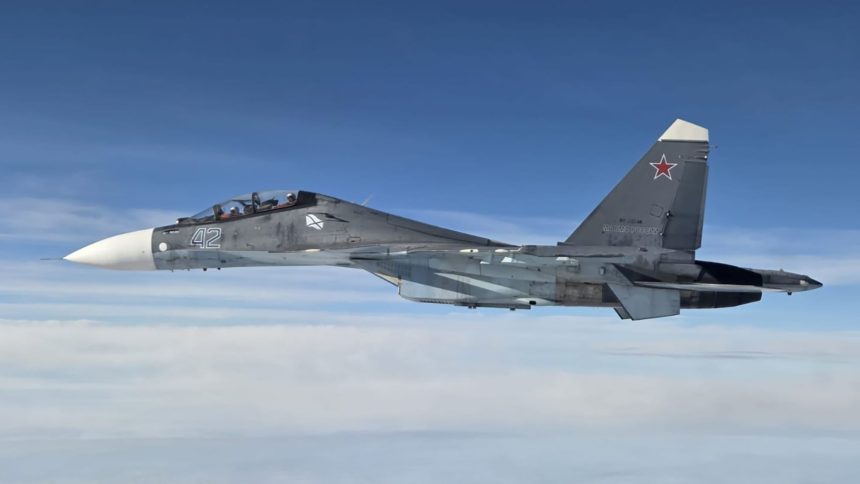
The Italian Air Force jets, deployed to Estonia to support NATO Baltic Air Policing mission, intercepted and escorted the Russian Navy Su-30SM.
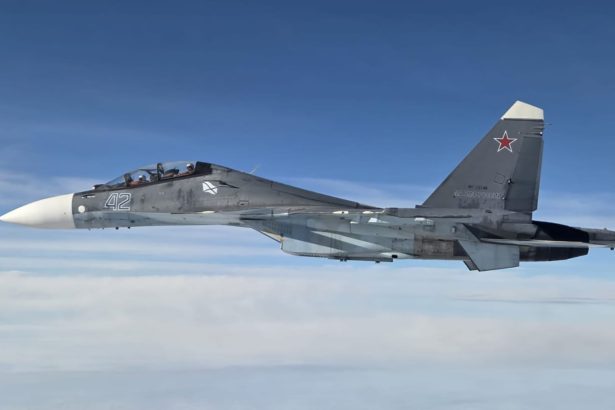
On Mar. 18, 2026, a Russian Navy Su-30SM multirole fighter entered Estonian airspace, which extends 12 NM (Nautical Miles) offshore from Estonia’s sovereign territory. Although the violation of NATO airspace was brief, lasting “approximately one minute” according to Estonian authorities, Italian Air Force Eurofighter Typhoons deployed to Ämari, a few kilometers from Tallinn, Estonia, for the NATO Baltic Air Policing mission were scrambled to identify and escort the Russian aircraft, which was flying without a flight plan and without establishing two-way radio contact with Estonian air traffic services.
The Su-30SM involved in the latest violation was unarmed.
An MA VMF Su-30SM multirole fighter. Prior to Russia’s large-scale invasion of Ukraine, this aircraft (B/N “42” Blue) is known to have been assigned to the Crimea-based 43rd OMShAP. Given that this photo was taken over the Baltic Sea, it may have since been re-assigned to the 4th… https://t.co/voKo1rsbjI pic.twitter.com/fyINA2n7zx
— Guy Plopsky (@GuyPlopsky) March 20, 2026
The violation of Estonian airspace occurred over the Gulf of Finland near Vaindloo Island, an area located in the “corridor” used by Russian military aircraft flying from mainland Russia to Kaliningrad Oblast. In that region, the international airspace between the sovereign airspaces of Estonia and Finland is quite narrow, and such incursions can occur either by accident, because of a navigation error, or intentionally, to test NATO readiness and gather situational intelligence on NATO’s capabilities.
On Wednesday, 18 March, a Russian SU-30 fighter jet entered 🇪🇪 airspace near Vaindloo Island without permission, remaining for approximately one minute.
NATO Baltic Air Policing aircraft, operated by the 🇮🇹 Air Force, conducted an identification flight in response. 1/3 pic.twitter.com/nCLxbpVuPo
— Estonian Defence Forces | Eesti Kaitsevägi (@Kaitsevagi) March 19, 2026
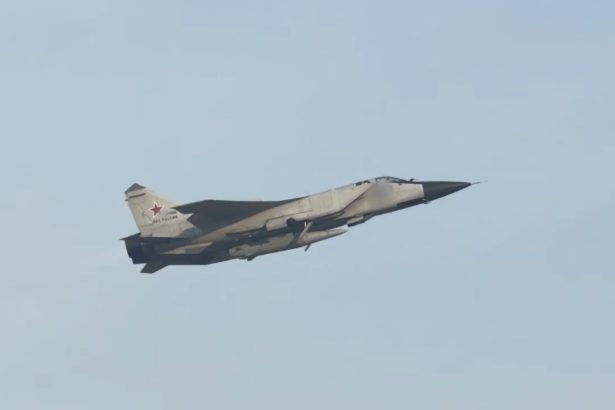
Indeed, the latest incident involving the Su-30 occurred in the same area where Russian MiG-31 Foxhound jets violated Estonian airspace, on Sept. 19, 2025. Back then, three MiG-31s of the Russian Aerospace Forces entered Estonian airspace near Vaindloo Island, remaining inside for much more time: about 12 minutes. The fighters initially flew on a course toward Estonia’s capital Tallinn before circling within Estonia’s airspace, where they were eventually intercepted by two F-35A Lightning II of the Italian Air Force deployed to Ämari Air Base, Estonia.
NEW: Russian MiG-31 interceptor jets violated Estonian airspace on September 19. ISW continues to assess that Russia is deliberately attempting to gauge NATO’s capabilities and reactions to various air incursions in hopes of applying lessons learned to possible future conflicts… pic.twitter.com/A23f7HnZju
— Institute for the Study of War (@TheStudyofWar) September 20, 2025
That incident reignited debate across social media and defense circles about NATO’s air policing protocols and rules of engagement in case of intrusion. In fact, as explained in detail, that incident, which occurred amid a wider pattern of drone intrusions over Poland and Romania, prompted some to question whether the Alliance should reconsider its threshold for kinetic response in the Baltic region. Others argued that maintaining a posture of restraint remains essential to prevent miscalculation and escalation along NATO’s eastern flank.
Once again, it’s worth highlighting a couple of things when reporting about such close encounter:
- such missions are quite routine. Sovereign airspace violations are not that frequent though.
- there’s a subtle difference between standard English and aviation usage of the word “intercept”: in aviation it means to approach, identify, monitor and eventually shadowing/escorting another aircraft whereas in English language there’s clear implication of stopping or preventing.
Operation Baltic Eagle III
The Italian jets that were scrambled from Estonia, are involved in Operation Baltic Eagle III. In fact, this is the third time the Italian Air Force has deployed personnel and assets to Estonia. The Eurofighter Typhoons have replaced the F-35A aircraf on the Alliance’s easternmost flank, in October 2025.
With Operation Baltic Eagle III, the Italian Air Force contributes to safeguarding the airspace of the Baltic Republics as part of NATO’s enhanced Air Policing mission, whose aim is to preserve Allied airspace while ensuring the related training requirements of the host nation.
The Air Task Force, deployed at Ämari Air Base, operated F-35A aircraft from the 32nd Wing at Amendola and the 6th Wing at Ghedi, now replaced by multirole Eurofighter Typhoons from the 4th Wing at Grosseto, the 36th Wing at Gioia del Colle, the 37th Wing at Trapani, and the 51st Wing at Istrana. The Task Force also employed the Gulfstream G550 CAEW (Conformal Airborne Early Warning) aircraft from the 14th Wing from Pratica di Mare for airspace control and command as well as the SAMP/T missile system from the Air Defense Artillery Command in Sabaudia to protect against aerial threats.
Interestingly, the Italian Air Force Eurofighters have been recently involved in multiple overseas operations. Until a few days ago, four F-2000As (as the single seater Typhoons are designated in Italy) had been deployed to Ali Al Salem Air Base, in Kuwait; an airbase that has come under Iranian attack following the U.S. and Israeli air strikes on Iran, recently. According to the Italian MOD, an ItAF MQ-9 RPV (Remotely Piloted Vehicle) was destroyed in one of the attacks; unconfirmed reports say that also one or two Eurofighters were damaged.
Not sure here: four Italian Eurofighters were deployed. Three returned home a few days ago. Either only one was damaged, or one of the two was only very lightly affected and could fly back home. https://t.co/IIU2Jrk5r1
— The Aviationist (@TheAviationist) March 20, 2026