CENTCOM says multiple 5,000 lb GBU-72/B Advanced 5K Penetrator munitions were used on hardened Iranian missile sites along Iran’s coastline near the Strait of Hormuz.
It appears that the U.S. has employed for the first time in combat the new GBU-72/B Advanced 5K Penetrator munition, the 5,000 lb bunker buster weapon designed to replace the GBU-28 which has been used since 1991. The U.S. Central Command says that “multiple 5,000-pound deep penetrator munitions” were used on Mar. 17 “on hardened Iranian missile sites along Iran’s coastline near the Strait of Hormuz.”
Hours ago, U.S. forces successfully employed multiple 5,000-pound deep penetrator munitions on hardened Iranian missile sites along Iran’s coastline near the Strait of Hormuz. The Iranian anti-ship cruise missiles in these sites posed a risk to international shipping in the… pic.twitter.com/hgCSFH0cqO
— U.S. Central Command (@CENTCOM) March 17, 2026
These hardened missile sites were said to host anti-ship cruise missiles, which posed a threat to shipping in the Strait. Officials later confirmed to CNN’s Pentagon correspondent Haley Britzky that the weapon was indeed the GBU-72.
US official confirms this was the GBU-72 Advanced 5K Penetrator
The AF put out a release in 2021 on the GBU-72 marking the first time the bomb was released, at Eglin AFBhttps://t.co/4mUn6xLC2B https://t.co/kSKUN6YunS
— Haley Britzky (@halbritz) March 18, 2026
The weapon now joins the line-up of penetrating munitions which have already been extensively used in Iran due to the high number of fortified targets. Among these are the GBU-31(V)3 Joint Direct Attack Munition (JDAM), the bunker-buster variant of the 2,000 lb weapon based on the BLU-109/B; the AGM-158 Joint Air-to-Surface Standoff Missiles (JASSM); and the ship-launched RGM-109 Tomahawk Land Attack Missile (TLAM).
What we know about the strike
CENTCOM did not release details about the strike mission and the aircraft employed. The only detail provided, in addition to the weapon, is the approximate timing, “hours ago,” with the statement published at approximately 11 pm UTC.
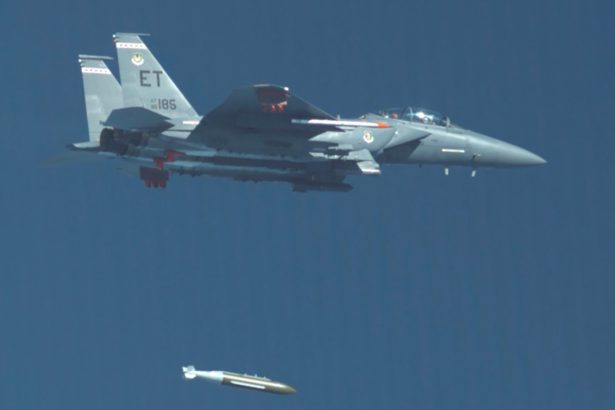
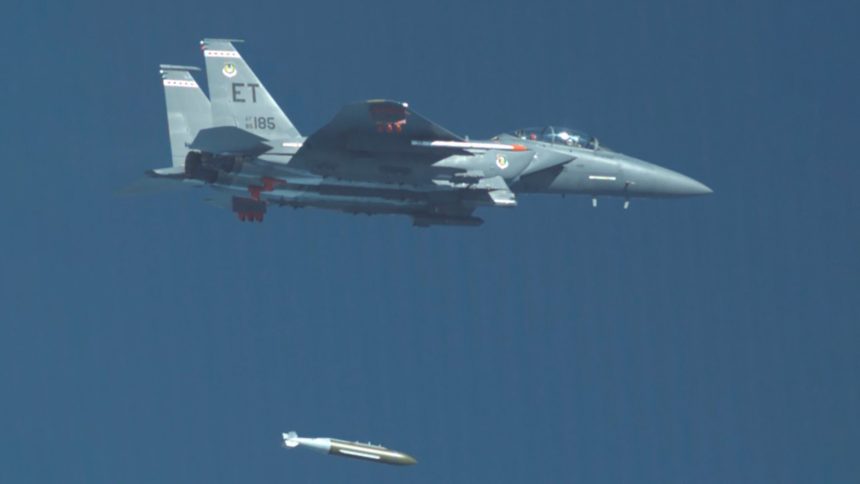
The U.S. Air Force has previously mentioned that only two aircraft types have been cleared so far to employ the GBU-72/B: the B-1B Lancer bomber and the F-15E Strike Eagle fighter jet. The weapon was first tested on the Strike Eagle in 2021, while the first photos of the testing with the BONE’s (from “B-One”, as the aircraft is unofficially nicknamed) external pylons emerged in 2024.
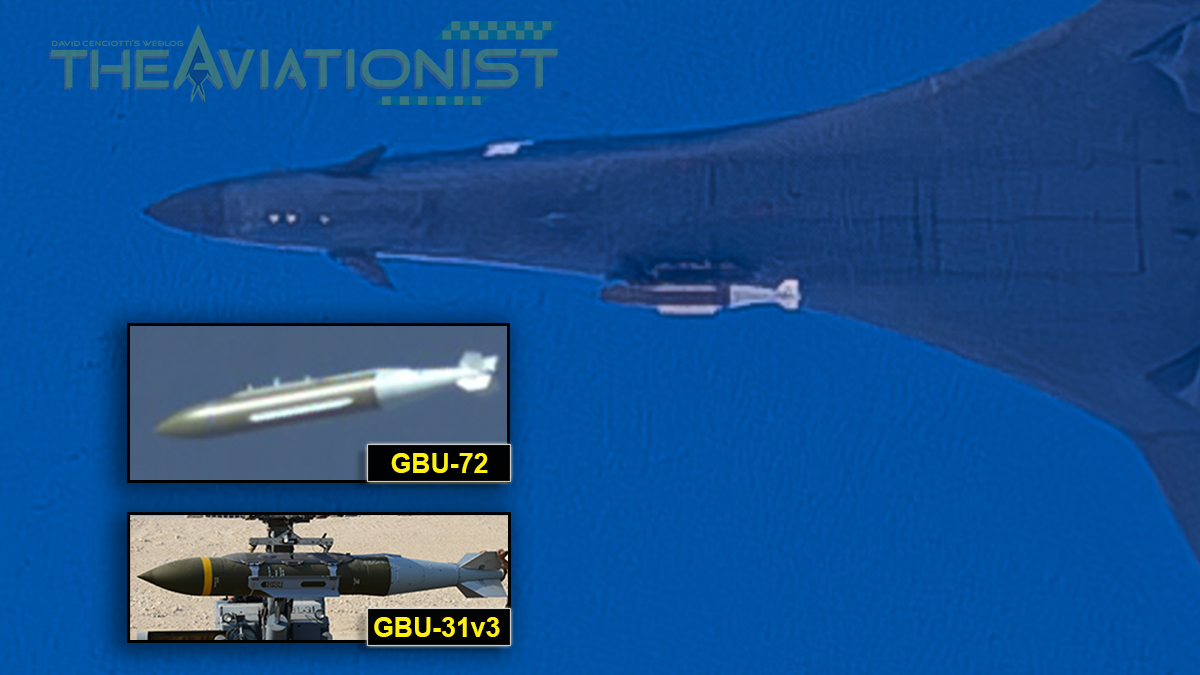
It is worth noting that there is no publicly available information regarding the status of the testing with the B-1B and the internal carriage of the weapon. Notably, “privacy screens” have been recently positioned on RAF Fairford’s fences, where a large part of the B-1B fleet is deployed, to stop spotters from capturing operations and especially weapons’ loading.
On Mar. 17, two B-1B missions were recorded from Fairford, with two bombers each. While one mission proceeded to target, the other had to abort due to unspecified issues.
Available flight tracking data on adsbexchange show that the two B-1Bs tracked on Mar. 17 were flying over the sea between Cyprus and Israel at approximately 1:30 pm UTC on their way to Iran and 10:20 pm UTC on their way back to the UK. The timing could be consistent with CENTCOM’s statement.
Bomber Mission XXI & XXII – A Day of Issues #FreeIran
— Operation EPIC FURY —
Yesterday (17th March 2026) the US bomber fleet at RAF Fairford (EGVA) attempted to launch 2 bombing missions to Iran, both to fly via the Atlantic and Gibraltar, being supported by tankers from… pic.twitter.com/vpCd8Uec5d
— DefenceGeek 🇬🇧 (@DefenceGeek) March 18, 2026
The other certified platform, the F-15E, could have launched from much closer locations, as multiple Strike Eagles are deployed in CENTCOM’s Area of Responsibility. That would also make much harder for the open source intelligence (OSINT) community to track them and the weapons they carried.
A factor which might have possibly influenced the choice of the platform for the strikes is the payload capability. The F-15E is likely limited to carrying only one GBU-72/B on the centerline without having to renounce to the external fuel tanks, similarly to the GBU-28, while unconfirmed reports mention the B-1B can carry up to 12 GBU-72s.
GBU-72/B Advanced 5K Penetrator
The GBU-72 Advanced 5K Penetrator is a 5,000-pound bunker-buster bomb tested for the first time in 2021. The test goals were to show the weapon could safely release from the aircraft and validate a modified 2,000-pound joint-direct-attack-munition tail kit’s ability to control and navigate a 5,000-pound weapon.

The GBU-72 was created to address the challenges of targeting deeply buried hardened structures and is suitable for both fighter jets and bombers. The Air Force says its design and anticipated performance were developed using advanced modeling and simulation techniques before the first warhead was ever produced.
This method can be applied to all future direct attack weapons. According to James Culliton, the GBU-72 Program Manager, the lethality is expected to be significantly higher than that of older weapons like the GBU-28.
At the time of the test, Culliton highlighted that an advantage of using modeling and simulation in the design process is that early prototypes closely resemble the final production models. “This approach allows us to involve our operational test partners earlier, enabling hands-on participation that validates our design and procedures sooner and incorporates feedback to improve the weapon. The collaboration with the 780th TS and 40th FLTS has been the best I’ve experienced in acquisitions,” he said.
The GBU-72 was first tested on the F-15E, but evidence of tests on the B-1B emerged in 2024 when a B-1B was photographed in flight with a GBU-72 carried externally. A year later, a U.S. Air Force video also showed the weapon being tested on the external Load Adaptable Modular (LAM) pylons for the B-1B.