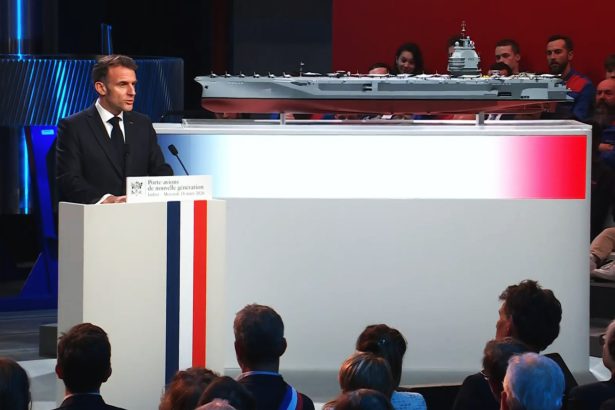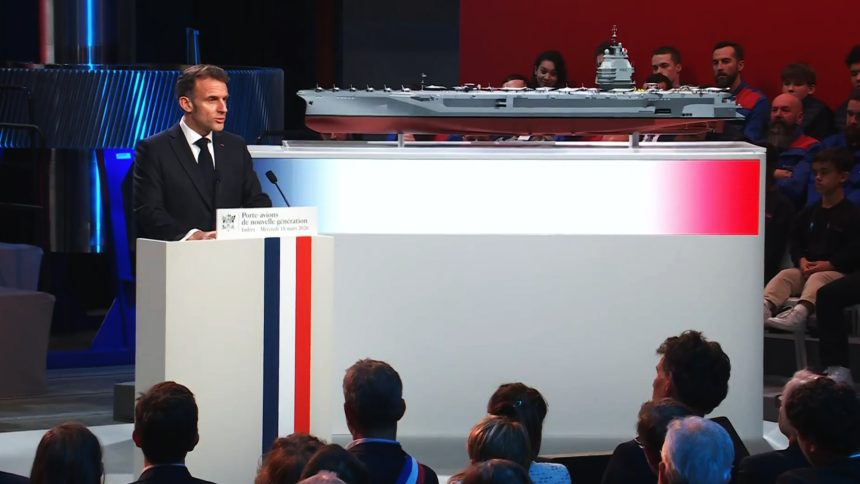
The France Libre, or Free France, will be powered by two nuclear reactors, displace just shy of 80,000 tons, and is planned to enter service and replace the Charles de Gaulle from 2038.
French President Emmanuel Macron announced the name, which pays tribute to French citizens who resisted Nazi rule during the Second World War, during a press conference on Mar. 18, 2026. The project has, until now, been known as Porte-Avions de Nouvelle Génération or PANG.
Upon entering service, the France Libre (R92) will almost certainly take the title of the largest warship in Europe. At around 78,000 tons the carrier is planned to displace a marginal amount more than the estimated in-service displacement of the Royal Navy’s Queen Elizabeth class, but it will, with a length of 310 m (1,020 ft) and beam of 90 m (300 ft), be physically larger. This will make the France Libre around 50 m longer than the Charles de Gaulle (R91) it is due to replace, and almost twice the tonnage.
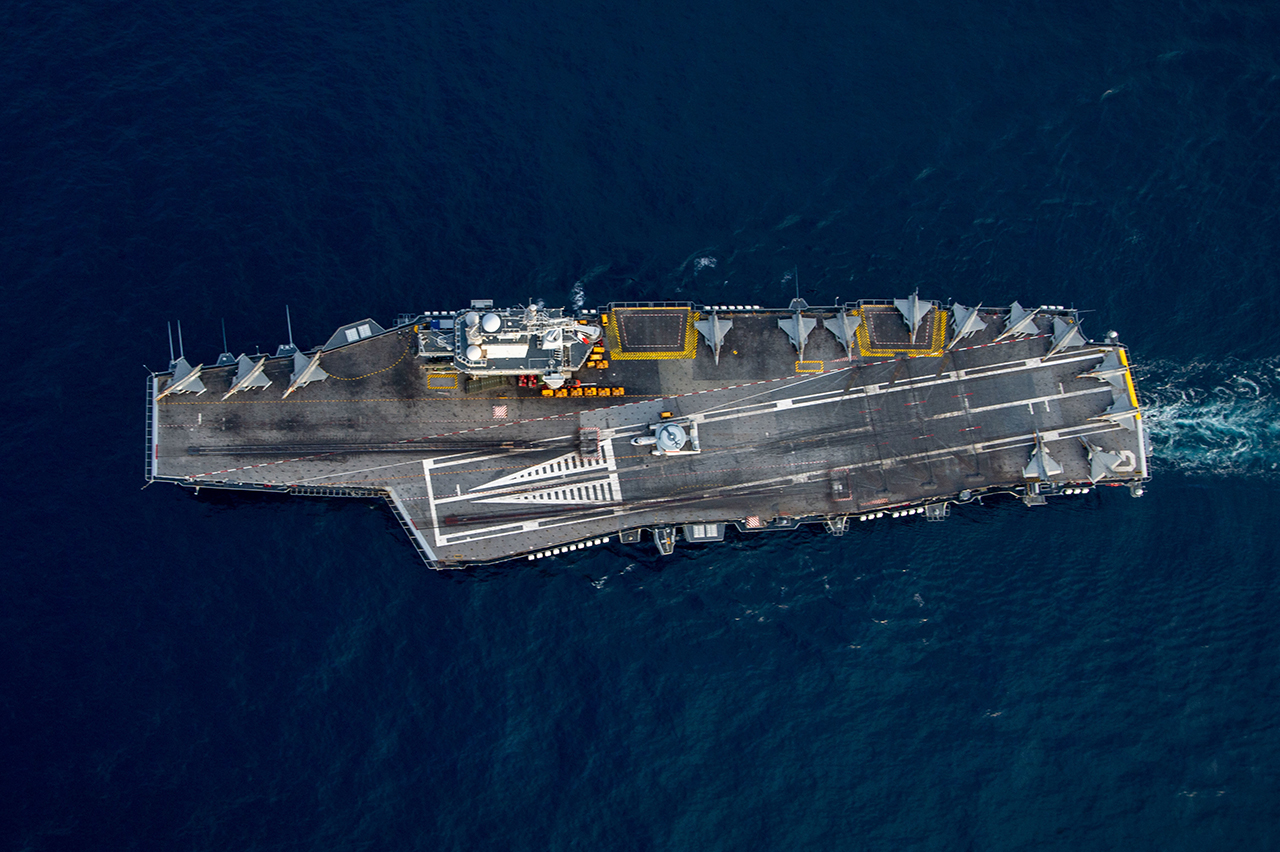
Increasing the size can allow for a greater number of aircraft to be carried, but most importantly it provides for a much increased sortie generation rate and improved safety on deck. More space means more area for deck handlers to maneuver, prepare, and arm aircraft before they are taxied to the catapults. Taking advantage of the boost in length, the France Libre will be able to accommodate the simultaneous launching and recovery of aircraft. On Charles de Gaulle, the two steam catapults overlap with the angled landing area to give them the necessary length for getting to launch speed.
France Libre will feature three electromagnetic aircraft launch system (EMALS) catapults as well as the Advanced Arresting Gear (AAG) developed for the U.S. Gerald R. Ford class. The Charles de Gaulle, for comparison, was completed with two steam catapults based on those of the Nimitz class.
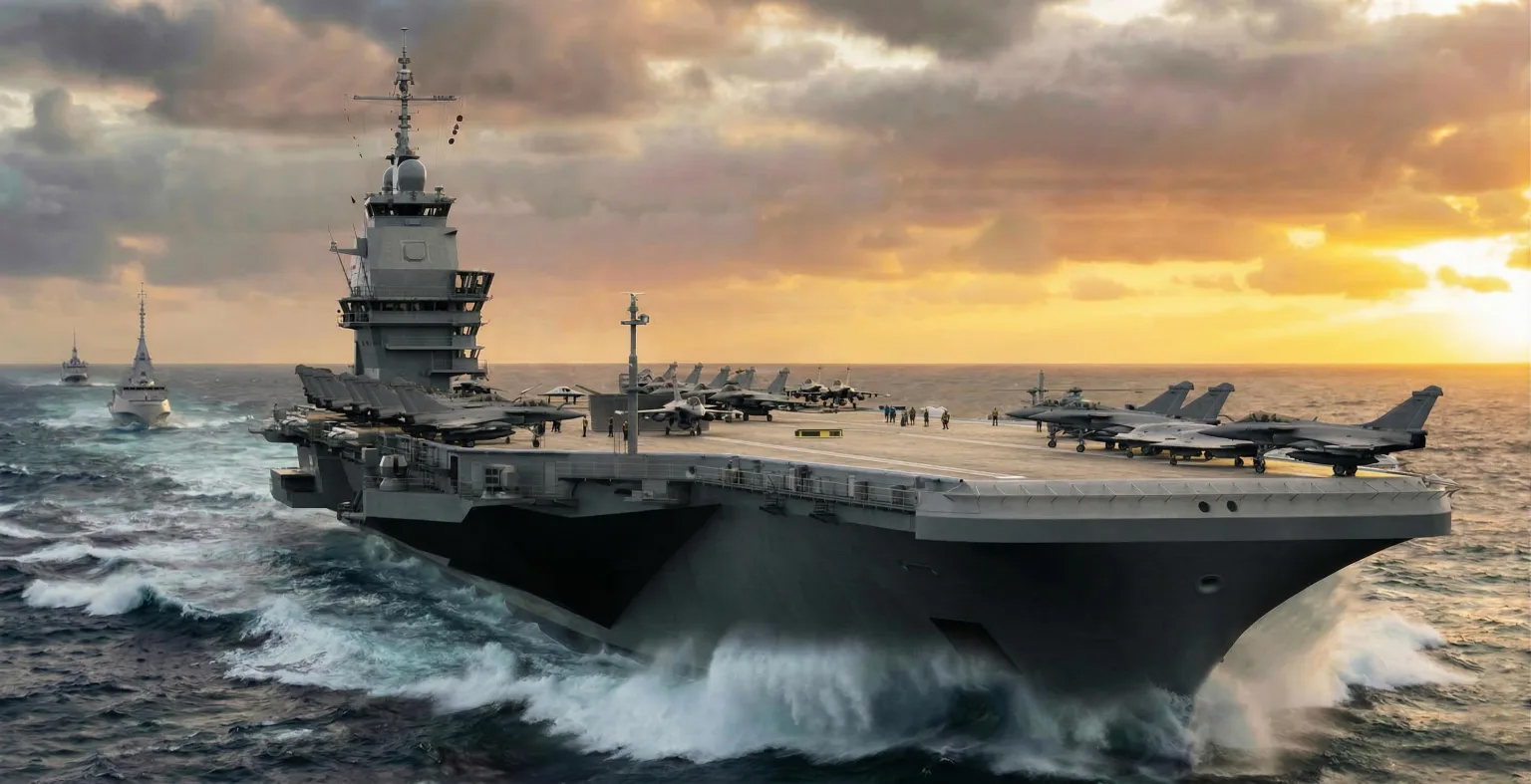
Various renderings and models released in recent days as well as over the previous few years indicate that the carrier’s air wing is envisioned to be somewhat similar to the Charles de Gaulle, featuring the Dassault Rafale M, E-2 Hawkeye, and the NH90 Caïman helicopter. Provisional designs of a sixth generation fighter aircraft (presumably the troubled Future Combat Air System (FCAS)) have also appeared in some depictions, as have unmanned aerial vehicles (UAV).
Macron said the name was chosen to invoke a direct lineage from the Charles de Gaulle, named for the leader of the Free French Forces and subsequent President of France. “In this name lives the memory of the women and men who stood up against barbarity, united to save the homeland, determined to defend a certain idea of our nation,” he remarked. “This name therefore seals a pledge for the future: to remain free, we must be feared. To be feared, we must be powerful.”
Vive le France Libre ! pic.twitter.com/OydF3TtY2F
— Emmanuel Macron (@EmmanuelMacron) March 18, 2026
The French President visited the Charles de Gaulle last week as it moved into the Mediterranean ready to defend French allies and interests from the threat of Iranian drones and missiles.
Votre présence démontre la puissance de la France, puissance d’équilibre et de paix, aux côtés de ses amis. pic.twitter.com/ME0SbiKhhx
— Emmanuel Macron (@EmmanuelMacron) March 9, 2026
Some of the more complex, long-lead elements of the carrier’s nuclear powerplant have been in production since 2025. The carrier itself will be assembled at the vast Chantiers de l’Atlantique shipyard in Saint-Nazaire – Europe’s largest shipyard – from 2031, and sea trials are planned from 2036.
Single Carrier Strategy
Although PANG evolved from a plan to create a complementary carrier for the Charles de Gaulle, when the years kept passing without any firm commitment to the build it morphed into a replacement program. The Charles de Gaulle began sea trials in 1999, and by 2038 will be in the twilight years of its planned service life.
At present, the France Libre has been billed as a single vessel, with no sister ships. Unless this changes, it will inherit the Charles de Gaulle’s biggest flaw. When France’s single carrier is unavailable there is no alternative.
For a nuclear powered vessel this is particularly important to note, as a substantial period out of service during its career is an almost dead certainty due to the need to refuel the nuclear reactors. The timing of this major overhaul would be dictated by the remaining viable fuel in the reactors as well as the material state of the vessel, and unlike a regular refit the process cannot easily be rushed.
#OTD in 2001, the French Navy’s flagship FS Charles de Gaulle entered active service, becoming the first nuclear-powerer aircraft carrier outside of the U.S. Navy. This is FS Charles de Gaulle with the world’s first nuclear carrier, USS Enterprise. pic.twitter.com/Q9F86HbnkK
— U.S. Naval Institute (@NavalInstitute) May 18, 2024
Charles de Gaulle began its first 18 month long refueling process in 2007, and completed a second refueling in 2018. If this pattern continues, the carrier will be due for another refueling in the next few years. Notably, this refueling process is shorter than those of U.S. aircraft carriers – however, U.S. carriers are designed to only require refueling once during their fifty year lifespan.
Carrier Comparisons
While comparisons between them are in some ways not helpful – the UK and France are close allies, cooperating on many matters of military strategy including carrier deployments – the natural point of comparison for French carriers is always those of the Royal Navy.
The two navies are out of sync in terms of their carrier development processes, meaning while one country is working up a brand new carrier the other country’s carrier(s) are around halfway through their envisioned careers, which adds to the difficulty in comparing them. Nonetheless, the key difference regularly noted by many is France’s use of catapult assisted take-off but arrested recovery (CATOBAR) configurations for its aircraft carriers while the Royal Navy, since the Invincible class, has opted for short take-off and/or vertical landing (STOVL) designs.
Nuclear armed air-launched cruise missile ASMP-A loaded on a Rafale M about to launch from French aircraft carrier Charles de Gaulle. 2023. pic.twitter.com/Gn5g64nHjK
— Tom Antonov (@Tom_Antonov) February 13, 2025
CATOBAR allows for the operation of a larger array of manned aircraft, including larger, fixed wing airborne early warning (AEW) and more capable fighter aircraft. However, the additional training and maintenance requirements of this configuration are significant. Ever since the Falklands War, the UK has embraced the concept that aircraft carriers could be utilised by aircraft both of the Fleet Air Arm and the Royal Air Force – the training requirements for vertical landings being part of the basic practices for any aircraft equipped for it. France, meanwhile, maintains separate units for land-based Rafales compared to naval configured Rafales.
Video shows F-35Bs launching from the deck of HMS Queen Elizabeth as the vessel and her air wing joins the fight against Islamic State. These are the first ever combat sorties flown from the carrier. pic.twitter.com/KbzIBiwLhe
— UK Defence Journal (@UKDefJournal) June 22, 2021
The UK’s decision to forgo nuclear propulsion, unlike France, is also heavily critiqued. Nuclear propulsion has many advantages, though the lengthy maintenance requirements are a major pitfall, and it adds significant cost to the construction of a vessel. The UK’s two conventionally powered carriers, meanwhile, can cover for each other while one is in refit. There is the additional safeguard of NATO and bilateral defence cooperation that can allow carrier availability of different nations across Europe to be balanced with each other, ensuring there is always a certain minimum level of capability. Outside of France, only the U.S. has successfully operated a nuclear powered aircraft carrier – though China is rapidly catching up.
It’s very easy to quickly write off one carrier as better than another, but the reality is that there is no real right answer when it comes to which of these two approaches are better.