The Belgian Air Force has been testing the FZ275 laser-guided rocket and APKWS II on its F-16s to effectively counter the evolving threat of cheap attack drones.
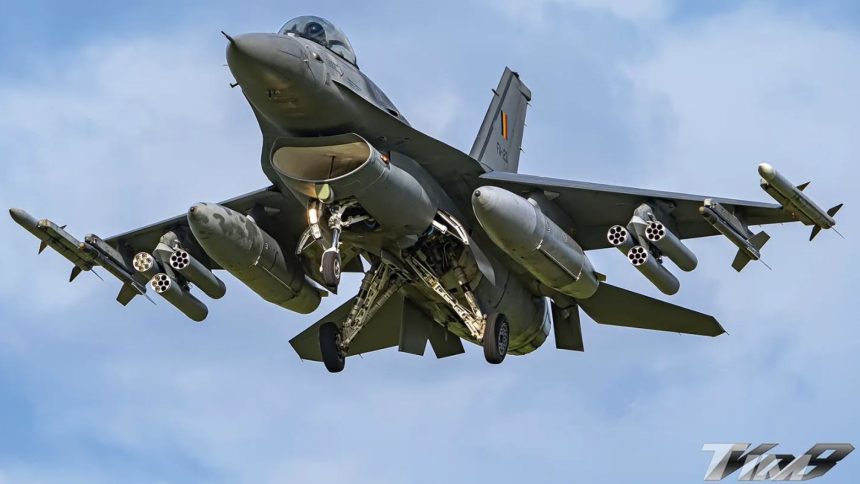
A Belgian Air Force F-16AM was spotted while flying with six seven-round LAU-131A/A rocket pods installed on Triple Ejector Racks (TER). The aircraft is being used to test domestically-made 2.75 inch/70 mm FZ275 Laser-Guided Rockets (LGR) as part of trials, underway since the beginning of this year, for the employment against low-cost attack drones.
The FZ275 was jointly developed by Forges de Zeebrugge (FZ) and Thales, and is considered a counterpart to the U.S.-made APKWS II. The image was published on Mar. 8, 2026, by aviation photographer ‘Tim VdB Photography’, who told us he captured it at Kleine Brogel Air Base, home to the 10th Tactical Air Wing, on Feb. 27, 2026.
This is also possibly the first time that an F-16 was seen airborne with the six LAU-131A/A pods for laser-guided rockets, which give the aircraft a 42-round capacity. A previous instance in which this loadout was spotted was on the ground in June 2025 at Shaw AFB, South Carolina, when a U.S. Air Force F-16CM was photographed during a munitions load event for a larger APKWS II payload.
Belgium’s Directorate General of Material Resources (DGMR) later shared the image on X on Mar. 11, 2026, touching upon the current need to develop cost-effective weapons systems and tactics against low-cost attack drones, instead of expensive surface-to-air missile systems. The agency said that the FZ275 is being tested alongside BAE Systems’ AGR-20F FALCO (Fixed Wing, Air Launched, Counter-Unmanned Aircraft Systems Ordnance) for the C-UAS role.
Tijdens recente conflicten hebben we gezien dat goedkope attack‑drones immense schade kunnen aanrichten. Klassieke luchtafweermiddelen inzetten tegen dit soort dreiging is vaak extreem duur.
— Material Resources (@DGMR_News) March 11, 2026
Belgian F-16s with six LAU-131s
Tim told The Aviationist that the F-16 in the image was part of a two-ship formation that he photographed in the afternoon of Feb. 27, while they were returning from a training sortie. In the image, we can see ten rockets still in two of the LAU-131A/A pods of the starboard (right-side) wing – the pod on the top right has its full load of seven FZ275 LGRs, while the pod in the middle has three.
The F-16 is also carrying inert AIM-9 Sidewinder short-range air-to-air missiles (missing the front fins) and AIM-120 Advanced Medium Range Air-to-Air Missile (AMRAAM). A photo of the two F-16s flying overhead shows the second F-16 similarly equipped with AIM-9s and AIM-120s, as well as a Sniper targeting pod.
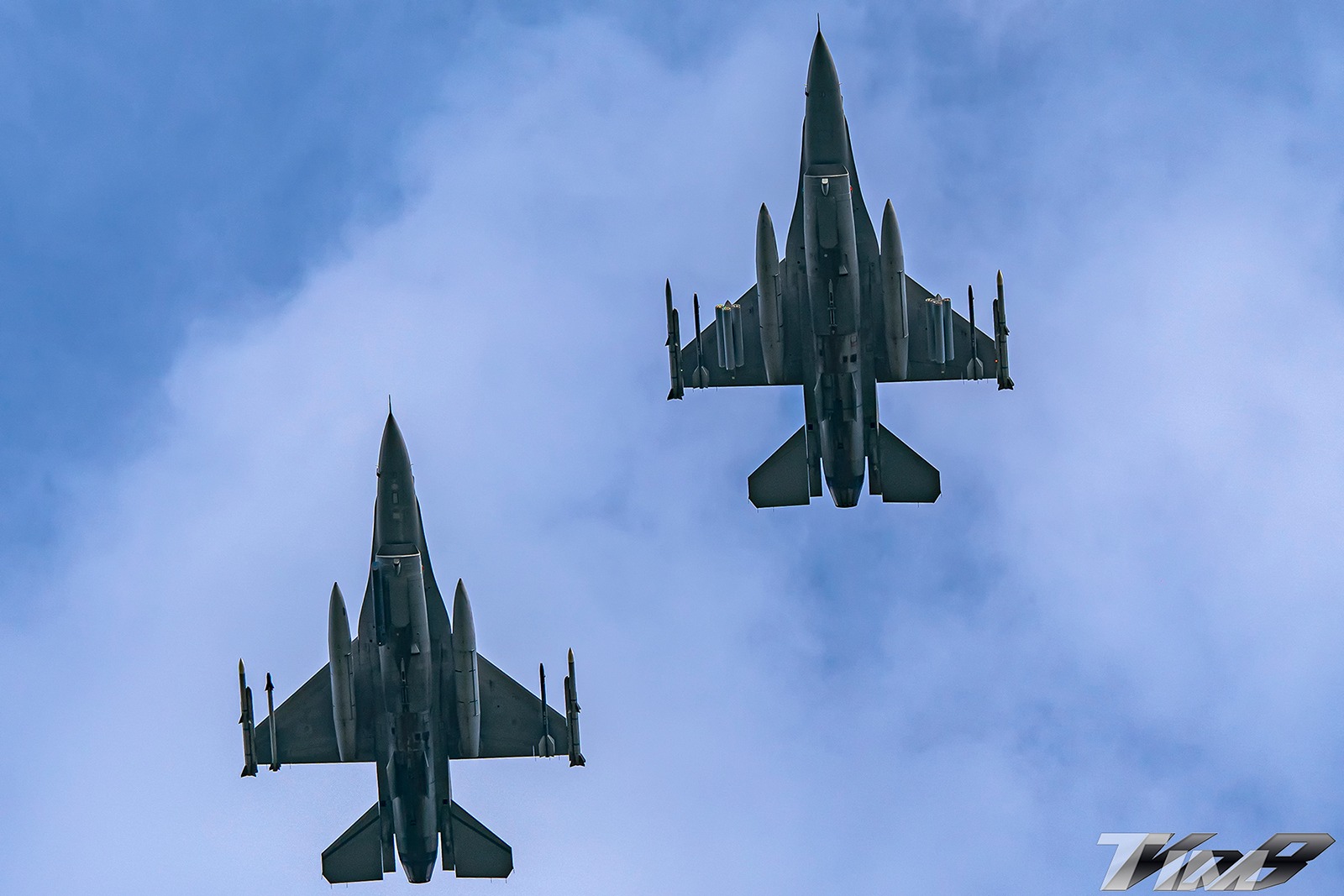
It is unclear if the F-16 expended some of the LGRs, while the other F-16 lased the targets with the Sniper pod during the test mission. “The other F-16 was carrying the Sniper pod, probably for designating/lasing the target,” Tim told The Aviationist.
As we have explained before, APKWS II rockets costing around $30,000 apiece are much cheaper and cost effective in destroying Shahed/Geran-type One-Way Attack (OWA) drones worth more than $20,000, instead of AIM-9s and AIM-120s worth around $450,000 and over $1 million, respectively.
The issue was also mentioned as a reason for these tests by the DGMR in its X post:
“Attack-drones pose a major and cost-effective threat in recent conflicts. Our Belgian Air Force is therefore testing laser-guided 70mm rockets, including the Belgian FZ275 LGR from Thales, to efficiently neutralize attack-drones.
Belgian Defence is preparing for the future.
During recent conflicts, we have seen that inexpensive attack drones can cause immense damage. Deploying traditional air defense systems against this type of threat is often extremely expensive.
To evolve with the threat, our air force is working on integrating laser-guided rockets that can efficiently neutralize drones. This involves not only the American AGR-20F, but also solutions from our own Belgian industry.
Since the beginning of this year, the Belgian Air Force has been conducting test campaigns with the 70mm FZ275 LGR from Thales Belgium, with a view to integration on our F-16s. With these steps, we are working on an effective, affordable, and future-oriented weapon against attack-drones.
Threat evolves, we evolve along.”
C-UAS loadouts on F-16s
According to FZ, the FZ275 LGR has a Semi-Active Laser (SAL) seeker, and the guided rocket “closes the gap between the long-range high-value missiles and the shorter range guns/cannon and unguided rockets, thus affording a full range of precision effects from a platform to defeat soft and light armoured targets.”
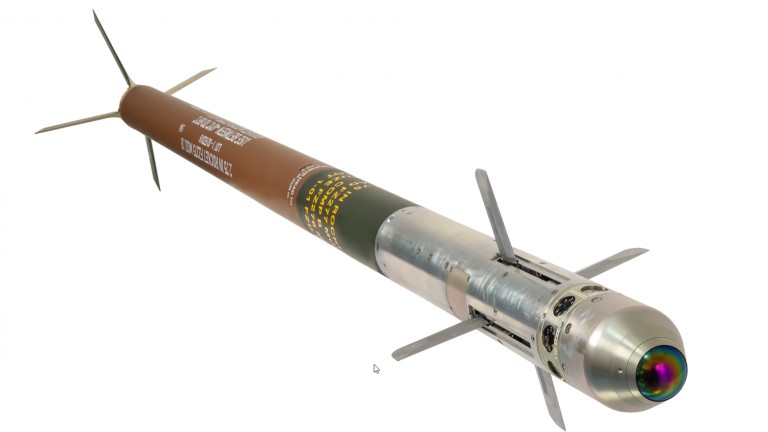
U.S.-based Arnold Defense, the manufacturer of the LAU-131 series of rocket launchers, had announced in January 2022 that the 2.75-inch/70mm FZ275 rockets were certified to be fired from its LAND-LGR4 launcher. There is however no information on when the FZ275 was certified on the LAU-131A/A specifically.
Ukraine too is poised to use the FZ275 LGR since it signed an Memorandum of Understanding (MoU) in November 2024 with Thales Belgium to jointly produce the rocket, and develop a new warhead under a transfer-of-technology (ToT) arrangement, Militarnyi reported. The rocket’s current warhead is designated as the FZ123, and features a small explosive charge and thousands of small steel ball bearings for area effects.
What is believed to be the first known footage showing an F-16 fighter jet operated by the Ukrainian Air Force intercepting a Russian Shahed/Geran-type long-range OWA-UAV with the APKWS II low-cost, laser-guided anti-aircraft rockets.
Such rockets are carried in LAU-131 rocket… pic.twitter.com/JTsCsgQ7NP
— Status-6 (War & Military News) (@Archer83Able) February 17, 2026
Ukraine, which uses the Advanced Kill Precision Weapon System II (APKWS II) from both its vehicle-mounted Vampire system and its F-16s for the C-UAS role, will also be able to use the FZ275 LGR from the former, Militarnyi added. Thus, it can be safely assumed that the Ukrainian Air Force would in the future use the FZ275 LGRs from the LAU-131A/A pods on its F-16s in place of the 2.75 inch Hydra rockets, given the latters’ limited numbers.
A video of an AGR-20 FALCO intercept. pic.twitter.com/Oee0UDEpcm
— Shahryar Pasandideh (@shahpas) April 9, 2025
Footage from a UKrAF F-16’s Sniper targeting pod captured the aircraft using its APKWS IIs against a Russian unmanned system in a Feb. 17, 2026, video. Prior to that, a December 2025 image showed a UKrAF F-16 carrying one LAU-131A/As rocket pod under each wing.