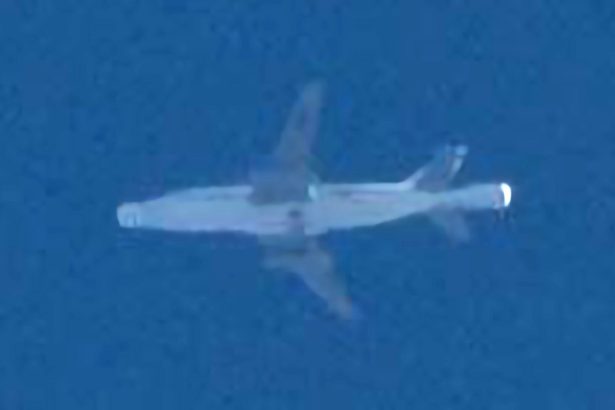
The Hava SOJ program envisages four aircraft, based on the Bombardier Global 6000 aircraft, with Aselsan developing the payload and Turkish Aerospace Industries (TAI) integrating it.
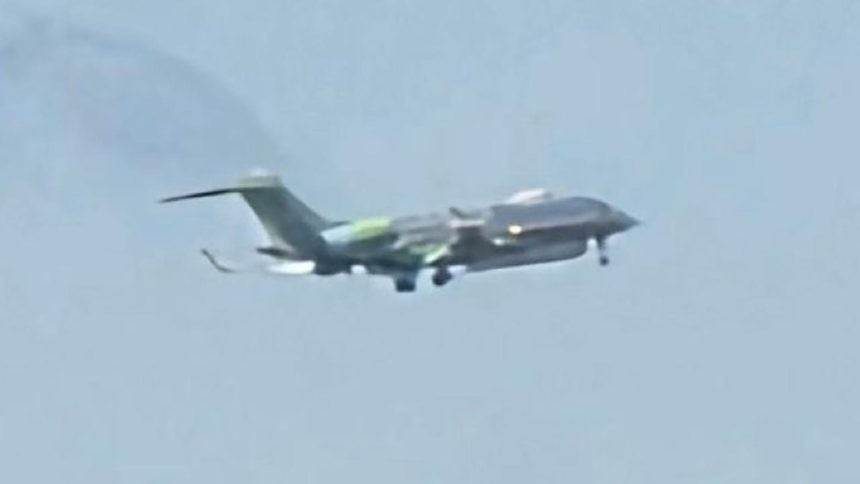
The first of the Turkish Air Force’s (Türk Hava Kuvvetleri – THK/TurAF) Stand-Off Jammer (SOJ) aircraft was photographed Mar. 1, 2026, in flight at the Turkish Aerospace Industries’ (TAI) facility in Ankara. Two of the aircraft, based on the Bombardier Global 6000 business jet, had also been tracked live on Feb. 20, 2026, as ‘THS42’ and ‘THS41’ during test flights.
It is not clear if the image, captured by photographer ‘ahmet8630580179’ pertains to these flights or a new trial flight, part of what could be the testing and certification campaign. The image was widely shared by several Turkish accounts and reported by ‘TurDef’.
The program is a collaboration between aircraft manufacturer TAI and defense electronics, radar and avionics major Aselsan.
Simultaneously conducted land and air platform based radar and jammer projects
➡️Air SOJ
➡️MIT Intelligence Aircraft
➡️IHA-SOJ (ASOJ-234U)
➡️Kara-SOJ 1 (Koral-1)
➡️Kara-SOJ 2 (Koral-2)
➡️AEW-C (ALP-200A)
➡️IHA AEW-C (Baykar-S band early warning radar) https://t.co/pfcATqqKWq pic.twitter.com/rv1sqF5Lt6
— TR_tech (@T_Nblty) March 1, 2026
Ulusavunma’s reports from May and September 2025 have called the project the Hava SOJ (Stand-Off Jammer), which envisages four platforms to be delivered to the THK starting in 2026. The term ‘Hava’ in Turkish, Central Asian Turkic languages, Urdu and Hindi means ‘air’.
Other Turkish defense commentators, like Oğuzhan Uygun and ‘Avionot’, have also called the project as the ASOJ 23-A, which could be the designation post-conversion for the aircraft.
The current image and an AI-enhanced picture show a large canoe-like faring, possibly hosting an array, on the underside, and long dorsal dome-shaped antennae along with antenna blades running across the spine and the underbelly.
Aircraft conversion
As mentioned earlier, Turkish reports have said the ASOJ 23-A program envisages four of the Global 6000-based systems to be delivered. These, which ‘Avioniot’ told The Aviationist were acquired between 2019 and 2020, already commenced conversion at TAI.
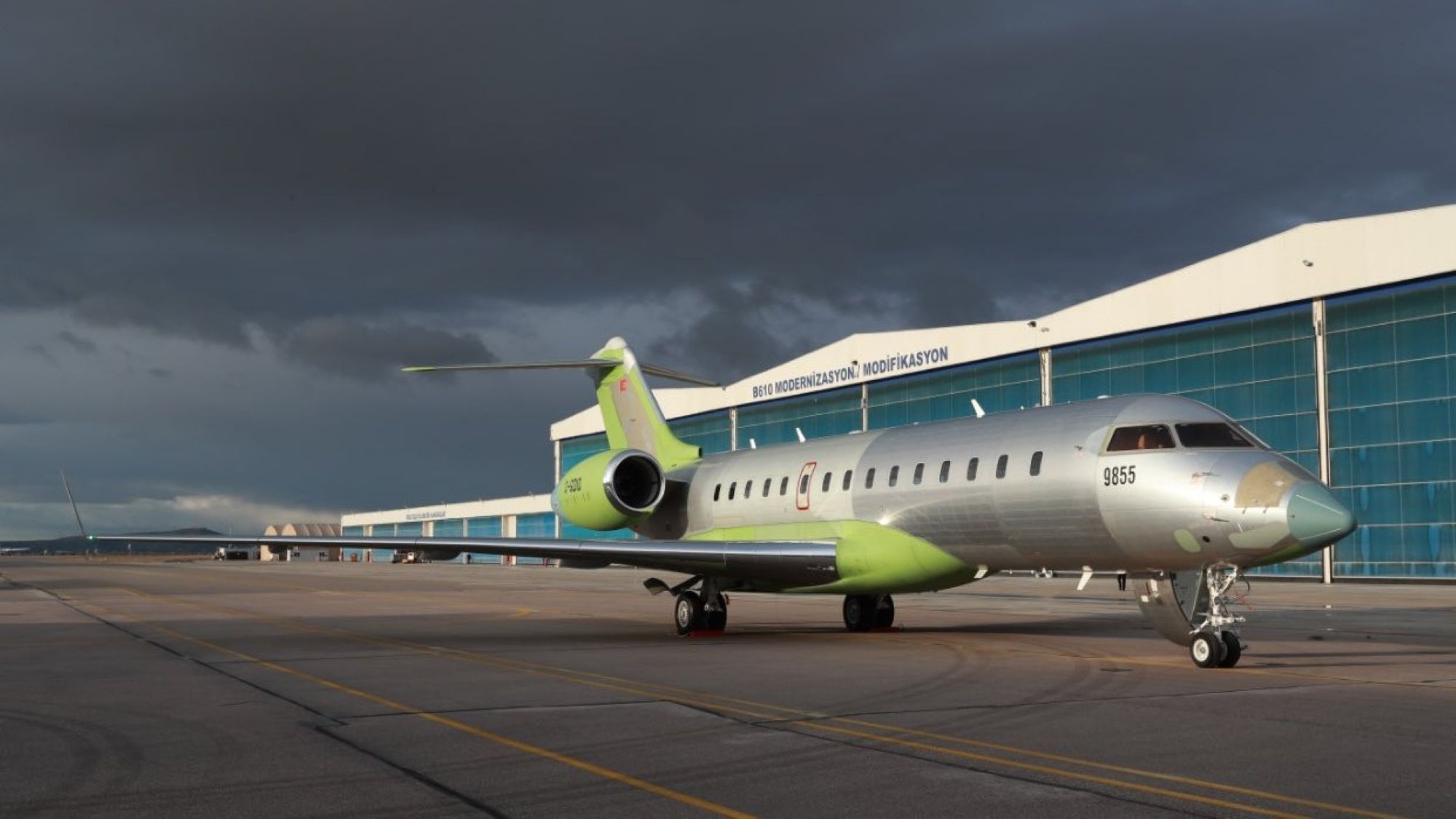
There are two known airframes that have been officially photographed. Avionot shared with us an official image of one of the aircraft, when the Secretariat of the Defence Industries (SSB) announced on Mar. 15, 2019, it had reached the TAI facility for conversion.
SSB tarafından elektronik harp özel görev uçakları geliştirilmesi amacıyla başlatılan HAVA SOJ Projesi kapsamında hayata geçirilecek sistemlerin entegre edileceği iki uçak Türkiye’ye geldi. pic.twitter.com/w8LY4myo0z
— SSB (@SavunmaSanayii) March 15, 2019
This was serial 9855, seen prior to conversion and installation of Aselsan’s EW/SIGINT payloads. The other airframe bore the serial 9854 and registration C-GBYG. Which one of the two took flight is not known, but the tail numbers can be expected to have been changed to local Turkish registrations post conversion.
SSB tarafından elektronik harp özel görev uçakları geliştirilmesi amacıyla başlatılan HAVA SOJ Projesi kapsamında hayata geçirilecek sistemlerin entegre edileceği iki uçak Türkiye’ye geldi. pic.twitter.com/w8LY4myo0z
— SSB (@SavunmaSanayii) March 15, 2019
The conversion work for then-designated Hava SOJ could also have been a part of a $18.9 million Electronic Warfare System Project contract signed between the SSB and Aselsan which Savunmasanayist reported in December 2020. “ASELSAN, which has developed numerous electronic warfare systems that can be deployed on various platforms so far, is meeting the Turkish Armed Forces’ needs in this field with national resources. Furthermore, it is anticipated that ASELSAN-produced systems will also be used in the HAVASOJ aircraft, which are currently under production for the Turkish Air Force Command,” the report said.
The report also included an image of Aselsan’s truck-mounted KORAL EW system and a rendition of the Hava SOJ aircraft. As per earlier reports, TAI was responsible for “Group-A structural modification designs” on the Bombardier Global 6000, which included internal and external alterations like the Electrical Power Distribution System (EPDS), the Cooling System, detailed component manufacturing, modification, assembly and system integration.
Radar Terminatörü ASOJ 23-A’dan ilk yüklü uçuş
Tüm elektronik sistemleri ASELSAN tarafından geliştirilen ve TUSAŞ tarafından da uçağa özel montaj işlemleri yapılan, “uzun menzili karıştırıcı” ASOJ 23-A’ların ilki tüm yüklü uçuş sırasında görüntülendi.
Yüzde yüz yerli olarak… pic.twitter.com/Epn3vcjfQG
— Oğuzhan Uygun (@ogzhn_uyg) March 2, 2026
The company would also test the effects of external modifications on flight control, stall prevention and finally deliver the four SOJ aircraft with their Military Supplementary Type Certificates (STC) to the Air Force Command. Savunmasanayist reported in June 2021 that TAI partnered with Turkish Cabin Interiors (TCI) to manufacture, install and certify the “galley, lavatory, closet, crewrest, sidewalls, and other interior cabin components” on the Global 6000.
Then, Savunmasanayist additionally reported in November 2021 that the SOJ aircraft would be equipped with Leonardo’s Miysis Directional Infrared Countermeasures (DIRCM).
🇹🇷 Milli Savunma Bakanı Yaşar Güler:
“Hava SOJ çok önemli. TUSAŞ ve Aselsan yoğun faaliyetler yürütüyor. 2025 ve 2026’da 4 uçağımız hazır olacak.” pic.twitter.com/JBnKXxBxpa
— Turan Oguz (@TyrannosurusRex) May 3, 2024
Payload systems and capabilities
Aselsan’s website does not mention either the EW or SIGINT-related payloads on the ASOJ 23-A/Hava SOJ. However, the company has a large portfolio of ground-based EW and podded EW technology like the ANTIDOT-series, which is used on the Artificial Intelligence (AI)-enabled version of the Bayraktar TB-2, the TB2T-AI.
The SOJ’s description by Turkish commentators and defense journalists fits the role of a classic airborne electromagnetic spectrum combat platform, broadly sharing the same mission profile as the EA-37B Compass Call, the French Archange, or the Australian MC-55A Peregrine.
The HAVA SOJ, which will be one of the Turkish Air Force’s most strategic aircraft, has not yet been shown to the media by officials, but they are flying. Will we finally get a glimpse of this beast? We’re waiting… https://t.co/BJHe5TqUCv pic.twitter.com/0op79IZqoj
— TR_tech (@T_Nblty) November 27, 2025
According to Turkish journalist Yusuf Akbaba, the HAVA SOJ is a, “Remote Electronic Listening/Electronic Attack system integrated into an air platform, for the purpose of listening to, jamming, suppressing, and/or deceiving all kinds of enemy radar and communication capabilities without entering the threat zone, in offensive air operations to be conducted against threat countries.”
Turkish accounts have also been stressing upon an SSB and Ministry of National Defence push to have indigenous EW capability and not depend upon foreign systems, given the sensitive nature of the technology. We have seen this desire also in Japan, which had announced the development of its own airborne EW platform and whose C-2-based EC-2 Stand-Off Jammer recently broke cover.
HAVA-SOJ : TEK BAŞINA SAVAŞ KAZANDIRAN UÇAK
Ona “Uçan Koral” da diyebiliriz. Dün 2 adet HAVA-SOJ uçağı Ankara semalarındaydı. Türk Hava Kuvvetlerine teslim edilmeden önceki son testleri için.
NEDİR HAVA-SOJ?
Keramet uçakta değil, uçağın içindeki Elektronik Harp… pic.twitter.com/PGNAbiS5S6
— Metehan (@mtkhanX) February 20, 2026
These aircraft monitor, detect, intercept and jam radio communications and radar emissions from both ground and air platforms, acting in concert with other special mission aircraft like Airborne Early Warning and Control (AEW&C) and Intelligence, Surveillance and Reconnaissance (ISR), through Electronic Support Measures (ESM) and Electronic Attack (EA) payloads, within the broader EW and Electronic Intelligence (ELINT) gamut. Some aircraft can also offer communications relay support to disparate air, ground and naval assets.