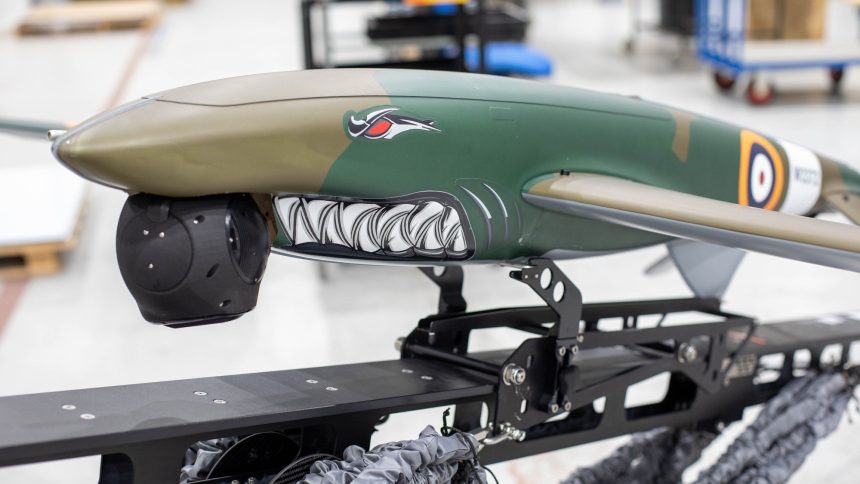
A new factory was unveiled in the UK dedicated to the production of Unmanned Aerial Systems for the Ukrainian Armed Forces.
As the fourth anniversary of the Russian invasion of Ukraine took place, a new factory was unveiled in the UK dedicated to the production of Unmanned Aerial Systems (UAS) for the Ukrainian Armed Forces.
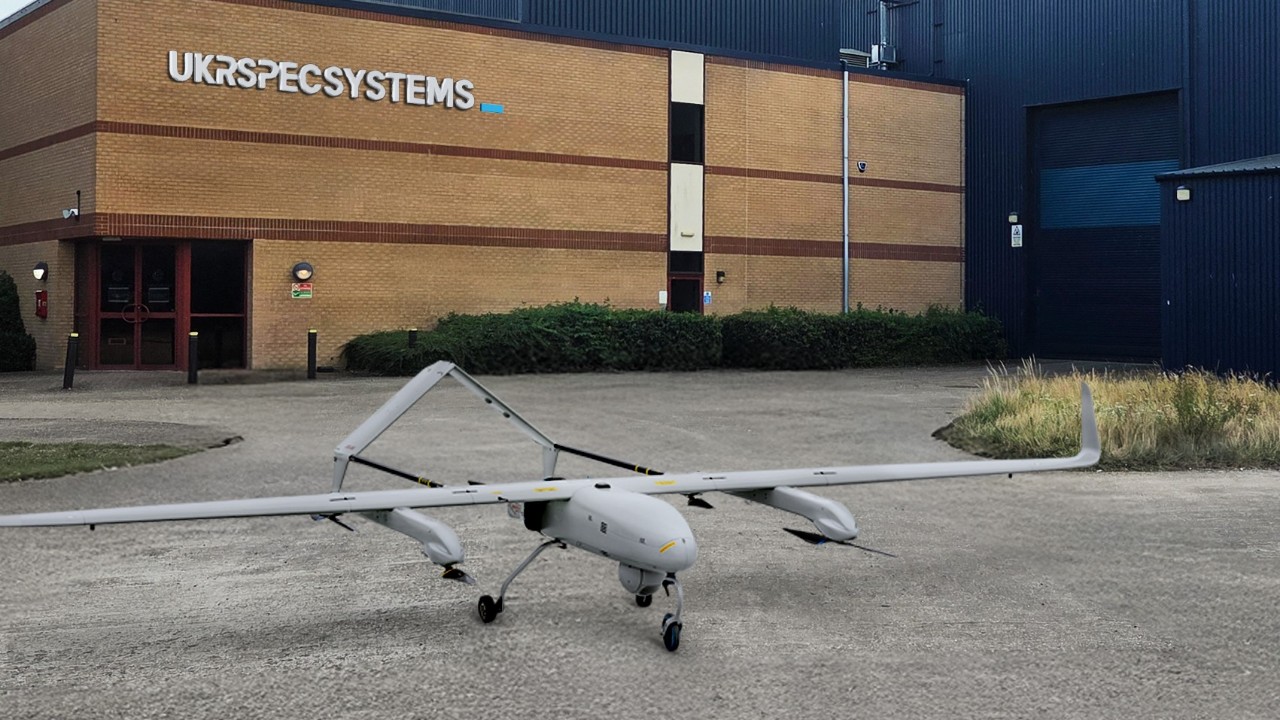
The 11,000-square meter factory is located in Mildenhall, Suffolk, close by to RAF Mildenhall, an overseas base used by the United States Air Force. It is also relatively nearby to a secondary facility in Elmsett, where a testing and training base will be established at the current airfield to prepare Ukrainian soldiers in the operation of the UAS, as a part of the UK-run Operation INTERFLEX.
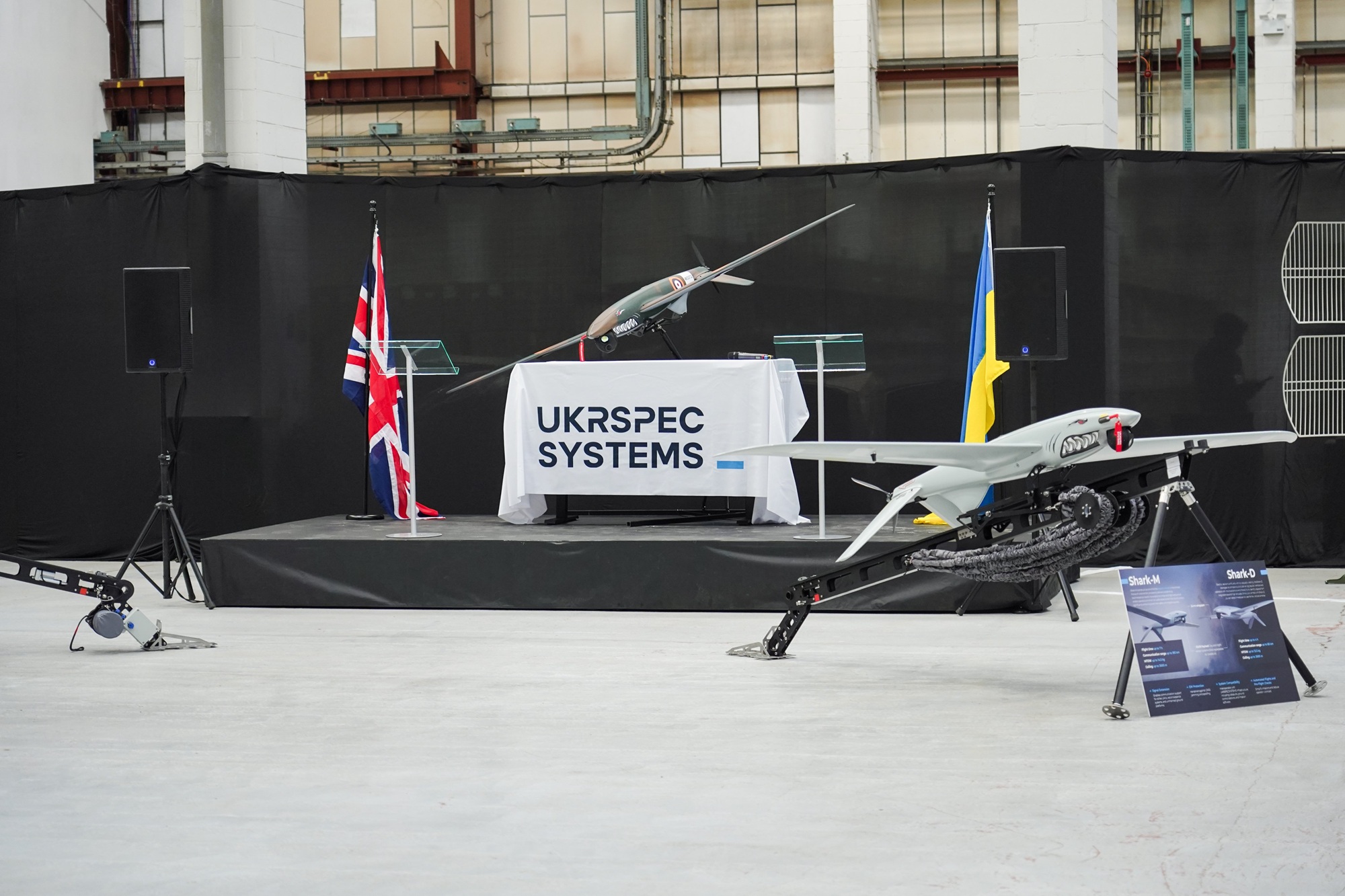
Operated by Ukraine’s largest drone manufacturer ‘Ukrspecsystems’, the factory aims to produce up to 1,000 drones of several types to aid the Ukrainian military in their fight against the Russian Federation. The company was founded in 2014 to provide drones to the Ukrainian military following the Maidan Revolution and Russia’s subsequent invasion of Crimea. They have since expanded production beyond Ukraine, first to Poland under licence with ALS Systems, and now to the UK where its drones will be made directly by the company.
Four years ago Russia invaded Ukraine. Today @Ukrspecsystems in Suffolk is building the weapons to fight back.@LukePollard opened the new factory yesterday where up to 500 UK jobs will be created. A clear message is sent: the UK will stand with Ukraine for as long as it takes. pic.twitter.com/XVTALS1GeM
— Ministry of Defence 🇬🇧 (@DefenceHQ) February 26, 2026
Ukrspecsystems is the first Ukrainian defence firm to invest in the UK for long term production of weaponry. They bring with them £200 million in investment for UK infrastructure, as well as a decade of experience designing and producing UAS that have been extensively battle tested.
This partnership gives Britain the ability to rapidly acquire its own advanced UAS, if the need arose, utilising Ukraine’s battlefield experience and technical knowledge. Meanwhile, Ukraine gains expanded production of essential warfighting material in a safe location that cannot be targeted by the Russian military.
The establishment of this facility stands as the first key pillar of the 100-year partnership signed by Ukrainian President Volodymyr Zelenskyy and British Prime Minister Sir Keir Starmer on Jan. 16, 2025, which set out how they would “Establish stronger and closer defence cooperation and industrial bases” for the mutual benefit of both nations.
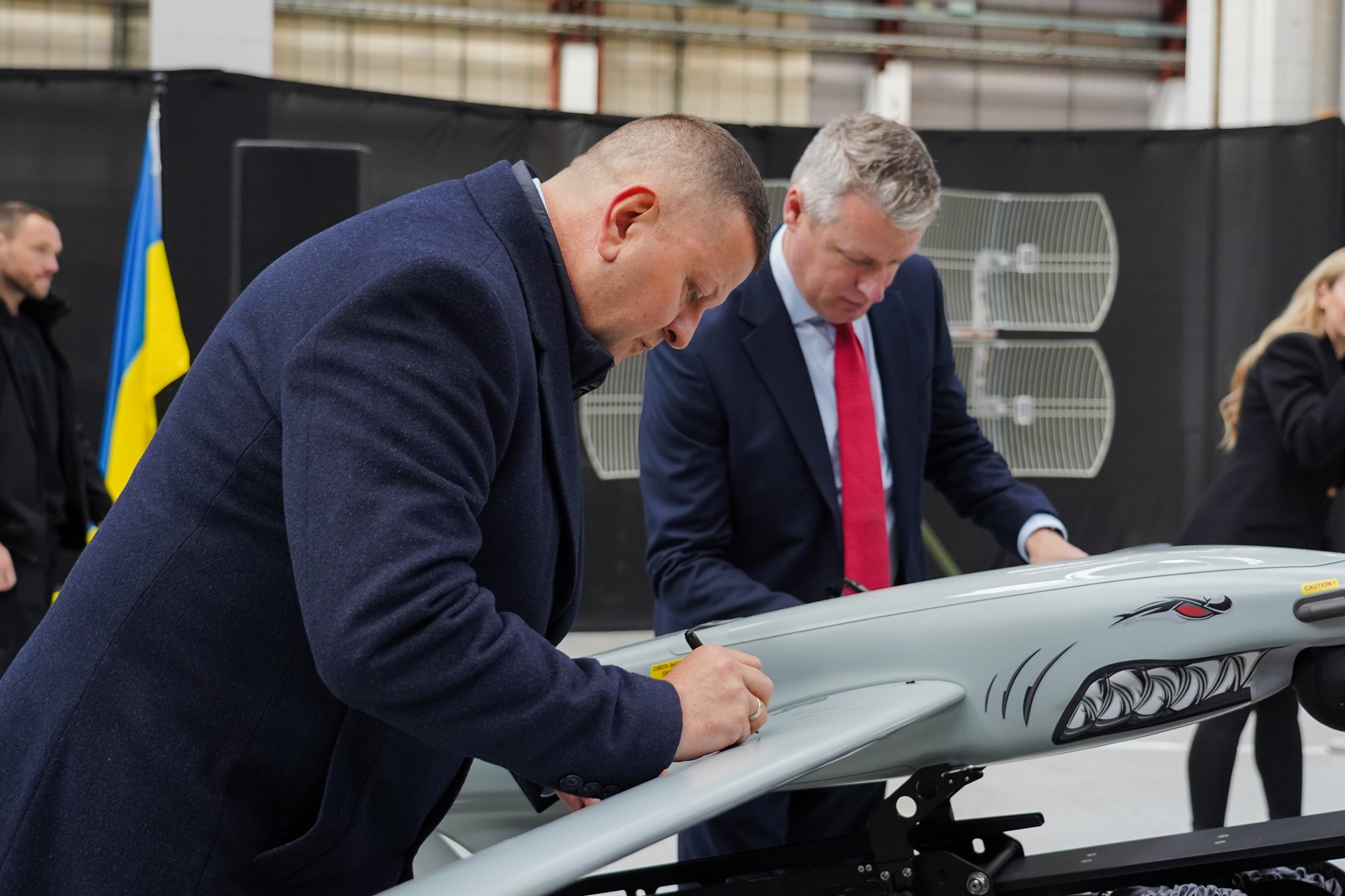
The opening of the factory was attended by both Minister of State for Defence Readiness and Industry Luke Pollard MP and Ukrainian Ambassador to the UK General Valerii Zaluzhnyi, both pictured above writing a message on a Shark drone that is intended to be delivered to Ukraine.
The first Ukrainian defense plant is starting to operate in the UK – a production complex of the Ukrspecsystems company, whose drones have long proven their effectiveness in high-tech warfare.
Ukraine is fighting in conditions of constant missile strikes, destruction of… pic.twitter.com/tZXi08cGaK
— Valerii Zaluzhnyi (@ZaluzhnyiUA) February 25, 2026
Luke Pollard MP had this to say on the opening of the facility:
“Our resolve to support Ukraine is stronger than ever, and we are backing Ukraine’s defiant Armed Forces as they fight for peace.
Ukrspecsystems’ new factory is a vote of confidence in UK support and underlines the deepening cooperation between our nations’ defence industries. This investment will create up to 500 new jobs in the East of England, drive defence as an engine for growth, and help Ukraine defend itself against Putin’s aggression.”
Additionally, General Zaluzhnyi stated that:
“This factory represents more than industrial cooperation – it is part of a new European security architecture built on shared responsibility and shared production. Ukraine brings battlefield experience and innovation, and together with the United Kingdom we are strengthening the capabilities needed to deter aggression.”
🗣️“In much the same way that the Spitfire is an icon for us, the Shark has become an icon for them”@reporternewton gets up close with the Shark drone – the Ukrainian company Ukrspecsystems has opened its first UK factory
Watch in full here 🔗 ⬇️https://t.co/ikeqQndWre pic.twitter.com/GCydYhYfjh
— BFBS Forces News (@ForcesNews) February 27, 2026
Finally, Director of Ukrspecsystems UK Rory Chamberlain said:
“Four years on from Russia’s full-scale invasion of Ukraine, this factory delivers what matters: secure supply, secure resource, and sustained support for Ukraine… Delivered with UK and Ukrainian Government support and in partnership with British SMEs, this is ‘Made with Ukraine’ in action – embodying the UK-Ukraine 100-Year Partnership through real industrial capability, happening now in East Anglia.”
Made with Ukraine – The Shark
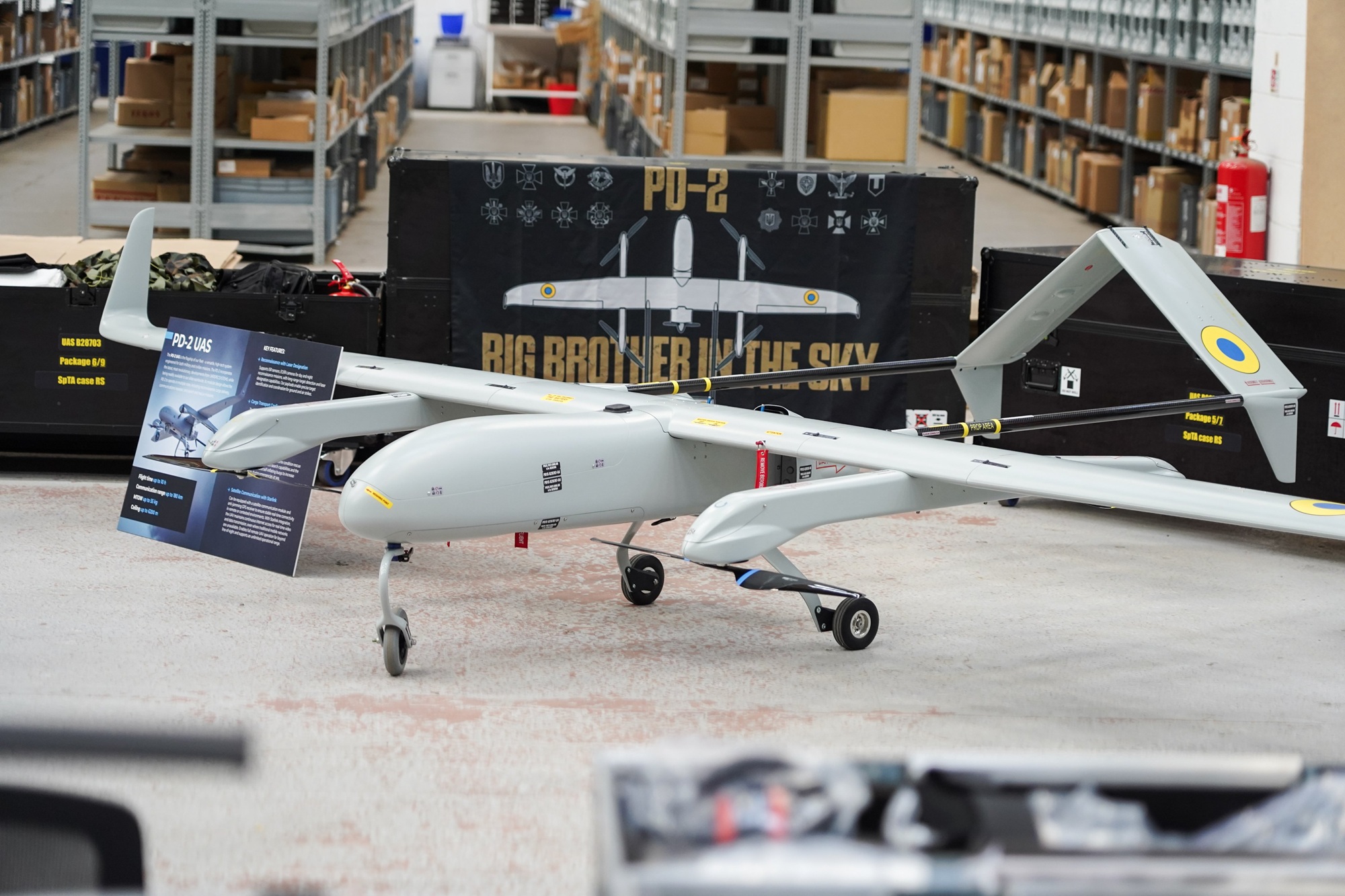
Being produced at the factory are several different types of reconnaissance UAS used by all branches of the Ukrainian military for various tasks, including target acquisition for strike drones, as well as wider surveillance and battle damage assessment duties. Their largest model, the PD-2 UAS is designed to carry either a cargo payload up to 11kg or various extra sensors, including Light Detection and Ranging (LiDAR) or a synthetic aperture radar (SAR). It can also be reconfigured to be vertical take off and landing (VTOL) capable, increasing the versatility of the airframe, although with limitations in range.
The PD-2 has an eight hour endurance, a 1,300 km max flight distance and a service ceiling of up to 4,700 m, which puts this drone in a tier lower than the popular Baykar Bayraktar TB2 produced by Turkey and popularised by Ukraine at the start of the invasion.
Smaller UAS produced here will include two variants of the Shark UAS, pictured here with the famous sharkmouth decal first seen on German aircraft during the First World War but popularised by 112 Squadron Royal Air Force ‘the Desert Sharks’ and later the Flying Tigers of the 1st American Volunteer Group (AVG) during the Second World War.
The Shark UAS comes in two variants, D and M, with the Shark-M featuring improved electronic warfare (EW) resistance allowing it to penetrate deeper into Russia’s frontline. These UAS require a catapult to launch, with all the operating equipment best stored within a 4×4 vehicle to ease their operation.
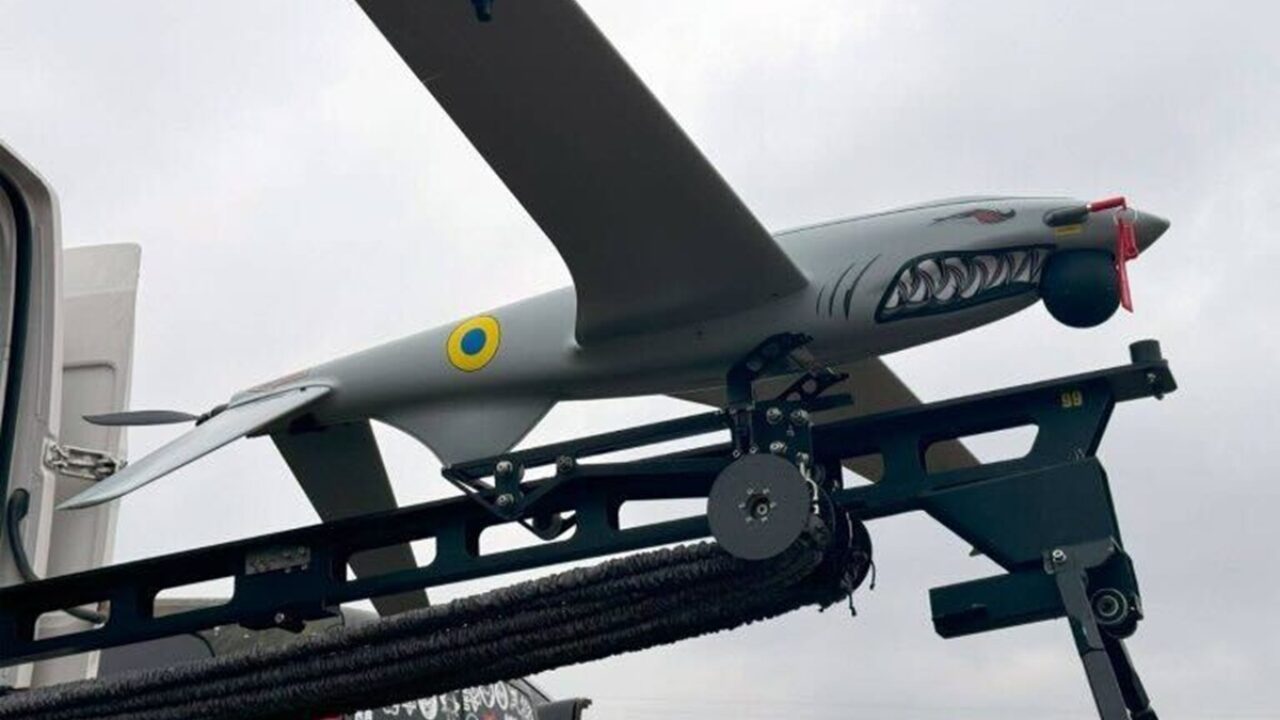
The Shark-D UAS has a four hour endurance and 80 km communication range with its operator, but this can be extended by signal hopping off other operational UAS. On the other hand the Shark-M has a seven hour endurance and a 180 km range as standard, as well as its EW enhancements, making it a superior, although more expensive alternative.
Both UAS can use a variety of different electro-optical and infrared cameras which are fitted on a gimbal near the nose of the system.
The Shark in action:
The larger footprint of the Shark and the PD-2 make them more sizable targets on the battlefield endangering their operators. However, the Mini-Shark UAS provides an even cheaper and safer substitute, being hand launched and requiring only two people to operate. All the necessary equipment can be carried in specialised backpacks enabling the smallest units to operate the UAS although at the cost of range and flight duration.
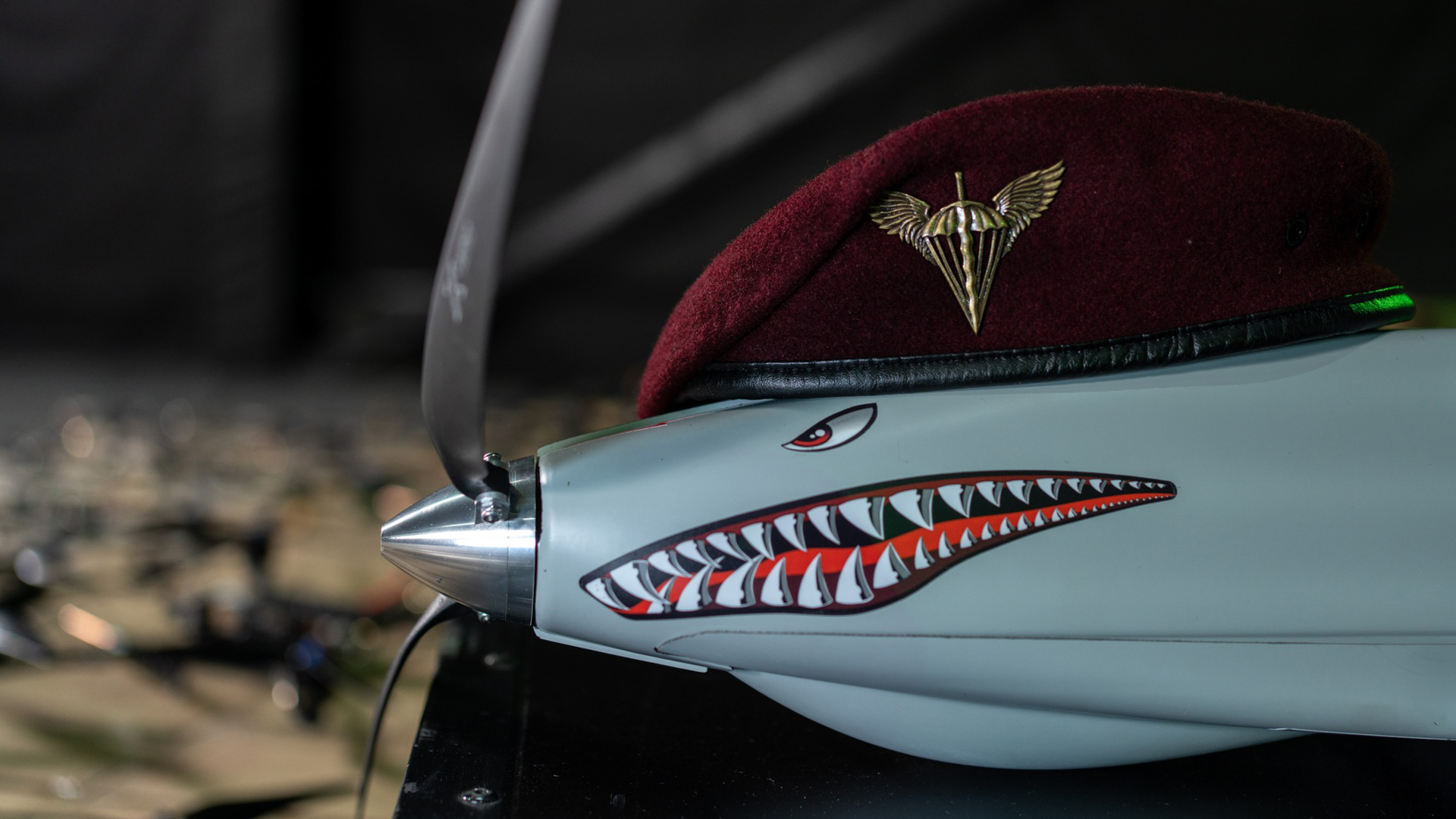
The Mini-Shark has a three and a half hour endurance and a 45 km range, making it specialised for deployment near the frontline with Russia.
The first Ukrainian defense plant is starting to operate in the UK – a production complex of the Ukrspecsystems company, whose drones have long proven their effectiveness in high-tech warfare.
Ukraine is fighting in conditions of constant missile strikes, destruction of… pic.twitter.com/tZXi08cGaK
— Valerii Zaluzhnyi (@ZaluzhnyiUA) February 25, 2026
The below video, best viewed using YouTube’s supplied captions, shows a 21-year old female Ukrainian soldier, callsign Dot, from the 104th Territorial Defense Brigade the ‘SERAFIMS’, who is trained in the use of the Mini-Shark UAS. Even after four years of war Ukrainian civilians continue to volunteer to join the nation’s armed forces, with many being trained rapidly in the use of UAS, such as the Shark and Mini-Shark, due to the ease of their use, requiring only short training periods for their operation.
All of the Shark UAS are designed to be reusable, with the larger variants recovered by parachute after the mission has finished, while the Mini-Shark is capable of conducting a soft belly landing allowing recovery and reuse. Whilst cheap and attritable, Ukrainian soldiers prefer to bring their UAS back in one piece, with the above operator naming her Mini-Shark “Barbie.”
The Ukrspecsystems website features a dozen more testimonials from Ukrainian soldiers using UAS that the company has produced, all are worth viewing.
It is also noteworthy that Ukrspecsystems explains that these drones can be used for civilian purposes such as, “monitoring crop areas, observing changes in forests and water bodies… tracking livestock, wild animals, and fish shoals” as well as the monitoring of key national infrastructure including power lines, oil, and gas pipelines. This opens up new avenues of interest from civilian markets, meaning that the company can continue investment in the systems once the war with Russia comes to a close.
Made with Ukraine – The Octopus
Alongside this factory, the UK has also committed itself to the production of another type of UAS for the Ukrainian military, separate from the deal with Ukrspecsystems. The Octopus UAS is a counter drone platform designed to provide a low cost alternative to surface-to-air missiles in countering Geran and Shahed style kamikaze drones. They utilise a VTOL design, allowing for rapid deployment against oncoming waves of Gerans and nose mounted sensor to guide the UAS in its terminal phase against the target.
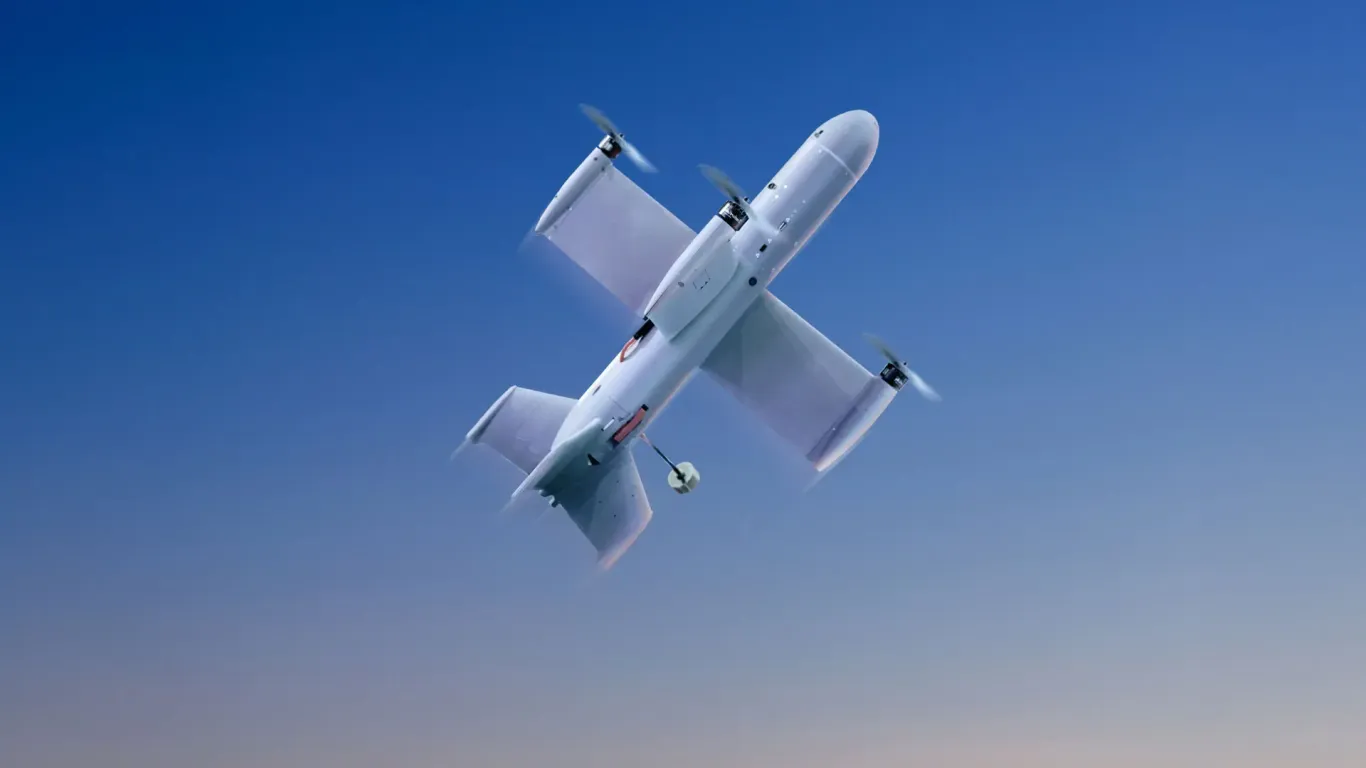
Counter drone operations have evolved significantly throughout the war, starting with drone hunting teams using mounted machine guns on pick up trucks, to converting old turboprop driven aircraft to be equipped with miniguns.
Helicopters and fighter jets too play a role in the hunt for Gerans, Shaheds and cruise missiles, all a part of Ukraine’s layered air defences. Now the interceptor drone is playing its part, at a significantly reduced cost compared to the alternatives.
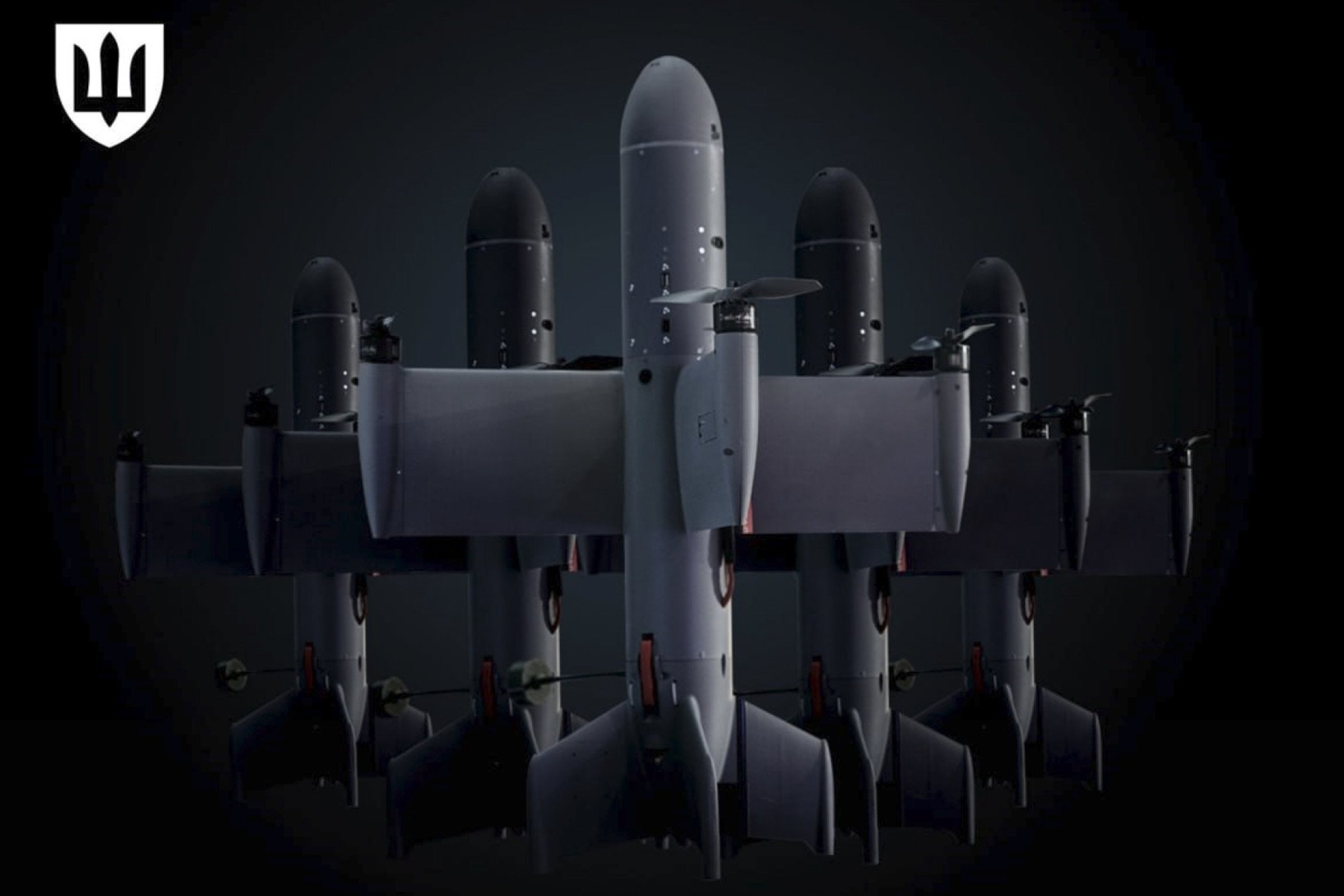
A licensing deal was signed in November 2025, allowing for British manufacturers to build the Ukrainian-designed UAS to strengthen Ukraine’s national air defences.
Luke Pollard MP confirmed that Project Octopus was the first joint industrial programme launched under Programme Lyra, a bilateral framework between the UK and Ukraine to jointly produce defence material. The Ukrspecsystems factory does not come under this programme as the production of drones here is done by the Ukrainian company directly, whilst Programme Lyra aims to use British manufacturers.
Pollard stated that:
“Under Project OCTOPUS, the UK and Ukraine will work together to rapidly optimise a Ukrainian designed air defence interceptor for mass production… with a target of being able to produce thousands of drones per month to support Ukraine’s defence needs.”
“Octopus” interceptor drone which will be co-produced in Britain
In the first stages, it is expected that about 2,000 drones will be produced per month, which will be transferred to the Armed Forces of Ukraine. https://t.co/jVE2x8bGwl pic.twitter.com/ABa6tVnPVz
— Special Kherson Cat 🐈🇺🇦 (@bayraktar_1love) October 24, 2025
The first successful flight tests of the Octopus took place in January 2026, with four UAS tested and now available for delivery to Ukraine. According to RUSI, the Octopus design was first proposed in 2024 and was ready for production in 2025 in Ukraine, but this was delayed by internal bureaucratic problems. 2025 saw a significant uptick in the deployment of Geran and Shahed type drones against Ukraine, putting significant pressure on Ukraine’s existing air defences.
The production of these counter UAS systems in the UK should allow Ukraine to alleviate the pressure off its own manufacturers, whilst sustaining a long term partnership with the UK on defence industry.
The opening of the Ukrspecsystems factory and the mass production of both reconnaissance and interceptor UAS is a significant step forward for the joint production of military equipment for the United Kingdom and Ukraine. Further deals on higher end military equipment is also a significant possibility with the UK looking to produce ballistic missiles for the Ukrainian military under the Nightfall project.
These are still early days for the partnership, which has evolved beyond donations of old military equipment to the production of new ones, together. The United Kingdom remains committed to aiding Ukraine in its fight for freedom, for as long as it takes.