Rolls-Royce and the U.S. Air Force validated the F130’s ability to meet performance requirements for the B-52 missions, getting closer to flight testing.
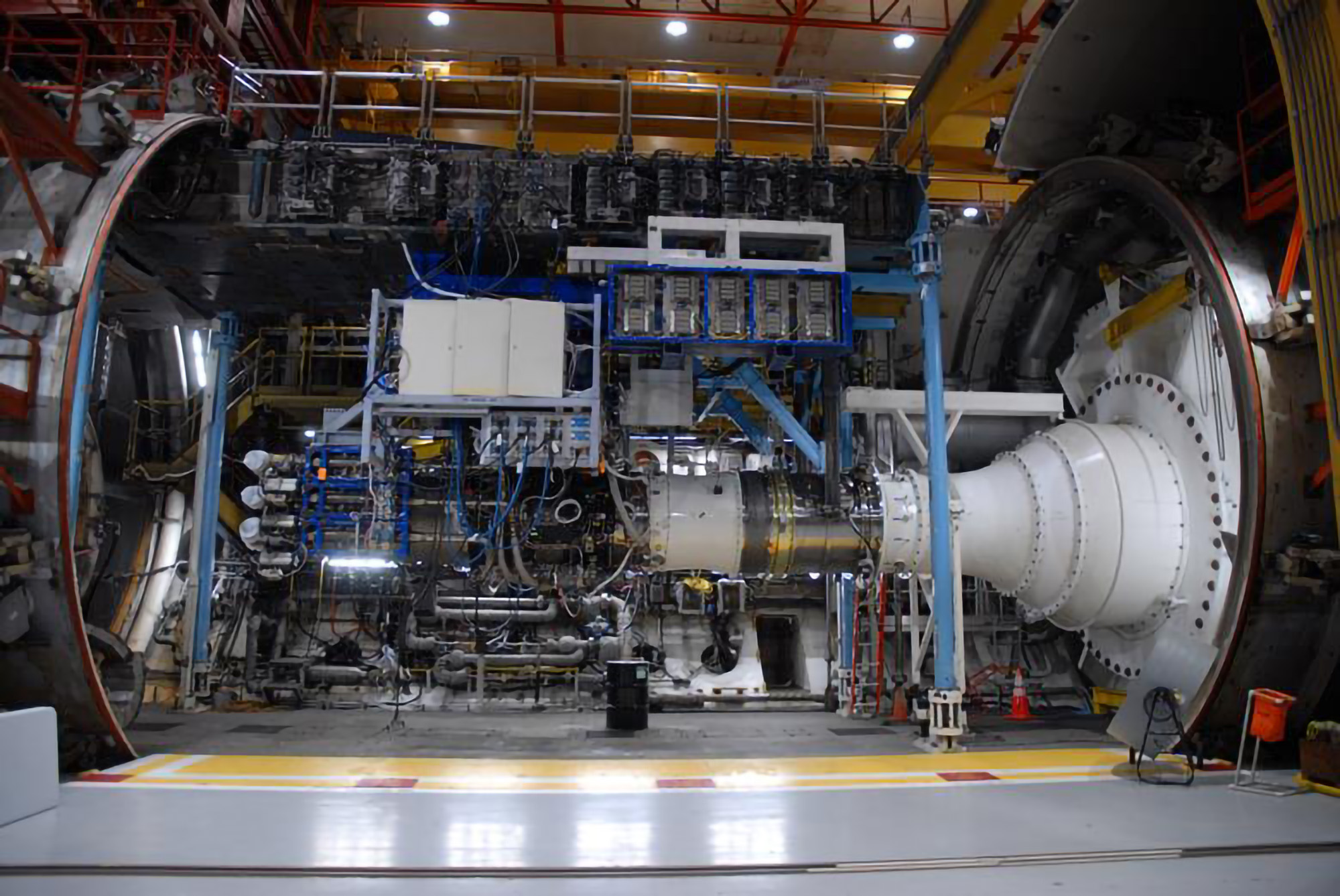
Engine maker Rolls-Royce announced on Feb. 24, 2026, the successful completion of altitude and operability testing for the F130 engine at the U.S. Air Force Arnold Engineering Development Complex (AEDC) in Tullahoma, Tennessee. The engine will power the upgraded B-52J strategic bomber, replacing the older TF33.
The testing was critical for gathering critical performance data on the engine’s performance by recreating actual flight conditions and matching it with simulated computer modelling. The work will now move further into system integration and dual-pod testing at the NASA Stennis Space Center in Mississippi, said Rolls-Royce.
Late in 2023, Rolls-Royce had said it was on track to complete initial F130 engine testing and was continuing the Rapid Twin Pod testing at Stennis. In December 2024, Rolls-Royce completed the F130’s Critical Design Review (CDR), paving the way for final development and the test campaigns.
Rolls-Royce completed F130 altitude and operability testing for the U.S. Air Force B-52J at AEDC in Tennessee. This is the engine that will replace the 60 year old TF33s and keep the Stratofortress relevant for decades. Test engines on track for Boeing delivery in 2027.
The old… pic.twitter.com/m6wyKwkaI1
— Fahad Naim (@Fahadnaimb) February 25, 2026
F130 engine tests
Rolls-Royce said in the press release that a joint team from the U.S. Air Force and Boeing validated the engine’s performance in demanding mission conditions. Three main areas were included in the testing:
- altitude tests, whose goal was to demonstrate sustained performance for long-duration, high-altitude strategic missions typical of bomber aircraft;
- operability testing with distortion screens, meant to replicate turbulent, real-world airflow and confirm engine stability under the stress and vibrations caused by turbulence;
- Integrated Drive Generator (IDG) testing with Boeing, which allowed to ensure stable and reliable electrical power during all mission scenarios.
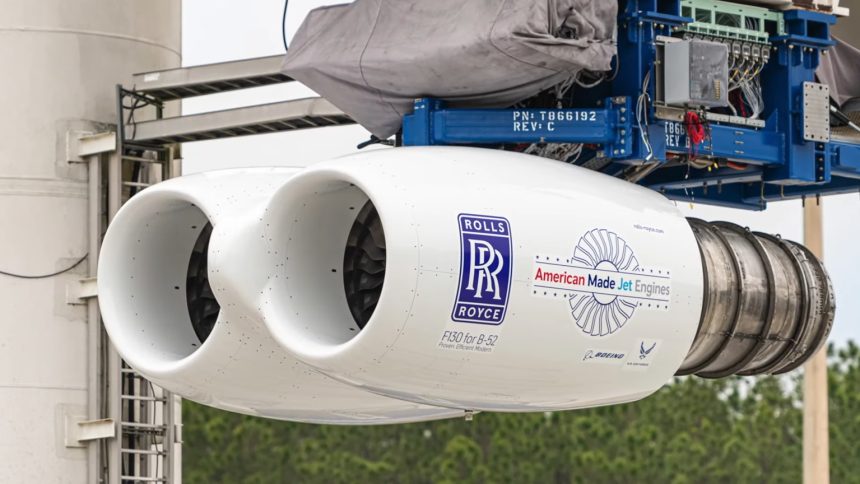
Rolls-Royce also touched upon the Rapid Twin Pod testing at the NASA Stennis Space Center, where the F130s were tested for the “first time in the unique dual-pod configuration” for the B-52. In fact, similarly to the TF33 engines, the F130s will be installed in pods each hosting two engines.
“These tests played a key role in validating Rolls-Royce’s analytical predictions, further de-risking the integration of the F130 engine onto the B-52J,” the release added.
The company had also conducted sea-level testing of the First Engine to Test (FETT) in mid-2024. That trial ran the initial software release for the F130 in the newly refurbished Test Cell 114, and generated vital performance data that validated Rolls-Royce’s analytical predictions in crosswind conditions.
A model of a B-52J undergoing wing tunnel testing for the new Rolls Royce F130 engine nacelles. It’s hard to imagine that an aircraft designed in the 1950s is receiving new engines in 2023! The longevity of this Boeing design is incredible. #avgeeks #aviation #aviationdaily #USAF pic.twitter.com/XxSzOGjycb
— Air Power (@RealAirPower1) September 3, 2023
The sea-level and crosswind tests of the FETT at Cell 114 laid the groundwork for the Critical Design Review (CDR) that the company later completed and announced in December 2024. Rolls-Royce described Test Cell 114 as a state-of-the-art facility supporting development testing and production acceptance campaigns, and had invested $1 billion in modernizing its Indianapolis facilities, which will manufacture, assemble and test the F130 engines.
“Next, the program will move into further system integration and dual-pod testing at Stennis, marking another milestone in the propulsion development. Throughout the testing program, engineering and design teams have gathered critical performance data to validate modelling and further confirm that the F130 engine is the right fit for the B-52J re-engining program,” the release said.
Officials’ statements
Jennifer Schwerin, Rolls-Royce’s Director of Early Life-Cycle and Naval Programs highlighted the “on-time and on-budget” progress of the F130 CERP effort in the release. “Working closely with our partners at Boeing and the Air Force, our team has demonstrated the F130’s ability to meet mission requirements and further strengthened confidence that this engine is the right choice for the B-52J,” said Schwerin.
The B-52 has been serving the #USAF for over 70 years.
Now, our testers with the Global Power Bombers Combined Test Force are ensuring it remains reliable, modern and integrated for @AFGlobalStrike into the 2050s.
Victory starts at Edwards. @HQ_AFMC pic.twitter.com/RzYmWfppJW
— Edwards Air Force Base (@EdwardsAFB) February 21, 2026
“Throughout this F130 engine test campaign, we gathered essential data about how this engine operates across the full spectrum of flight conditions,” said the U.S. Air Force’s Program Manager for the B-52 CERP, Lt. Col. Timothy Cleaver, quoted in the release. “Completing the series of tests at AEDC’s world-class facility gives us confidence in the engine and associated systems as we proceed into test aircraft modification and flight testing.”
B-52J’s CERP and RMP programs
The Commercial Engine Replacement Program (CERP) program was launched to swap out the B-52H’s existing TF33 engines, now out-of-production, with the newer F130 engines. The project took another step forward on Dec. 23, 2025, when Boeing Defense Systems received a $2.04 billion task order to continue the work on the CERP for the post-CDR phase.
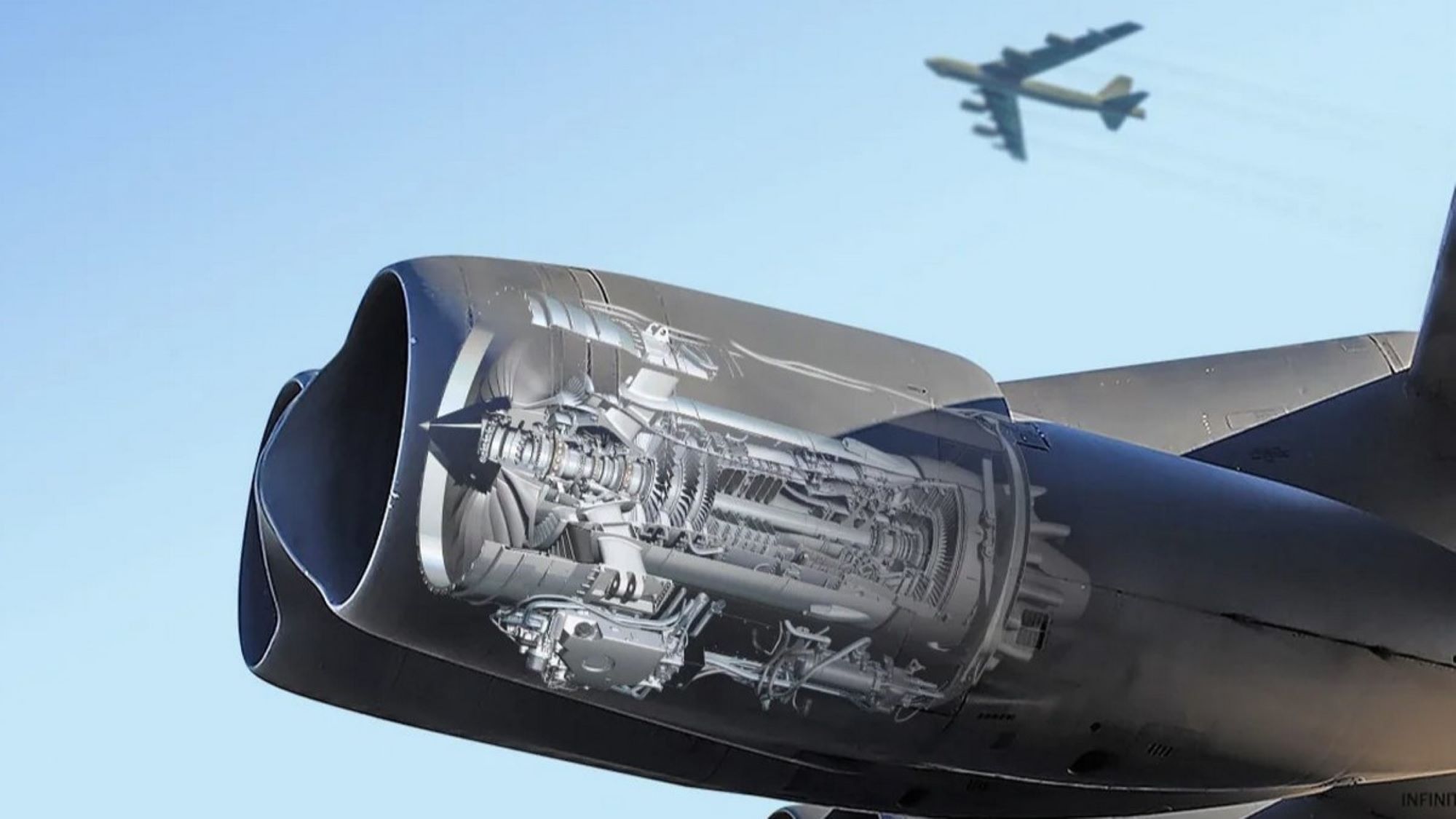
Rolls-Royce says the F130 engines will extend the life of the B-52 aircraft, allowing it to fly for 30 more years, and are durable enough to “remain on wing for the remainder of the aircraft life.” The F130 is derived from the Rolls-Royce BR family of commercial engines that has been in production for 12 years, with more than 1,000 engines flying today and counting over 30 million hours of operation.
We are thrilled to announce that we are on track to complete initial F130 engine testing for the @usairforce B-52J by the end of this year.
Find out more about our progress: https://t.co/kKNR281ZMY
#B52 #testing #F130 #rollsroyce #USAF pic.twitter.com/r5GCq0suFb
— Rolls-Royce (@RollsRoyce) September 7, 2023
The Radar Modernization Program (RMP) is the other main component of the broader B-52J project. The program replaces the legacy AN/APQ-166 radars with the new AN/APQ-188 Active Electronically Scanned Array (AESA) radar.
The AN/APQ-188 is derived from the F/A-18E/F Super Hornet’s AN/APG-79, and also borrows some features from the AN/APG-82 that equips the F-15E and F-15EX. The first B-52 integrated with the AN/APQ-188 was ferried to Edwards AFB, California, on Dec. 8, 2025.
Barksdale AFB’s 49th Test and Evaluation Squadron and Edwards AFB’s 419th TES are now conducting extensive trials of the new radar to validate the capability and performance parameters envisaged for the B-52J upgrade. The radar will provide an upgraded all-weather navigation and targeting capability, potentially with ground moving target indication and synthetic aperture radar functions.