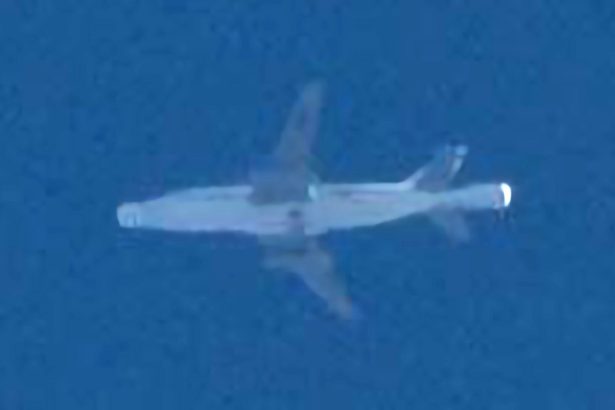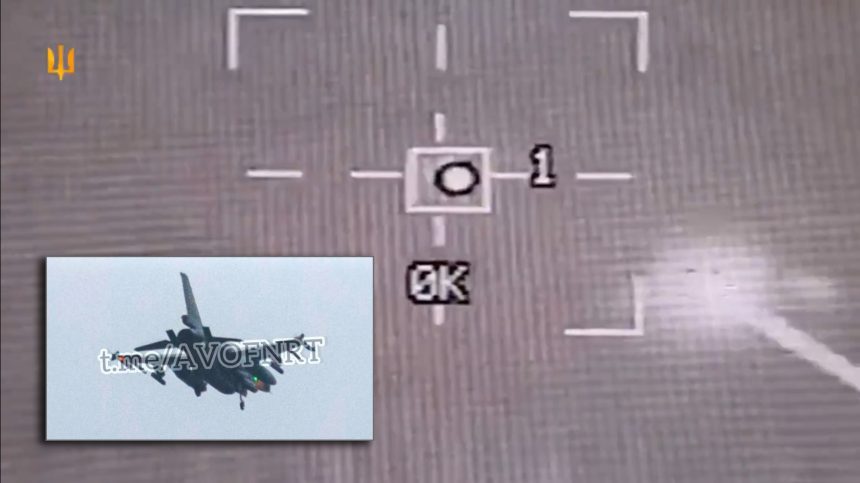
Following the first sighting of the new capability in December 2025, a Ukrainian F-16 was captured using APKWS II laser-guided rockets to engage a drone.
A Ukrainian Air Force F-16 was captured for the first time while using its Advanced Precision Kill Weapon System (APKWS) II guided rockets against a Russian unmanned system, believed to be a Geran-type One-Way Attack (OWA) drone, in a video that appeared on Feb. 17, 2025. The video is actually infrared footage from the Sniper targeting pod used to lase the target, part of a longer promotional video by the Ukrainian Air Force.
This new development comes after a Ukrainian F-16 was recently captured in unofficial footage from the ground shooting down a Russian Geran drone with its onboard M61 Vulcan cannon. Notably, Russian Geran drones themselves have been evolving, carrying Soviet-era R-60 short-range infrared-guided Air-to-Air Missiles (AAMs) and Verba Man-Portable Air Defense Systems (MANPADS).
What is believed to be the first known footage showing an F-16 fighter jet operated by the Ukrainian Air Force intercepting a Russian Shahed/Geran-type long-range OWA-UAV with the APKWS II low-cost, laser-guided anti-aircraft rockets.
Such rockets are carried in LAU-131 rocket… pic.twitter.com/JTsCsgQ7NP
— Status-6 (War & Military News) (@Archer83Able) February 17, 2026
The persistent asymmetric threats had forced both Ukraine and Russia to convert their older Yak-52 trainers for the counter-drone role in 2024 and 2025, respectively. Furthermore, Ukrainian Mi-8 helicopters are using their door-mounted PK-type machine guns and miniguns to bring down the Geran drones.
Interestingly, a modified Antonov An-28 aircraft was also captured in a French news feature engaging Geran drones with side-shooting M-134 miniguns.
A passenger An-28 aircraft armed with miniguns is shooting down Russian drones over Ukraine, French TF1 got an inside. The crew consists of civilian volunteers who have already destroyed nearly 150 drones during air defense missions. #Ukraine pic.twitter.com/x1E921TPT2
— NOELREPORTS 🇪🇺 🇺🇦 (@NOELreports) February 5, 2026
AGR-20F APKWS II in Ukraine
The APKWS II was spotted for the time on a UKrAF Fighting Falcon in December 2025, although the latest video represents the first time the weapon was recorded being used in the Ukrainian conflict in the air-to-air mode. The ground-based VAMPIRE system, also used by Ukraine installed on Humvees and pickup-trucks, had however been used in the past against Russian Shahed-type drones.
The December 2025 image showed the UKrAF F-16, possibly preparing to land as it had both landing gear and speed brakes extended, carrying one LAU-131A/As rocket pod under each wing. The F-16 was carrying the seven-shot rocket pods on Triple Ejector Racks (TER), which allow up to three pods on each wing.
Ukrainian Air Force F-16s appear to have finally received APKWS laser-guided rockets, a massive upgrade to hunt drones.
The rockets, mounted in a pair of LAU-131 pods, allow a Ukrainian Falcon to carry up to 18 air-to-air missiles (14x APKWS, 4x AIM-9). pic.twitter.com/7XDbdb4Pkt
— OSINTtechnical (@Osinttechnical) December 5, 2025
In the CENTCOM region, U.S. Air Force F-16s have been flying with the APKWS II for more than a year now, with at least two LAU-131A/A seven-shot rocket pods seen so far. The service has also equipped an F-16 with six LAU-131A/A pods for a large magazine capacity of 42 rockets.
However, that trial appeared to be only a ground demonstration and possibly a training session for munitions load crews to cater for the larger APKWS II payload in high-threat situations. The need might come in handy again, given tensions with Iran and the convergence of U.S. forces in the region.
A U.S. Air Force F-16 Fighting Falcon conducts a combat air patrol over the U.S. Central Command area of responsibility. By delivering critical resources to U.S. and coalition aircraft in flight, we guarantee war-winning airpower throughout the region.@USAFCENT
📷 Staff Sgt.… pic.twitter.com/rwI73H9VXr
— U.S. Central Command (@CENTCOM) October 1, 2025
Ukraine’s fighters have meanwhile also been engaging other Russian targets, with F-16s being used to shoot down Russian Kh-101 air-launched cruise missiles (ALCM) with AIM-9 Sidewinders in an official video. The Mirage 2000 have borne the kill-marks of the Kh-101, with its pilots touting its effectiveness in the role, using both Magic 2 and MICA AAM.
A video of an AGR-20 FALCO intercept. pic.twitter.com/Oee0UDEpcm
— Shahryar Pasandideh (@shahpas) April 9, 2025
APKWS II
The AGR-20 APKWS II is a conversion of the Hydra 70 unguided rocket, with a laser guidance kit added to the baseline weapon. The system sits between the 10-pound high-explosive warhead at the front and the Mk66 Mod 4 rocket motor at the rear, turning the Hydra 70 into a precision-guided munition (PGM).
Specifically, the guidance section includes wing-mounted laser seeker collection optics on the four foldable wings, offering a wide field of view, and enabling it to engage both moving and stationary targets.
The second modification on the APKWS II came in the form of a counter-drone software upgrade, called the AGR-20F FALCO (Fixed Wing, Air Launched, Counter-Unmanned Aircraft Systems Ordnance). It is now the weapon of choice in the counter-UAS role and is used extensively against cheaper Houthi projectiles, which cost around $15,000-$20,000, instead of the costlier AIM-120 AMRAAM and AIM-9 Sidewinder air-to-air missiles, which are worth around $450,000 and over $1 million, respectively.
Ukrainian Navy’s VAMPIRE anti-drone system using low-cost laser-guided APKWS rockets against Russian Shahed-136 kamikaze UAVs in Odesa region.
The U.S. Air Force already employs APKWS on F-16s to cheaply counter Houthi drones and plans to add a passive IR seeker to create a… pic.twitter.com/iDx01Yy2z0
— Clash Report (@clashreport) February 16, 2025
On the other hand, a single APKWS II rocket is estimated to have a price point of around $30,000. The AIM-9 and the AIM-120 however are still part of the standard air-to-air loadout in the CENTCOM region.
In April 2025, APKWS II developer BAE Systems unveiled an Advanced Precision Kit (APK) for the 70 mm Hydra rockets, consisting of a infrared (IR) seeker in addition to the existing laser guidance, making this a dual-mode weapon. The APK spares the pilot the need for continuous lasing of the target drone, allowing him to swiftly move on to other targets. BAE had said the APK upgrade served as the next stage for the system’s evolution.
In December 2025, BAE revealed it received a U.S. Navy contract collectively worth $1.7 billion, with a $322 million initial order, for the APKWS II system. With the Special Defense Acquisition Fund (SDAF) being one of the customers, among other users including U.S. Air Force, U.S. Army, U.S. Navy and several foreign partners, Ukraine is likely to receive a big chunk of those deliveries. In fact, the SDAF has previously been used for arms donations to Ukraine.