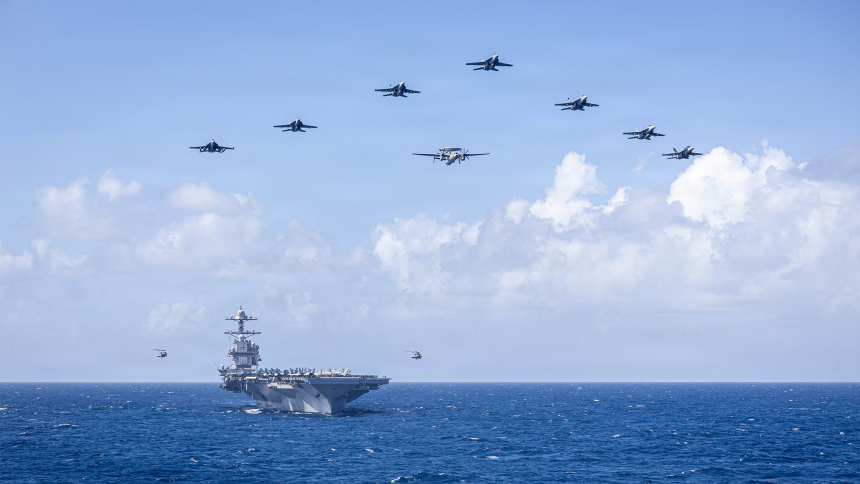
The U.S. Navy’s newest supercarrier is heading back towards the Middle East having already been recalled across the Atlantic to station off Venezuela.
Already in its eighth month at sea, this new assignment – which will require the third Atlantic transit of its current deployment – in the midst of heightened tensions between the U.S. and Iran will push back the 100,000 ton carrier’s expected arrival back home to the U.S. to at least April or May.
CONFIRMED USS Gerald R. Ford ordered to deploy immediately to the Middle East. The Ford and its aircraft carrier strike group arrived in the Caribbean on Nov 16 from the Med. Now it is heading back to the Mediterranean.
— Jennifer Griffin (@JenGriffinFNC) February 13, 2026
Setting sail from Norfolk, Virginia in the latter half of June 2025, the USS Gerald R. Ford (CVN-78) spent several months operating in European waters before an unexpected shift in operational focus led to the redeployment of the carrier and its strike group to the Caribbean. Ford, its escorts, and its air wing then took part in Operations Southern Spear and Absolute Resolve.
This change of plans was expected by many to have shelved original plans for further operations by the Ford carrier strike group (CSG) in Europe or the Middle East during its current deployment, instead heading directly for home after wrapping up operations and leaving the U.S. Southern Command (SOUTHCOM). We now know that this homecoming will not happen so soon.
As outlets reported on rumors that U.S. Government officials were eyeing the fielding of a second carrier in the U.S. Central Command (CENTCOM) area of operations, alongside the USS Abraham Lincoln (CVN-72), many – including The Aviationist – pointed out that in ideal terms there were no carriers available.
The only carrier available for immediate tasking to the Middle East is the USS Gerald R. Ford.
The USS George Washington is forward deployed to INDOPACCOM and completed a 2 month patrol in December.
The USS George HW Bush will be the next carrier to deploy from the East Coast… https://t.co/IuIoJQdEZj pic.twitter.com/Aegx6Spjsd
— TheIntelFrog (@TheIntelFrog) February 10, 2026
We speculated the two most likely options were the Ford and the USS George H. W. Bush (CVN-77), pointing out in the first case that the deployment would come at the tail end of what should be a nearly complete voyage, and in the latter case that the carrier had yet to complete the necessary exercise programs in order to be considered combat ready. It is certainly possible that the Ford will act as a stopgap measure while the Bush CSG can be fully generated and deployed.
It is still unclear what action, if any, the U.S. intends to take against Iran. Interestingly, if one compares the deployed forces of today to those amassed ahead of the 2003 Iraq War, a stark contrast is immediately apparent in terms of naval air power. While the deployment of a second carrier today has only been possible through a less-than-ideal deployment extension, as many as six U.S. Navy aircraft carriers were fielded simultaneously across the Gulf and the Mediterranean during the 2003 war.
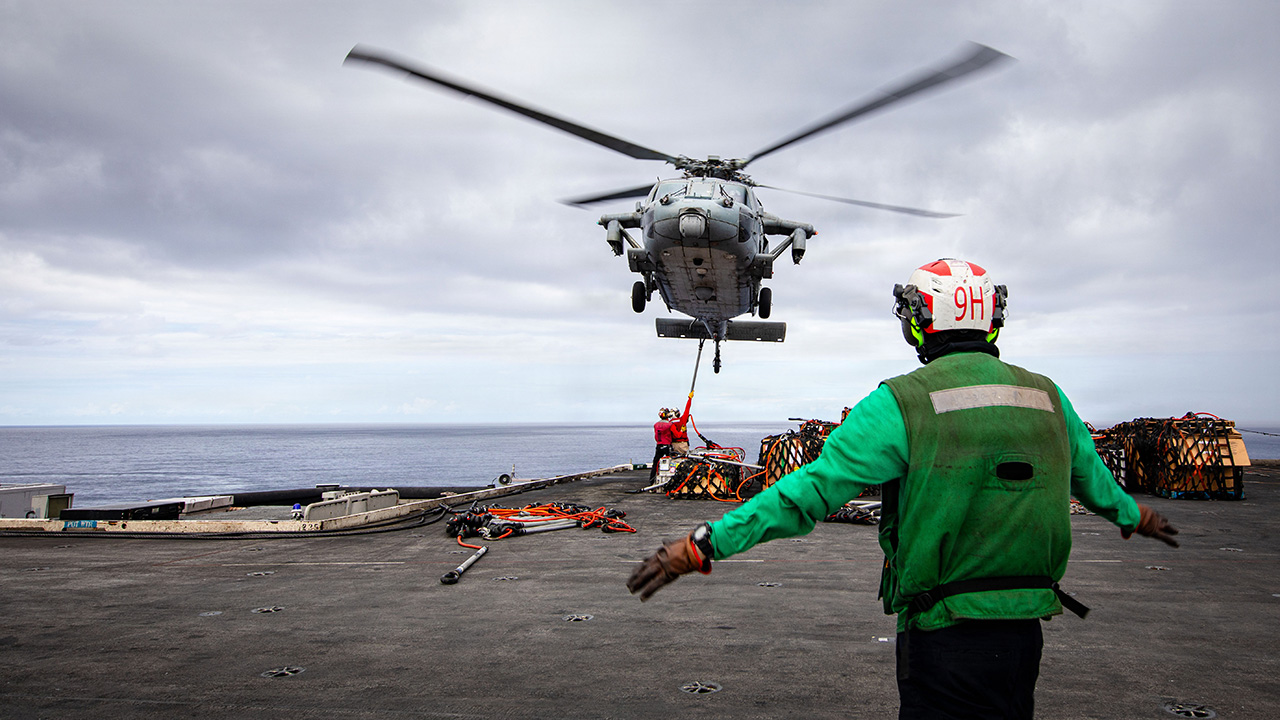
The Ford CSG currently hosts Carrier Air Wing 8 (CVW-8), comprising F/A-18E Super Hornets of Strike Fighter Squadrons (VFA) 31, 37, and 87, F/A-18F Super Hornets of VFA-213, EA-18G Growlers of Electronic Attack Squadron (VAQ) 142, E-2D Hawkeyes of Airborne Command and Control Squadron (VAW) 124, C-2A Greyhounds from Fleet Logistics Support Squadron (VRC) 40, and MH-60S and MH-60R Seahawks of Helicopter Sea Combat Squadron (HSC) 9 and Helicopter Maritime Strike Squadron (HSM) 70 respectively.
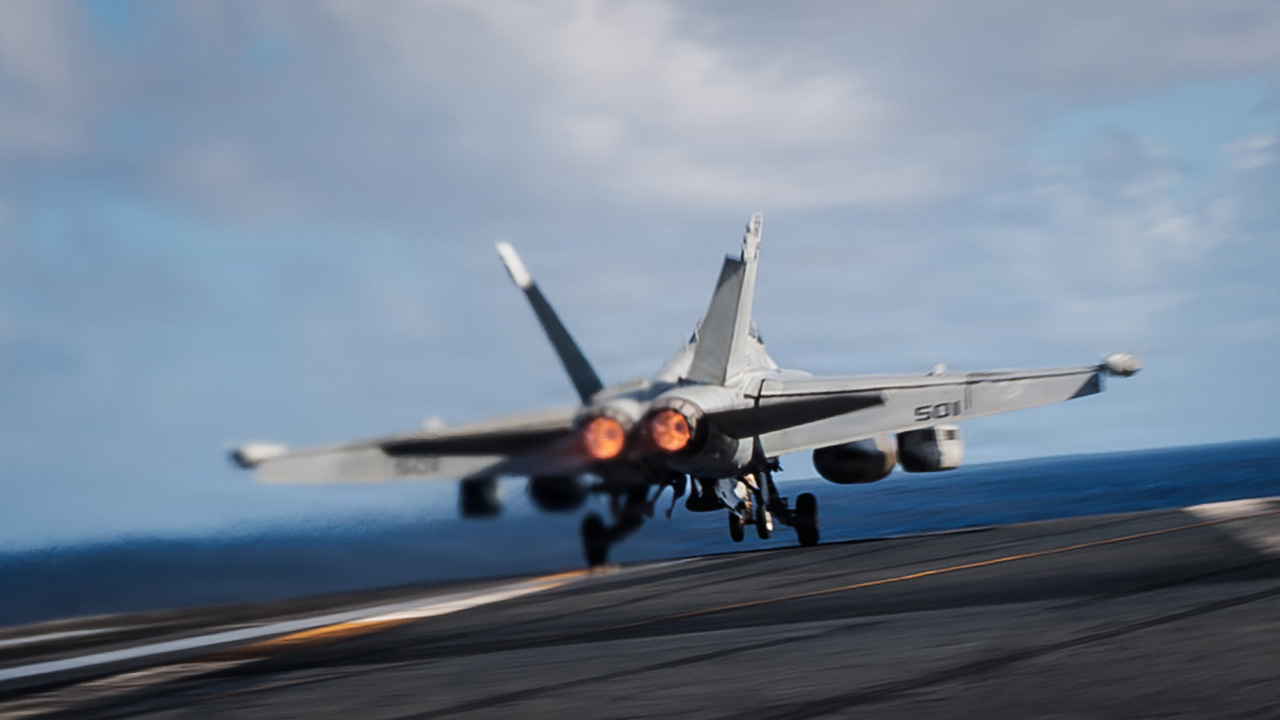
The EA-18G Growlers will be among the most prized assets available in any potential operations against Iran, offering specialised electronic warfare and suppression of enemy air defences (SEAD) capability in a form that does not exist anywhere else in the U.S. inventory. Growlers are also fielded by the Lincoln CSG, but additional aircraft have also been deployed to operate from land bases in the region.
The remaining two EA-18G Growlers have now departed Morón AB for Muwaffaq Salti AB as #TABOR62 flt, supported by KC-46A #GOLD32. https://t.co/owXFW7se31 pic.twitter.com/6v0h4d6c0p
— EISNspotter (@EISNspotter) February 13, 2026
Major Endurance Test
For the Ford, the newly extended deployment – which could now last 10 to 11 months – will be a serious test of the first-of-class’ reliability as well as its crew’s morale. Aircraft carrier crews, unlike those of smaller vessels, are not usually able to be exchanged en masse in the middle of a deployment. With over 5,000 personnel making their homes on board for the duration, such a task would be an enormously complex logistical exercise even before considering the availability of such a large replacement crew.
Speaking to reporters, including from The War Zone, in January 2026, Chief of Naval Operations (CNO) Admiral Daryl Caudle said: “Number one, I’m a sailors-first CNO. People want to have some type of certainty that they’re going to do a seven-month deployment. When it goes past that, that disrupts lives, it disrupts things like funerals that were planned, marriages that were planned, okay, babies that were planned, you know, so the human element of extension, I’m not a big fan of obviously.”
He added: “To the financial and readiness aspects, we have maintenance agreements and contracts that have been made with yards that are going to repair the ships that are in that strike group, including the carrier itself. And so when those are tied to a specific time, the yard is expecting it to be there. All that is highly disruptive.”
The materiel condition of the ship and it’s systems are going to suffer.
The USS Dwight D. Eisenhower completed a ~9 month combat deployment and it took a toll on the ship. It entered it’s post deployment maintenance availability 1/8/2025 and is STILL there. 6-9 months is…
— TheIntelFrog (@TheIntelFrog) February 13, 2026
As the CNO suggested, it will almost certainly have a knock-on effect in terms of the U.S. Navy’s planned carrier availability cycles. Even after a regular length deployment, these nuclear-powered supercarriers require an extraordinary amount of care before they are declared ready to go back out to sea. After its eight-month maiden operational deployment that culminated in January 2024, the Ford spent over a year out of action, only completing the routine pre-deployment Composite Training Unit Exercise (COMPTUEX) in April 2025.
The refit planned for the Ford in 2026 will now need to be pushed back, likely at quite a significant cost, and will mean certain resources at HII’s Newport News shipyard will now be tied up for longer to accommodate.
Today, our nation’s newest aircraft carrier, John F. Kennedy (#CVN79), departed our #NewportNewsShipbuilding division to begin builder’s sea trials. These trials will test important ship systems and components at sea for the first time. @USNavy @COMNAV_AIRLANT @USNavyNNPP (1/2) pic.twitter.com/7ECK3YhPfw
— HII (@WeAreHII) January 28, 2026
Continuous extensions to deployments over previous years for several of the U.S. Navy’s carriers, as well as leftover delays to ongoing overhauls from the COVID-19 pandemic, have severely impacted carrier availability and is one of the reasons why there is no readily available carrier that could alternatively take on this new task.
With the final scheduled deployment of the USS Nimitz (CVN-68) now completed, and the ship preparing to sail to the East Coast for decommissioning, the Navy is down to 10 active aircraft carriers. This will remain the case until the John F. Kennedy commissions in several years time, though the. Unlike the Ford, the Kennedy will be delivered from the shipyard with the ability to field the F-35C Lightning II.