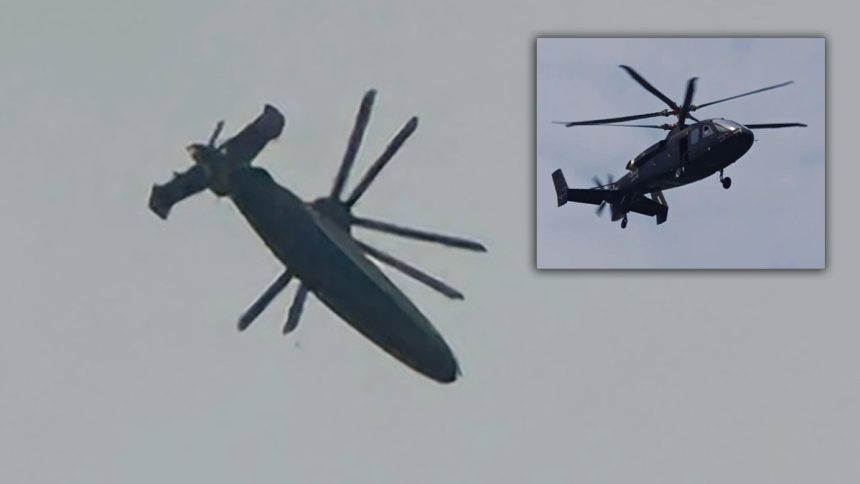
Newly emerged images raise the possibility that China has built another compound helicopter demonstrator, following the S-97 Raider-like aircraft seen in 2025, this time bearing a resemblance to the larger SB>1 Defiant.
Months after the first images emerged online, the Chinese clone of the Sikorsky X2 technology appeared again. However, this time the new images raise the possibility that China might have built a second demonstrator, similar to the SB>1 Defiant.
It is unclear when and where this video was captured. The first images, which we covered in a previous report here at The Aviationist, emerged in August 2025 but were reportedly captured in April 2025 and initially only published on the Chinese social media Weibo. On that occasion, the aircraft was an almost exact clone of the Sikorsky S-97 Raider, as we noted in our report.
The Changhe coaxial testbed was seen again
(via @欧阳振我86468 from Weibo) pic.twitter.com/ODTPHAAYOx
— @Rupprecht_A (@RupprechtDeino) February 5, 2026
Compared to the first sighting, the helicopter might have now been equipped with an aerodynamic fairing over the rotor hub. However, the helicopter also appears to be longer than in the previous images, opening to the possibility of either modifications to the airframe seen last year or even a new, larger variant being built.
This would be somewhat similar to Sikorsky’s program, which saw a larger variant of the same aircraft, the SB>1 Defiant, being developed based upon the same technology. The helicopter in the the new images appears visibly different, with a slender, longer airframe and possibly a new powerplant, as the lateral engine’s outlet does not appear to be visible.
The quality of the video and the distance at which it was captured do not allow to discern useful details to further analyze the design.
China’s coaxial compound helicopter.
The rigid coaxial rotors with push propellers gives it a sleek profile, perfect for high speed forced entry into enemy airspace.
With a speed and range advantage compared to traditional helicopters, it’s perfect for special forces insertion… pic.twitter.com/g5Iuo95JeX
— Zhao DaShuai 东北进修🇨🇳 (@zhao_dashuai) February 6, 2026
Chinese Compound Helicopter
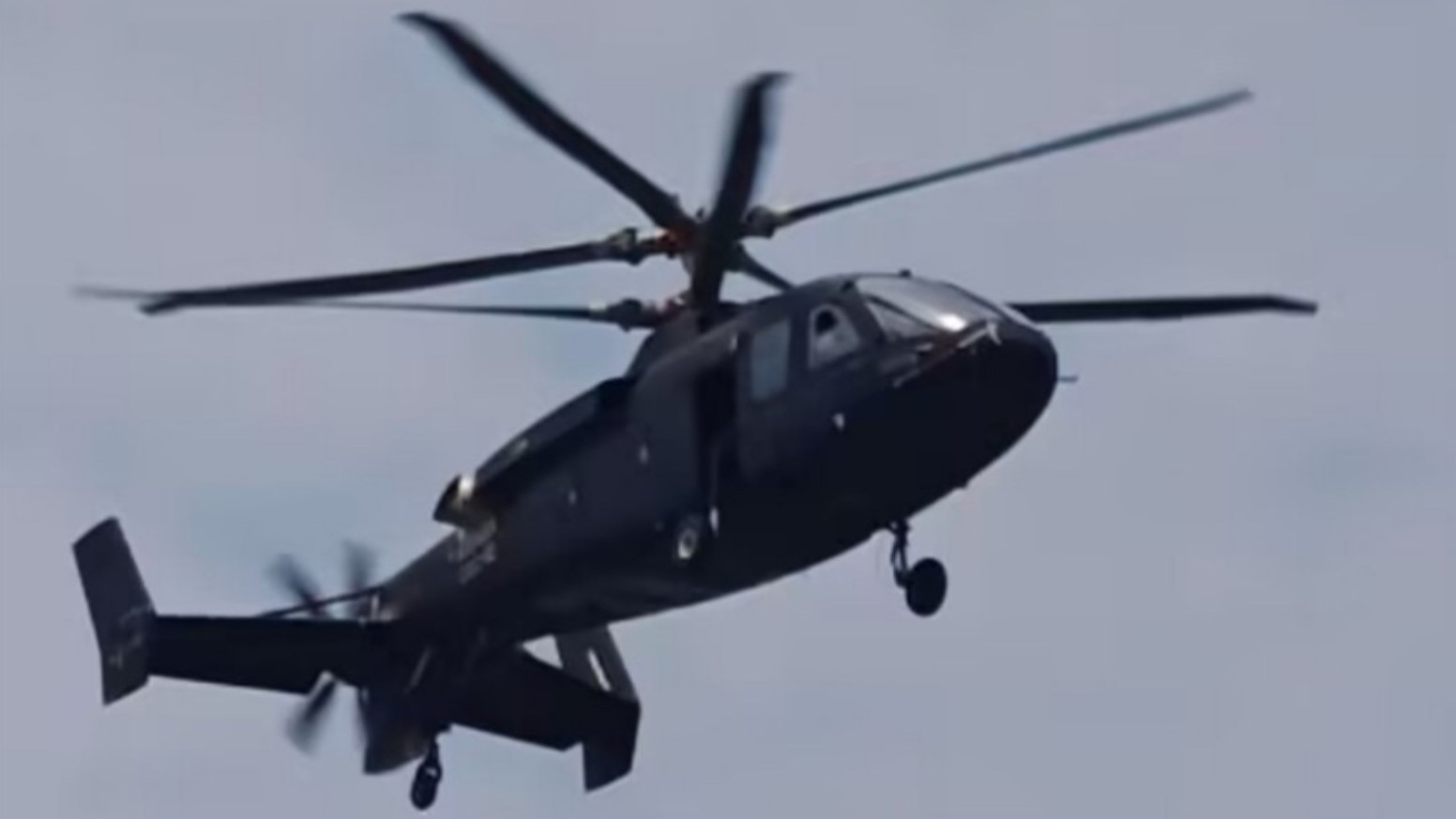
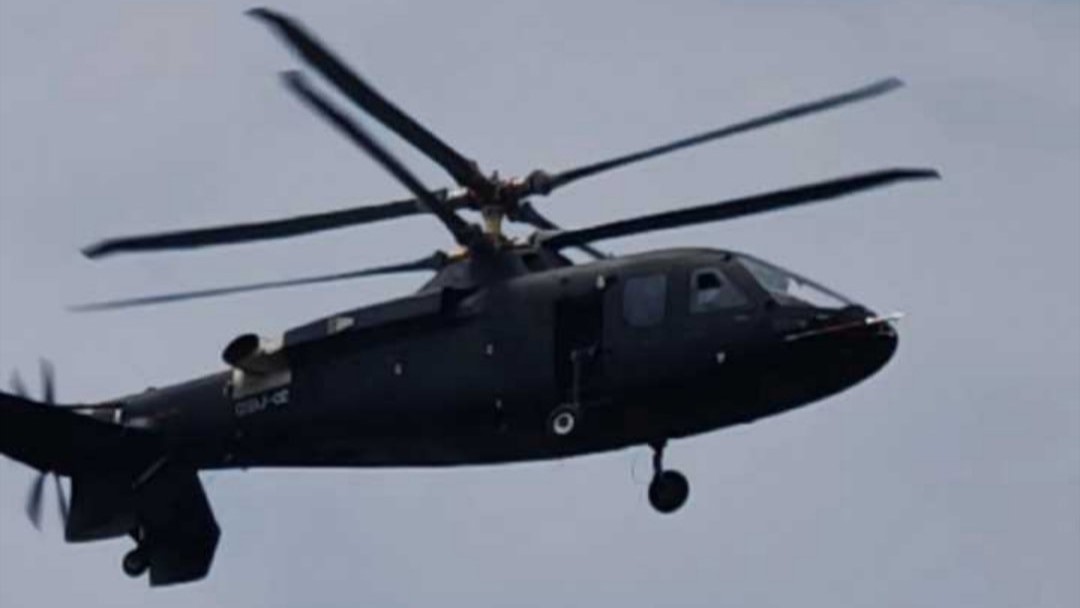
Compared to a standard helicopter, this compound helicopter features two coaxial counter-rotating main rotors and a prop rotor in the tail. The architecture of the aircraft and its overall shape immediately catch the eye for their resemblance to the Sikorsky S-97 Raider demonstrator, based on the company’s X2 technology.
The helicopter has a slender shape optimized for higher speed, with two four-bladed counter-rotating coaxial main rotors and the proprotor in the rear. The proprotor is installed behind large tail planes and a lower tail fin which also serves as mounting point for the tail wheel.
And the surprises from China do not stop – it seems as if one currently wants to burn off true fireworks of news – because today this coaxial helicopter (probably a test carrier) was shown for the first time.
(Image via @Captain小潇 from Weibo) pic.twitter.com/UvLOCwuk4y
— @Rupprecht_A (@RupprechtDeino) August 21, 2025
Compared to the S-97 Raider, the horizontal tailplane sits lower than the axis of the prop rotor, while the vertical fins extend up, on the opposite side. The main landing gear appears to retract with a swiveling mechanism behind the cockpit, another aspect which is similar to the Raider.
The helicopter appears to have a protrusion on the right side, starting in coincidence of the main rotors’ mast and ending where the engine outlet is located. It is unclear if there is also a cabin in the area behind the main landing gear and below the main rotors, although the quality of the images emerged last year did not allow to discern many details.
Chinese military aviation observers noted that this aircraft could be a small-medium size technology demonstrator for next generation configurations, somewhat similar to the U.S. Future Vertical Lift (FVL) program. It is believed that China might be evaluating the state of helicopter technologies for a future application, as the compound helicopter was not the only one to emerge.
In fact, a tiltrotor has also been unveiled, reported to be built by Hafei Aviation Industry, a subsidiary of Harbin Aircraft Industry Group (HAIG). On the other hand, the design of this S-97 clone is attributed to Changhe Aircraft Industry Group (CAIG), a subsidiary of AVIC, which reportedly started working on the project in 2023.
As noted in many of China’s military programs, there are multiple parallels with U.S. developments, with some examples being the J-35 fighters, with variant for both the air force and navy, and the EMALS catapults. Given the interest that the U.S. showed in the new helicopter technologies, China might have decided to test similar technologies to evaluate which ones are more suited to its military doctrine and needs.
Looking at the main advantages, a tiltrotor and a compound helicopter would extend the range and the speed of China’s helicopter fleet. In a military application, it would mean being able to move troops or materials farther and faster, among all things.
The compound helicopter would also exploit the ability to sharply accelerate and decelerate by using the prop rotor. At the same time, this design can benefit of a higher maneuverability compared to a tiltrotor.
These capabilities, taken together, would allow the aircraft to quickly arrive on the battlefield, minimize the exposure to threats and use some “tricks up the sleeve” to escape enemy fire.
The S-97 Raider
Almost exactly a year ago, The Aviationist was among the outlets who were invited to the Sikorsky Development Flight Center to attend a demonstration of the X2 technology and get an up-close look at the S-97 Raider. Similarly to the Chinese helicopter, this compound helicopter has two coaxial counter-rotating main rotors and a prop rotor in the tail.
This aircraft is the result of 20 years of development, started in 2005 with the X2 demonstrator, and exploited the Advancing Blade Concept that Sikorsky developed in the 1970s. However, at the time there were still some technical challenges to solve, and that took decades.
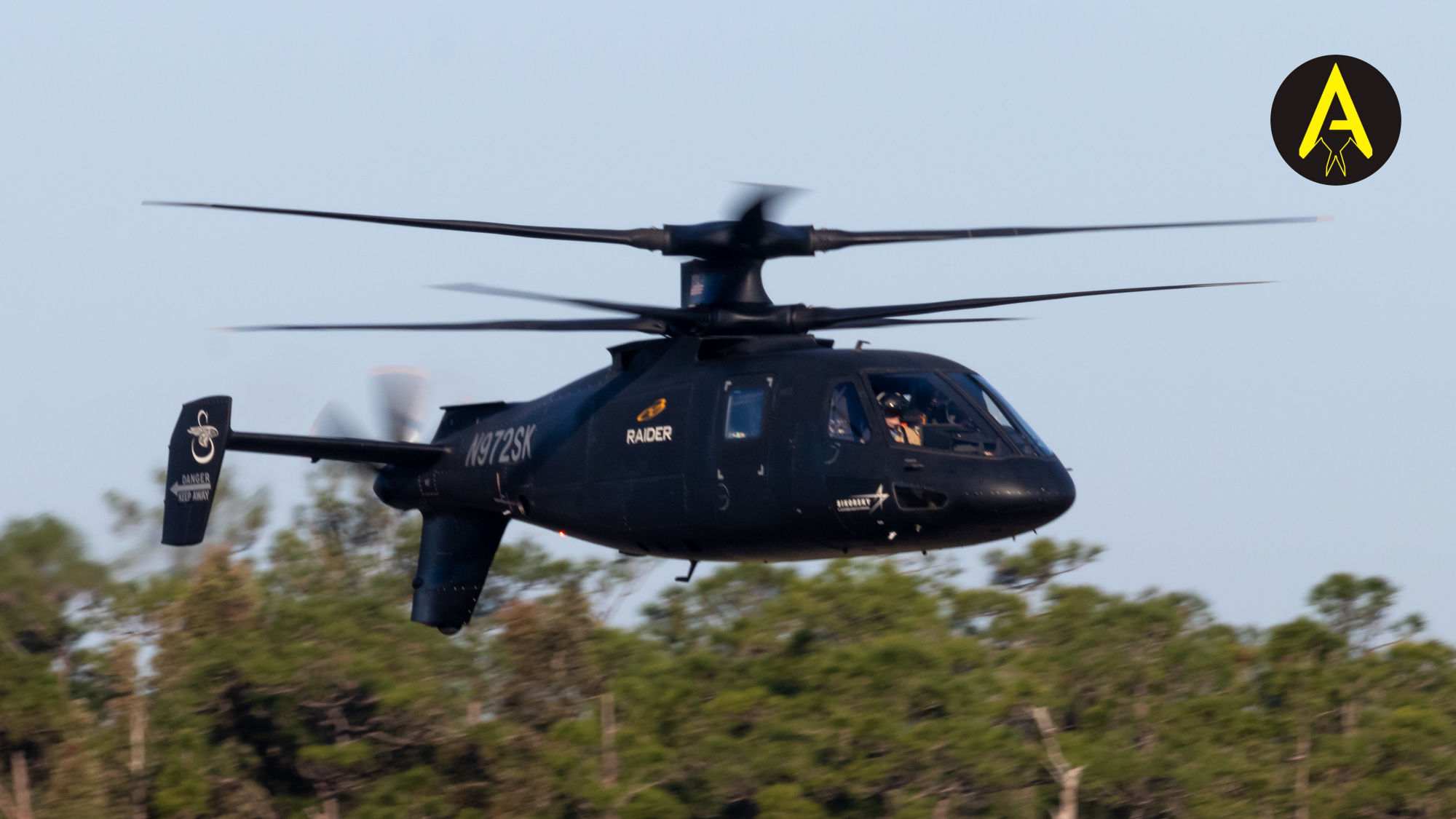
Sikorsky created the Advancing Blade Concept with the goal of significantly increasing helicopter flight speed. The concept is based on the rotor’s ability to develop lift on the blade that advances in the direction of flight, relieving of this duty the retreating blade that goes in the opposite direction.
Using counter-rotating, rigid rotors with limited bending in the vertical direction, this design delayed the drag increase caused by the blades’ tip Mach number effects, thus enabling higher speeds. Technology evolved through the years and, decades later, advancements such as composites rotor blades and fly by wire control system, together with a pusher propeller added for efficiency, solved some of the technical challenges.
This paved the way for the X2 technology demonstrator which proved out the efficiency and the viability of this technology. Sikorsky viewed this as the perfect choice for the U.S. Army’s armed aerial scout which was supposed to replace the OH-58 Kiowa Warrior, the Future Attack Reconnaissance Aircraft (FARA) program, which resulted in the S-97 Raider.
The rigid rotor system is a critical element of the S-97’s design, and is said to also have 50% less parts than an articulated rotor. Unlike traditional helicopters, the S-97 employs rigid rotors with an effective hinge offset significantly higher than conventional designs.
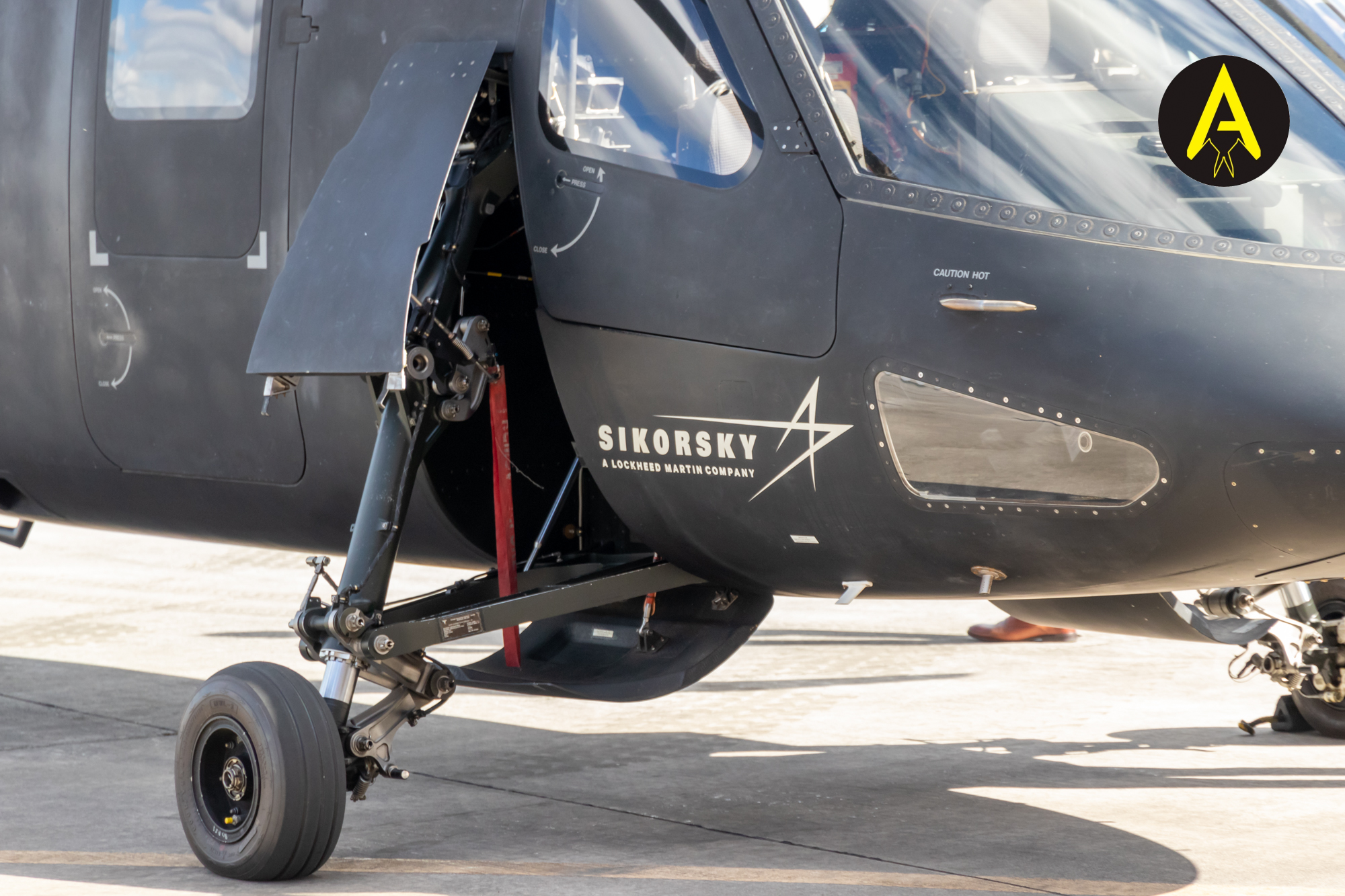
Whereas helicopters like the UH-60 Black Hawk have a hinge offset (the distance between the flapping hinge and the rotor mast, used as a measure of the rigidity of the rotor) of 12-18%, the X2 boasts a figure exceeding 40%, potentially reaching 45%. This increased rigidity enhances control power and reduces response time, allowing for precise maneuverability.
Since the counter-rotating rotors cancel out torque effects, instead of a tail rotor, the S-97 features a pusher propeller that provides forward thrust. This is a critical component of the S-97’s high speed capability, which allowed the aircraft to reach 207 kts in level flight, while without the prop the S-97 “only” reaches 150 kts.
The pusher propeller is engaged via a clutch system and can be disengaged entirely. According to the situation, more power can be allocated to the pusher propeller than to both main rotors combined, as opposed to the small fraction used by tail rotors in conventional helicopters.
The system allows for variable thrust output, including a significant negative pitch range, which can act as an airbrake. As an example, during an aggressive assault landing where the helicopter approaches the landing zone at high speed, putting negative pitch on the prop allows to quickly decelerate without having to bring the nose up too much, which would cause a loss of situational awareness and visibility in one of the most delicate phases of the flight.
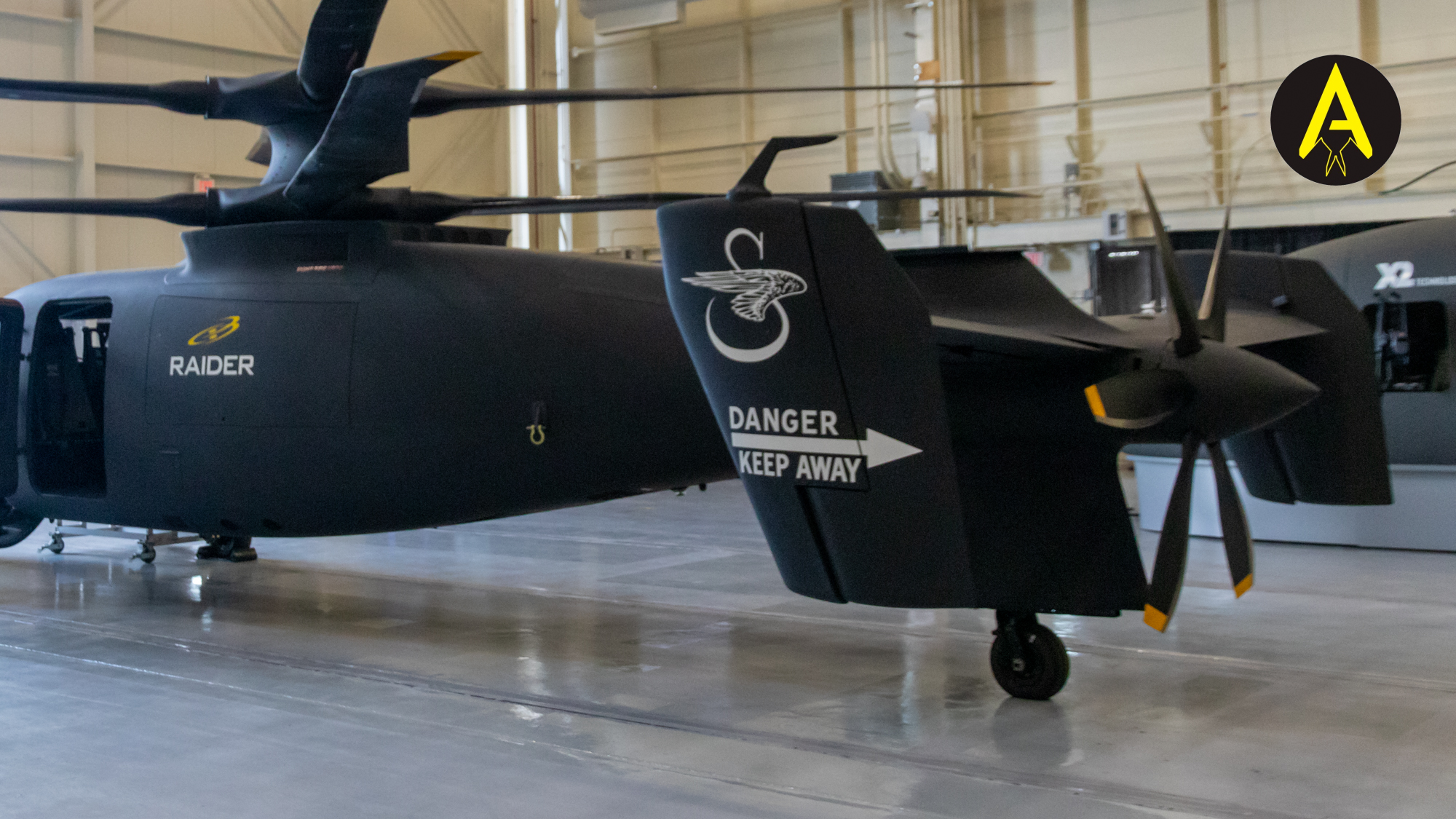
You can read our in-depth report about the S-97 here.