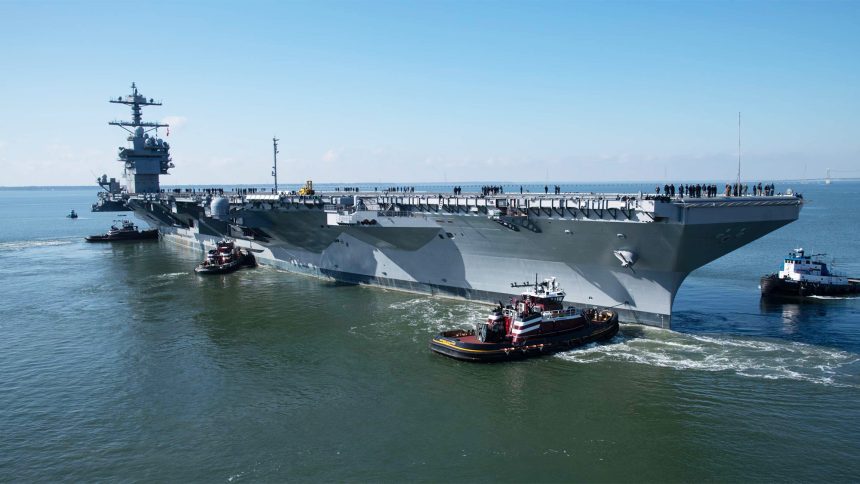
The next Gerald R. Ford class supercarrier, to be known as the USS John F. Kennedy (CVN 79), set sail under its own power from Newport News for the first time on Jan. 28, 2026 to begin manufacturer sea trials.
Ahead of scheduled delivery to the U.S. Navy in March 2027, which will come with its own set of sea trials, these initial tests will certify the 100,000 tonne behemoth’s major systems and components under close watch from specialist Huntington Ingalls Industries (HII) personnel.
The Kennedy was laid down at the HII facility in Newport News, birthplace of all U.S. Navy nuclear aircraft carriers, in 2015. The subsequent eleven year gap until commencing sea trials is longer than the USS Gerald R. Ford experienced, the first-of-class having been laid down in 2009 and began sea trials in 2017.
This huge milestone is the result of the selfless teamwork and unwavering commitment by our incredible shipbuilders, suppliers and ship’s force crew. We wish them a safe and successful time at sea! @USNavy @COMNAV_AIRLANT @USNavyNNPP (2/2) pic.twitter.com/EEwJdltygV
— HII (@WeAreHII) January 28, 2026
Impacts from the COVID-19 pandemic are sure to have had a major effect, but timelines were also shifted by a Congressional mandate to deliver the new ship with the capability of hosting the U.S. Navy’s fifth generation F-35C Lightning II fighters. The USS Gerald R. Ford (CVN 78), though the newest carrier in the U.S. inventory, has yet to receive the modifications necessary to operate the new jet.
These delays pushed delivery back beyond the withdrawal of the USS Nimitz (CVN 68), which capped off its final planned deployment last month. For a few years, the Navy will once again drop to 10 active aircraft carriers rather than the legally enshrined goal of at least 11.
Usually the second-in-class example of a ship can have a speedier journey through trials and testing than its progenitor, though notably the Kennedy incorporates some major design changes compared to the USS Gerald R. Ford. Alongside the operation of the F-35C Lightning II – which will need its own certification process – from the very start, the Kennedy ditches the now unique AN/SPY-3 Multi-Function Radar (MFR) and AN/SPY-4 Volume Search Radar (VSR) combo carried by the Ford in favor of the AN/SPY-6(V)3 as fitted in an alternate form to Flight III Arleigh Burke class guided missile destroyers. This has led to a noticeable difference in design between the ‘island’ or superstructure of the Ford compared to the Kennedy.
SPY-6 family of radars from left to right:
🛰️AN/SPY-6(V)1 for Flight III Arleigh Burke-class destroyers
🛰️AN/SPY-6(V)2 for Flight II San Antonio-class LPD & LHA-8 & Nimitz-class aircraft carriers
🛰️AN/SPY-6(V)3 for Gerald R. Ford-class aircraft carriers(starting with CVN-79) &… https://t.co/38MEZsakYt pic.twitter.com/OpBSn5YlgJ
— 笑脸男人 (@lfx160219) April 9, 2025
Among the features carried over from the Ford are the Electromagnetic Aircraft Launch System (EMALS) catapults, Advanced Arresting Gear (AAG), and Advanced Weapons Elevator (AWE) weapons handling systems. All three of these have had teething issues, with the last AWE system on the USS Gerald R. Ford only having been installed in 2021 – four years after the ship formally entered Navy service. EMALS and AAG, both of which have famously been plagued by problems, have become more dependable but official reports still note that reliability is below the target level.
This is how you test a new aircraft carrier’s catapult system 🚢
36,000kg vehicles are propelled into the water from the USS John F. Kennedy to simulate the weight of an aircraft that the carrier will soon be launching ✈️
📺 Watch here 👇 pic.twitter.com/8ld0uBYI3P
— BFBS Forces News (@ForcesNews) March 7, 2024
President Donald Trump, who spoke out against the modern systems as far back as his first term in office, promised in October 2025 to sign an executive order mandating a return to steam catapults and hydraulic aircraft elevators. This order has yet to come, if it ever does at all – such a change would almost certainly be heavily opposed by U.S. Navy commanders. While the ruggedness of legacy systems – benefiting from many decades of improvements and service experience – is popular among ship crews, the newer technologies for launching and recovering aircraft, for example, are more efficient and much broader in how they can be configured. Precise dialing-in of launch and recovery weights for aircraft reduce airframe fatigue alongside the smoother ride offered by electromagnets.
Until commissioning, the ship is known by the U.S. Navy as Pre-Commissioning Unit or PCU John F. Kennedy. Naval personnel have been assigned to PCU John F. Kennedy since 2019 and, having already spent a significant time aboard, will play a major role in the sea trials. On-board amenities like the shop have already been readied and filled with stock to support these crew members.

After entering service, the Kennedy is due to be homeported at Naval Base Kitsap-Bremerton in the state of Washington. This will make it the first Ford class based on the U.S. West Coast, ideally positioned for regular deployments to the Indian and Pacific Oceans. Under current plans the carrier will arrive no earlier than 2029. A $145 million overhaul of the naval port’s facilities – focused on electrical infrastructure – ahead of the Kennedy’s arrival began in May 2025.
Delivery of CVN 80, the next Ford class carrier, bearing the iconic name of Enterprise, has slipped backwards to 2030. The USS Dwight D. Eisenhower, which it is due to replace, was originally due to retire in 2028 but will now likely serve into the next decade to cover any gap in carrier availability caused by delivery delays.
Namesake
CVN 79 will be the second U.S. aircraft carrier named after President John F. Kennedy, a U.S. Navy veteran who served as Commander in Chief from Jan. 20, 1961, until his assassination in Dallas, Texas on Nov. 22, 1963. The USS John F. Kennedy (CV 67) was laid down the following year.
Based on the Kitty Hawk class, CV 67 eventually incorporated so many design changes that it became into a single ship class of its own. Plans for nuclear propulsion were shelved during construction and the ship was instead fitted with eight steam boilers.
Former USS John F. Kennedy (CV 67) aircraft carrier being towed into Brownsville, Texas for scrapping – February 2, 2025 #ussjohnfkennedy #cv67
SRC: TW-@BocaChicaGal pic.twitter.com/hFoGij3dUS
— WarshipCam (@WarshipCam) February 2, 2025
Decommissioning in 2007, the original USS John F. Kennedy was the last conventionally powered aircraft carrier in the U.S. fleet. The vessel was stored in Philadelphia until 2025 when it began a voyage under tow to Texas for dismantling.