South Korea’s DAPA held a meeting with LIG Nex1, which was awarded the contract in December 2025, to start planning the activities towards a planned fielding in 2034.
Reports from South Korea on Jan. 20, 2026, said its Defense Acquisition and Program Administration (DAPA) finally launched the $1.29 billion Block-I airborne electronic warfare and jamming platform. The development comes as DAPA held a meeting with one of the major domestic defense companies, LIG Nex1, which was awarded a $1.1 billion contract in December 2025.
The program has been moving since September 2025, with Korean Air-LIG Nex1 and Korea Aerospace Industries (KAI)-Hanwha Systems submitting their concepts, based on the Bombardier Global 6500 and Gulfstream G550 carrier aircraft, respectively. The agency plans to field the new platform by 2034 and then launch a more advanced Block-II variant, building upon the experience gained from the Block-I project.
LIG Nex1 revealed the award of the contract on Dec. 24, when it was listed in the company’s filings on the Korean stock market. The filing mentioned the contract, worth W1.6 trillion ($1.1 billion) was awarded by DAPA and covers development and systems integration for the new electronic warfare (EW) aircraft.
Korean reports
Yonhap, The Korea Times and The Korea Herald, quoting DAPA officials and a statement from the agency, said: “Korea has launched a 1.9 trillion-won ($1.29 billion) project to develop special aircraft capable of jamming extensive air defense networks in the event of electronic warfare, the state arms procurement agency said Tuesday.”
“DAPA held a meeting to discuss the development plan of the system, named Block-I, with major defense firm LIG Nex1,” continued the reports. “Under the project, DAPA seeks to develop large aircraft capable of disabling and disturbing an opponent’s air defense network and electronic command systems through jamming attacks. If developed, the agency aims to deploy it in 2034.”
The future aircraft is expected to be a “game changer” in “future electronic warfare,” enhancing the survivability and interoperability of aerial assets during joint operations. DAPA added that the development of a more advanced Block-II system will follow the fielding of the initial Block-I variant.
South Korea launched a $1.29 billion program to develop a dedicated electronic warfare aircraft designed to jam enemy air defense & command networks by 2034.the project,led by DAPA with LIG Nex1, aims to improve survivability, interoperability of South Korean and allied airspace. pic.twitter.com/7sjpYvfZ0L
— Valhalla (@ELMObrokenWings) January 22, 2026
South Korean EW and SOJ aircraft
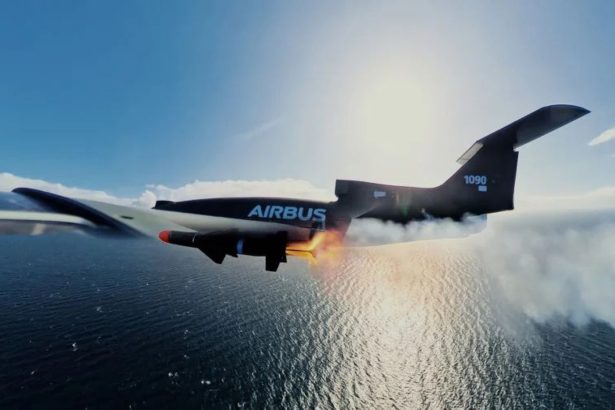
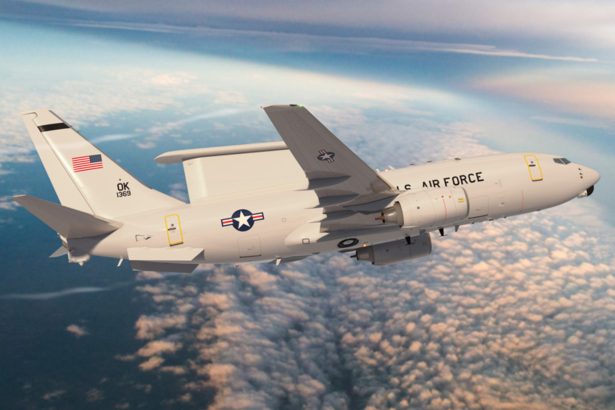
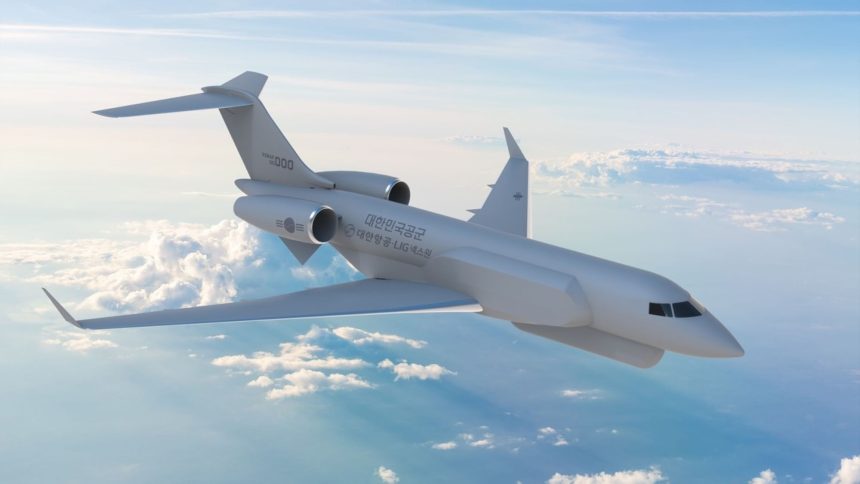
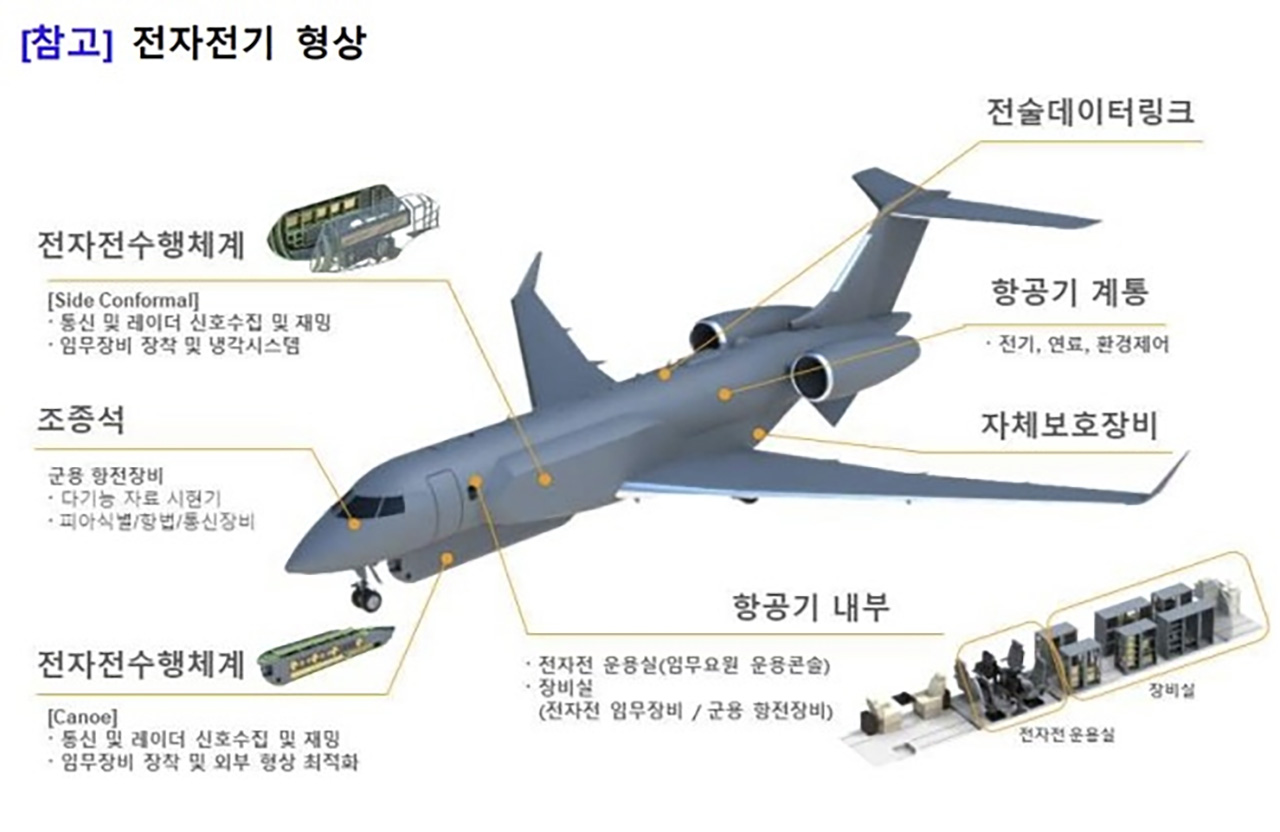
In September 2025, Korea Aerospace Industries (KAI) revealed its concept of an airborne electronic warfare and standoff jamming platform based on the Bombardier Global 6500 aircraft, in response to the DAPA’s Block-I Electronic Warfare System Development Project. KAI and its industry partner Hanwha Systems would develop the system with a full conformal array, running across a significant portion of the aircraft’s length.
Korean Air and LIG Nex1 also announced their partnership on Sep. 21, 2025, and were expected to formally submit their proposal towards the end of that month. The aircraft has a conformal array too, along with a large ventral sensor, similar to the French Archange.
There are conflicting reports on the choice of the carrier aircraft for the Korean Air-LIG Nex1 concept. FlightGlobal reported that Korean Air confirmed the aircraft will be based on the Global 6500, while Janes reports it will be based on the Gulfstream G550.
Smaller AEW&C platform called Conformal AEW (CAEW) based on biz jet platform has become a trend right now. https://t.co/GmDxAtPS9w pic.twitter.com/l38nDgjokN
— Keane Rara (@GardaAramis) September 28, 2025
In each team, while Hanwha and LIG Nex1 would develop the EW and Stand-Off Jamming (SOJ) hardware, mission systems and software, KAI and Korean Air would be responsible for the airframe modification, systems integration, flight testing and certification. Reports last year said the government planned an outlay of KRW 1.775 trillion ($1.3 billion) to induct four aircraft by 2034, and the latest quoted figure of $1.29 billion is hardly off the mark from that amount.
Chosun already reported on Sep. 22 that the Korean Air and LIG Nex1 proposal “scored higher” in the bid evaluation process by DAPA, but an “objection process” still remained before the final contractor’s selection. DAPA at the time was “evaluating each company’s electronic warfare equipment technology and airframe integration capability, among other factors,” Chosun added.
Importance of indigenous EW technology
The new platform has not yet been listed on LIG Nex1’s website, with the airborne EW systems section still listing only the current platform used in this role by the Republic of Korea Air Force (RoKAF), based on the Dassault Falcon 2000. The company says the airborne EW system is meant for “the collection of communication intelligence/electronic intelligence/instrumentation signals.”
The Block-I program evolved to develop an indigenous system, given the strategically sensitive nature of electronic warfare technology. Even Japan has announced plans for its own EW system, based on its domestically-developed Kawasaki P-1 Maritime Patrol Aircraft.
South Korea also leads in electronics manufacturing and has both semiconductor design and fabrication facilities, while nearly all countries only design chips but manufacture them through third parties in Taiwan and South Korea. This allows Seoul more flexibility in experimenting with and producing processors required for the heavy computing requirements of sensor fusion systems, which blend electromagnetic sensing, communication, tactical data links and satellite data into a cohesive picture.