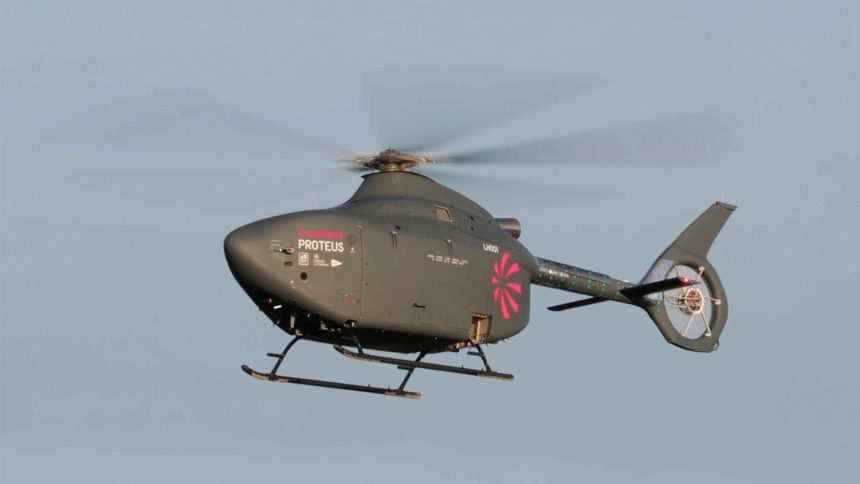
The UK’s first full-size autonomous helicopter, produced by Leonardo, has taken flight for the first time from the National Drone Hub facility at Predannack Airfield.
The Proteus, developed by Leonardo from the civilian AW09 helicopter, performed two short test flights following a test routine that included fully autonomous operation, independent of any human input. This milestone comes just over a month after the uncrewed design completed ground testing at Leonardo’s Yeovil HQ.
From the images, we can see the aircraft has been given the serial LH001.
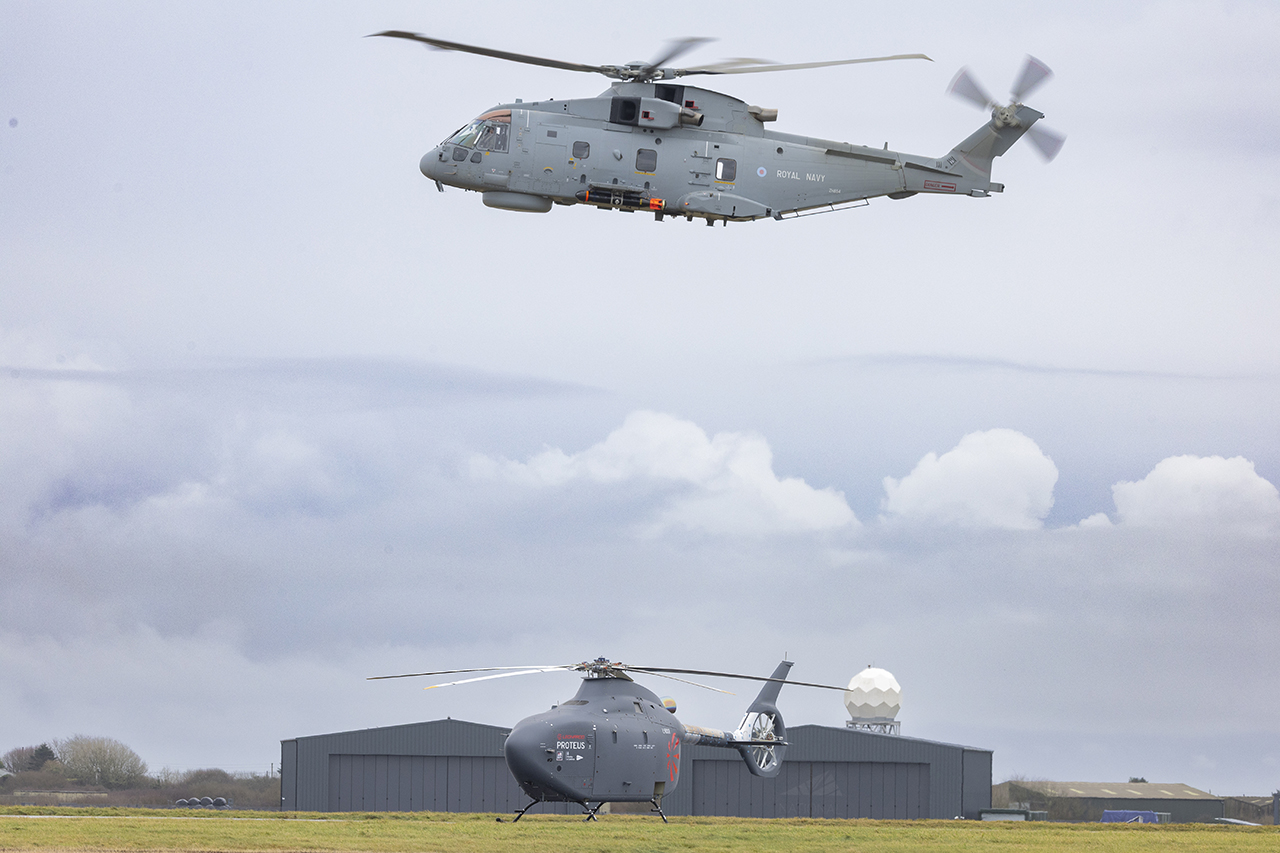
Though the aircraft’s maiden flight comes slightly beyond the mid-2025 timeframe that was on the cards in January last year, development has still been comparatively rapid compared to many other ongoing defence projects. An initial contract worth £60 million was awarded to Leonardo in 2022 and we got a first look at computer renderings in 2023.
🚁 Liftoff!
The UK’s first autonomous full-size helicopter, #Proteus, has completed a historic maiden flight at Predannack airfield in Cornwall.
Designed and built by #Leonardo in Yeovil, the Home of British Helicopters, Proteus is a major step forward in autonomous maritime… pic.twitter.com/nqZ9Qyp23Z
— Leonardo Helicopters (@LDO_Helicopters) January 16, 2026
Hybrid Air Wings and the Atlantic Bastion
The maiden flight is regarded as a significant step towards the Royal Navy’s ambition to operate a hybrid air wing from its carrier strike groups, mixing crewed and uncrewed capabilities. 2025’s deployment of HMS Prince of Wales to the Indo-Pacific saw some limited use of drones on board, with RNAS Culdrose’s 700X Naval Air Squadron deploying with Malloy T-150 octacopters for logistics use and small RQ-20 Puma fixed wing drones for intelligence, surveillance, and reconnaissance (ISR).
Uncrewed helicopter platforms are also vital as a force multiplier for the Royal Navy’s Atlantic Bastion strategy, the latest effort to fortify the North Atlantic and the Greenland-Iceland-UK (GIUK) Gap and defend critical undersea infrastructure (CUI). Crewed aircraft will still be used where necessary, but uncrewed systems can provide additional mass and allow for wider and more persistent coverage.
British aviation history has been made with the UK’s first truly autonomous full-size helicopter Proteus completing its maiden flight at Predannack Airfield #Cornwall. Built by @LDO_Helicopters for @RoyalNavy pic.twitter.com/pWlv7USk8P
— RNAS Culdrose (@RNASCuldrose) January 16, 2026
With a payload of over one tonne, Leonardo’s visions for the Proteus include equipment modules that would allow it to undertake anti-submarine warfare (ASW), anti-surface warfare (ASuW), airborne early warning (AEW), and general utility missions. Although Commodore Steve Bolton, Deputy Director Aviation Future Programmes for the Royal Navy, noted that the Proteus is not planned to enter full production or service as an operational airframe, it will be used significantly to inform the development of future platforms that will. Leonardo, indeed, may decide to offer a direct descendant of the Proteus for a future contract which takes advantage of its earlier plans.
An interesting modular model was displayed at last year’s @DefenceIQ International Military Helicopter conference… pic.twitter.com/pZM0q6sw6v
— Gareth Jennings (@GarethJennings3) January 7, 2025
Bolton, speaking on the Proteus’ first flight, added: “The successful first flight of Proteus is a significant step in delivering the Royal Navy’s maritime aviation transformation vision, and to demonstrating our steadfast commitment to investing in autonomy as part of a hybrid air wing. This milestone signals our intent to lead technological innovation, to enhance the fighting effectiveness of the Royal Navy in an increasingly complex operating environment, and to maintain operational advantage against evolving maritime threats.”
Luke Pollard, Member of Parliament for Plymouth Sutton and Devonport and current Minister of State for Defence Readiness and Industry, said “This maiden flight is a proud moment for British innovation. Designed and built in Yeovil, Proteus supports skilled UK jobs while helping deliver the hybrid navy outlined in our Strategic Defence Review. Autonomous systems like this will be vital in protecting our seas without putting personnel in harm’s way”.
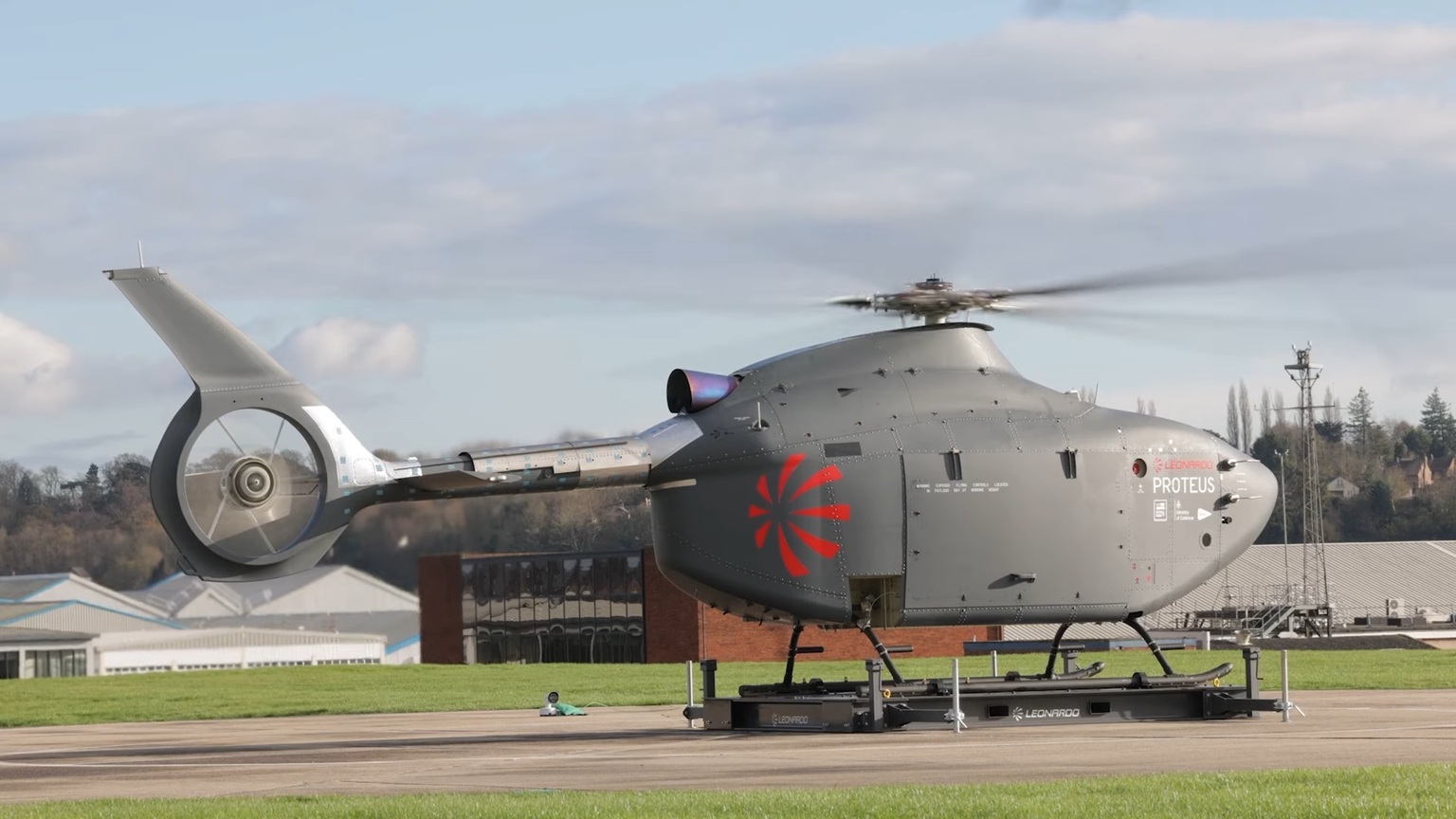
Representing manufacturer Leonardo, the Managing Director for their UK Helicopter division, Nigel Colman, remarked “Proteus represents a step-change in how maritime aviation can deliver persistence, adaptability and reach – conducting the dull, dirty and dangerous missions in challenging environments without putting human operators at risk. As the UK’s only end-to-end rotary wing manufacturer it has been a pleasure working with the Royal Navy and seeing Proteus take off for the first time after being designed, developed, and manufactured at Leonardo’s Yeovil site is a fantastic milestone.”
National Drone Hub
While helicopters built at Yeovil often perform their first flight tests on site, the special requirements necessary for operating uncrewed aircraft – particularly early in development, prior to any certification – lead to Predannack’s National Drone Hub facility being a clear choice of venue.
As a satellite airfield of RNAS Culdrose, and the most southerly airfield on the British mainland, Predannack has access to a vast area of open water already designated for military use. Airspace corridors that provide a segregated route for uncrewed aircraft to and from these over-water exercise areas were instituted as the site took on an increased role supporting Royal Navy uncrewed aerial system (UAS) trials and testing.
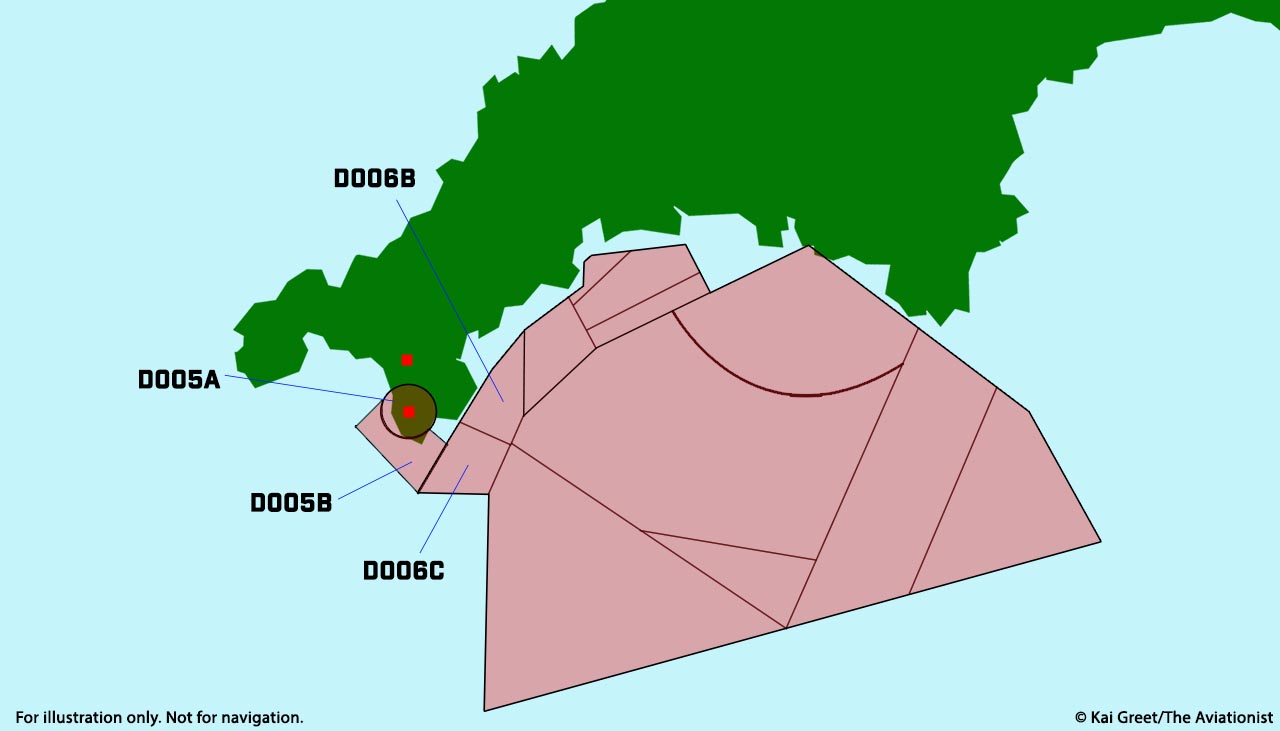
We were one of the first to report on the significant expansion of facilities at Predannack in support of further drone development, known as the National Drone Hub and operated in partnership with Wholeship Ltd. The expansion included the addition of two new 485.8 square meter hangars, with illustrations depicting use by MQ-9 type aircraft. The airfield has provided a home for a varied array of drones, including fixed wing propeller and jet drones, quadcopter and octacopter platforms, other, smaller helicopter-type aircraft, and even vertically dropped pods intended for microgravity experiments.