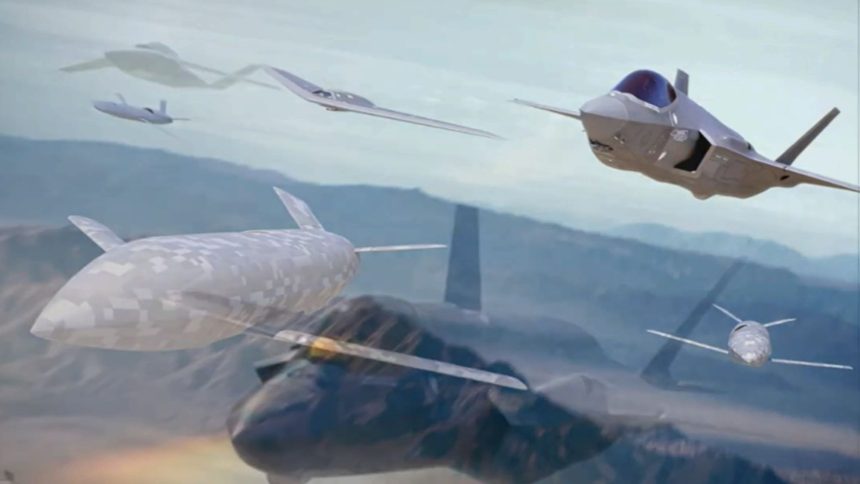
The Joint Simulation Environment is playing a key role in developing tactics and operational concepts for integrating Collaborative Combat Aircraft with the F-35.
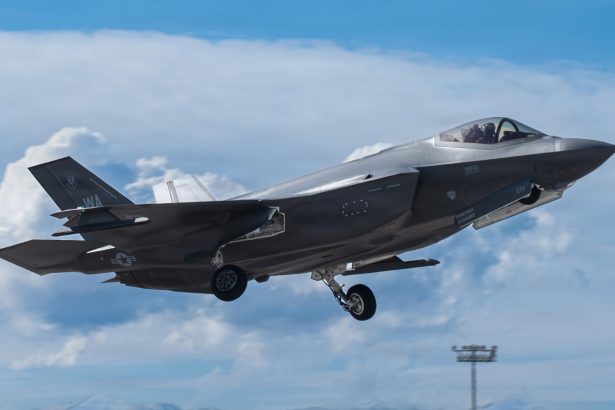
Advancing the effort towards integrating F-35A Lightning II fighters with Collaborative Combat Aircraft (CCA), the Naval Air Warfare Center Aircraft Division (NAWCAD) recently integrated F-35s with the uncrewed systems in its Joint Simulation Environment (JSE) training system. The Jan. 5, 2025 announcement outlined the “tactical demonstration” in the JSE, which created realistic and real-world scenarios to put in place protocols and procedures before fifth-generation F-35s begin operating unmanned combat systems.
The CCA effort globally appears to be largely addressing how to employ these drones in combat, rather than a technological maturation effort. Minor and major safety, operation, logistical, tactical and communication protocols would need freezing, before the CCAs are thrown into combat.
The JSE simulator, which creates a “hyper-realistic simulation environment” with 4K projectors and software replicating a “near-exact virtual battlespace,” has been operational since 2021 at the Naval Air Station Patuxent River (NAS Pax River), Maryland. Part of the syllabus for the Navy Strike Fighter Tactics Instructor Course, or TOPGUN, the JSE was developed “out of a need to fully test F-35 capabilities and pilots,” according to Naval Aviation News.
An unrelated image of a pilot operating a simulator inside the Naval Air Warfare Center Aircraft Division’s Joint Simulation Environment at Naval Air Station Patuxent River, Maryland. (Image credit: U.S. Navy courtesy photo)
F-35 and CCA simulated integration
According to the release, the event employed “advanced modeling and simulation” to “develop tactics and strategies for fifth-generation” aircraft like the F-35 which operate CCAs.
“Modern warfare is demanding more from our aviators,” NAWCAD commander Rear Adm. Todd Evans said. “This milestone shows the Joint Simulation Environment’s impact on equipping them with the advanced tactics they need to win future battles.”
The demonstration saw F-35 pilots using touch-screen tablets “to control multiple CCA during simulated missions.” In fact, tablets strapped on the thigh are emerging as the initial mode for operating CCAs, as seen in an F-22 Raptor’s recent control test of a GA-ASI MQ-20 Avenger, and Japan trialing miniature drones from inside helicopters.
“Using advanced operational communication systems and precision-guided missiles, pilots engaged complex threats in the JSE’s highly realistic virtual environment,” the release added.
An illustrative video by Collins Aerospace on its mission autonomy systems showing F-35s controlling and tasking CCAs is also instructive. Tablets would be useful at least for single-seat stealth fighters like the F-35s and Gen. 4.5 jets that are not purpose-built for another crew member and mission systems that could be operating CCAs.
NAVAIR called the JSE the Department of Defense’s “state-of-the-art digital test and training range that replicates real-world combat scenarios in a virtual environment.”
“Built by NAWCAD engineers, the JSE combines cockpit simulators, advanced software, and domed visual displays to allow pilots to train and test systems in a safe, controlled setting,” said NAVAIR. “The JSE enables pilots to fly more sorties in one week than they can on open-air ranges in a year, sharpening their skills and improving readiness.”
According to the Dec. 19, 2023 release on NAN, more than 500 pilots have used the JSE so far, which has also seen the participation of Lockheed Martin in its development. The JSE’s biggest advantage is replicating enemy threats that can, albeit simulated, detect, track and engage an F-35, which no other aircraft in the U.S. inventory can. This helps validate tactics and concepts, while also assessing and incorporating inputs of the intelligence community on adversary systems.
The JSE can introduce “additional threats and more dangerous scenarios,” including “denial zones” of electronic attack jamming. Instructors can more or less “drag and drop” new scenarios and threats “in a matter of minutes in the JSE.”
“The JSE enables such a diverse training environment that a group of students could fly more than 50 missions in a week and never encounter the same scenario,” the release said.
Meet the future of air dominance. 💪
Two @usairforce F-35As paired up with an XQ-58A Valkyrie uncrewed combat aerial system for a recent test, showcasing the seamless connectivity of the F-35 with an autonomous platform—creating a team that’s even smarter and faster. pic.twitter.com/87Rr3cQhel
— F-35 Lightning II (@thef35) November 26, 2024
U.S. and other countries’ CCAs
The U.S. Navy recently chose Boeing, along with Anduril, Lockheed Martin and General Atomics, to produce conceptual designs for carrier-borne CCAs.
The MQ-28A Ghost Bat is likely to be a contender for the U.S. Navy’s CCA project, given that the aircraft was seen in the background of an official Dec. 6, 2025 video about Secretary Pete Hegseth’s visit to Naval Air Station Point Mugu, California. This hinted that the service is possibly evaluating the aircraft to determine the requirements for its CCAs.
An unmanned system being actively tested by the Navy is the MQ-25 Stingray, which is primarily an uncrewed refueler, and is expected to be integrated aboard aircraft carriers this year. Shield AI’s X-BAT Vertical Take-Off Landing (VTOL) CCA has also been depicted operating off carriers and regular amphibious assault ships and surface combatants.
The USN refused to develop it, instead opting to buy the MQ-25 Stingray – an unmanned tanker that is little more than a flying drop tank for its fleet of F/A-18s and F-35Cs.
I suspect the infamous Fighter Mafia, sensing an existential threat, intervened to kill the program. pic.twitter.com/nkFlOtW1Nx
— Armchair Warlord (@ArmchairW) June 9, 2023
The release said this about the Navy’s CCAs: “Navy’s CCA are multi-role uncrewed combat vehicles that will operate with crewed fighters enhancing the mission effectiveness of crewed platforms in highly contested environments. They are central to the Department’s future strategy, enabling pilots to focus on high-level decision-making while expanding operational capabilities. The JSE is playing a key role in developing tactics and operational concepts for integrating these systems with fifth-generation platforms like the F-35.”
US Navy plans to field an unmanned “joint combat aircraft” (CCA), similar to the one being developed by the Air Force. The US Navy has already selected American General Atomics Aeronautical Systems (GA-ASi), which is creating a similar strike UAV and for the US Air Force. pic.twitter.com/Od2MpNdhwI
— Valhalla (@ELMObrokenWings) October 18, 2025
The U.S. Air Force meanwhile is flight testing Anduril’s YFQ-44A and the two prototypes of General Atomics’ YFQ-42A as a part of the CCA Increment 1 program, and recently designated Northrop Grumman’s Project Talon as the YFQ-48A. Talon is likely to be a contender for the Increment 2 phase. The service is also parallelly working with the XQ-58A Valkyrie, which has been controlled by manned aircraft earlier this year.
China’s GJ-11, and Turkey’s Kizilelma are two of the other flying CCA examples, where the former appears to be operational based on its markings and paint scheme in a recent publicity video. The Kizilelma meanwhile has shown sophisticated maneuvers, including tracking and engaging targets with its onboard Murad 100-A Active Electronically Scanned Array (AESA) radar and the Gökdoğan long-range AAM.