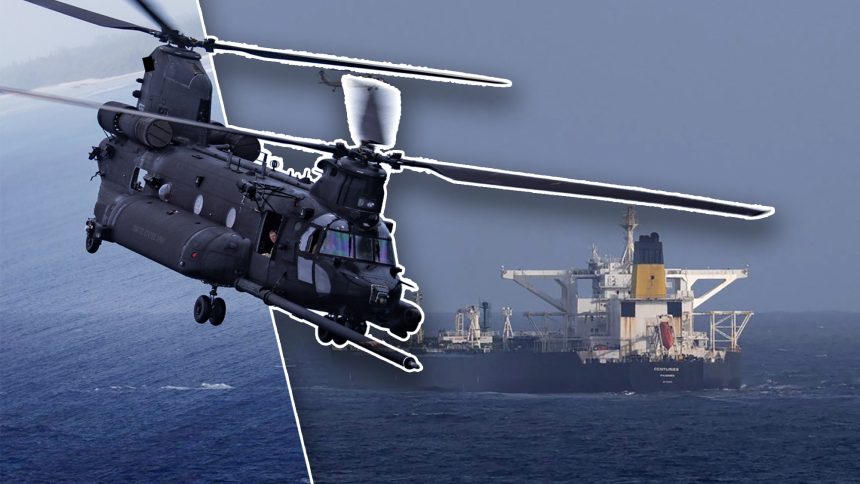
As rumors swirl over the deployment of 160th SOAR aircraft to the UK as the sanctioned tanker Bella 1, or Marinera, approaches the GIUK gap, let’s look at what we do and don’t know about the bizarre situation.
While the world watched the U.S. stage an impressively swift operation to capture Venezuelan President Nicolás Maduro, a steady stream of C-17A Globemaster IIIs began transiting from the U.S. across the Atlantic to RAF Fairford in the UK. These flights, using the standard Air Mobility Command (AMC) callsign ‘REACH’, originated from a variety of stateside locations, including Campbell Army Airfield (AAF), Hunter AAF, and Pope AAF. Upwards of 10 C-17s called into Fairford, though many others were also tracked passing by by eager aviation enthusiasts that were instead part of the regular, and extremely busy, air transport bridge between the U.S. and its major European bases.
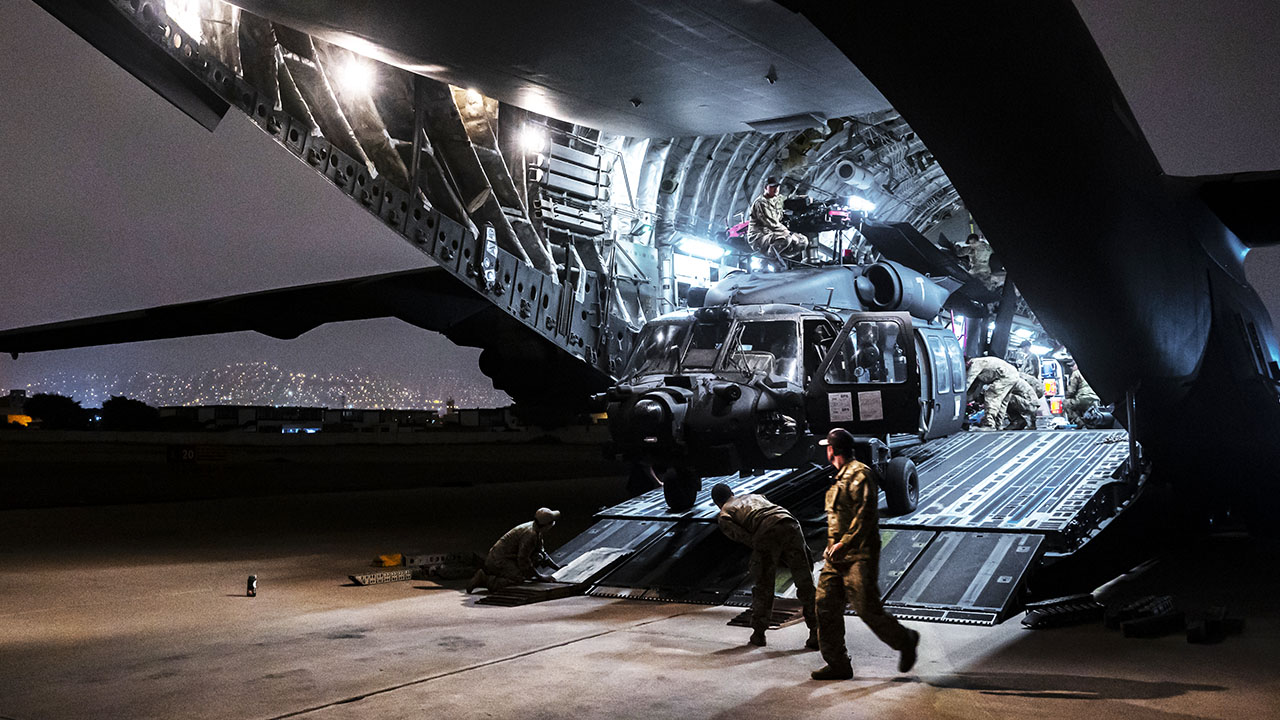
Campbell AAF and Hunter AAF will ring alarm bells for any familiar with them, as they are both home to battalions of the 160th Special Operations Aviation Regiment (SOAR) – famously known as the Nightstalkers. Consequently, upon arrival at RAF Fairford, the C-17s unloaded MH-47G Chinook and MH-60M Black Hawk airframes, both operated exclusively by this famous clandestine unit which, all while these aircraft were being shipped, simultaneously performed the mission to capture Maduro. Reacting to the unfolding events, numerous aviation enthusiast groups on social media began to clamp down on posts relating to the aircraft that had appeared at the Gloucestershire base in an attempt – whether effective or not – to safeguard operational security (OPSEC).
We can clarify that the aircraft were visibly confirmed to be on site by local spotters. At the time of writing, the deployed force is known to include two MH-47G Chinooks and five MH-60M Black Hawks. One of the MH-47Gs has already flown, having made what appeared to have been a brief test flight in the very early hours of Jan. 5.
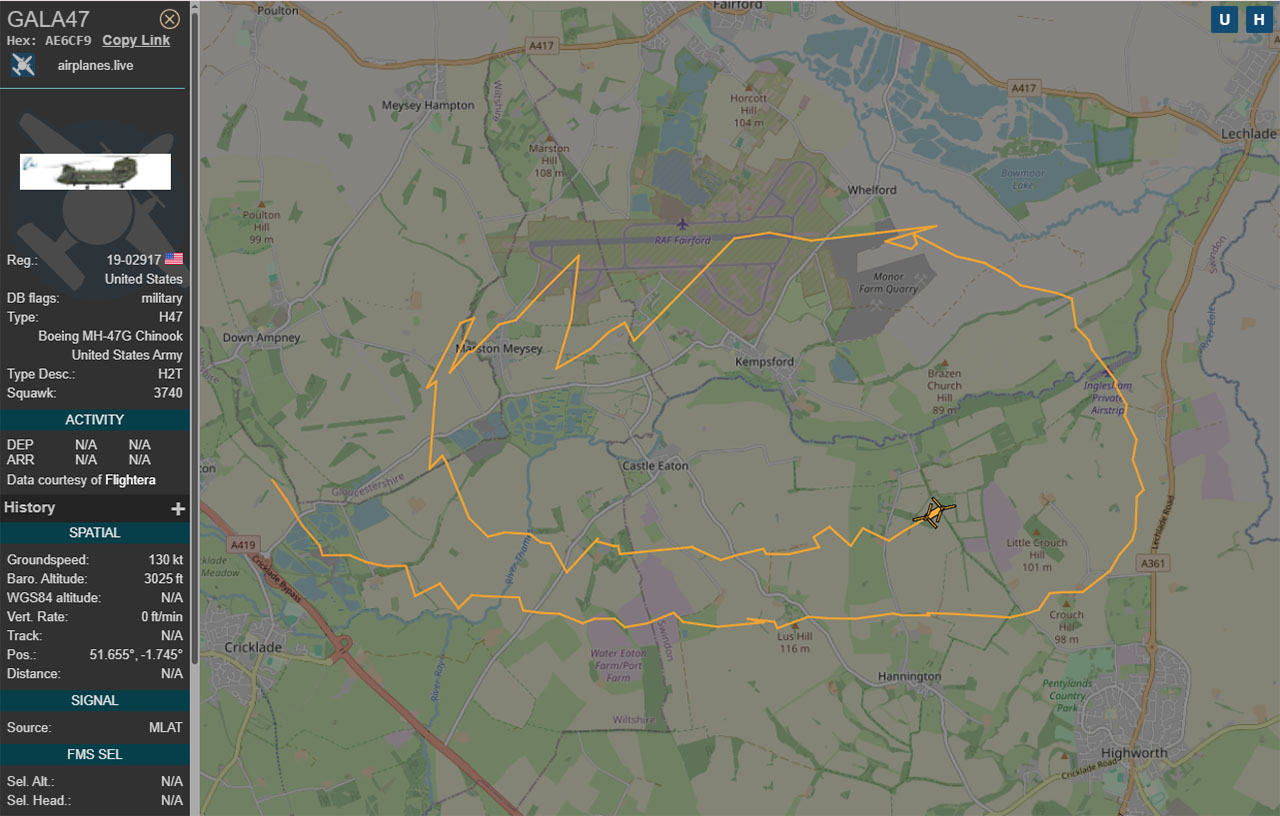
Some initial thoughts were that these aircraft were deployed to take part in an exercise. Indeed, with what we know for sure at present, that may still be the case – though there are strong arguments against this also. In the latter half of 2024, two MH-47Gs made a rare deployment to the UK to participate in Exercise Dark Lightning. This joint training mission is likely to be the first of many, as it provided an opportunity for Royal Air Force Chinook crews and members of the UK’s special forces units to familiarise themselves with the special operations Chinook variant. From 2027, the RAF is expecting to take delivery of its first new build H-47ER Chinooks, which are thought to share some of the MH-47G’s special operations adaptations.
Alongside the above, though, we must consider the other locations from which the train of C-17s originated. At least one C-17, using the callsign REACH 130, traveled to RAF Fairford via Pope AAF. Pope AAF acts as the airfield portion of Fort Bragg, which is the headquarters of the United States Army Special Operations Command and, notably, the 1st Special Forces Operational Detachment-Delta (Airborne) – commonly known as Delta Force. Like the 160th, Delta Force were involved in Operation Absolute Resolve on Jan. 3, and they also led the 2019 operation targeting Daesh leader Abu Bakr al-Baghdadi.
#USAF United States Air Force – RAF Fairford
Boeing C-17 Globemaster III 7x#AE123D 04-4132 – REACH 197 (Hunter AAF, Pos)#AE10BA 01-0191 – REACH 165 (Hunter AAF, Pos)#AE117D 02-1111 – REACH 167 (Campbell AAF)#AE2FAE 08-8202 – REACH 199 (Campbell AAF)#AE146D 07-7175 – REACH… pic.twitter.com/Lp7whtWo1T
— Armchair Admiral 🇬🇧 (@ArmchairAdml) January 3, 2026
Before stopping at Pope AAF, even more interestingly, REACH 130 came from Naval Air Station Oceana. At the Dam Neck Annex, just a short drive from the main NAS Oceana base, is the headquarters of the Naval Special Warfare Development Group, also known as DEVGRU, or, more famously, SEAL Team 6. SEAL Team 6 is considered the most elite, specialist unit under the wider U.S. Navy SEALs umbrella, and were responsible for leading the 2011 mission that killed Osama bin Laden, as well as an apparently botched 2019 raid inside North Korean territory.
This was all noticed widely on X, otherwise known as Twitter, with many of the regular flight tracking enthusiasts who we feature regularly here compiling lists and maps of all of the apparently related movements. Eventually, it began to be picked up by the media. First with specialist sites, like the UK Defence Journal, The War Zone, and Forces News, and then soon the mainstream press too. At The Aviationist, we kept a close eye on developments and conversed between ourselves and with our friends in the community before compiling this piece.
Special Airlift Assignment Missions
Could REACH 130 have collected a joint force from the U.S. military’s top two most elite special forces units? It certainly seems likely. Both this flight as well as those carrying the helicopters flew across the Atlantic using mission codes that indicate Special Airlift Assignment Missions (SAAMs). According to the U.S. Transportation Command (TRANSCOM), SAAM flights are distinguished from regular sorties – known as channel flights – due to their “unusual nature”, “sensitivity”, “urgency of the cargo”, or “operational delivery to points other than the established channel structure”. It should be noted at this point that a SAAM is different to a SAM, or Special Air Mission, which is used as a callsign for VIP transit.
While it might now seem easy to jump to a conclusion – let’s hold fire. Though transportation in preparation for a live, real-world mission would certainly fall under the categorizations for a SAAM, some of the distinguishing features of SAAMs can also be applied to exercise traffic. For example – cargo of an unusual nature, or sensitivity, could both be triggered by the cargo itself requiring a higher level of security clearance to be in the presence of.
This would impact mission planning, and potentially require an SAAM designation, because it would enforce stricter limits on where the C-17 could potentially land should its planned destination be unavailable. Each aircraft in the U.S. Air Force inventory, and presumably each aircraft in the wider U.S. inventory, has a defined Protection Level (PL). C-17s are usually a Protection Level 3 (PL-3) asset, at the lower end of the spectrum.
However, when a low PL aircraft carries on board information, equipment, or other assets which require a higher PL, that higher PL can override the lower rating. Special forces aircraft, with their highly specialized and sensitive equipment for self-protection and communications, would undoubtedly warrant an extra layer of security, as would the presence of special forces personnel, whose faces and identities are often highly sensitive and closely guarded. While many Channel Flights could, if necessary, divert to a normal civilian airport, this might not be the case for a SAAM flight.
Looking back to 2024, when the MH-47Gs were shipped to RAF Mildenhall by C-17s from Hunter AAF for Exercise Dark Lightning, these flights too used SAAM codes.
A Scoop from CBS News
Jim LaPorta, a reporter at the Washington bureau of CBS News, fueled the fire of the planespotters’ rumors with a piece published on Jan. 5. Via sources with knowledge of a planned operation, LaPorta writes that U.S. forces were preparing a mission to interdict an evading Russian-flagged oil tanker.
New from me: U.S. forces plan to interdict an evading Russian-flagged oil tanker. Also, Venezuelan officials discussed placing armed military personnel on oil tankers — disguising them as civilians — as well as giving them portable Soviet-era MANPADS. https://t.co/639zjcW6vw
— Jim LaPorta (@JimLaPorta) January 5, 2026
Soon after LaPorta published his story, CNN released a story confirming the CBS News report via their own anonymous inside sources.
The US is making plans to try to intercept a fleeing oil tanker that Russia has claimed ownership of, according to four people familiar with the matter, setting up a possible confrontation between Washington and the Kremlin… confirming CBS: https://t.co/9YRNBbW7TI
— Natasha Bertrand (@NatashaBertrand) January 5, 2026
This tanker is the Bella 1 – now renamed Marinera – which is sanctioned by the United States under accusation of transporting Iranian crude oil for designated terrorist groups. The U.S. Coast Guard attempted to board the ship in the Caribbean Sea on Dec. 21, 2025, under suspicion that it was bound for Venezuela, but – in an unclear series of events – the ship’s crew evaded the boarding attempt. Making an about turn, the ship fled into the Atlantic Ocean as U.S. forces pursued.
On Dec. 31 it was reported that the Bella 1 had officially been renamed Marinera, and, most importantly, was re-flagged as a Russian ship. Adopting Russian colours is almost certainly an attempt to deter any further attempt by U.S. forces to board the vessel but, as has been noted in many other outlets, it is not technically permissible under the UN Convention on the Law of the Sea (UNCLOS) for a ship to change its flag while underway without an official change in ownership or registry. The U.S. might choose to use this regulation in its favor to disregard the change in flag, interpreting the letter of the law “real transfer of ownership or change in registry” as potentially disallowing circumstances where the change in flag appears to be for a nefarious or fraudulent purpose. Whether that interpretation would stand in a courtroom is another story – but that case would either have to be settled after the mission is done, or maybe it is something that U.S. legal counsel is already wrestling over behind the scenes.
As of Jan. 6, the ship is on the western side of the Atlantic Ocean, with the closest land masses being Ireland and the United Kingdom. This would appear to place the 160th SOAR deployment well within striking distance. However…
Why the 160th SOAR?
RAF Mildenhall, a U.S. operated airbase in the UK, houses one of the most experienced and well equipped Air Force Special Operations Command (AFSOC) units worldwide. Frequently called upon to deploy at a moments notice in support of operations across Europe, Africa, and the Middle East, the MC-130J Commando IIs and CV-22B Ospreys of the 352nd Special Operations Wing (SOW) are no strangers to long range, high stakes missions.
Arguably, with the distance involved with a move against the tanker easily exceeding 1000 kilometres each way, even with the 160th SOAR’s aerial refueling capability the longer-legged and faster CV-22B Ospreys would arguably be the more suitable platform. That is, of course, unless there is a large-decked ship lurking out in the Atlantic Ocean which the U.S. are planning to use as a staging post – though this is pure speculation at this point, as we have no way of knowing for certain. Without such a ship, even with aerial refueling the 160th SOAR’s Chinooks and Black Hawks would have very little time to hang around on scene.
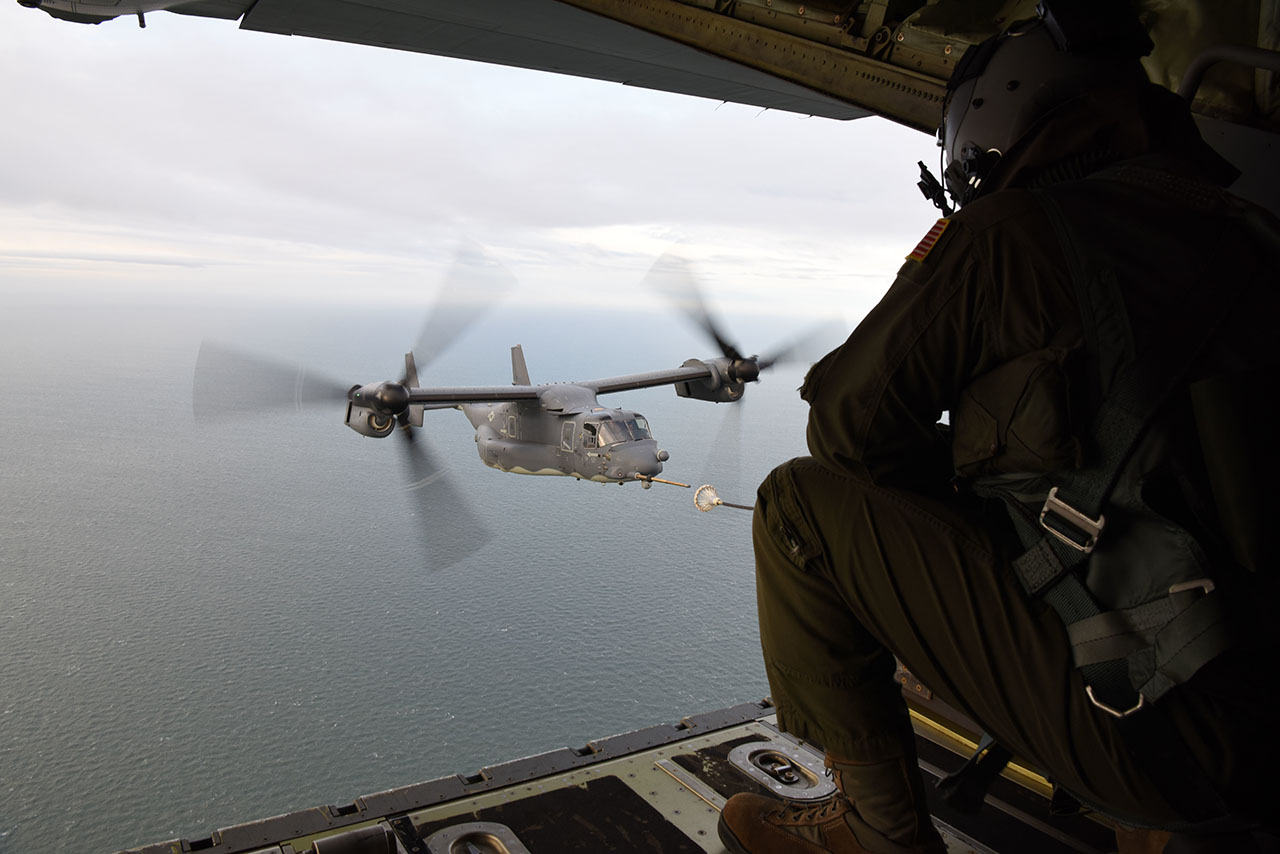
Would the entire special forces team stay with the ship after re-capturing it, along with the crew? The question must also be asked: what if the mission goes wrong, and they need to leave the ship in a hurry? Ospreys would have a much greater capability to loiter, supported by the MC-130Js which in turn can be supported by KC-135 Stratotankers of the 100th Air Refueling Wing (ARW).
This all too begs the question – if the intent has been there to seize this ship, why was more of an effort not made when it was effectively in America’s backyard, surrounded by the plethora of deployed capabilities supporting Operations Southern Spear and Absolute Resolve? Seizing it earlier would have also avoided the trickier legal and diplomatic question of its re-flagging as a Russian vessel.
Ghostriders
As the special mission helicopters arrived at Fairford, over at Mildenhall spotters welcomed the arrival of two AC-130J Ghostriders. AC-130s regularly pass through Mildenhall on their way to and from the Middle East, though in this case there are indications that Mildenhall was in fact their destination. On Jan. 5, one of the two aircraft – which have had their serial numbers obscured – departed Mildenhall and flew a short evening sortie towards the northwest.
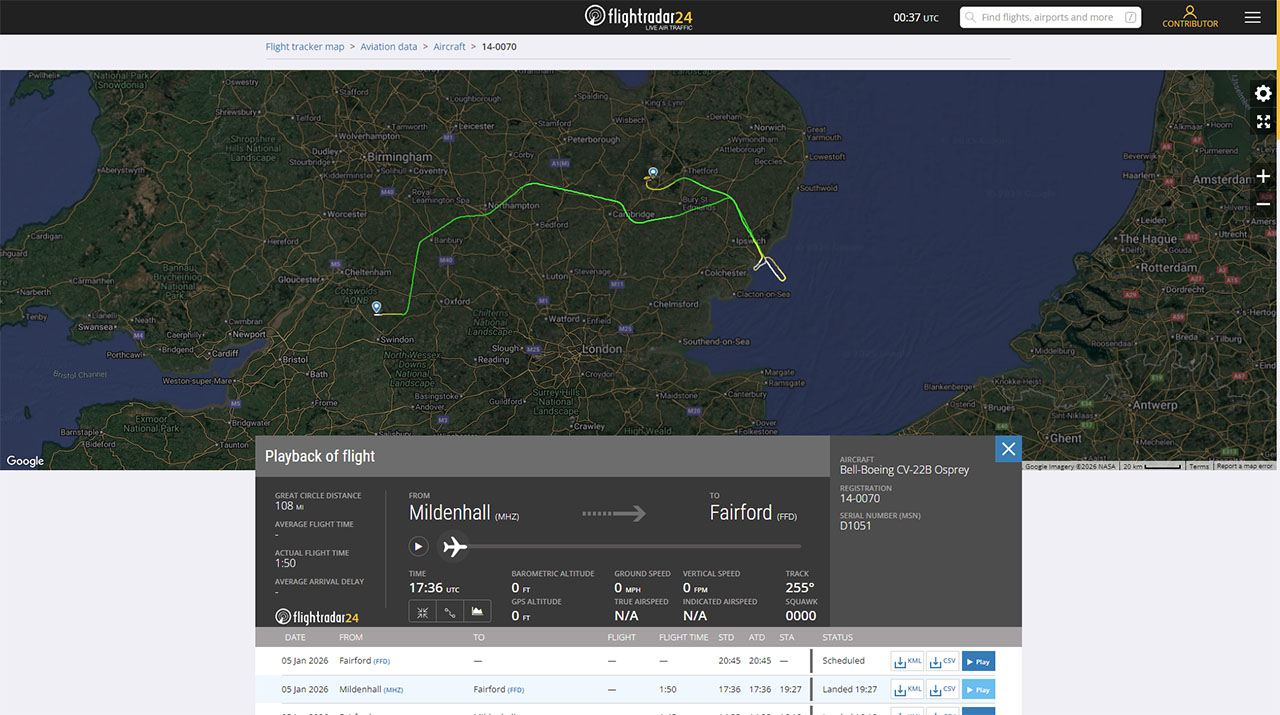
Meanwhile, the based units at Mildenhall were also busy. The aforementioned CV-22Bs were active, and flew missions out over the sea where eyewitnesses saw them with personnel rehearsing fastroping techniques. They also made calls into RAF Fairford, right where it seems members of Delta Force and the SEALs might be convening.
U.S. Navy P-8 Poseidons were also in and out of Mildenhall, heading out beyond flight tracking coverage to conduct their maritime patrol missions. Of course, this is quite regular, but the operational tempo has noticeably increased and many flights appear to be close to the known locations of the suspect tanker.
US Navy P-8A #PM051 out of Mildenhall is tracking westbound over Ireland for point KOKIB, at which point they’ll go operational due regard.
169328 / #AE6858 https://t.co/ukw8hvf8bl pic.twitter.com/ZfOdopOZC1
— EISNspotter (@EISNspotter) January 5, 2026
It does all seem a bit quick and convenient to all just be a coincidence.
Why wouldn’t they keep it secret?
The UK is probably one of the worst places a military force could deploy assets to while hoping to keep it all under wraps. A fervent, growing planespotter community and a relatively open and permissive atmosphere when it comes to enthusiasts at base fencelines have made it so most forums and groups have long instituted rules about what can and can’t be posted, due to the risk of someone accidentally revealing sensitive information.
A recent, notable, and long-running case of this comes in fact from RAF Fairford, where base officials and reportedly requested privately to those who run said groups to restrict the reporting of U-2 movements and photographs before the aircraft returns home from its intelligence missions. While any state adversary could track these aircraft on radar, spotters posting photographs online of a departure could reveal the specific payload carried on that flight and could then jeopardize the value of the sortie.
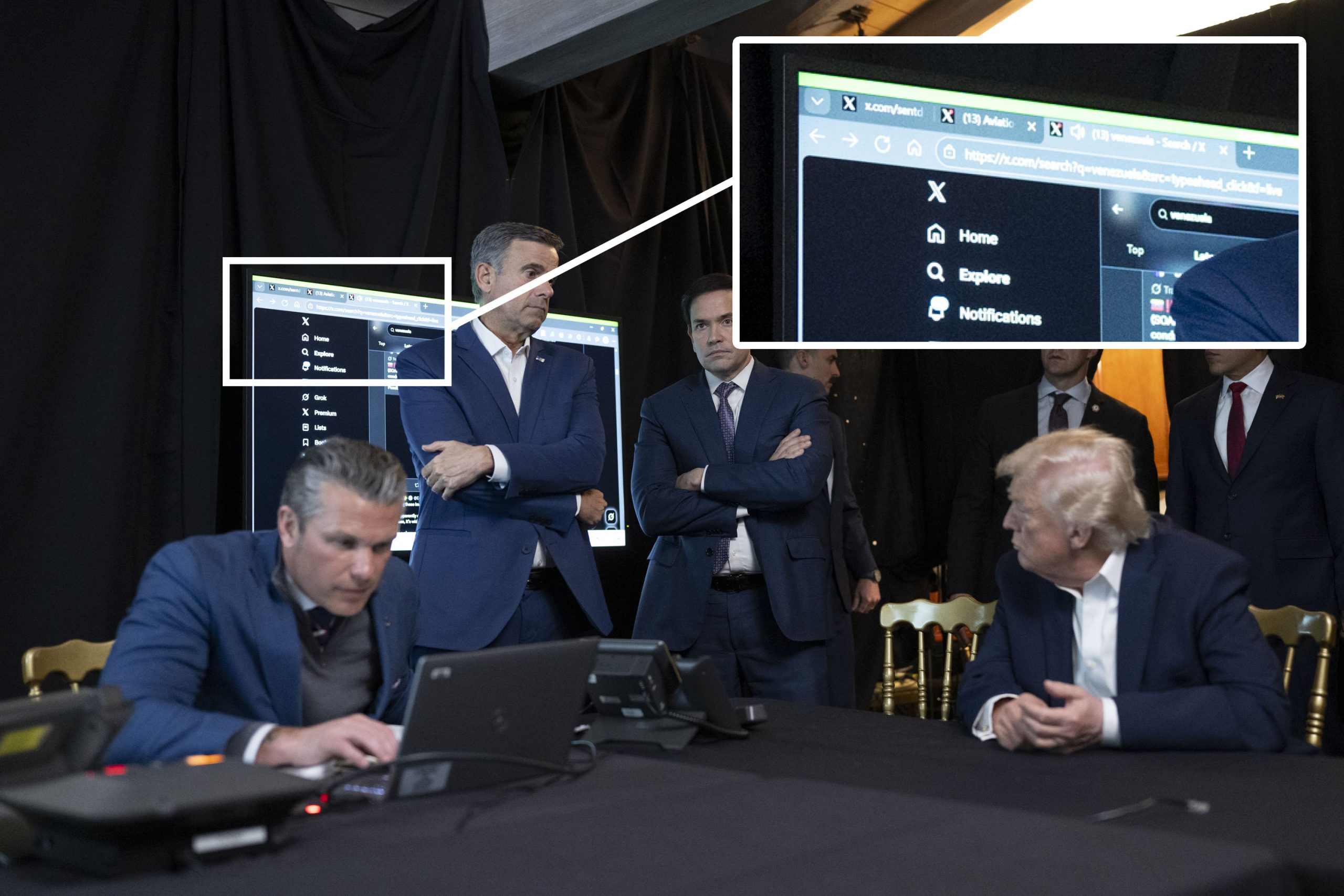
The U.S. military knows all of this. They also know about sites like The Aviationist – we have, in fact, been referenced in an official reminder for personnel about how even seemingly inconsequential pieces of information can lead to problematic breaches of OPSEC. We also know, thanks to images posted depicting President Trump, Secretary of State Rubio, Secretary of Defense Hegseth, and various other officials, watching the Absolute Resolve raid unfold on Jan. 3 that even the executive branch itself takes a keen interest in following the open source reporting that features heavily on X/Twitter.
Knowing that these movements would become highly publicized might itself have been a deliberate strategy as part of the plan. This would play particularly well with the Trump administration’s tendency to appreciate showmanship, big statements, and powerful shows of force. Messaging, especially in the 21st century, is an intrinsic part of warfare – whether explicit or not.
Conclusion
Quite simply, we don’t know what will happen. Given the nature of special forces units, that shouldn’t come at a huge surprise. Even with all of the incredible opportunities to monitor and track movements that new technologies continually grant us, there are many areas where, as civilians, we simply cannot gain a perspective of the full picture. We may soon have answers to some of the questions raised in the above article, or we may be left wondering about them for years to come. Perhaps this is in fact all a bluff. Perhaps, as Jim LaPorta very pertinently noted in his report, the order to commence the apparently planned raid never comes through.
There has always been a degree of uncertainty when reporting on military affairs, especially when it comes to trying to read what may happen down the line. The unpredictability of President Trump – rash and rapid swings in opinion, interviews which contain contradictory claims and statements – as well as his wider cabinet makes this even more difficult. You never want to be the last to report on an emerging story, but you don’t want to jump the gun either.
Perhaps by the time you read this the supposed raid will be all said and done. In another timeline, the tanker might have just safely berthed at a Russian port.