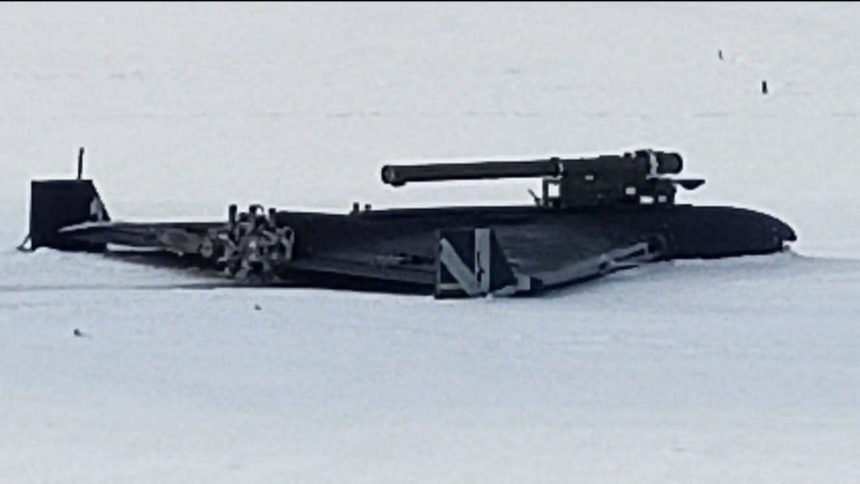
A nearly intact Geran-2, landed upright on the ground, was found with a 9K333 Verba Man-Portable Air Defense System (MANPADS) mounted on the top.
A month after a Russian Geran-2 one-way attack (OWA) drone was found with a Soviet-era R-60 infrared (IR)-guided short-range Air-to-Air Missile (AAM), another example has now emerged with a shoulder-fired Man-Portable Air Defense System(MANPADS) installed on top, according to images emerged on Jan. 4, 2025.
Visuals of the nearly intact drone, landed upright on the snow, with only the propeller of its four-cylinder piston engine broken, were first shared on the Telegram channel of popular Ukrainian radio and electronic warfare expert Serhii “Flash” Beskrestnov, before they were shared by other social media profiles.
In our previous reporting on the Gerans – Russian reverse-engineered, heavily improved and mass-produced derivatives of the Iranian Shahed-136 OWA UAV – we analyzed how future discoveries of such AAM-armed unmanned aircraft could indicate whether this was a serious or a casual attempt at threatening larger Ukrainian manned aircraft.
And another mesh network-enabled air-to-air variant of the Geran-2. This time with a MANPAD. pic.twitter.com/7MQDKCyoZG
— Fabian Hinz (@fab_hinz) January 4, 2026
As it now turns out, the Russians are concerted in their goal to disrupt Ukrainian counter-drone efforts. The presence of such crude UAVs with simple modifications can also have a psychological impact and make the anti-UAV measures more cautious.
Geran-2 with MANPADS
The generally accepted designation for the propeller variant of the Geran is the Geran-2, while the jet-powered one is commonly referred to as the Geran-3. The one in the latest discovery is the Geran-2, based on the broken propeller and engine.
Russian jet-powered Shahed chased by STING interceptor drone. pic.twitter.com/aFC6nW9IN4
— Special Kherson Cat 🐈🇺🇦 (@bayraktar_1love) January 5, 2026
The MANPADS meanwhile is the 9K333 Verba (NATO codename SA-29 Gizmo), developed by KB Mashinostroyeniya, as noted by the markings. The Verba has been in service since 2014 and it is believed to replace the older 1980s-era 9K38 Igla and the 9K338 Igla-S that entered service in 2002.
It is not clear how this Geran-2 in the video was brought down. However, the perfect upright landing with little damage suggests that electronic warfare may have been involved in severing either the man-in-the-loop radio control signal or the SATNAV signal, or both.
Radio spectrum analyzers are heavily used by both sides in identifying patterns in signals across several frequencies and bands in the constantly escalating and evolving tactical Electronic Intelligence (ELINT) game.
Video of a Russian Shahed / Geran-2 OWA UAV equipped with an R-60 air-to-air missile downed by the 412th Nemesis Brigade’s Darknode battalion with a Sting interceptor from @wilendhornets. https://t.co/QkWH79sXfHhttps://t.co/w3BS2MaRwq pic.twitter.com/f6VE4uNmu2
— Rob Lee (@RALee85) December 1, 2025
A close up video of the launcher system on which the Verba MANPAD is fastened shows a fairly sophisticated mount and electronics controlling the launcher tube’s cover and trigger. As one user noted, the trigger and the launcher tube’s cover are actuated via servomotors while control commands and video from the camera are transmitted to/from the operator via a MESH network.
The servomotors are clearly recognizable as the black and red boxes in proximity of the Verba. Cables are connected to them and taped on the drone, possibly covering the holes where they are connected inside.
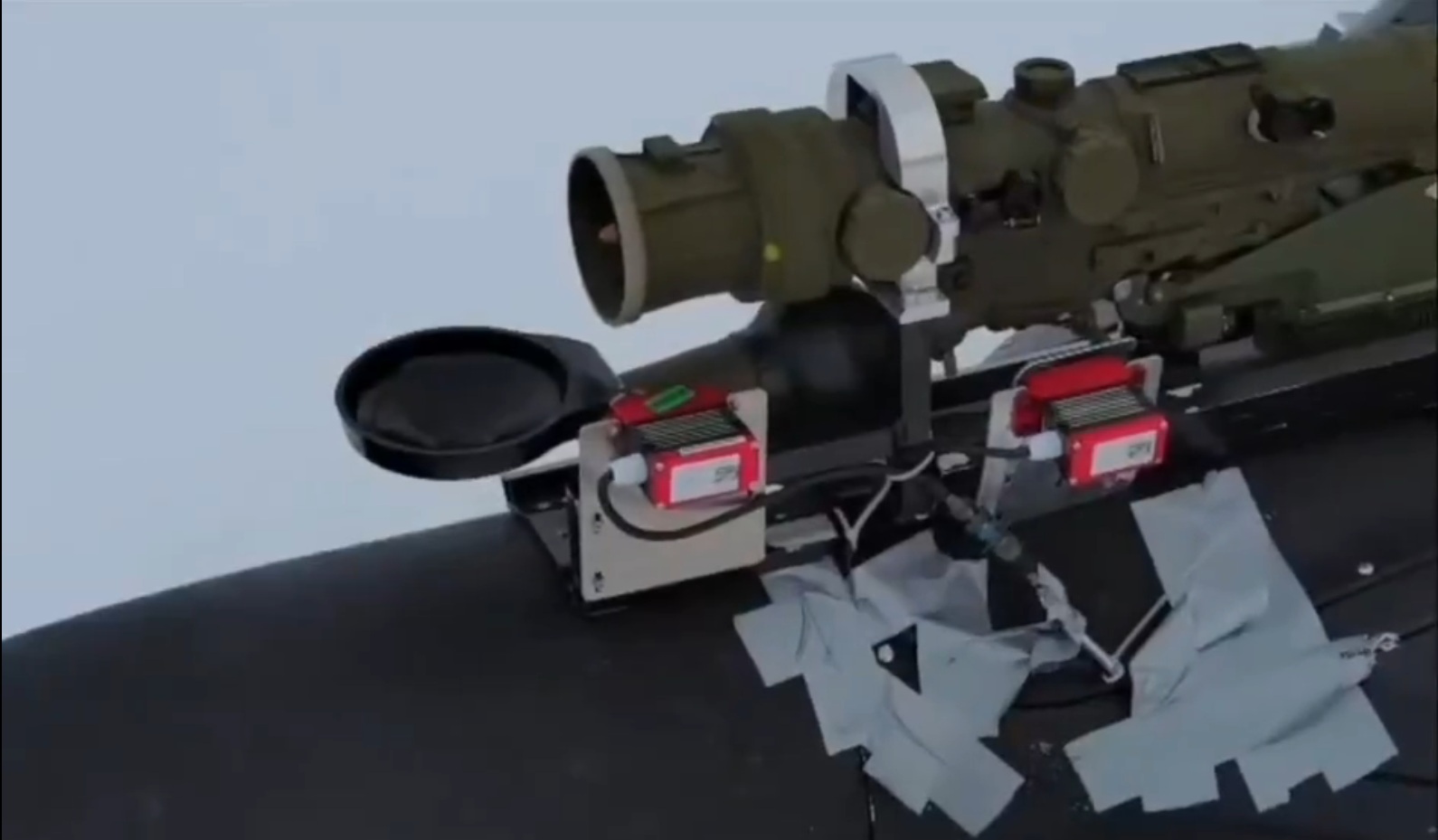
The video does not capture the front portion of the Geran-2 here, to confirm the presence of Electro-Optical (EO) ball turret or an embedded optical seeker in the nose, seen on other examples, that would be used to cue the missile onto the target. The Geran-2 would ideally need to be behind the aircraft for line-of-sight targeting.
The Verba’s 9M333 missile has a tri-channel optical infrared seeker operating in the ultraviolet, near and mid-infrared wavelengths, powered by a solid-fuel rocket motor that takes it to a maximum distance of 6 km. It has a 1.5 kg directed energy High-Explosive (HE) warhead, triggered by a magnetic proximity fuse.
The Verba launcher can also be coupled with a night-vision optical device and Identification Friend or Foe (IFF) antenna for more complex, contested scenarios.
russian 9K333 Verba MANPADS in the Bakhmut direction.
In the screenshot is clearly visible the 9M333 missile. As it knowing this missile uses western components (A power converter produced by the Swiss company Traco Power). pic.twitter.com/XoPzF3PosH
— 𝔗𝔥𝔢 𝕯𝔢𝔞𝔡 𝕯𝔦𝔰𝔱𝔯𝔦𝔠𝔱△ 🇬🇪🇺🇦🇺🇲🇬🇷 (@TheDeadDistrict) November 1, 2023
Tactical disruptor
Serhii “Flash” said this on his Telegram account about the control, operation and tactical procedure associated with Verba MANPAD-armed Geran-2: “Today, we encountered a Shahed for the first time, which is equipped with a man-portable air defense system (MANPADS).”
“The Shahed is equipped with a camera and a radio modem. The launch of the missile is carried out by the Shahed’s pilot, who controls it from Russian territory,” he added. “I ask the pilots of the army aviation to take note of the emergence of a new threat. They should avoid approaching the Shahed on a head-on course and be more cautious with those who are standing by.”
The caution to Ukrainian army aviation helicopters refers to the country using door-mounted machine guns from Mi-8 and Mi-24 helicopters to shoot down Shahed drones. Any close proximity, at least by a group of Gerans being tackled by Mi-8s and Mi-24s, is seriously risky for a force that is low on frontline fighter and rotary wing airframes.
Footage of a Ukrainian Mi-8 helicopter door gunner shooting down a Russian Shahed attack drone with a M134 Minigun. pic.twitter.com/9vQVBdsVMI
— OSINTtechnical (@Osinttechnical) November 12, 2025
It is difficult for helicopter gunners to shoot down a UAV from right behind it, given that the gun mount might now allow turning the gun completely parallel to the helicopter’s airframe to fire ahead. However, videos showing engagement between a Mi-8 and Shaheds from door-mounted M134 miniguns and standard PK-type belt-fed machine guns, show the helicopters flying alongside the drone, separated by several meters.
It is not exactly clear how one can expect the IR seeking missile to be optically cued to the target in this non-line of sight trajectory, but putting a manned aircraft at risk, especially if a group of Gerans get their missiles off, is an adequate asymmetric threat. This has now possibly spurred a wide revision of set counter-drone equipment and procedures.
Over western Ukraine, a Ukrainian Army Aviation Mi-8 door gunner downs a Russian Shahed-136 attack drone with his PK machine gun. pic.twitter.com/AUUX3FaZ6I
— OSINTtechnical (@Osinttechnical) August 25, 2024
Control and operation
The mention of MESH networks to operate the Gerans via man-in-the-loop control has been around for a while. Russian Gerans have been found with Chinese-made commercial off-the-shelf cellular and MESH network modems since last year.
A closer look at the Chinese-sourced radio mesh modems that along with cameras are used in Russian “Geran-2” (Shahed) strike UAVs and “Gerbera” reconnaissance UAVs.
A radio network can be established leading back to an operator in Russia who directly controls the UAV. https://t.co/UfHHcraOKi pic.twitter.com/CYrhHjnrUR
— Roy🇨🇦 (@GrandpaRoy2) December 14, 2025
These allow receiving signals from cellular and other military radio network nodes, possibly by other signal relay and repeater antennas, mounted on other drones and the ground, that connect the operator to the drone.
This Russian “Geran-2” (Shahed) has a new antenna, apparently for navigation using radio beacons.
Ground-based VHF omnidirectional azimuth radio beacons (VOF) broadcast a reference signal in the 108–118 MHz range, while encoding azimuth bearing in a rotating variable signal.
1/ pic.twitter.com/z6BVhziJAo
— Roy🇨🇦 (@GrandpaRoy2) January 4, 2026
‘Roy’, another Ukraine war analyst who has followed the evolution of Geran drones, also shared on Jan. 4, 2026, a screengrab of an interception from a Sting counter-drone UAV, showing a Geran-2 with a new antenna that used radio beacons for navigation. This replaces the traditional SATNAV signals that utilize Russian GLONASS and the U.S. GPS satellites.