South Korea is working on the introduction of an air-to-ground capability for the KF-21 Boramae, as well as a new air-to-air missile and a new domestically-developed engine.
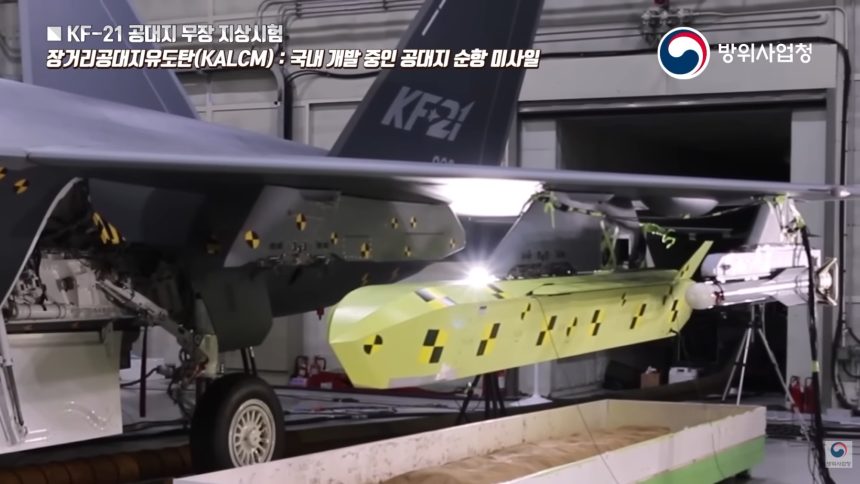
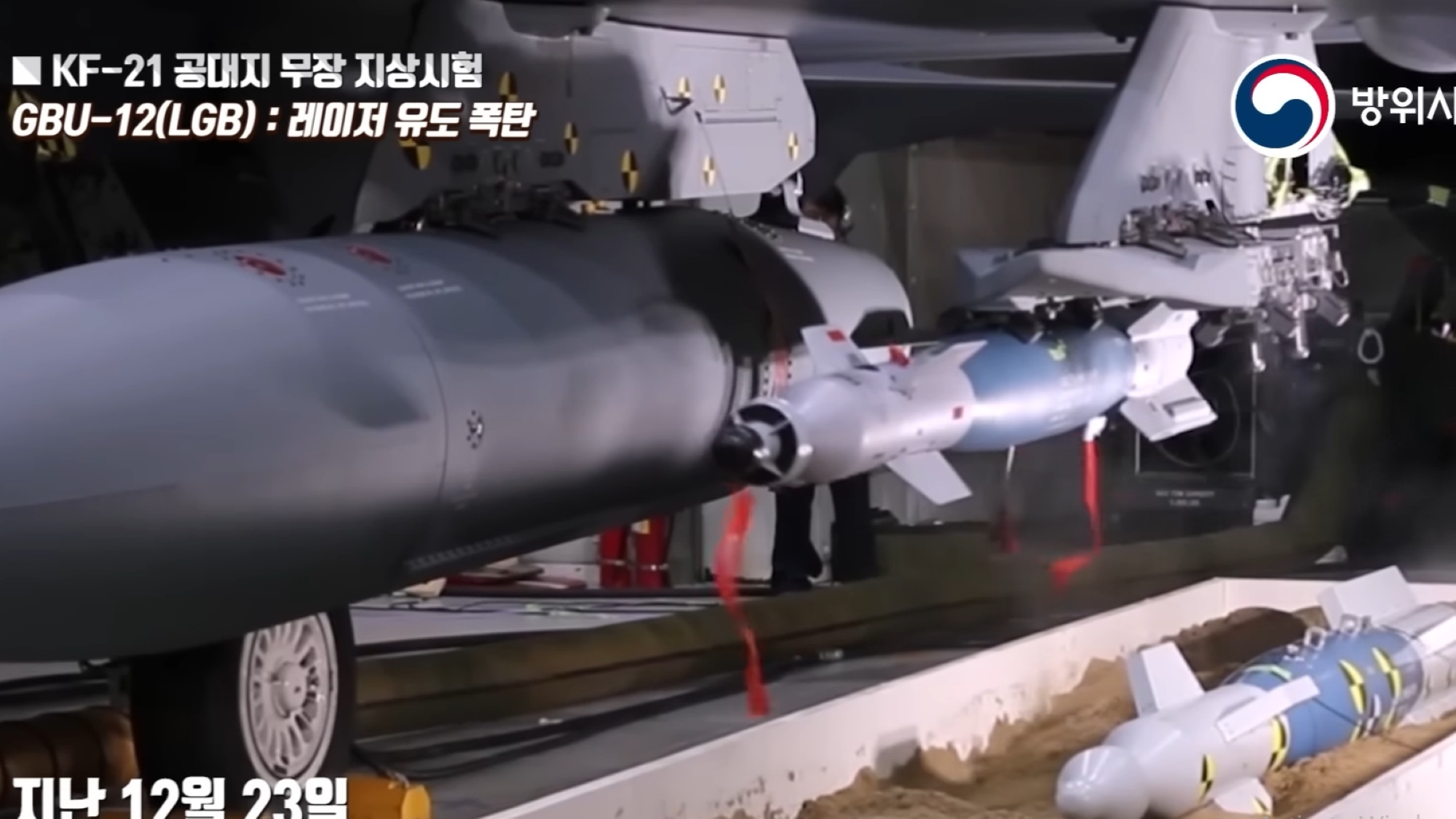
South Korea’s Defense Acquisition Program Administration (DAPA) released on Dec. 23, 2025, a video of air-to-ground weapons’ drop trials with the indigenous KF-21 Boramae. The videos shows multiple weapons, including test articles of the GBU-12 Laser-Guided Bomb (LGB), the GBU-56 Laser Joint Direct Attack Munition (LJDAM) and the Korean Air-Launched Cruise Missile (KALCM) currently in development.
The weapons, bearing various test markings, are released from the port (left-side) wing of a specially instrumented KF-21 Boramae in the controlled environment of a testing facility. The weapons then fall a short-distance of a few centimeters onto a sand pit – from which also the name of “pit drop tests” – to check for a clean separation.
This development comes as Yonhap, Chosun and The Korea Times quoted DAPA officials on Dec. 23, 2025, who announced advancing the plan to give the KF-21 air-to-ground attack capability one-and-a-half year earlier than planned, starting in 2027. Authorities had previously allocated 700 billion won (US $472 million) to be spent through December 2028 to commence testing and integrate “10 different types of air-to-ground” munitions on the KF-21.
FlightGlobal also reported on Dec. 24, 2025, that Seoul has committed 3.4 trillion won ($3.4 billion) to develop an indigenous jet engine to power the KF-21 Block 3 variant, with the programme running from 2027 to 2040.
Previously, on Dec. 2, 2025, Korean reports said the DAPA announced another 435.5 billion won ($296 million) program to develop short-range AAMs for the KF-21 by 2032, in a “bid to diversify the weapons systems for its fighter jets and increase arms exports.” Local defense firms LIG Nex1 and Hanwha Aerospace, are expected to participate in the project.
Latest drop tests
As the accompanying information in the video suggested, these tests might not be recent, with the clips being released only now. Close-up cameras capture in slow-motion the release mechanism and holds that push down the munitions, as well as the resulting vibration on the wing.
A machine translation of the text in the DAPA video referred to a “meeting” on Dec. 23 to “launch the KF-21 additional weapons testing project,” needed to confirm its “multirole fighter aircraft” mission set and ordnance capabilities. A possible early operational fielding would also support the Boramae’s export push internationally.
The DAPA statement said:
“The additional weapons testing project aims to verify the KF-21’s diverse weapons operational capabilities and, through this, secure its full performance as a multi-role fighter aircraft. The Defense Acquisition Program Administration, the Air Force, KAI, and the Agency for Defense Development (ADD) will collaborate to conduct flight tests according to the test plan.
The initial air-to-ground capability will be achieved approximately 18 months earlier than the original project plan, and will be applied to mass-produced KF-21 aircraft starting in 2027. Currently, design, verification, and ground testing for air-to-ground weapons flight testing have been completed.
The KF-21 additional weapons testing project will be an important milestone in Korea’s ability to independently develop multi-role fighter aircraft. Furthermore, it is expected to have a positive impact on the technological self-reliance of the domestic aerospace industry and its entry into the global market.”
KF-21 Boramae berhasil melaksanakan aerial refueling flight. pic.twitter.com/PiWxobt26K
— robe_1807 (@Robe1807) March 19, 2024
The GBU-12 and GBU-56 are among the weapons that reportedly will be used by the KF-21 and are part of the Republic of Korea Air Force’s (RoKAF) inventory. The service will also operate other weapons developed domestically, such as the KALCM.
The KALCM Cheonryong (Sky Dragon) has been reported to be in development for a few years now, overseen by the ADD and with industrial participation from LIG Nex1 and Hanwha Aerospace. Official renditions and full-sized mock-ups at exhibition stalls in 2023 have shown it to be a highly faceted weapon optimized for stealth and low-observability.
Possessing both land and maritime strike capability, the weapon has been depicted with a range of 800 km, and is meant to initially complement, and eventually replace, Western systems like the Taurus KEPD 350 ALCM, used by the RoKAF’s F-15K Slam Eagles.
The @fapperu (🇵🇪) is considering joining South Korea’s (🇰🇷) 5th generation KAI KF-21 Boramae program.
The South Koreans have been courting foreign investors for the KF-21, and included #Peru as a potential operator in the rollout ceremony for the aircraft. pic.twitter.com/tB97dHsyYR
— SA Defensa (@SA_Defensa) July 2, 2024
Engine development
As for the domestic engine development push, the DAPA’s Advanced Aviation Engine Development Project aims to deliver a power plant that would produce 16,000 pounds of dry thrust and 24,000 pounds of thrust with afterburners. The program involves prototype manufacturing, ground testing, certification and aircraft-mounted tests to be integrated with the KF-21 Block III by 2040.
The Block IIIs is envisaged to be a pure stealth fighter with radar-absorbent material, paint and coatings, internal weapons bays, sensor fusion and certified to operate with Collaborative Combat Aircraft (CCA).
The KF-21 Block I currently flies with the General Electric F414, which Hanwha Aerospace manufactures locally under license. South Korea hopes the new engine would offer a 15% reduction in fuel consumption, while the domestically developed components and design would reduce foreign dependence and eliminate export restrictions arising from the presence of U.S. technology.
Güney Kore, KF-21 Blok 3 İçin Yerli Motor Geliştirecek
Güney Kore, 106,75 kN itki gücüne sahip yerli savaş uçağı motoru geliştirmek için 3,4 milyar dolar bütçe ayırdı. Motorun, 2040 yılına kadar KF-21 Blok 3 varyantında kullanılması planlanıyor.
KF-21 Blok 3, gerçek 5.… pic.twitter.com/P8SqVqgAiE
— DefenseNews (@SavunmaHaber) December 27, 2025
KAI KF-21 Boramae weapons trials so far
The KF-21 has been tested with at least two Air-to-Air Missiles (AAMs). These include the MBDA Meteor Beyond Visual-Range (BVR) AAM and the German IRIS-T short-range AAM (referred to with its alternative AIM-2000 designation by the South Koreans).
A Mar. 28, 2023, video from Korean Air showed prototype ‘002’ dropping a Meteor, in what was described as a captive-carry and “armament separation test (without launch)” trial.
Then, on Apr. 6, 2023, aircraft 002 fired the IRIS-T from its left wing’s outer weapons station, while also carrying at least two Meteors on its four recessed underbelly ordnance stations. This was followed by South Korea’s Defense Acquisition Program Administration (DAPA) releasing on May 24, 2023, a video of a “mounting demonstration” of the Meteor and the IRIS-T/AIM-2000 short-range AAMs on ‘004’.
Then, on Dec. 29, 2023, KED Global reported that the DAPA pledged 591.9 billion won ($460 million) for developing short-range AAMs with “homegrown technology.” The report quoted a statement from DAPA, which mentioned “The project will improve our self-defense capabilities through domestic development of cutting-edge weapon systems and will also increase the export competitiveness of guided missiles linked to the KF-21.”