The development of the Izdeliye 177 appears to be driven by the need to upgrade the earlier Su-57 production models and offer a new powerplant to international customers.
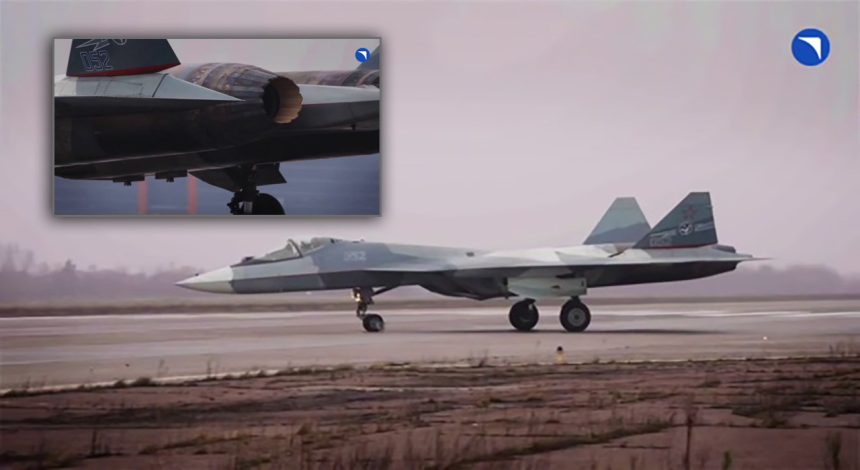
Russia’s United Aircraft Corporation (UAC) announced on Dec. 22, 2025 the test flight of an Su-57 Felon (airframe T-50-052) with a new Izdeliye 177 (Russian for ‘Product 177’) Gen. 5 engine – a powerplant it had revealed in the Dubai Air Show.
Photos and videos released by UAC on its Telegram channel showed the Product 177/Izdeliye 177 engine installed on the Su-57’s port (left) side, distinguished from the older engine by the serrated nozzle. The older Stage 1 Izdeliye 117, derived from the Su-35’s AL-41F-1S afterburning turbofan, is on the starboard (right) side.
The Su-57 was flown by UAC test pilot Roman Kondratiev, and landed with a brake-chute, with UAC saying the test “proceeded normally in accordance with the flight mission requirements.”
As per Russian reports, UAC statement and the 177’s product catalogue, the development and introduction of the engine appears to be driven by both the need to upgrade the earlier Su-57 production models and to offer another powerplant to international customers operating the compatible Sukhoi Su-30 Flanker, which uses the AL-31F/FP.
T-50-2 makes its first flight with izd. 177 engine.
Astonishing how it is T-50-2 third engine.
Built with izd. 117, tested early izd. 30 (serrated nozzle), then late izd. 30 (hexagonal nozzle) and now izd. 177
Source: https://t.co/Rgg25CFEeW pic.twitter.com/hZuMswuImm
— George N. (@GeorgeN28581) December 22, 2025
This nevertheless represents a dogged arms marketing effort for Russian arms in general. The effort includes the Su-57, the weaponized Yak-130M, the Su-75 Checkmate (in the run up to a scheduled first flight in 2026), and other Russian weapons to make up for its recent slump in any big-ticket defense deal, with the West and China having briefly captured that space.
Su-57, its engines and Russian powerplants
As per reports from 2023, the ten Su-57s delivered to the Russian Aerospace Forces (RuAF) until the end of that year from the Komsomolsk-on-Amur plant, and all future production batches, were flying with the Stage 2 Izdeliye/Product 30 (or the AL-51F-1). All these engines are developed by the UEC’s NPO Saturn.
Airframes produced until 2023 were flying with the AL-41F-1S, which produces a 142 kN afterburner thrust. The AL-31F/FP generates 123 kN, and the AL-51F-1 (Izdeliye 30) a 162 kN thrust. The new Izdeliye 177 stands at 156 kN, and the Izdeliye 177S export version at 142 kN.
🔵🇷🇺Rusya 5. nesil uçaklar için en yeni motorunu sergiledi
🔸Rus devlet şirketi Rostec, Orta Doğu’da 🇦🇪Dubai Airshow kapsamında ilk kez en yeni 177S motorunu ve geliştirilmiş versiyonunu tanıttı.
🔸Şirket, bu 5. nesil motorların, birçok temel özellik bakımından yabancı… https://t.co/M11Dheycsv pic.twitter.com/R5MLDo0xUs
— Defence Turk (@Defence_Turk) November 19, 2025
Izdeliye 177 and 177S development goals
UAC’s statement quoted the Director of the A. Lulka Design Bureau under the United Engine Corporation (UEC), Yevgeny Marchukov: “The fifth-generation aircraft engine ‘Product 177’ is a cutting-edge development of the United Engine Corporation for operational-tactical aircraft. The first test flight marked the beginning of […] flight tests of the Su-57 with the latest engine. The new engine operated normally and demonstrated reliable operation as part of the Su-57 aircraft.”
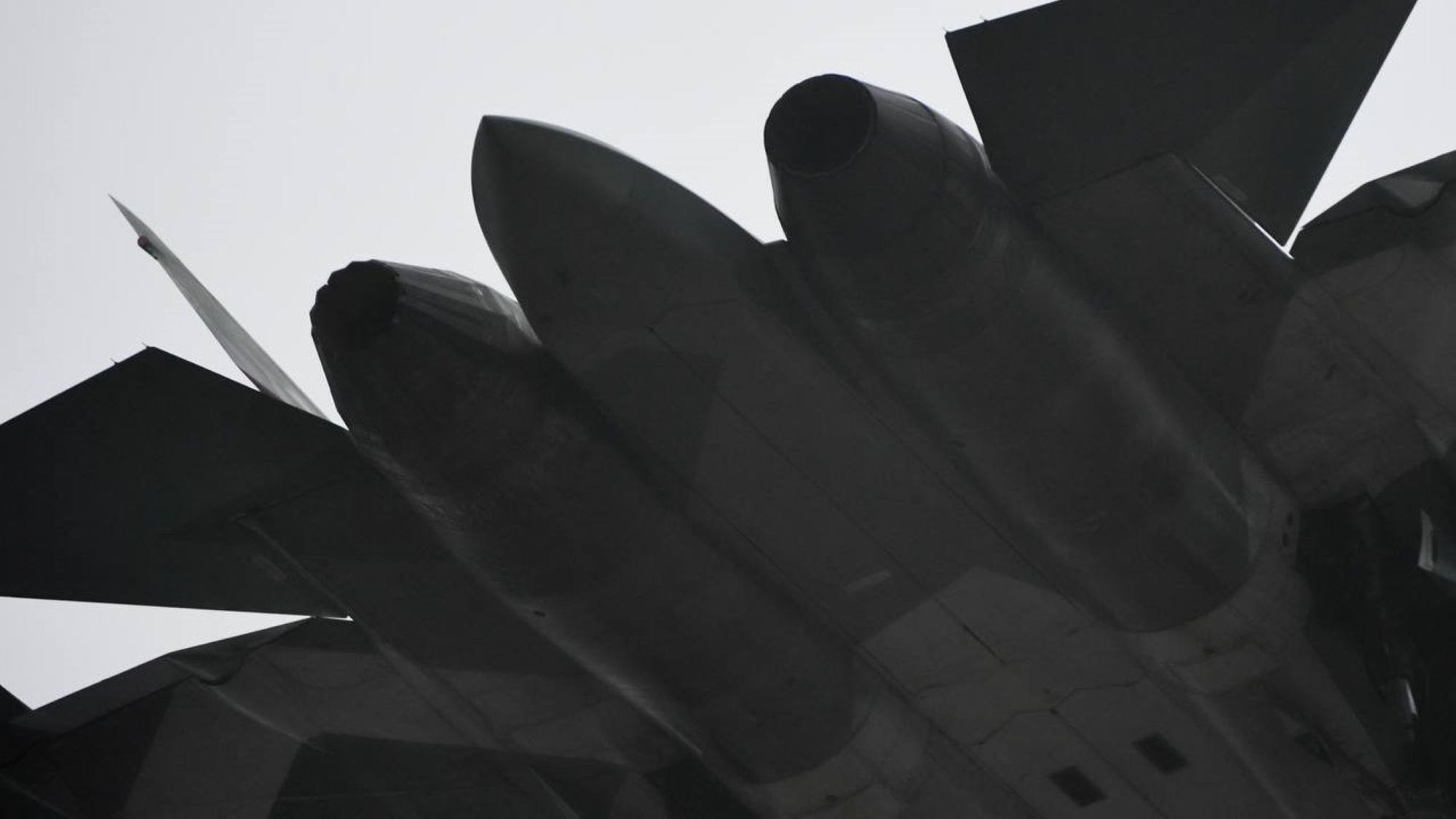
Izvestia, reporting on the 177S’s unveiling at Dubai, claimed the Su-57E (the Felon’s export variant) has been bought by Algeria with two airframes, and plans to expand to a full squadron of 12 units soon. The report added the new engine delivers 14.5 tons of thrust, has “three times” service life of the AL-41F1, allows the Su-57 to maintain supersonic speed without afterburners (meaning a ‘supercruise’ capability), and can be installed on existing aircraft without any modifications. This means that “re-engining of existing Su-57 aircraft can be completed quickly,” added the report.
Whether the RuAF will actually re-engine all its pre-2023 Su-57s with the Izdeliye 177 remains to be seen. UAC officials and unofficial pro-Kremlin Telegram channels have claimed in the past these Su-57s remain capable with the AL-41.
The aircraft itself recently revealed its rear, front underbelly and side internal weapons bays for the first time, and in December 2024 was also spotted with one flat 2D thrust vectoring nozzle. This too was installed on the T-50-2 on the same (port/left) side.
🇷🇺🔥 Russia’s Su-57 takes center stage at Dubai Airshow
Zoom in on 0:50 to see the missiles inside — a highlight of Dubai display.
Flown by Sergey Bogdan, Chief Test Pilot of Sukhoi Design Bureau & Hero of Russia — those who followed 🇮🇳Aero India 2025 will remember his… pic.twitter.com/bAavW9Ah9C
— Sputnik India (@Sputnik_India) November 17, 2025
Images of product information banners of the Izdeliye 177 and the 177S, possibly from Dubai Air Show, suggest the Su-57 ‘052’ flight with the Izdeliye 177 is marketing the 177S to foreign customers. The 177 and 177S are pitched as “prospective” turbofan engines for “Gen. 4++” (4.5), “Gen. 5” fighters and “full compatibility with AL-31F/FP equipped platforms.”
The banner describes the 177 itself as a Gen. 5 engine, with Full Authority Digital Engine Control (FADEC). FADEC allows automation of optimal engine operation in various flight regimes and improved health/fault monitoring, thereby unburdening flight and technical crews. The engine has a three-stage low pressure compressor, with thrust-vector control – a signature staple across Russian Gen. 4, 4.5 and 5 platforms.
— George N. (@GeorgeN28581) December 22, 2025
India stands to gain
As mentioned earlier, though the 177S, UAC and UEC are targeting current users of the AL-31FP that primarily power major Su-30 users like the Indian Air Force. Eighty-four of the IAF’s 272 Su-30MKIs (minus the 12 that have been lost in crashes so far) have been poised for a major upgrade over the next three-four years.
A major system is the domestically-made Virupaskha Gallium Nitride (GaN) AESA radar, among other improved displays, navigation, encrypted communication, a new Digital Flight Control Computer, avionics, mission computer and Electronic Warfare (EW) suites.
Super Sukhoi 😈
IAF Indigenous Upgrade of 84 Su-30 at Rs 60,000 Cr will make it Potent 4.5+Gen Jet with all modern features🇮🇳👇
Aesa Radar
Avionics
IRST Sensors
Next Gen RWR
EW Suits
Advance Jammer
DFCC
New Engine as mid life refit for Old Su
Indian Missiles & Bombs
Approval… pic.twitter.com/vVko5ZeuxG
— Vivek Singh (@VivekSi85847001) February 20, 2024
These have been developed by the Electronics and Radar Development Establishment (LRDE), Defence Avionics Research Establishment (DARE) of India’s state-run Defence Research Development Organization (DRDO) and Bharat Electronics Limited (BEL). However, as Indian reports have stated, there will be no engine upgrade for India’s Su-30 fleet, which will retain the AL-31FP.
Super Sukhoi ‼️
Russia offers its 5th Gen 177S Engine with Stealth treated TVC nozzle for IAF Super Sukhoi Upgrade under Make in India if Ordered in large 🇮🇳
HAL in 1st phase will Upgrade 84 Su-30MKI & later more
With upcoming AESA Radar IAF shld go for this 142Kn Beast 🔥 pic.twitter.com/8cOLDS1UU1
— Vivek Singh (@VivekSi85847001) February 11, 2025
This decision has faced some criticism from Indian defence commentators, who point out the older engine limits the capabilities and power requirements of the new upgrades in particular, and the Su-30MKIs in general. These would otherwise be brought on par with the Russian Su-30SM or the PLA Air Force’s J-16s.
TAGS: Military Aviation, Russia, Su-57 Felon, United Aircraft Corporation, Sukhoi Design Bureau, United Engine Corporation, Izdeliye 177