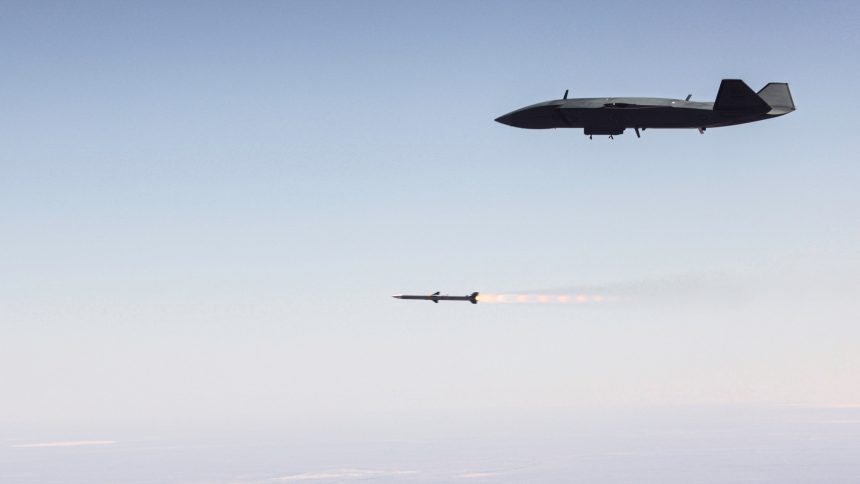
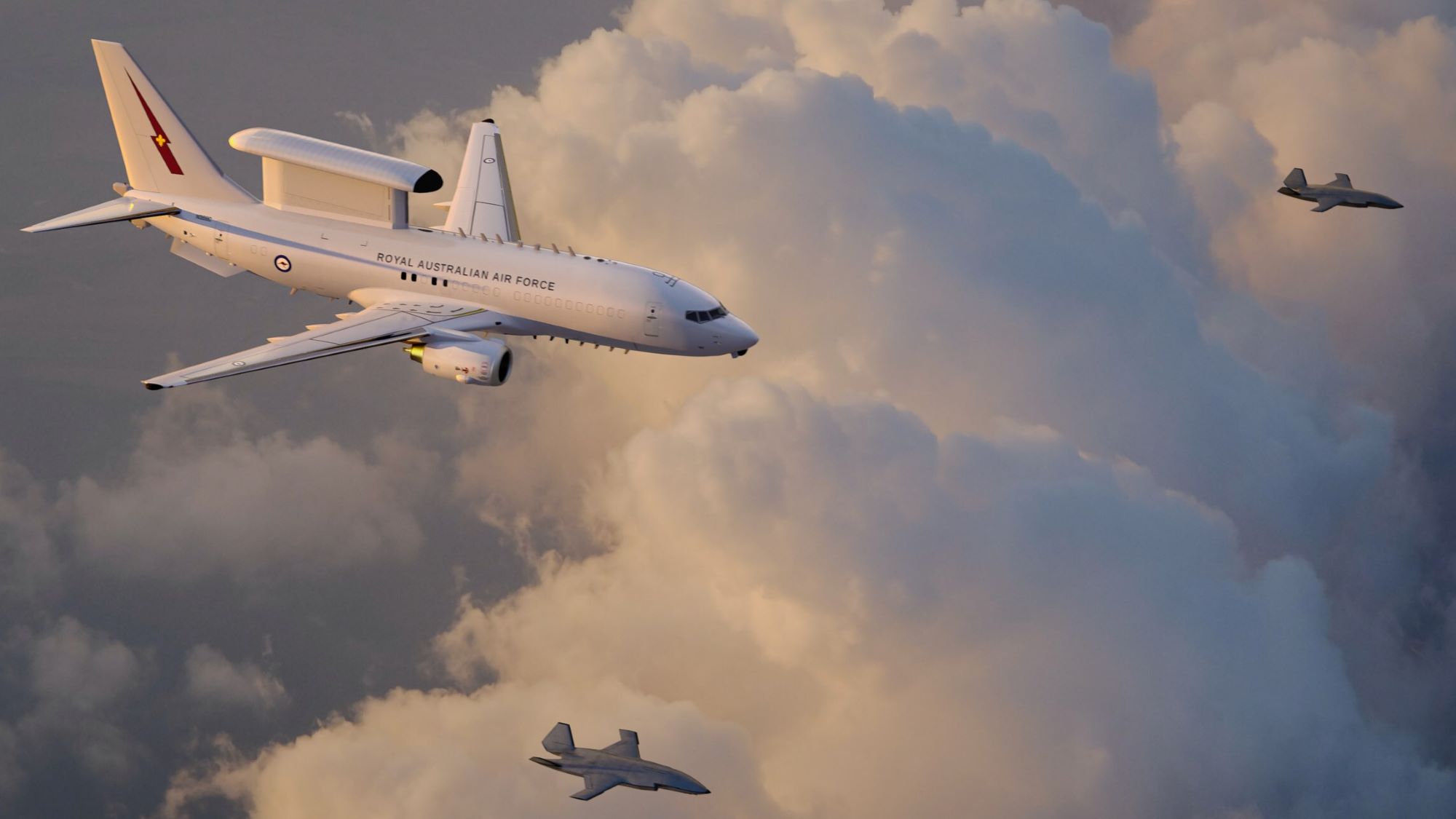
The Ghost Bat was controlled from aboard an RAAF E-7A Wedgetail and received targeting data from an F/A-18F Super Hornet before firing the AIM-120.
Boeing Defence Australia announced on Dec. 9, 2025 the first live-fire test of an AIM-120 AMRAAM (Advanced Medium-Range Air-to-Air Missile) from an MQ-28A Ghost Bat CCA (Collaborative Combat Aircraft). Noting this was the first time an autonomous combat drone tested the missile, Boeing said the live-shot involved the Ghost Bat teaming up with an RAAF (Royal Australian Air Force) E-7A Wedgetail AEW&C (Airborne Early Warning and Control) aircraft and F/A-18F Super Hornet.
Boeing had previously announced a previous test in June where two MQ-28s were controlled by an RAAF E-7A in a mission against a simulated airborne target. Boeing and the RAAF had also demonstrated the MQ-28A’s ability to network and coordinate with the MQ-4C Triton and the F-35A Lightning II.
The MQ-28, E-7A, and F/A-18F successfully demonstrated an autonomous air-to-air weapon engagement. The MQ-28 proves combat capability — reducing risk for crewed aircraft and providing greater tactical reach. pic.twitter.com/KT464nwftN
— Boeing Australia (@BoeingAustralia) December 9, 2025
Live Fire Test
Boeing had first announced this planned live test in March 2025, and then reiterated the upcoming stage in the MQ-28QA Ghost Bat’s development on the sidelines of the Dubai Air Show – that time specifically identifying the missile as the AIM-120. The company called the overall test effort as a “force integrated air-to-air autonomous weapon engagement” that involved the MQ-28 “teaming with a RAAF E-7A Wedgetail and F/A-18F Super Hornet to destroy a fighter-class target drone.”
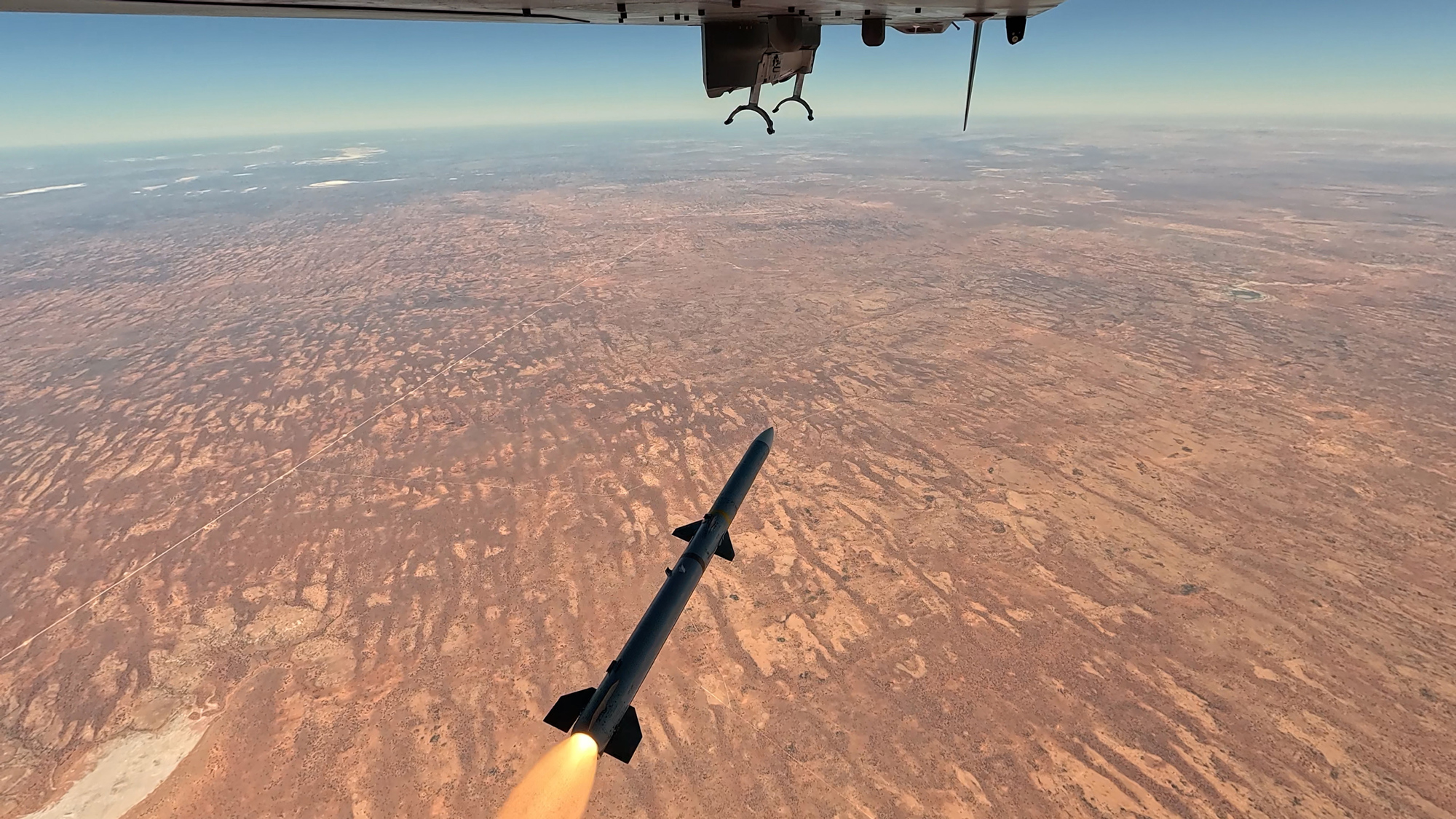
The live fire test, called “Trial Kareela 25-4” by the Australian Defence Force and conducted on Dec. 8, saw the MQ-28 armed with an AIM-120 AMRAAM. Notably, tape was applied on the markings that denoted the missile’s variant and serial number, although the shape and fins identify it as an AIM-120C or newer variant.
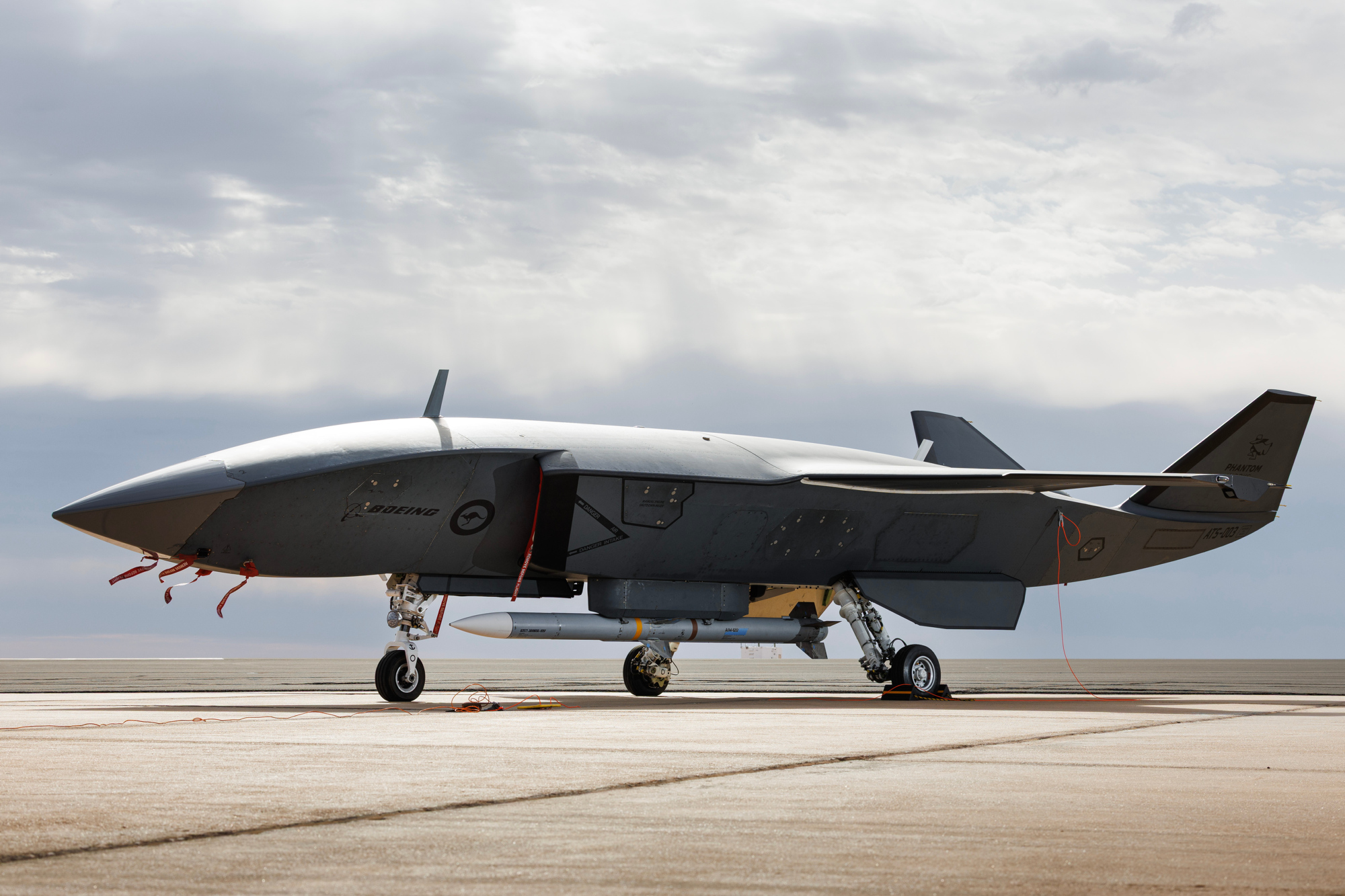
Kareela 25-4 is test campaign taking place at RAAF Base Woomera in South Australia from Nov. 17 to Dec. 12. The RAAF described it as “a demonstration of a Collaborative Combat Aircraft (CCA) employing an air-to-air weapon against an aerial target in an operationally relevant scenario.”
The Australian-designed and manufactured MQ-28A Ghost Bat has marked another major milestone at 📍 RAAF Base Woomera, SA – becoming one of the first Collaborative Combat Aircraft (CCA) to successfully engage an aerial target with an air-to-air missile in an operationally relevant… pic.twitter.com/zdcAyH6L6p
— Defence Australia (@DefenceAust) December 10, 2025
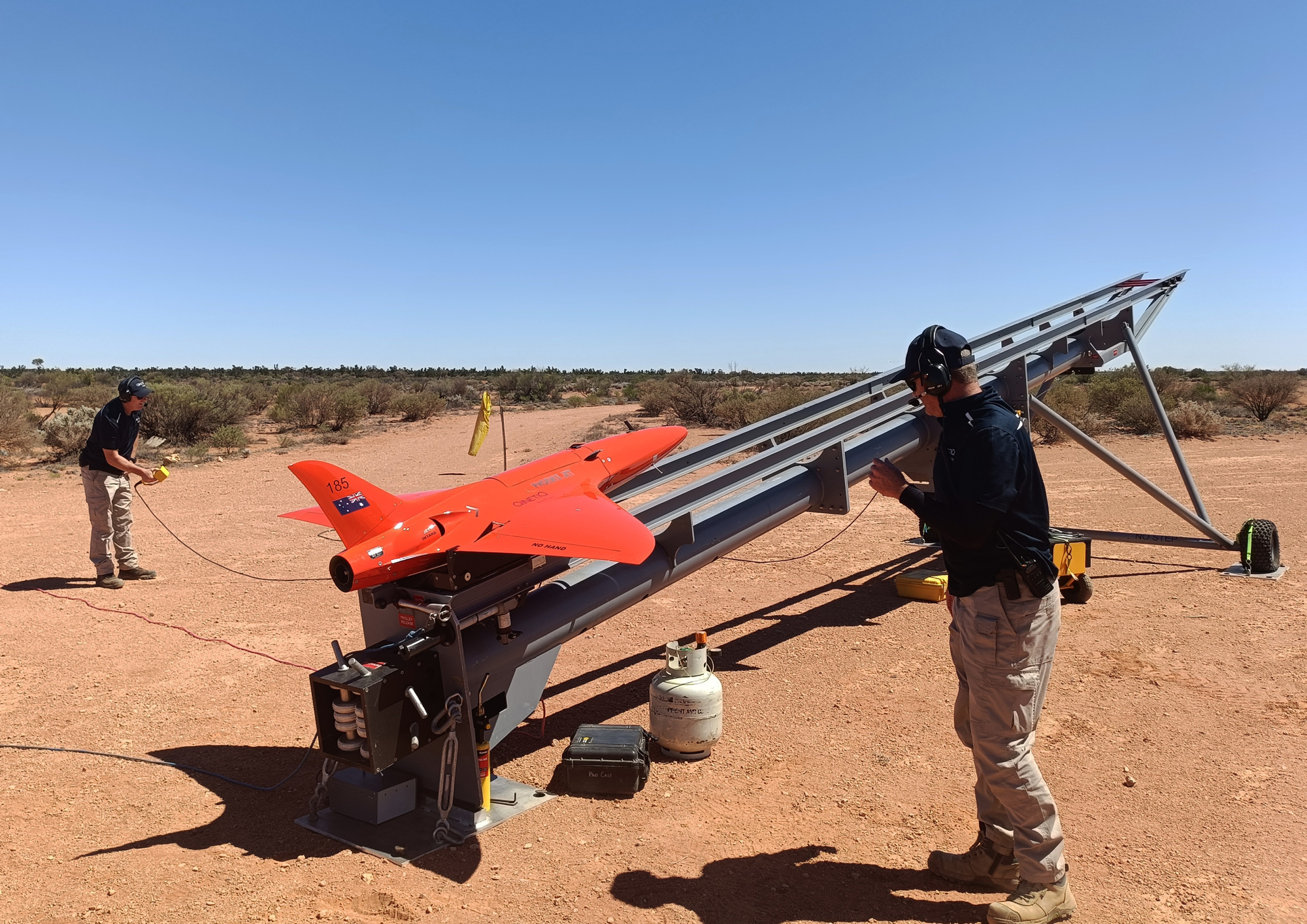
The CCA carried the missile externally on a ventral hardpoint, with the missile pushed down by two retracting holds and its rocket motor igniting after descending some distance away from the aircraft. A target drone, identified as Phoenix jet-powered drones operated by Qinetiq, is also shown being launched from the ground, but the overall video does not show the missile striking the drones, unlike the Kizilelma-Gökdoğan BVR AAM test late in November.
“This is the first time an autonomous aircraft has completed an air-to-air weapon engagement with an AIM-120 missile, establishing the MQ-28 as a mature combat capable CCA,” said Boeing Defence Australia’s managing director, Amy List, in the press release. “This latest achievement proves the advantage specialized CCA platforms bring to defense forces’ mission effectiveness, delivering increased operational mass and data exchange for informed decision-making while reducing cost and crewed pilot risk.”
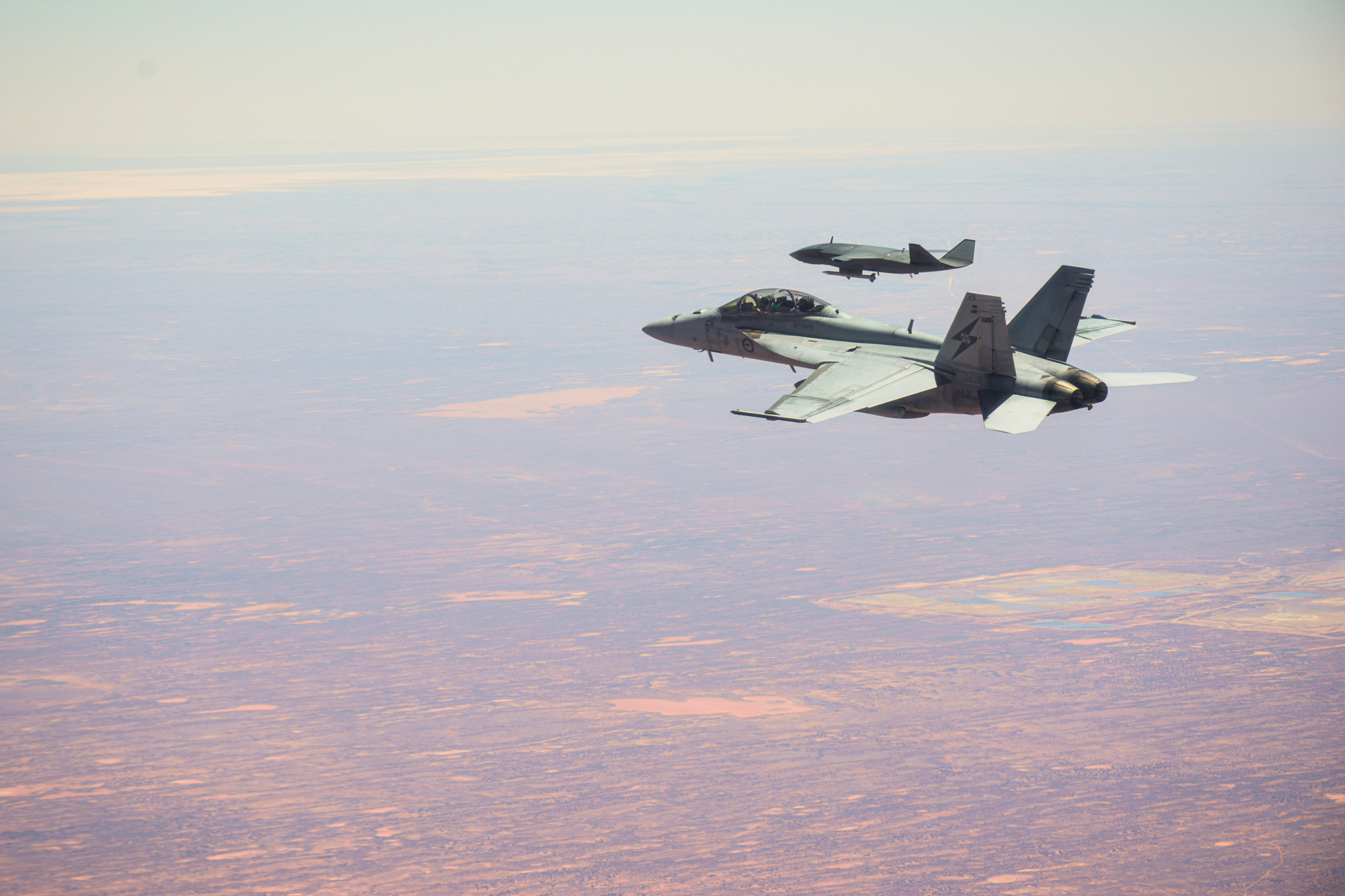
The test suggests the Ghost Bat acted as an off-board weapons release platform, leveraging sensor, detection, control and guidance data from the E-7A and F/A-18F. The three platforms were launched from separate locations according to the press release, and the Super Hornet is shown flying off the Ghost Bat’s wing.
Thank you to the Australian Government. MQ-28 funding through to 2028 backs new aircraft production and Block 3 aircraft development — prepping for @AusAirForce operations and accelerating capability. pic.twitter.com/6YXa4iuhos
— Boeing Australia (@BoeingAustralia) December 9, 2025
“Once airborne, an E-7A operator took custodianship of the MQ-28 ensuring safety and engagement oversight,” the release explained. “The F/A-18F teamed with the MQ-28 in combat formation to provide sensor coverage, and once the Super Hornet identified and tracked the target, targeting data was shared across all three platforms. The MQ-28 adjusted its position and received authorization from the E-7A to engage and successfully destroy the target using a Raytheon AIM-120 AMRAAM missile.”
The testing scenario is broadly consistent with the Australian Department of Defence’s previous suggestion that the Ghost Bat can serve in an escort role for high-value support assets such as the E-7A or KC-30 aerial refueler. Generally, the MQ-28A is meant to “to team with crewed platforms performing mission roles and responsibilities typical of fighter aircraft, complementing and extending airborne missions while increasing situational awareness and survivability,” the Australian Department of Defence explained.
‘Mature platform’
The RAAF and Boeing are working to continue development on the MQ-28, with a Block 2 variant being built using the lessons learned from the current Block 1 aircraft. This new variant is the one which will provide the Initial Operational Capability for the type in the RAAF.
“The capabilities validated throughout 2025 will be incorporated into the Block 2 aircraft now in production, forming the basis of an initial operational capability for the RAAF and allied partners,” the company had said on Sep. 5, announcing the successful conclusion of the MQ-28A Ghost Bat’s Capability Demonstration 2025 test campaign with the RAAF. These were held between April and June, and involved the aforementioned tests with the E-7, F-35A and MQ-4C.
Regarding the latest test, Vice President and General Manager for Boeing’s Phantom Works division Colin Miller said it demonstrated the “maturity and sophistication of Boeing’s mission autonomy solution which is built on open standards and government architectures and is capable of integrating with fourth, fifth and sixth generation aircraft.” He further defined this as “a true example of speed-to-capability.”
“The team implemented open architectures and an advanced digital ecosystem to develop the necessary hardware, software, and mission systems required to successfully integrate, test and employ the weapon in a live, operationally relevant scenario in under eight months,” added Miller.
Concept illustrations have shown the Ghost Bat’s nose to be swappable, with payloads for ISR and electronic warfare/electronic intelligence roles. Some of the Block 1 MQ-28s have also been equipped with an IRST (InfraRed Search and Track) sensor.
Future
Interestingly, Boeing’s press release also mentioned the U.S. Air Force as being one of the partners in the “collaborative effort,” hinting the service has kept its doors open to acquire some units of the drone, after having previously received at least one for testing. Notably, an MQ-28 was visible in the background of a video released after the U.S. Secretary of Defense Pete Hegseth visited Naval Air Station Point Mugu, California.
.@SECWAR spoke to our warriors at Naval Air Station Point Magu:
He reminded them that WE HAVE THEIR BACKS! pic.twitter.com/SzlklDHbfX
— DOW Rapid Response (@DOWResponse) December 6, 2025
Should the U.S. Air Force decide to procure the MQ-28, the expanded acquisition would spread out costs between the service and the RAAF. However, it is unclear if the Ghost Bat’s Block 2 variant is being proposed for the Increment 2 phase of CCA program.
Flight of the Ghost Bat! ✈️👻🦇
The MQ-28A Ghost Bat achieved first flight outside of Woomera Training area during Exercise Carlsbad.
Ghost Bat is the first military aircraft designed and built in Australia in more than 50 years. #YourADF pic.twitter.com/mO3Y0upyB6
— Defence Australia (@DefenceAust) June 21, 2025
The USAF presently has Anduril’s YFQ-44A and the two prototypes of General Atomics’ YFQ-42A involved in flight testing as part of the CCA Increment 1 program. The service is also conducting tests in parallel with the XQ-58A Valkyrie, which has been controlled by manned aircraft earlier this year.
Meanwhile, the U.S. Navy recently chose Boeing, along with Anduril, Lockheed Martin and General Atomics, to produce conceptual designs for carrier-borne CCAs. The fact the MQ-28 was spotted at Point Mugu might also hint at an evaluation by the U.S. Navy to determine the requirements for its CCA program.