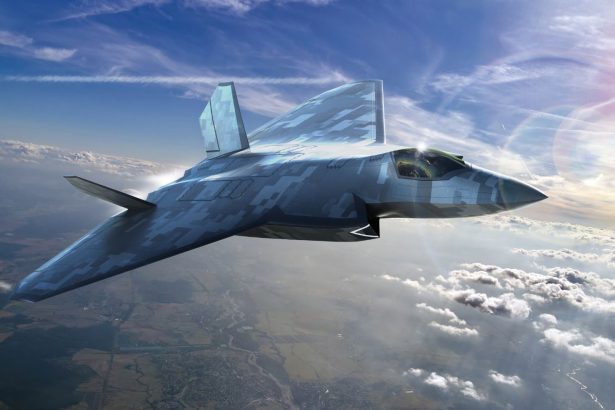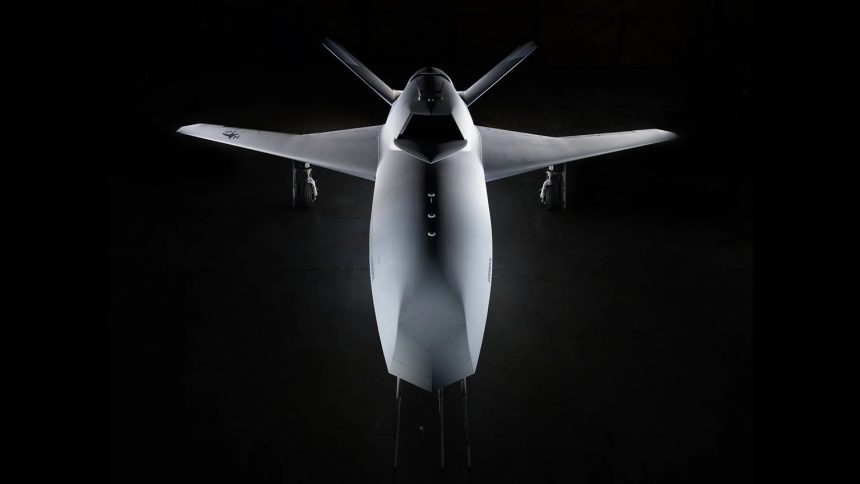
Project Talon is an evolution of Northrop Grumman’s proposed design for the U.S. Air Force’s CCA Increment One program, addressing affordability and cost shortcomings.
Northrop Grumman has formally unveiled “Project Talon,” a new autonomous aircraft demonstrator built to validate faster and more affordable manufacturing methods for large uncrewed platforms. The aircraft, developed largely in secrecy at Mojave Air and Space Port, was presented to media on Dec. 3, 2025.
The company described the program as a response to lessons learned from its unsuccessful bid for the U.S. Air Force’s Collaborative Combat Aircraft (CCA) Increment 1. According to statements made during the unveiling, reported by multiple outlets, the company’s previous CCA proposal performed well technically but was considered too costly and thus not affordable.
Talon aimed to find the right balance between capability and cost, with Tom Jones, president of Northrop’s aeronautics systems division, saying the result was a design that is both cheaper and more capable. However, it appears the aircraft was created less as a direct competitor for future CCA increments and more as a proof-of-concept for a different production philosophy, with faster development, fewer parts, and a lower cost.
In fact, Talon is not a missionized combat drone and has not yet flown, however the demonstrator provides insight into Northrop Grumman’s evolving approach to attritable systems and rapid prototyping. Jones further added that the aircraft s not specifically targeted for the follow-on CCA Increment 2 or other international programs.
From Project Lotus to Talon
Project Talon’s unveiling doesn’t come completely as a surprise. In fact, its existence was already somewhat known, although with a different name. In fact, in late October, Aviation Week reported about a mysterious “Project Lotus” being secretly built at Northrop Grumman’s Scaled Composites rapid prototyping facility in Mojave, California.
The publication obtained photographs of “a completed, turbofan-powered aircraft parked within the Scaled Composites compound,” with “a long, slender fuselage positioned forward of the leading edges of the wings, capped by a nose with swept-back edges leading to a slender point.” The design also features an engine inlet which “sits high atop of the extreme aft section of its fuselage,” as well as “sharply canted tails.”
At the time, no details were provided about its purpose, development status, or customer. However, this reporting was followed by speculation about a possible CCA about to be unveiled by the company.
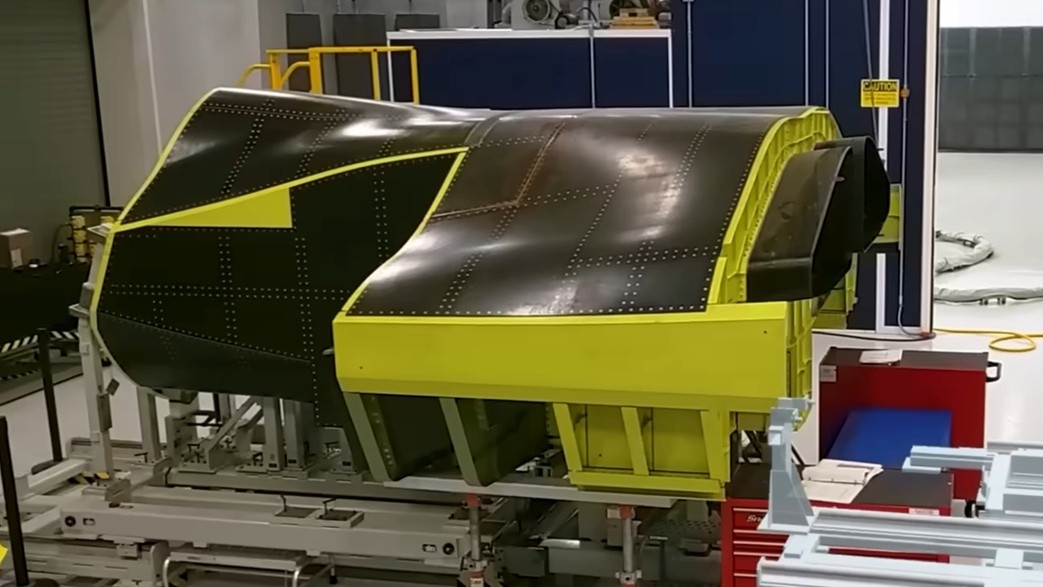
Separately, The War Zone had highlighted unknown and unusual fuselage structures visible in a Northrop Grumman promotional video, suggesting they could belong to an undisclosed aircraft under development. The reports about both publications aligned with the physical characteristics later seen on Talon during the unveiling.
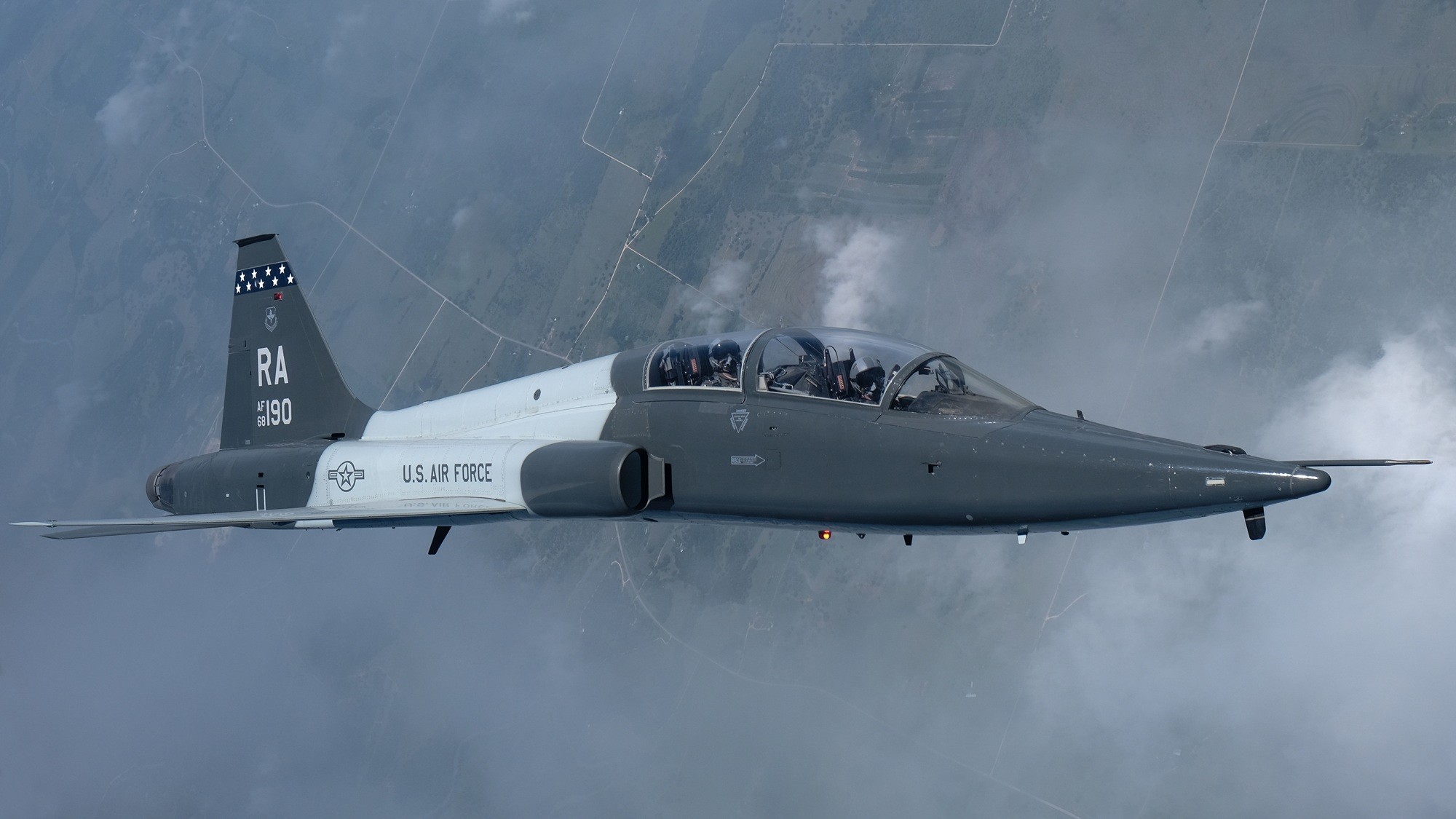
Jones further confirmed that Project Lotus was the original name of the demonstrator, later changed to Project Talon refer to the same demonstrator. According to Aviation Week, Jones said the new name is a reference to the Northrop T-38 Talon, an aircraft designed for high performance and agility while also focused on lower costs as a trainer, characteristics that are also part of the new demonstrator.
Objectives of the Demonstrator
Northrop Grumman emphasized that Talon was designed primarily to validate a faster and more efficient development cycle. According to Breaking Defense, company officials acknowledged that their earlier CCA Increment 1 proposal had been too complex and expensive.
Talon was therefore created to test whether a large uncrewed aircraft could be produced with reduced part counts, simplified structure, and lower overall cost, while still meeting performance goals typical of a loyal-wingman-type platform.
“The idea was to see if we could build an aircraft that had all the same capability of our original offering, and do it faster,” said Jones. “So the outcome was an aircraft, but the [more important] outcome we’re shooting for was the process. How do we design and build things that perform at a high level, but that we can build quickly now and can do affordably?”
Among the key development milestones and objectives, Greg Morris, president of Scaled Composites, noted around 50% fewer parts compared to the original design and structure fully made of composite materials. This led to a 1,000-pound reduction in weight and a roughly 30% faster assembly of the aircraft.
The development of Talon was also intended to validate a blend of digital-engineering tools with rapid physical prototyping. This allowed to demonstrate a manufacturing approach that could one day support high-rate, affordable production of uncrewed aircraft.
Jones detailed that it took roughly 15 months from initial program start to “weight on wheels,” with the demonstrator fully assembled. He further added that the company is targeting a first flight within nine months of the public unveiling, which would put the timeframe within Fall 2026.
Design Features and Airframe Layout
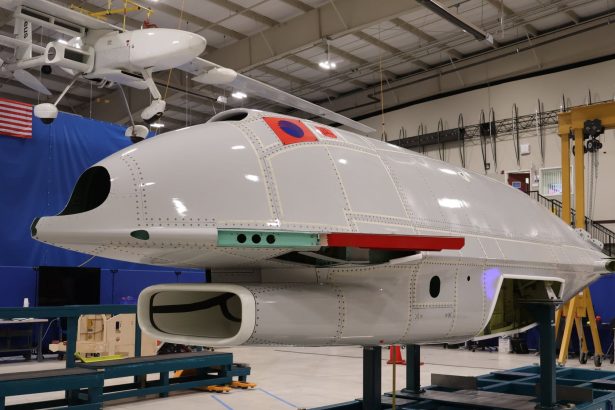
Although Northrop Grumman declined to release performance specifications, the photo released by the company and descriptions provided by outlets which were allowed to attend the event give a clearer view of the aircraft’s configuration.
Regarding the general configuration, it is largely the same mentioned by Aviation Week in the report about Project Lotus, featuring a shovel-shaped nose, long slender fuselage, low aspect ratio lambda wing planform, top mounted engine air inlet and exhaust, and canted twin tails.
The design appears optimized for high performance and agility, with low-observable characteristics also visible. Aviation Week and The War Zone also noted that the aircraft carried FAA registration “N444LX,” associated with a Scaled Composites aircraft designated as “Model 444.”
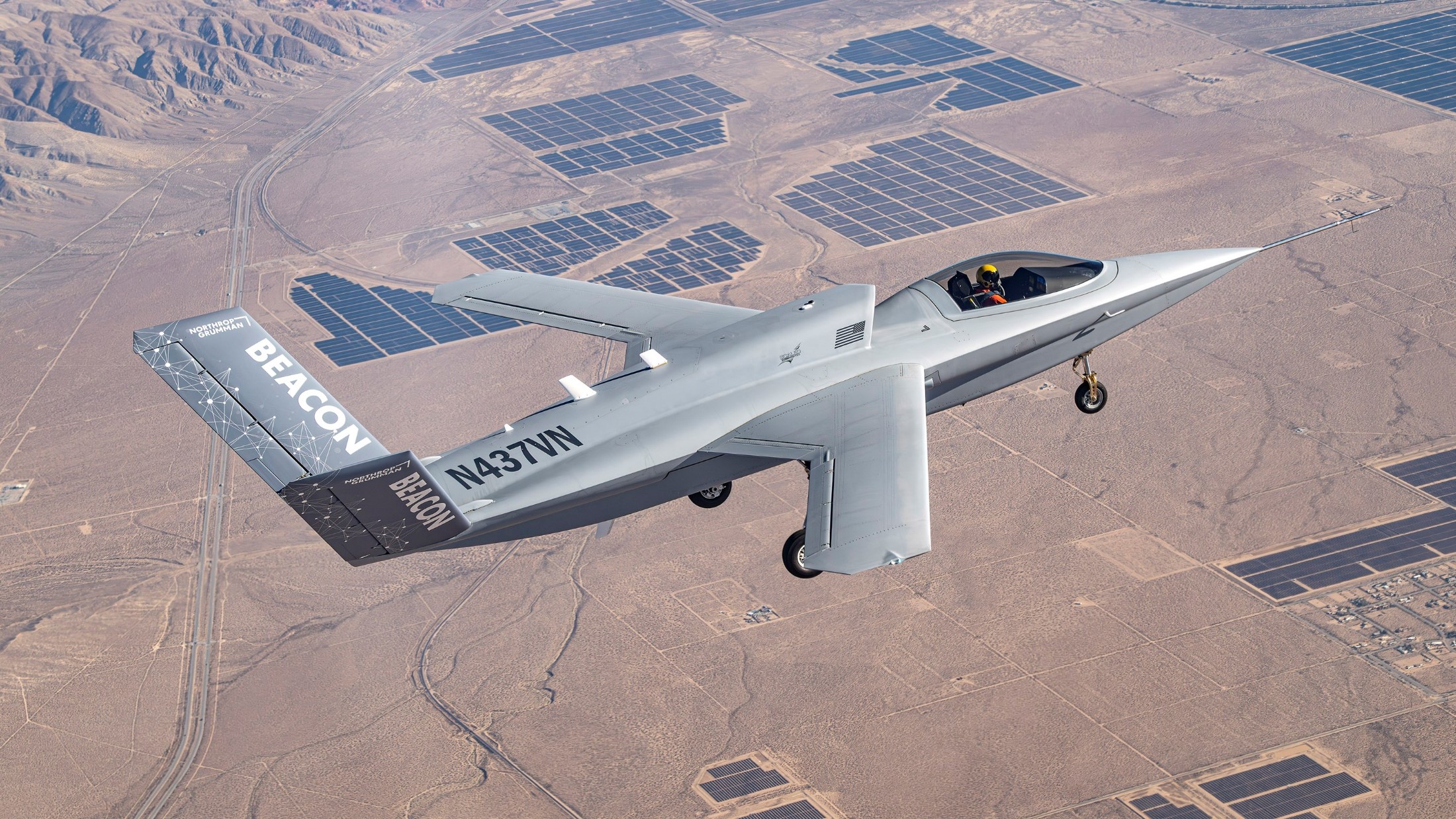
Regarding the powerplant, Northrop Grumman confirmed only that Talon uses a single turbofan engine, but declined to identify the manufacturer or thrust class. The engine is supplied air by a trapezoidal dorsal inlet mounted above the aft fuselage, while the exhaust is positioned between the canted tail surfaces.
The nose section features test instrumentation typical of early flight-test articles, including three air data probes extending forward of the radome. The War Zone further noted the presence of a small aperture under the nose, possibly for a camera or sensor during testing.
The War Zone also observed a large trapezoidal panel on the underside of the fuselage, possibly indicating space for an internal bay. The company did not comment on whether the demonstrator is intended to carry stores internally, though a weapons or sensor bay would be consistent with CCA-type architecture.
Development Approach and Production Philosophy
Company officials highlighted Talon as a test case for a new development culture. As noted by Breaking Defense, the demonstrator was created by a blended team consisting partly of Northrop staff and partly of Scaled Composites engineers, reflecting an organizational push toward faster, more flexible prototyping.
According to executives quoted by The War Zone, the team relied heavily on digital engineering tools, such as virtual modeling and simulation, to compress design cycles. These tools were combined with accelerated physical builds of key structures and test articles to resolve uncertainties early.
The manufacturing approach emphasized a reduced part count, rapid composite materials fabrication, reuse of existing components where feasible (landing gear being an example) and simplified systems architecture. Short decision-making loops within the mixed teams also helped speed up the effort.
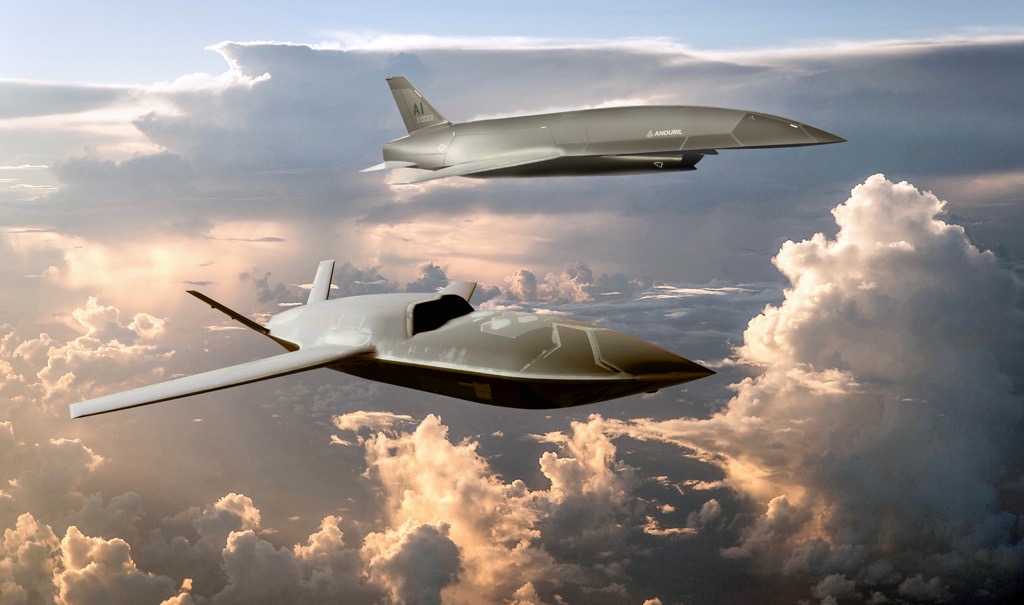
The company framed this approach as essential for supporting the potential future requirement for high-volume uncrewed aircraft, particularly in high-attrition scenarios. This would allow to quickly manufacture new airframes to replace losses, avoiding dangerous reductions in the fleet.
Relation to the CCA Program
The unveiling occurs at a moment when the U.S. Air Force is preparing for further development phases of its Collaborative Combat Aircraft program. The first increment selected two manufacturers, General Atomics and Anduril, to deliver operational demonstrators, the YFQ-42 and YFQ-44, respectively.
According to statements reported by Aviation Week and Breaking Defense, Jones maintains that Talon was not explicitly built to compete in CCA Increment 2, although he didn’t rule out a submission of the design to the Air Force. Executives said the company expects requirements for Increment 2 to differ significantly, and the service has not yet issued a request for proposals.
Nevertheless, the company’s officials said lessons learned from Talon’s manufacturing could be applied to future offerings. Moreover, Breaking Defense reported that there is interest across multiple U.S. military services and international delegations have already visited Mojave to observe the airframe.
What Talon Represents in the Today’s Environment
Although Talon’s operational potential cannot yet be evaluated, its public debut highlights several significant trends within the defense aerospace sector.
A first trend is the shift toward attritable systems, with current planning scenarios increasingly prioritizing uncrewed systems that can be produced rapidly, deployed in numbers, and easily replaced if lost. Northrop Grumman’s emphasis on reducing part count, simplifying structures, and accelerating assembly reflects the goal to deliver lower-cost platforms suitable for mass production.
The Project Talon program also demonstrates a tighter integration of digital engineering, rapid prototyping, and iterative physical testing, another trend of recent unmanned aircraft designs. “There’s not a full ‘digital twin‘ for the aircraft, but digital tools have been used extremely extensively,” noted Morris in The War Zone’s report.
“It’s an optimization question, leveraging each aspect of the process in order to enable you to go as fast as possible,” he added. “Digital environments are amazing for some things. Testing in the physical world is amazing at other things. Marrying the two together gets you the benefits of both.”