Three decades after the first flight, the F/A-18E/F is still central to U.S. Naval Aviation and is expected to serve into the 2040s alongside the F-35C and future F/A-XX.
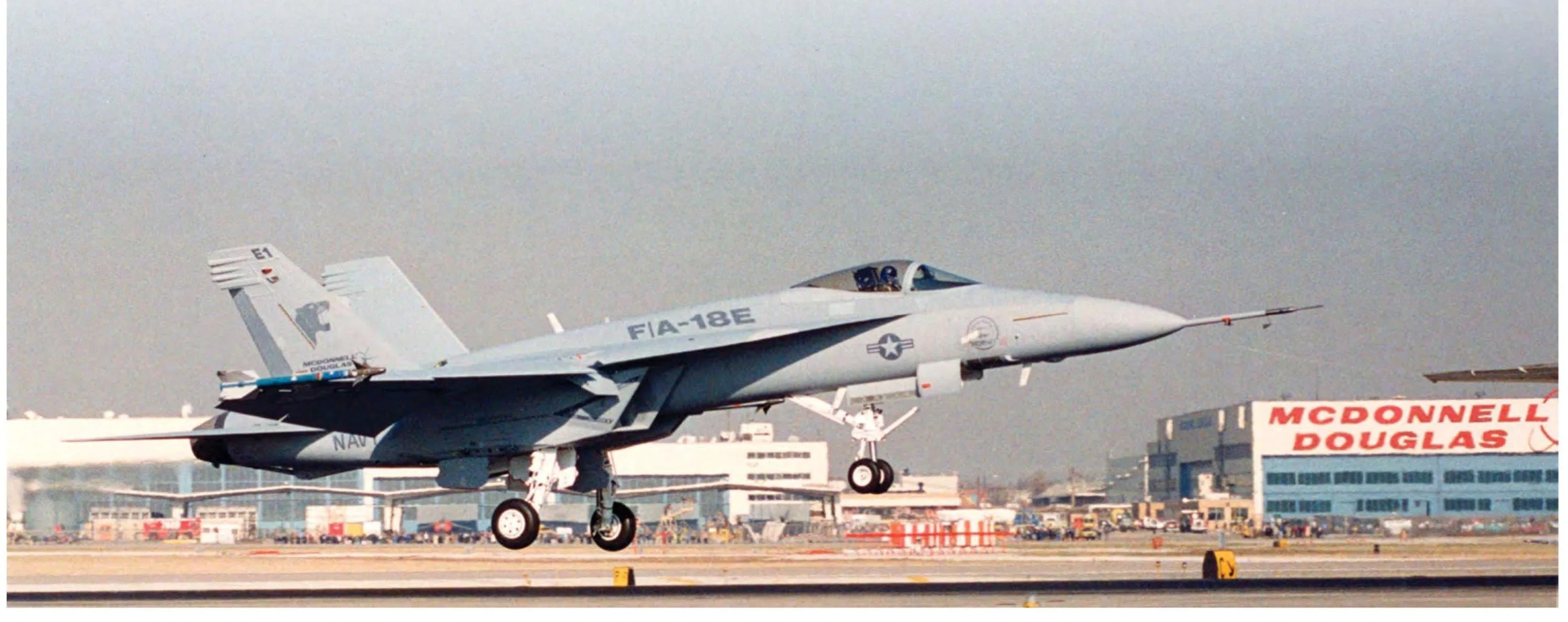
The F/A-18E/F Super Hornet celebrated the 30th anniversary since its first flight. In fact, on Nov. 29, 1995, the prototype F/A-18E Super Hornet lifted off from then McDonnell Douglas’ (now Boeing’s) St. Louis facility for the first time, marking the beginning of a program that would reshape U.S. carrier aviation for the next three decades.
The Super Hornet was born in a period of budget cuts and restructuring, which led the Navy to cancel a number of programs. However, the new aircraft was able to succeed and ultimately became the most widely used strike fighter aboard U.S. Navy aircraft carriers and still continues to evolve today.
- 1 Three decades after the first flight, the F/A-18E/F is still central to U.S. Naval Aviation and is expected to serve into the 2040s alongside the F-35C and future F/A-XX.
- 1.1 Restructuring Naval Aviation
- 1.2 November 29, 1995
- 1.3 Developmental Challenges and Carrier Suitability
- 1.4 Fleet Introduction and Operational Debut
- 1.5 Block II – AESA and the Maturation of the Platform
- 1.6 EA-18G Growler – A New Electronic Attack Backbone
- 1.7 Operational Use
- 1.8 International Use
- 1.9 Block III
- 1.10 The Super Hornet at 30
30 Super years in flight!
Thirty years ago, the first F/A-18 Super Hornet took to the skies for the first time. We’re thankful for the thousands of #TeamBoeing employees, partners and suppliers who keep the Super Hornet modernized and evolving, delivering unmatched capabilities… pic.twitter.com/kRhpsJWmi1
— Boeing Defense (@BoeingDefense) December 1, 2025
Restructuring Naval Aviation
The Super Hornet program emerged when the McDonnell Douglas A-12 Avenger II Advanced Tactical Aircraft (ATA) was cancelled in 1991, and the Navy launched the Advanced-Attack (A-X) program while considering interim capabilities. For the latter, the service needed a rapid, politically feasible solution that avoided the risks associated with another clean-sheet design.
McDonnell Douglas proposed an enlarged, substantially redesigned evolution of the F/A-18C/D Hornet, large enough to fill the capability gap left by the Intruder, yet similar enough to leverage existing infrastructure, training pipelines, and maintenance regimes. This proposal, initially dubbed “Hornet II” and later “Hornet 2000,” offered the Navy reduced development risk and predictable cost, while still enabling meaningful capability growth.
Despite resistance in Congress and skepticism within parts of the naval aviation community, the Navy pursued the proposal and first ordered the new aircraft in 1992. The Navy Advanced Tactical Fighter (NATF) and the A-X programs were cancelled in 1992 and 1993, respectively, while production and upgrades to the F-14D Tomcat were cancelled in favor of the cheaper F/A-18E/F.
The redesign effort produced an aircraft that shared the Hornet’s name but little else beyond basic configuration principles. In fact, the Super Hornet was 25% larger, carried 33% more internal fuel, had 50% longer range, incorporated a completely new wing, and adopted new intakes, avionics architecture, and survivability features.
November 29, 1995
The first F/A-18E prototype took to the air on Nov. 29, 1995, flown by McDonnell Douglas test pilot Fred Madenwald. The flight was a symbolic milestone for a program that many had questioned just a few years earlier.
The aircraft was first christened Super Hornet during the rollout on Sept. 18, 1995. The first prototype was followed by a second F/A-18E which first flew a month later, on Dec. 26, and the first twin-seater F/A-18F on Apr. 1, 1996.
The aircraft represented a shift in U.S. Navy procurement strategy, with a cautious: evolutionary approach instead of revolutionary as initially intended with the A-12, A-X and NATF. The service was confident in the jet’s capabilities, and the Super Hornet first landed on a carrier in 1997, quickly moving into production.
Following the Boeing–McDonnell Douglas merger in 1997, the program transitioned under Boeing’s leadership.
Developmental Challenges and Carrier Suitability
As with any major tactical aircraft program, issues emerged early in testing. The most notable was the “wing drop” phenomenon – an uncommanded roll (up to 40 degrees) during high angles of attack caused by airflow separation. Engineers resolved the problem through a combination of leading-edge stall strips, wing refinements and flight control software updates.
Another problem was the risk of interference of the payload with the airframe. The pylons were then canted around 3.5 degrees to provide more space and safety margin between the engines’ air inlets and the pylons.
Fleet Introduction and Operational Debut
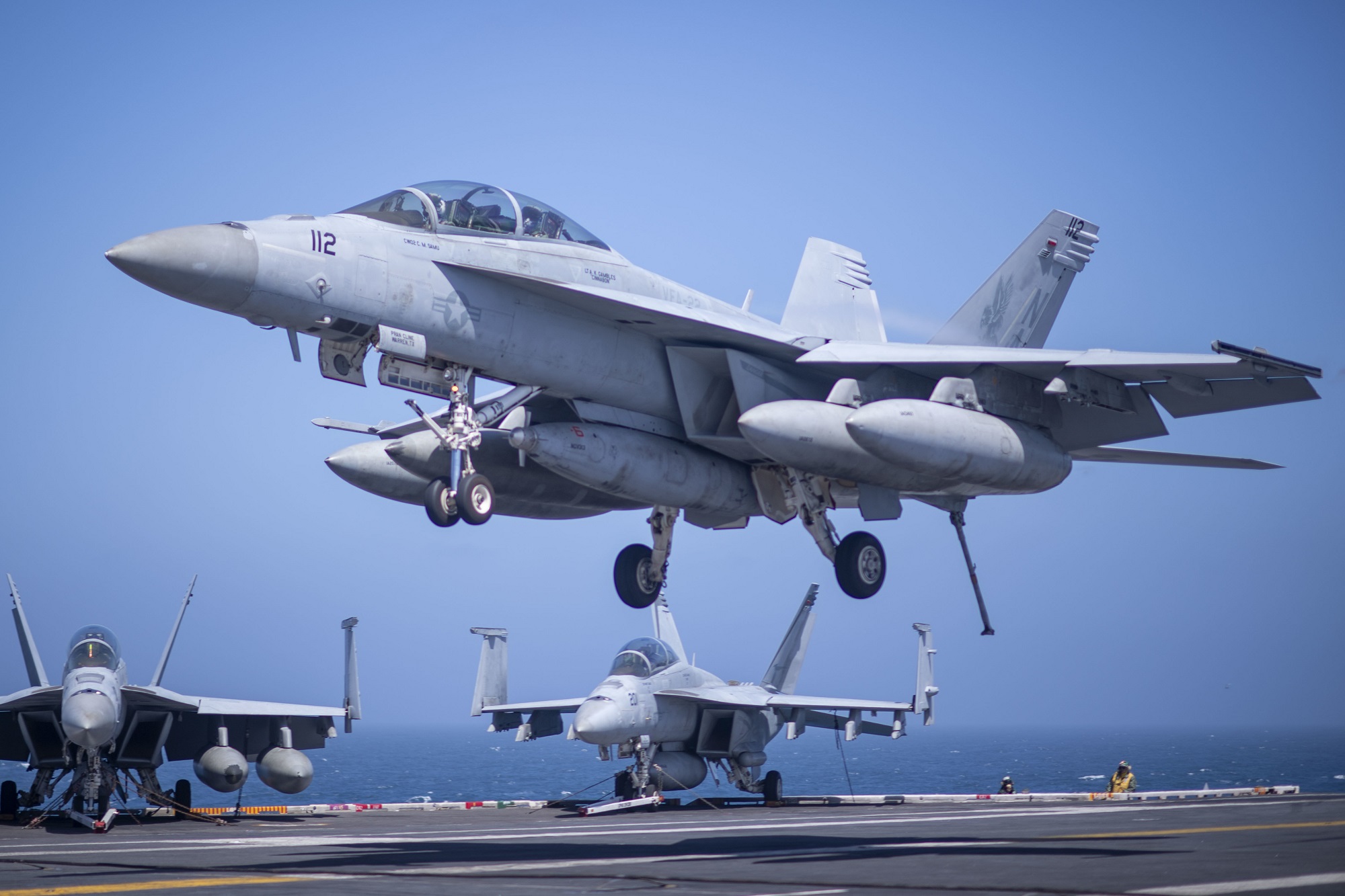
The first operational squadron, VFA-115 “Eagles,” declared Initial Operational Capability (IOC) in September 2001. Less than a year later, in July 2002, the unit deployed for the type’s first operational cruise aboard USS Abraham Lincoln.
Few months later, in November, the Super Hornet made combat debut with a strike against hostile targets in Iraq’s no-fly zone as part of Operation Southern Watch. The deployment also validated the aircraft’s expanded payload flexibility and greater endurance, bringing a significantly more capable strike fighter into the fleet during the opening phase of the Global War on Terror.
From that point onward, carrier air wings transitioned rapidly, with units on both the East and West coast transitioning to the new aircraft as the F-14, A-6 Intruder and S-3 Viking were gradually phased out.

By the mid-2000s, the Super Hornet had become the dominant strike fighter aboard U.S. carriers. As a multi-role fighter, the Super Hornet took over a large share of precision-strike, ISR, and tanker duties.
Block II – AESA and the Maturation of the Platform
In 2001, the Navy introduced the Super Hornet’s Block II, which transformed the jet into a technologically modern multirole fighter. This incorporated a number of capabilities-enhancing technologies which made the Block II earn a reputation as the backbone of the Navy’s carrier air wing and a workhorse within the fleet.
Among the most important enhancements were the AN/APG-79 Active Electronically Scanned Array (AESA) radar, improved sensors and avionics, increased range, and capability to employ an arsenal of precision weapons. These were installed thanks to an open mission systems architecture, enabling ease of integration for new weapons and technology systems.
EA-18G Growler – A New Electronic Attack Backbone
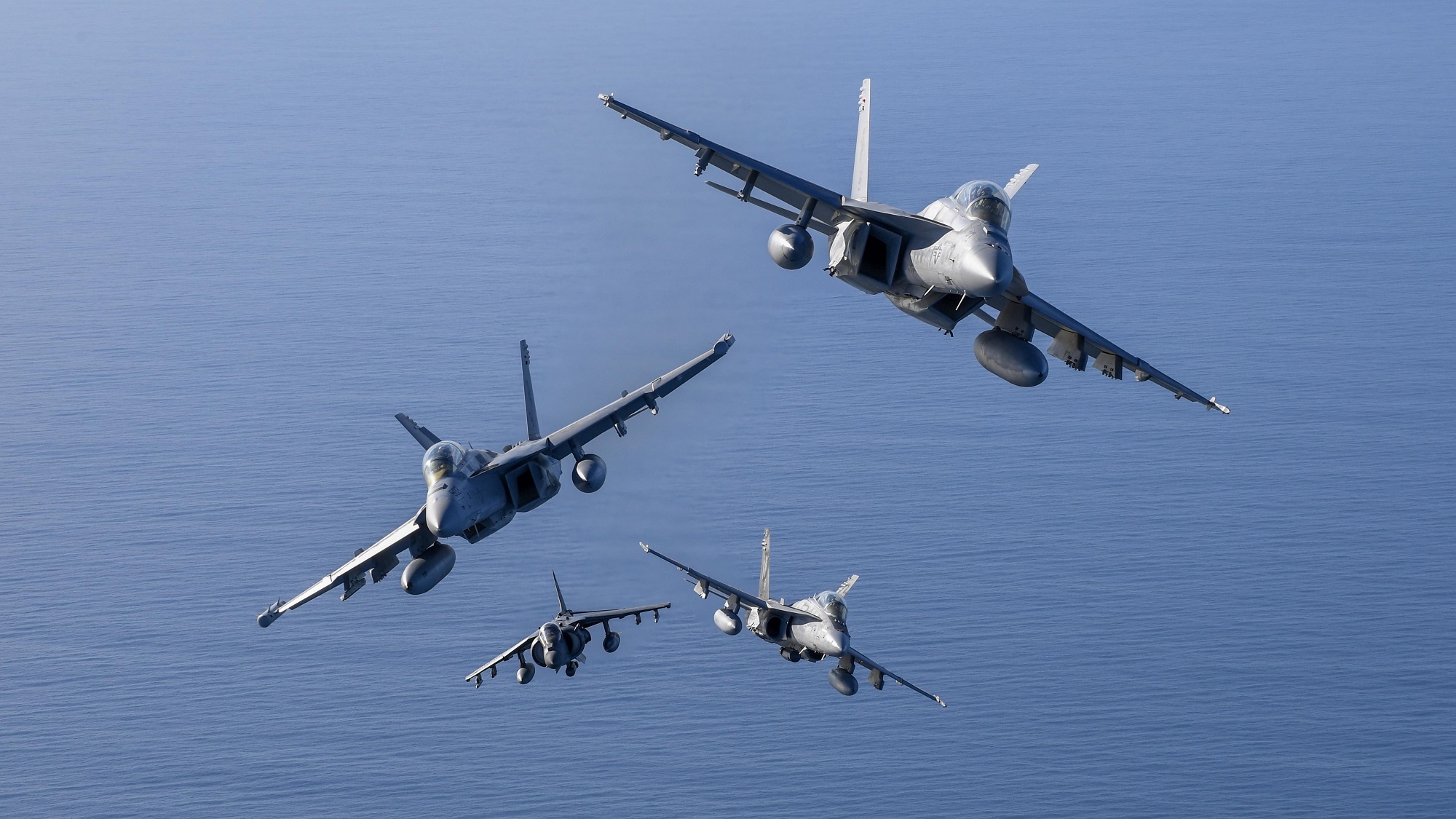
One of the Super Hornet program’s most consequential derivatives is the EA-18G Growler. The twin-seater aircraft, designed to replace the quad-seater EA-6B Prowler, first flew on Aug. 15, 2006.
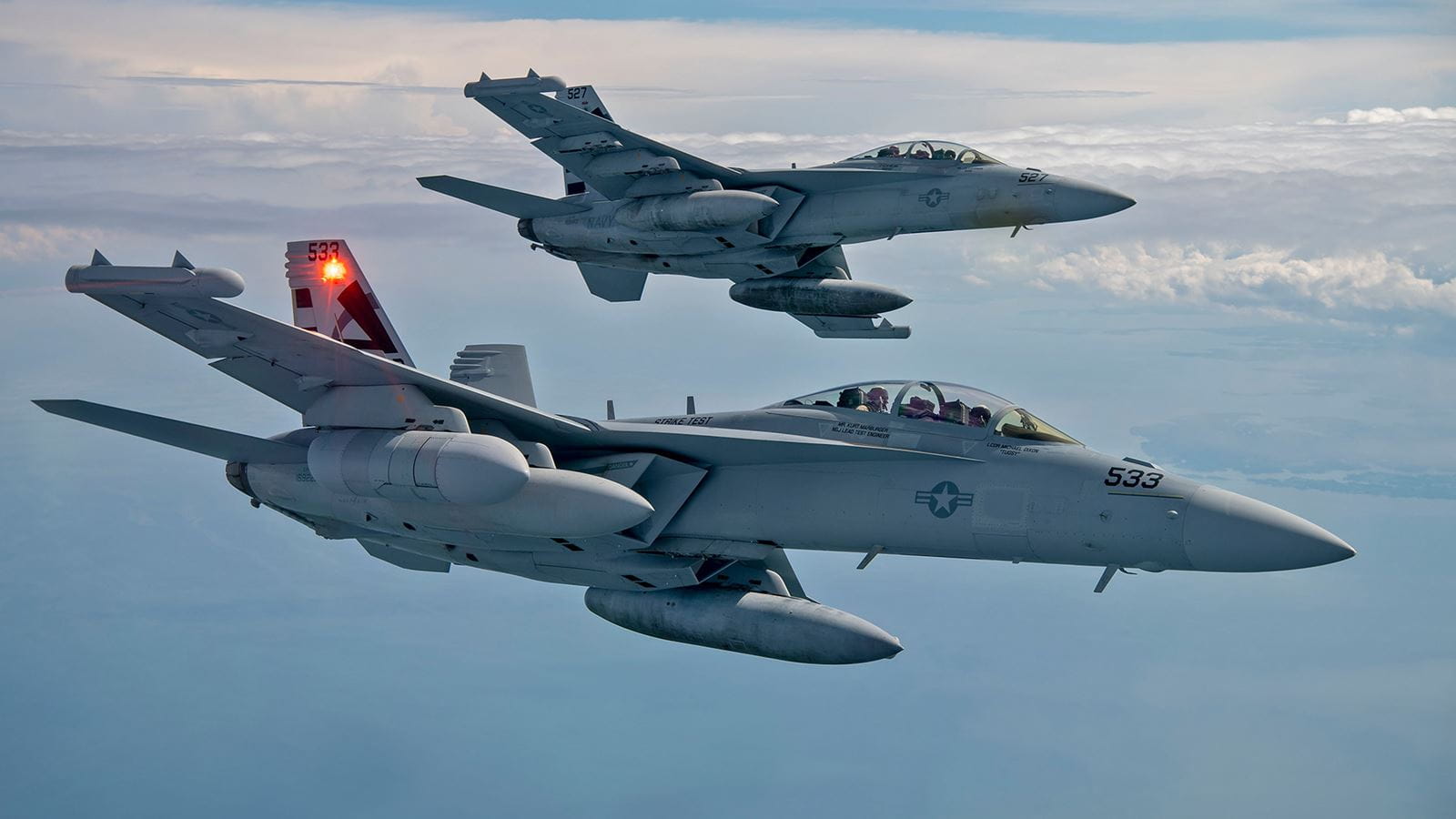
The Growler notably integrated the ALQ-218 receiver suite and ALQ-99 jamming pods, with the latter also used by the EA-6B. The Initial Operational Capability was achieved in December 2009.
The aircraft rapidly became the world’s most advanced tactical electronic attack platform. The Growler completed the United States’ Suppression of Enemy Air Defense (SEAD) triad, which also includes the F-16CM Block 50/52 Fighting Falcon and the EA-37B Compass Call.
Like the Super Hornet, the Growler continues to evolve. Among the main upgrades are the Next Generation Jammer Mid-Band (NGJ-MB) and Low-Band (NGJ-LB) set to replace legacy systems across the next decade.
Operational Use
The Super Hornet has now participated in nearly every major U.S. carrier deployment since 2002. Its missions have included operations in Afghanistan and Iraq during Operations Enduring Freedom and Iraqi Freedom, in Libya during Operation Odyssey Dawn and Unified Protector, in the Middle East during Operation Inherent Resolve, as well as routine missions in the Indo-Pacific.
International Use
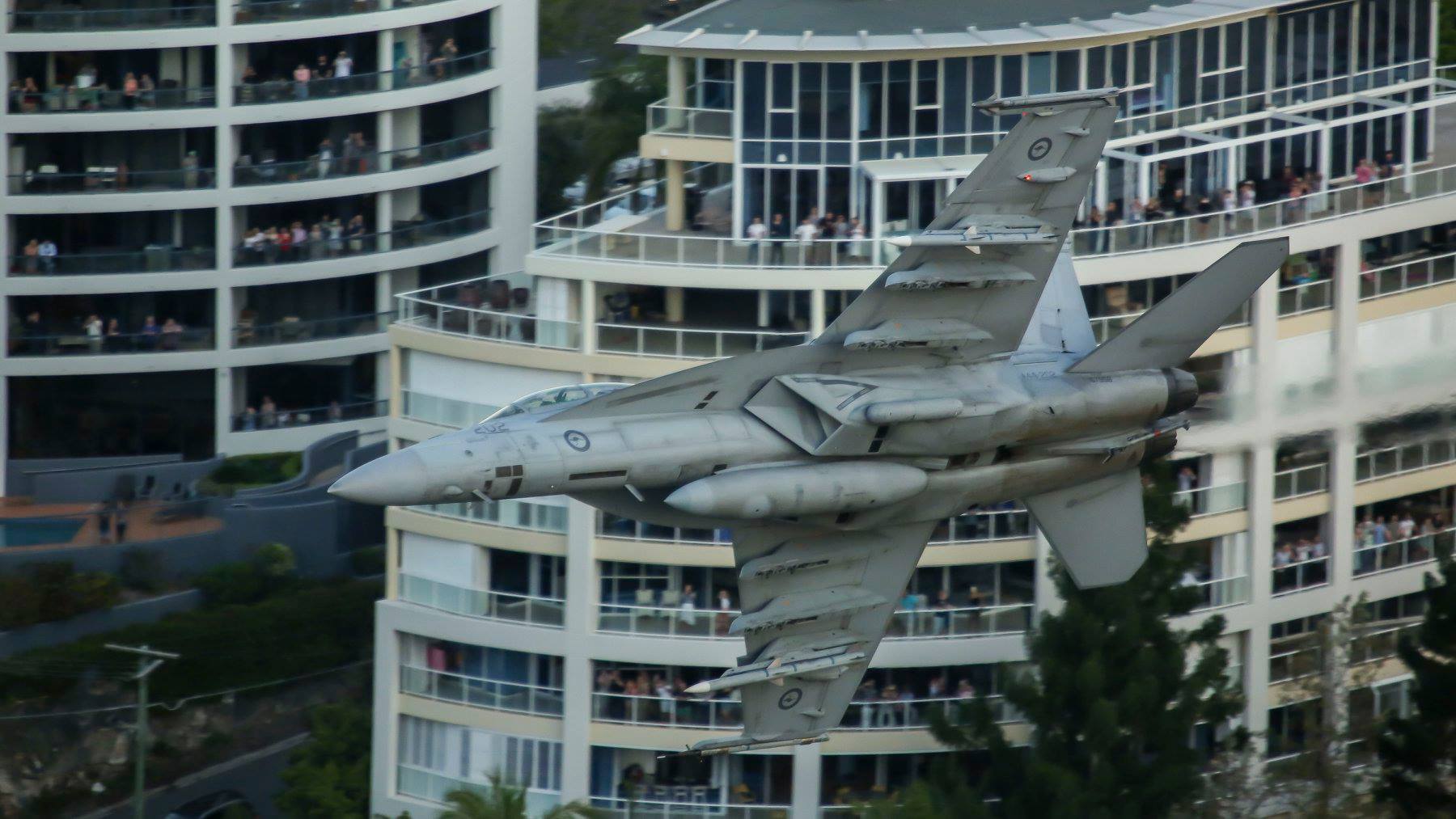
Australia became the first export customer for the Super Hornet family, purchasing 24 F/A-18F aircraft and later 12 EA-18G Growlers. These aircraft allowed the Royal Australian Air Force to retire the F-111 and maintain a credible strike capability until the arrival of the F-35A.
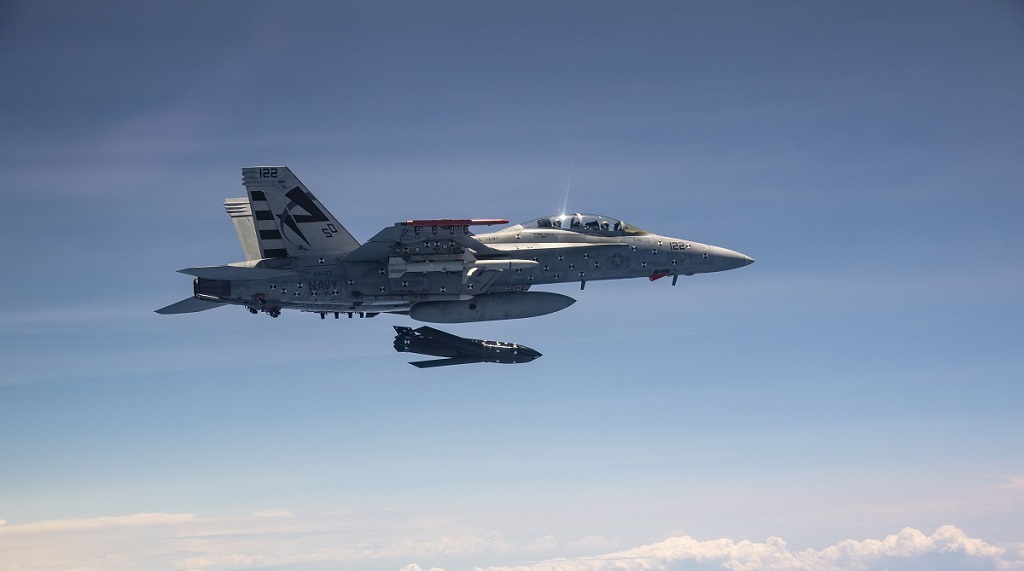
The RAAF continues to operate both types, with the fleet undergoing upgrades aligned with U.S. Navy modernization timelines. Among these is the integration of the new AGM-158C Long-Range Anti-Ship Missile (LRASM).
A second operator is Kuwait, which ordered 28 Super Hornets in 2018, including 22 single-seater F/A-18Es and six twin-seater F/A-18Fs. The first Kuwaiti Super Hornet flew for the first time in 2020, with the deliveries reportedly completed in 2021.
Few details are available, but it was reported that the aircraft were transferred by Boeing to the U.S. Navy for custody ahead to their handover to Kuwait. It appears the handover has not yet taken place because of ongoing infrastructure upgrades at Ahmed Al-Jaber Air Base and logistical changes, and is now expected for 2026.
Block III
As the airframe approached mid-life, the U.S. Navy initiated the Block III upgrade. The upgrade, featuring a renewed cockpit, new computing architecture and network infrastructure, as well as the possibility – later dismissed – to add conformal fuel tanks, has been developed to extend the fleet’s service life and relevance.
The key capabilities made available by the new variant include an Advanced Cockpit System centered around the 10×19 inch large-area touchscreen display, an advanced network infrastructure that incorporates the Distributed Targeting Processor Network (DTP-N) and the Tactical Targeting Network Technology (TTNT), open mission systems, reduced radar signature, a 10,000-hour airframe, the AN/ASG-34 IRST (Infrared Search-and-Track) and the provisions for Conformal Fuel Tanks (CFT) with an additional 3,500 lb fuel capacity.
The Navy is currently receiving new-build Block III jets while also upgrading select Block II aircraft. The Block III upgrades will be applied as part of the Service Life Modernization program, which will add 4,000 flight hours to the service life of the already delivered Super Hornets.
The first phase of the SLM program has already been in motion for some years, extending the service life of the Super Hornet from 6,000 to 7,500 flight hours, while the second phase, started in 2023, is looking to extend the service life to 10,000 flight hours and perform the modifications required for the Block III upgrades.
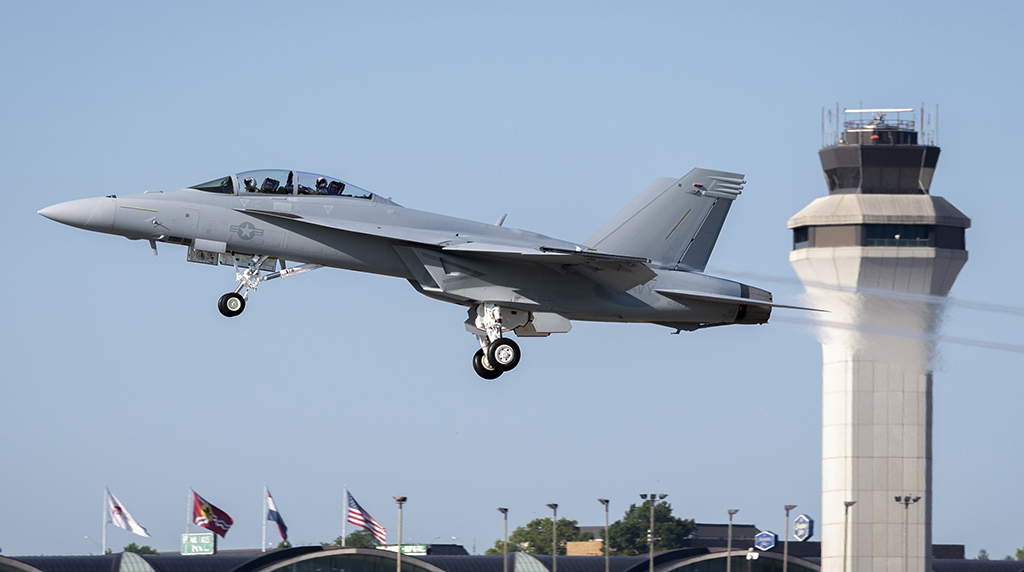
The Super Hornet at 30
Three decades after the first prototype flew, the F/A-18E/F is still central to U.S. Naval Aviation. The U.S. Navy has announced on Aug. 1, 2025, that the F/A-18 and EA-18G aircraft fleet has surpassed 12 million flight hours since the introduction in the 1980s.
This important achievement now cements even more the fleet’s status as one of the most enduring families of aircraft in modern naval aviation, which have served as the backbone of the U.S. Navy and Marine Corps aerial branches for decades. The Navy today has around 550 F/A-18E/F Super Hornets and 150 EA-18G Growlers in service, together with 180 F/A-18A/C/D “Legacy” Hornets used by the U.S. Marine Corps.
The aircraft is expected to serve into the early 2040s alongside the F-35C Lightning II and future F/A-XX family of systems. Even as the Navy transitions toward sixth-generation concepts and distributed maritime operations, the Super Hornet remains a key enabler for long-range strike, maritime interdiction, air defense, and networked warfare across carrier strike groups.