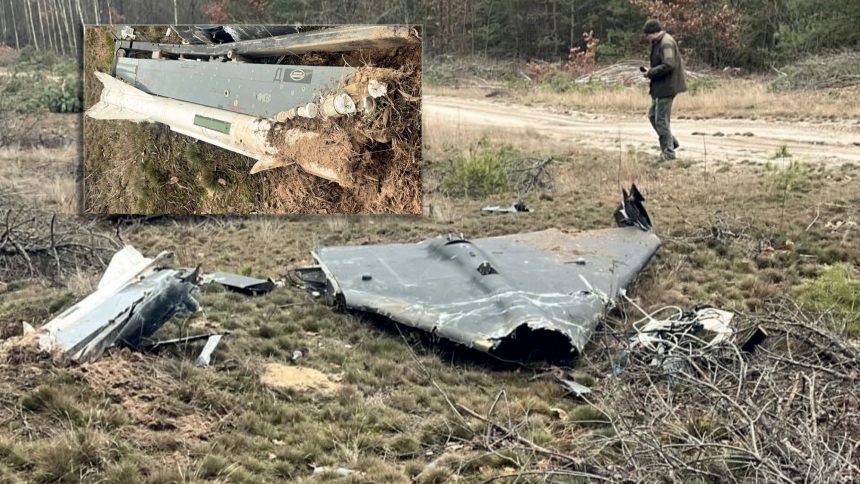
A Russian Geran-2 drone – shot down by a Sting anti-UAV loitering munition – was found equipped with an R-60 IR-guided air-to-air missile.
Ukrainians brought down a Russian Shahed-type Geran-2 attack drone which was carrying an R-60 IR-guided AAM (Air-to-Air Missile) on a top-mounted rail launcher. The drone was shot down with a Ukrainian-made Sting counter-drone loitering munition.
Images of the wreckage, with the partially damaged R-60 and the launch rail on the ground, and the footage by Sting’s developer, Wild Hornets, were shared on X by Ukraine war analysts John Hardie and Rob Lee on Dec. 1, 2025. This marked a new evolution of the dynamically evolving drone warfare in the nearly four-year war.
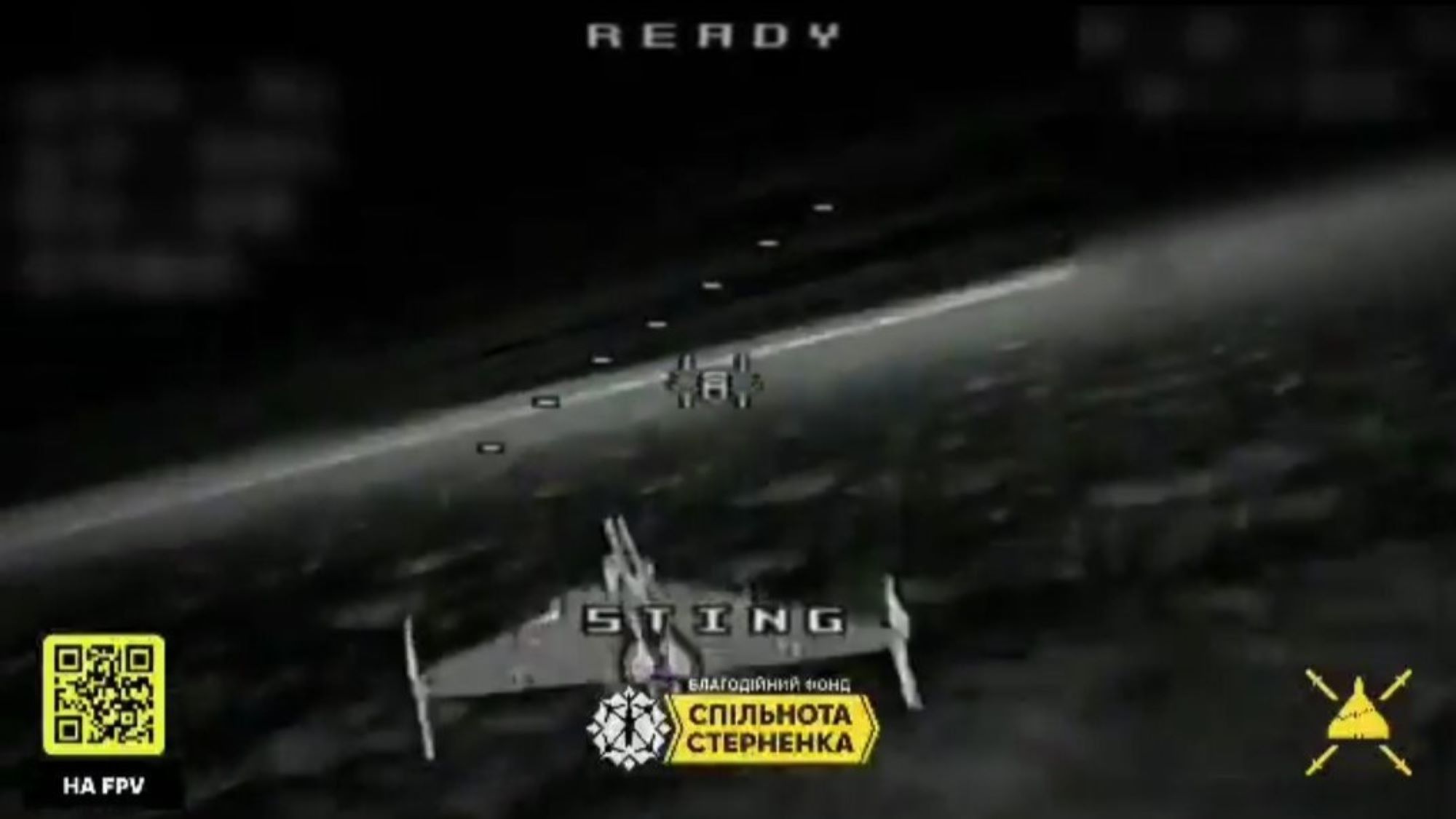
The video released by Wild Hornets showed the visual recorded from the Sting’s onboard camera, in which the R-60 is clearly visible on top of the Geran-2. While initially only photos of the missile at the crash site emerged, the video confirmed that the Geran-2 was indeed carrying the 1970s Soviet-era missile.
Video of a Russian Shahed / Geran-2 OWA UAV equipped with an R-60 air-to-air missile downed by the 412th Nemesis Brigade’s Darknode battalion with a Sting interceptor from @wilendhornets. https://t.co/QkWH79sXfHhttps://t.co/w3BS2MaRwq pic.twitter.com/f6VE4uNmu2
— Rob Lee (@RALee85) December 1, 2025
Popular Ukrainian Telegram channel ‘serhii_flash’ was one of the first to share the image of the wreckage. “Today, for the first time, an R-60 air-to-air missile was detected on a Shahed. This combination is designed to destroy helicopters and tactical aviation aircraft that hunt Shaheds,” the post said. The missile’s front nose seeker section appears to be completely missing.
Wild Hornets said the operation was conducted by the Ukrainian 412th Brigade “Nemesis.” The company also shared footage from two Sting intercepts a day earlier, on Nov. 30, downing jet-powered Shaheds. The latest clip also showed a discernable outline of a rotating push-propeller, while in the previous Nov. 30 intercept we could see a burning exhaust, confirming this was a different Shahed/Geran variant.
2/2
🇷🇺🇺🇦 Confirmación del lanzamiento de la misil R-60 por un “Geran”.
Este video nuevamente es de un interceptador ucraniano y, según parece, esos escombros mostrados eran precisamente de este “Geran” derribado.
Aquí podemos ver que el “Geran 2” lleva un misil de corto… pic.twitter.com/48RObFd4VG
— 𝐄𝐮𝐫𝐞𝐤𝐚 𝐍𝐞𝐰𝐬 📰💻 (@EurekaNews10) December 1, 2025
Russia’s Geran-2 drones are derivatives of the Iranian Shahed-136 loitering munition. The jet-propelled Shahed has been designated as the Shahed-238, with the Russian derivative – reverse engineered and manufactured at the Alabuga factory – becoming the Geran-3.
Battlefield use
It must be noted that both the Dec. 1 and Nov. 30 Sting intercept videos of R-60 armed Geran-2 and the Geran-3, respectively, are IR footage. While it is unclear at which time of the day the videos were recorded, this could possibly point to the actions taking place in low daylight hours to complicate visual identification.
A reason for this could be because the Ukrainians have now evolved to much simpler and asymmetrically comparable counter-drone measures. These include traditional searchlight-armed anti-aircraft guns, taking down drones with door guns on helicopters, and anti-UAV munitions like Sting.
Exclusive: two jet-powered Shaheds taken down by interceptor STING drones. https://t.co/5NZVmFo65q pic.twitter.com/WYylk1lUbU
— Wild Hornets (@wilendhornets) December 1, 2025
With Russia possibly still having a large stock of the Soviet-era R-60, the development of the rail launcher and the requisite electronic interfaces may have been some months in the making. The goals of such modification are not yet clear, although the R-60 can be employed against a variety of air targets.
Future intercepts of such AAM-armed Gerans and their possible use against manned and unmanned aircraft will reveal whether this was a serious concerted effort or a casual experiment – among the dozens that both sides have been thrown into the fray. However, the presence of infrared seeking short-range AAMs is enough to slightly disrupt, or make Ukrainian counter-drone efforts more cautious.
💥 Geran-2
Ucrania derribó un drone HESA Shahed 136 o Geran-2 y la sorpresa es que este dron ruso llevaba un misil aire-aire R-60 en un pilón situado en la parte superior del dron, justo en el eje del aparato. https://t.co/yiJdBF9Rzv pic.twitter.com/2lr06SmWGA
— Historias de aviación 🇪🇦 (@ReinaldoDMM) December 1, 2025
Ukraine’s Sting drone
Ukraine’s Sting drone is a munition-shaped conical aircraft with four arms at the tail-end, positioned in an x-form placement, each driving a pusher-propeller. A recent promotional video showed two Stings placed as payloads on a large winged UAV mothership to increase their range.
An operator controls them via FPV (First-Person View) visors. There have been instances of drones taking on larger aircraft,with Ukrainian FPV drones hitting Russian Mi-8 and a Ka-52 Alligator attack helicopter mid-flight, as The Aviationist had reported.
Ukrainian drone equipped with two drone interceptors under its wings. https://t.co/43kVS1whYU pic.twitter.com/GYtCyO43gI
— Special Kherson Cat 🐈🇺🇦 (@bayraktar_1love) June 6, 2025
Conclusion
It must be noted that an aircraft’s radar and a helmet mounted cueing system contribute greatly to the targeting capability of an IR-guided missile. The Shahed/Gerans are anything but smart drones, far from the capabilities and technology seen in the recent Kizilelma-Gökdoğan BVR AAM test. Their autonomous capabilities are broadly in the realm of just flying to predesignated locations in the navigation system, with the only improvements seen in their guidance electronic circuitry.
However, the simplicity is just right for their core intended use – flooding Ukrainian radars, command and control to cover and draw fire away from the larger Kh-101 ALCMs, Iskander-M tactical ballistic missile and the sea-launched Kalibr LACM (Land-Attack Cruise Missile). At what point the Geran-2 in the latest Sting interception was programmed to release the R-60 is not known, and the drone is evidently too small to have an onboard radar to detect other aircraft.
A remote controlled launch of the R-60 from the Geran also seems unlikely, given how the Ukrainians have caught up with their own electronic intelligence to detect any control signal. A capability fielded by Iran, that emerged in Oct. 2023, showed its Karrar jet-powered drone carrying a Majid SHORAD (Short-Range Air Defense) missile. Official footage showed the drone destroying an unidentified target.
The moment when the Majid AD-08 missile fired from Karar UAV hit the aerial target pic.twitter.com/gdnX0WWRNn
— Iran Observer (@IranObserver0) October 4, 2023
HESA Karrar jet powered UCAV seen with new air to air missile for the first time
The missile appears to be a new air launched variant of the AD-08 missile used on Majid SHORADs. Big step over previous Azarakhsh dual-purpose missiles pic.twitter.com/7ilSXyhEQJ
— Iran Defense commentary (unofficial) (@IranDefense) October 3, 2023
The R-60-armed Geran-2 therefore gives a very crude capability against manned aircraft, but is still restricted by the amount of technology that needs to be packed into it, adding cost and thus diminishing its cost-effectiveness.