Austria acquired 12 Leonardo M-346FA aircraft in a deal worth €1.5 billion, with deliveries starting in 2028.
The Austrian Ministry of Defense has finalized the acquisition of the Leonardo M-346FA aircraft. The development follows the Government-to-Government agreement with Italy signed in May 2025 and a Letter of Intent in December 2024.
The Deal
The acquisition of the M-346FA will allow the Austrian Air Force to fill the gap left by the retirement of the Saab 105 retired in 2020 after 50 years of service. The aircraft will be stationed at Linz-Hörsching Air Base, the same base where the Saab 105s were previously assigned and served as elementary jet trainers with the Fliegerregiment 3, with the deliveries starting in 2028.
The MoD says the unit price of the aircraft is €80 million, while the entire package, including armament, simulator, training, and maintenance, costs around €1.5 billion. Defense Minister Klaudia Tanner explained the M-346 will be used both as an operational aircraft and as a training aircraft.
Tanner and the Minister for Economy Wolfgang Hattmannsdorfer said the purchase represents a step forward in both security policy and economics improving operational readiness while simultaneously generating industrial value in the country. In fact, parallel to the M-346 acquisition, an industrial agreement signed with Italy is expected to generate around €400 million in orders for Austria.
Two-Fleet Strategy
According to the MoD’s press release, the acquisition of the M-346 will allow to implement the long-standing goal of the two-fleet strategy. As part of this strategy, Austria will operate two complementary systems, the Eurofighter for airspace surveillance and the lighter M-346FA for training, lower-intensity missions, and relieving the high-performance fleet.
The MoD also noted that this will also allow to restart pilot training in Austria. In fact, as we previously reported here at The Aviationist, with the phase out of the Saab 105, the Austrian Air Force lost the jet training capability, which led to the service sending student pilots to Italy and Germany to train.
With the arrival of the new M-346s in 2028, the training of Austrian pilots can once again be conducted entirely domestically. “This increases availability, reduces costs in the long term, and strengthens operational sovereignty,” says the MoD.
Austrian Procurement
In September 2024, Austrian Defense Minister Klaudia Tanner mentioned that Austria was considering a joint purchase of M-346 jet trainers with Italy. The initial reports mentioned that Austria was looking for an aircraft which could be employed not only for training, but also for air surveillance and defense, complementing the Eurofighters.
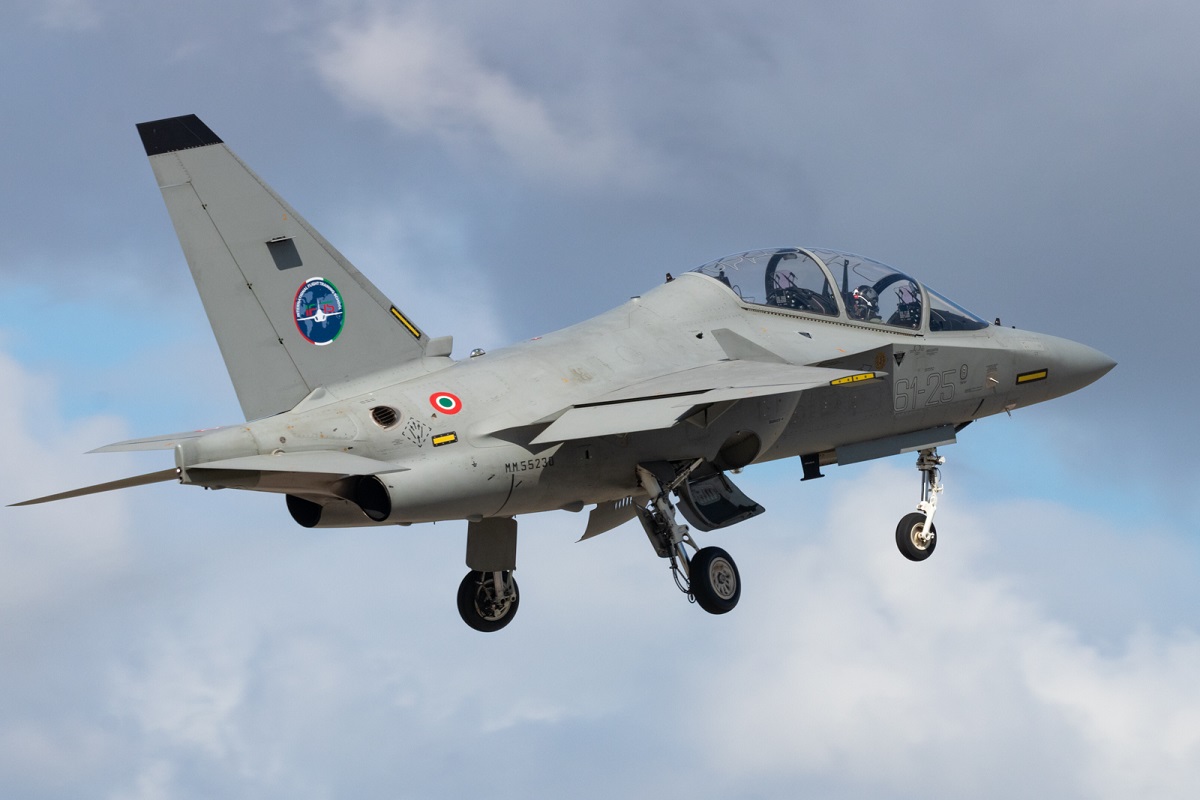
With the agreement signed in May 2025, Austria said it would acquire the Leonardo M-346FA, the light fighter variant of the M-346 Advanced Jet Trainer (AJT). The choice of the FA variant allows to have a combat-capable aircraft which still retains the full dual role capability of the AJT version.
According to the document released by the Italian Ministry of Defense, the package requested by Austria includes:
- 12 M-346FAs, plus 12 more on option in two batches of six aircraft;
- Full Mission Simulator (FMS), Unit Level Training Device (ULTD), Computer Based Training (CBT) and Simulation Based Training (SBT) for pilots;
- Live Virtual Constructive (LVC) capability;
- Eight Role Equipment kits for the FA configuration;
- 12 Helmet Mounted Devices (HMD);
- 12 Identification Friend or Foe (IFF) Interrogators;
- Link 16 and IRIS-T Integration;
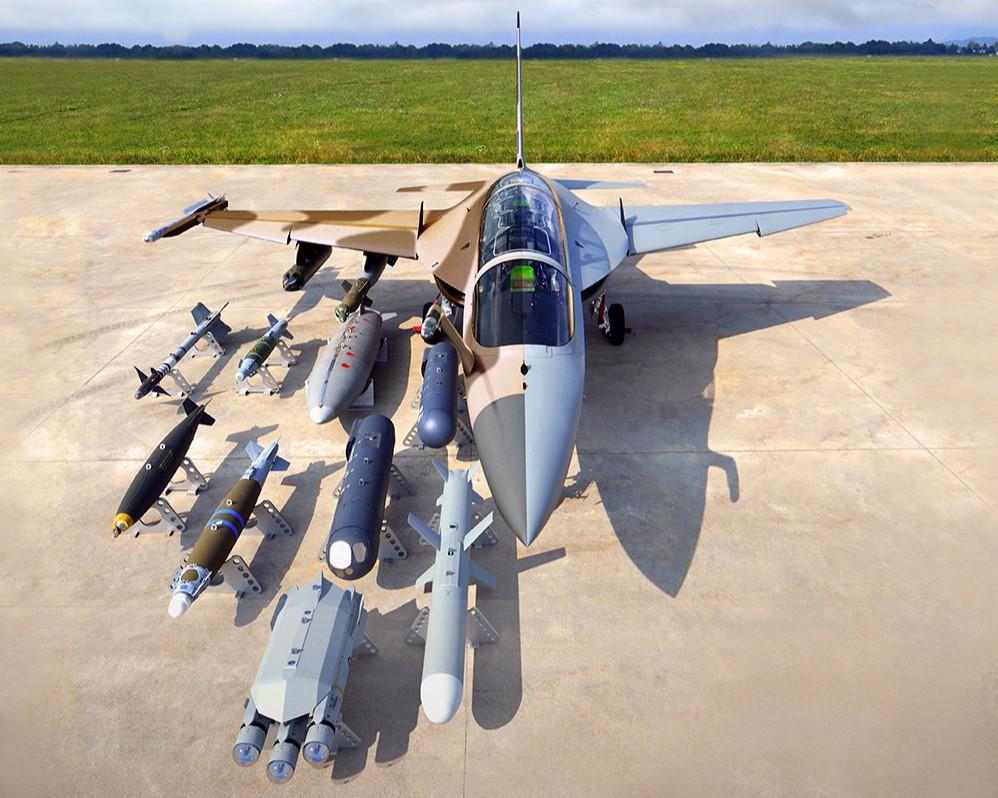
- Eight Nexter NC621 20mm gun pods and 16 LAU-32 7-round rocket launchers;
- Eight Elbit SPEAR AECM pods.
While the intention to integrate the IRIS-T (InfraRed Imaging System Tail-Thrust Vector Controlled) short-range air-to-air missile on the M-346 was already known, the possible integration of an Electronic Counter Measures pod was mentioned in the past without referencing a specific system. Elbit says the SPEAR AECM pod is a modular solution that can provide Self-Protection, Electronic Attack and Reconnaissance capabilities with the use of Digital Radio Frequency Memory (DRFM) and Solid State Phased Array (SSPA) transmitters.
The M-346FA
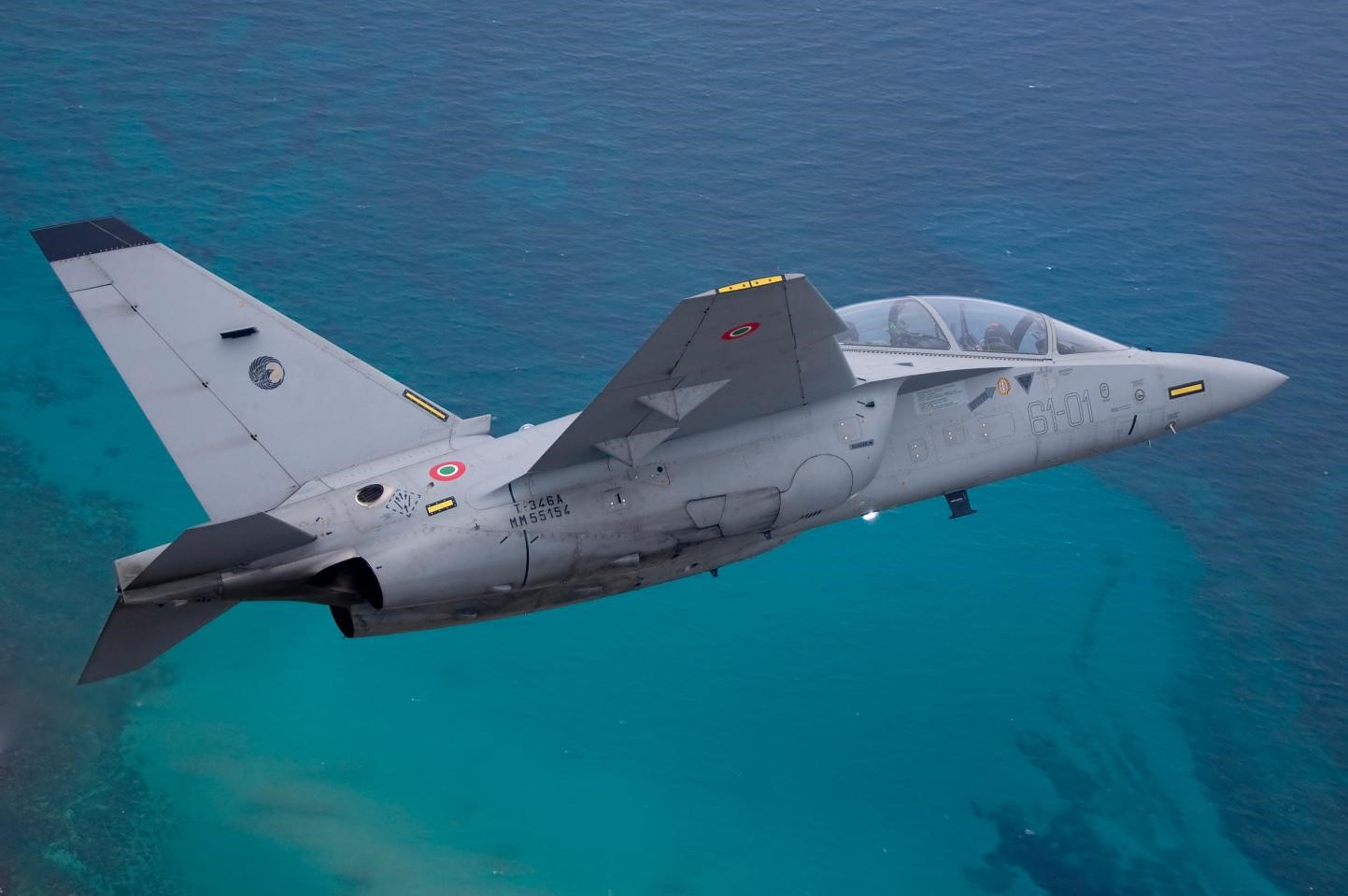
The M-346 Master celebrated in 2024 the 20th anniversary since its first flight. The aircraft, considered by many as the most advanced jet trainer currently available, brought many new technologies to improve the training of future 4th and 5th gen fighter pilots, including the state-of-the-art Ground-Based Training System and the Live Virtual and Constructive (LVC) technologies.
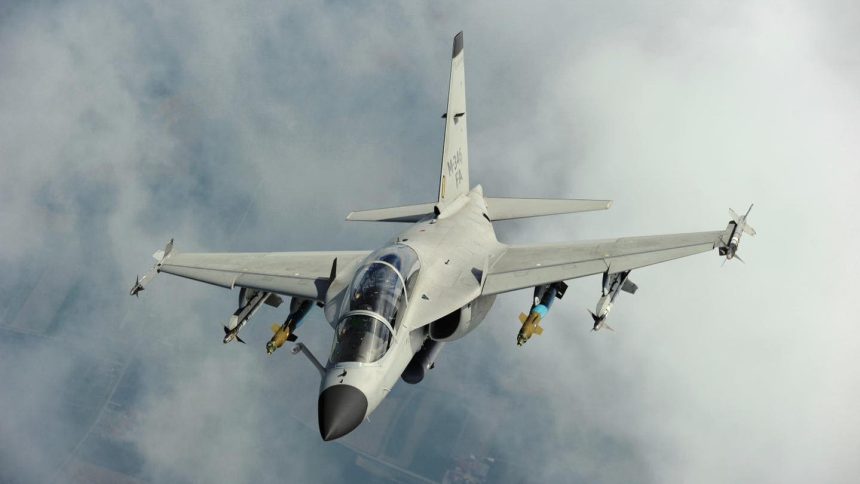
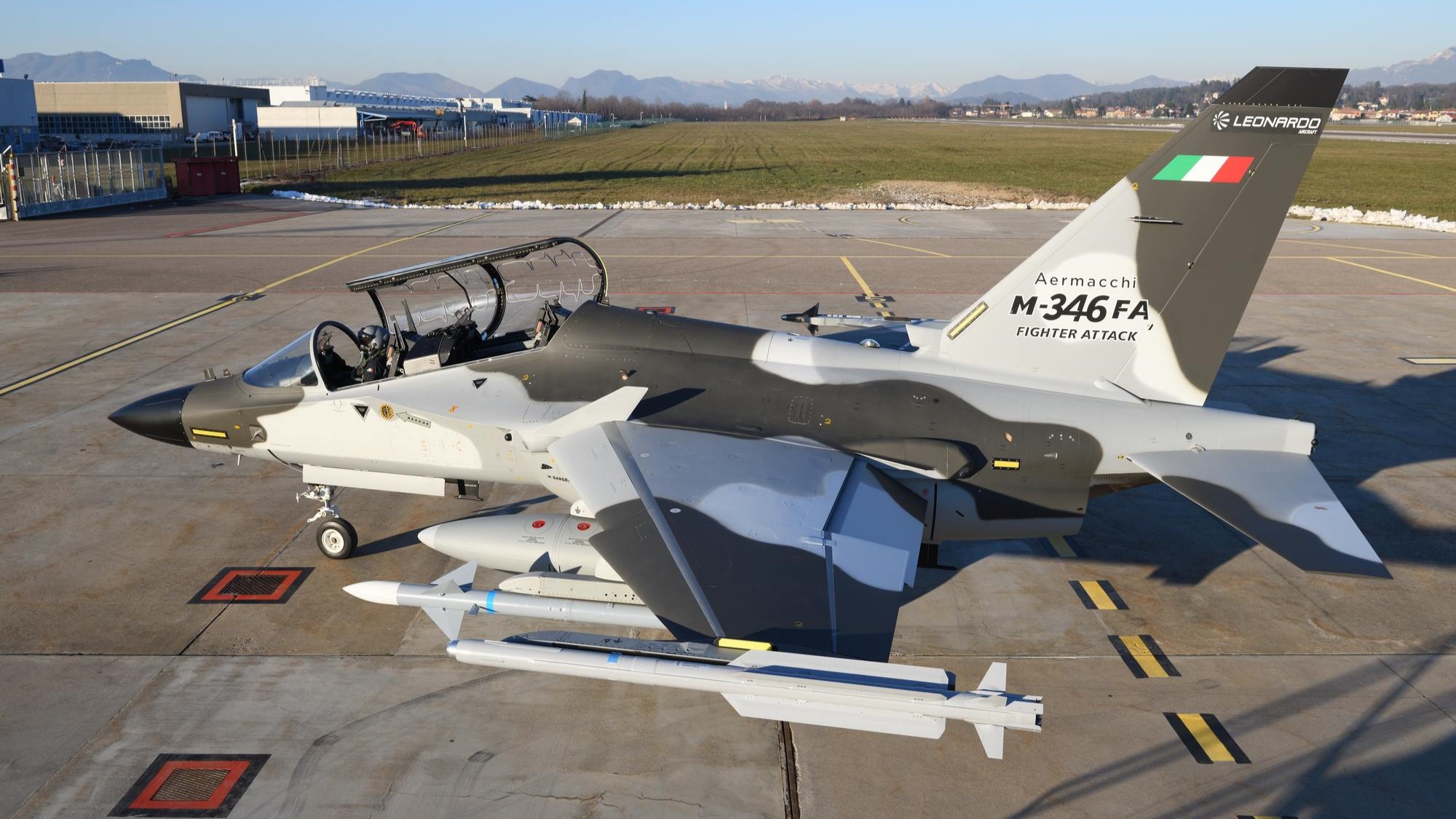
In addition to its training variant, Leonardo has developed a combat-capable version of the aircraft called the M-346 FA (Fighter Attack), also known as Light Fighter Family of Aircraft (LFFA). The most visible differences from the standard AJT configuration are the two wingtip missile rails, that bring the total hardpoints to seven, new antennas and the Defensive Aid Sub System (DASS).
The M-346FA variant is designed to retain the full dual role capability of the AJT version, already in service with the Italian, Israeli, Polish and Singapore Air Forces, while incorporating also some new features like a tactical data link, Grifo-346 mechanical scan, multi-mode radar, new secure radios and IFF system (Identification Friend or Foe), and a stronger airframe.
The aircraft, which is being proposed for Homeland Defence/Air Policing, Slow Mover Intercept, Close Air Support (CAS), Counter INsurgency (COIN), Forward Air Controller – Airborne (FAC-A), Combat Search And Rescue (CSAR), Interdiction, Battlefield Air Interdiction (BAI), Tactical Air Support for Maritime Operations (TASMO) and Tactical Reconnaissance roles, can carry more than 2,000 kg of weapons.
M-346 Block 20
Leonardo also announced at the 2024 Farnborough International Air Show the launch of a comprehensive capability enhancement package for the M-346. This major upgrade comes as the M-346 fleet surpassed 100,000 flight hours as well as ten years of service.
Both M-346 AJT (Advanced Jet Trainer) training and M-346 LFFA (Light Fighter Family of Aircraft) fighter variants will benefit from these enhancements for a wide spectrum of applications, while implying significant margin for further developments in the future. Leonardo said that ‘M-346 T Block 20’ and ‘M-346 F Block 20’ are the designations for the new standard of both aircraft.
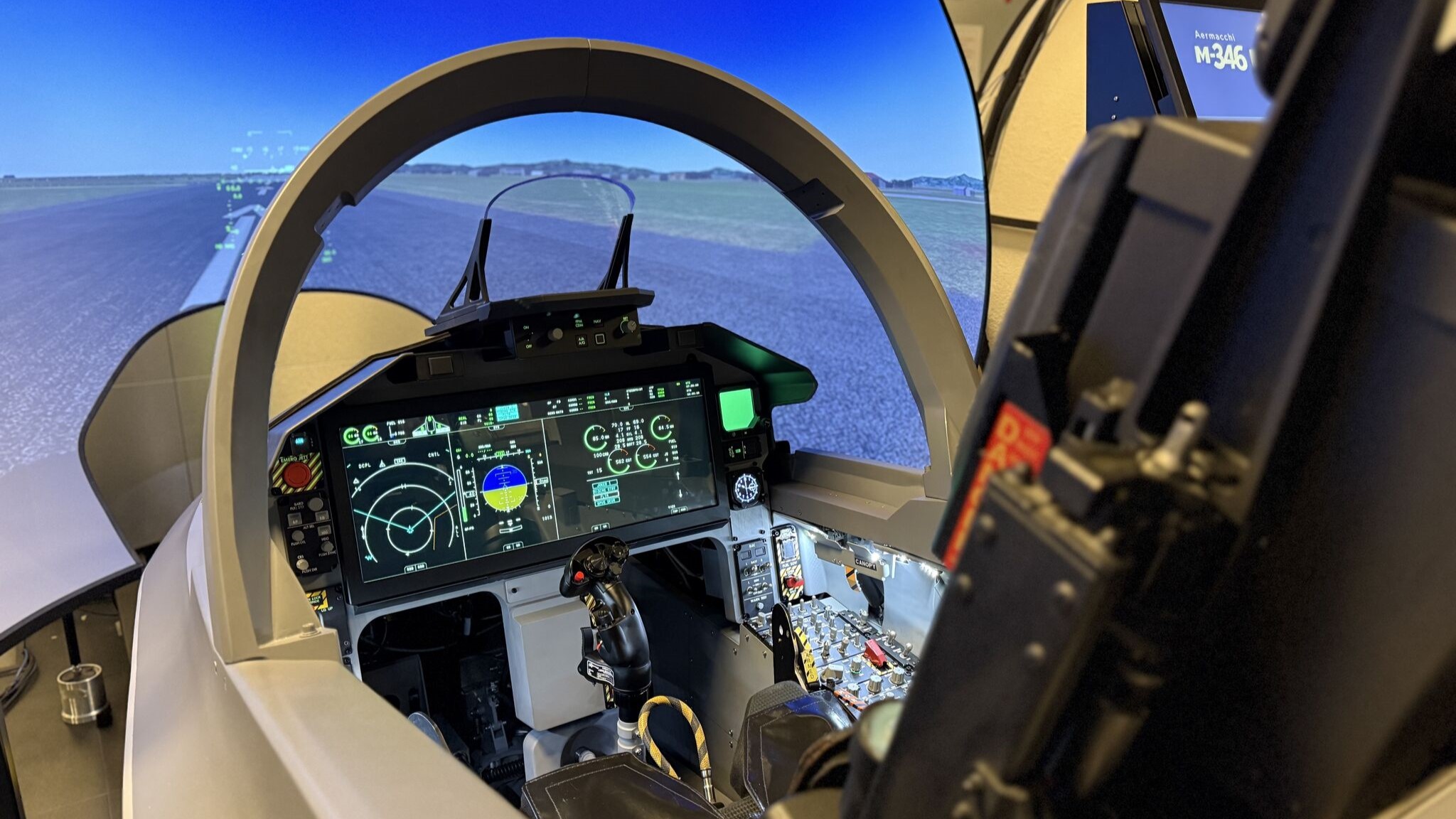
The Block 20 standard cockpit will be completely renewed, featuring two Large Area Displays (LAD), one per each seat, replacing the existing six Multi-Functional Displays (MFD), plus a low-profile Head-Up Display (HUD). These will be combined with a new digital video and data recorder and a new augmented reality Helmet Mounted Display (HMD).
The M-346 Block 20 will also benefit from new navigation, weapon management, flight management system, IFF (Identification of Friend or Foe) transponder. Specifically for the M-346 F variant, further critical capability enhancements include an AESA (Active Electronically Scanned Array) radar featuring fire control radar capability, integration of new weapons for both air-to-air and air-to-ground roles in addition to a built-in missile datalink.
It is being reported that Austria might be the first Block 20 customer. The Austrian acquisition is a joint procurement with Italy, which is acquiring 20 additional M-346s for the International Flight Training School and the Frecce Tricolori aerobatic team in the original configuration.
What future for the Eurofighters?
The acquisition of the M-346FA initially opened up to new questions regarding the controversial presence of the Eurofighter Typhoon in the Austrian Air Force. Austria selected the Typhoon over the Saab Gripen in 2022 to replace the Saab Draken which has been in service from 1988 to 2005.
The country initially decided to procure 18 Typhoons, but later reduced the order to 15 aircraft. The aircraft, however, are very basic, as during the renegotiation of the contract the country decided to acquire Tranche 1 jets (six of which were second-hand from the German Air Force) instead of the then more advanced Tranche 2 ones.
Among the reasons was the argument that the Typhoons would only be needed for peacetime air policing over neutral airspace. The aircraft have no air-to-ground capabilities and their only air-to-air weapons are the Mauser BK27 cannon and the IRIS-T infrared air-to-air missile, without beyond visual range weapons such as the AIM-120 AMRAAM.
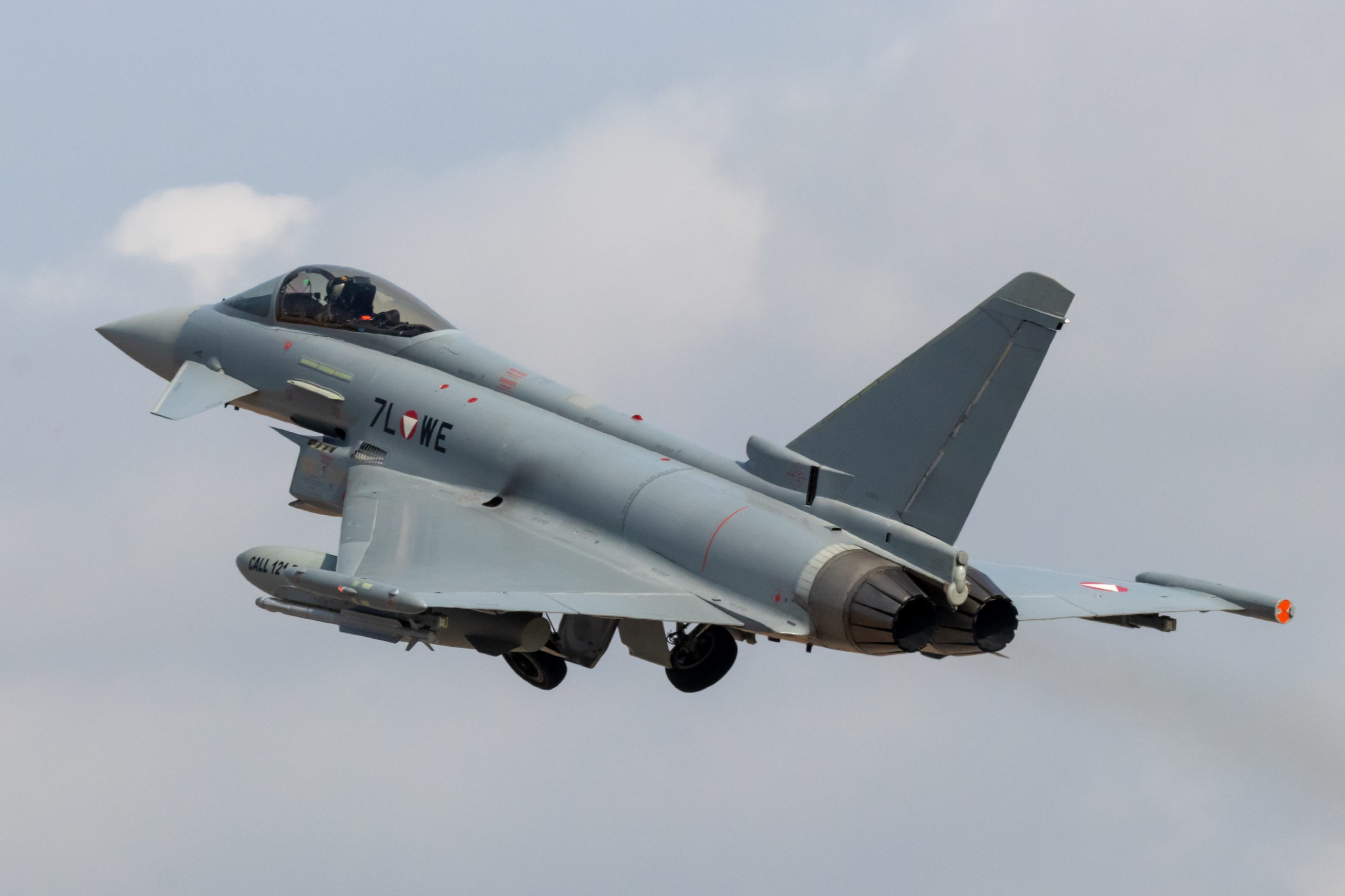
Austria later evaluated to get rid of the European fighter and replace it with a cheaper aircraft, even an armed trainer. For an instance, in 2020 reports mentioned negotiation to transfer the entire Austrian Typhoon fleet to Indonesia, although they never became reality.
While the Typhoon has been considered cheaper to acquire, with a total cost of about €2 billion, the MoD has argued that the high operating costs and lack of advanced capabilities, which were later introduced by other Typhoon operators, represent a critical problem.
Disposing of the aircraft was considered the most convenient option, and in 2017 the MoD even said it would have been €2 billion cheaper than upgrading the jet. Austria, however, still needs an aircraft for the air defense, as not being part of NATO preludes the country from requesting air policing support.
With the procurement of the M-346FA now finalized and the MoD mentioning that it reached its goal to implement a two-fleet strategy, it is clear that the Austrian Air Force has no intention to get rid of the Eurofighter.