.
jump to navigation

Syrian rebels have captured an intact (Made in Iran) “Pahpad” drone. And here’s a video showing some details. June 13, 2013

Posted by David Cenciotti in : Drones, Syria , 3comments

Many videos showing the so-called “Pahpad” drone, made in Iran and used by Syria to spy on the clashes in Homs were uploaded by the rebels since the beginning of the uprising in Syria.

All the footage depicted the made in Iran UAV (unmanned aerial vehicle) from the ground or what remained of the crashed ones.

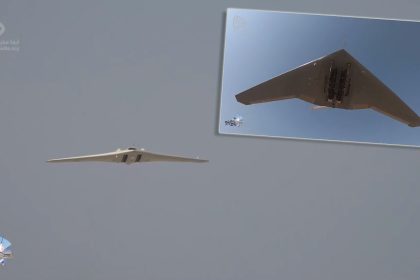
Until Jun. 12, when a new video showed a seemingly intact “Pahpad” in the hands of the rebels.

Intact Pahpad

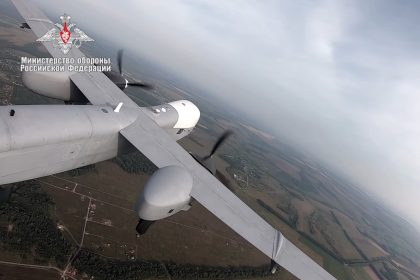
The new video provides close-up images of the mysterious drone: the engine, the wings, some numbers (as aircraft’s individual codes), as well as a turret, most probably the one of the FLIR (Forward Looking Infra Red) camera.

Noteworthy, the airframe’s base color is light blue, as in the first images of the Iranian drone published on the Mashreghnews.ir website, with a sand-colored coat.

“Pahpad” (پهپاد) is not actually the official name of the UAV but the short form of “parandeye hedayat pazire az rahe door” (“پرنده هدایت پذیر از راه دور”) that is the Persian for “remotely piloted aircraft”.

H/T to Eliot Higgins aka “Brown Moses” for the heads-up

Enhanced by Zemanta

New photo shows that China has really copied the U.S. RQ-170 Sentinel stealth drone June 2, 2013

Posted by David Cenciotti in : China, Drones , 2comments

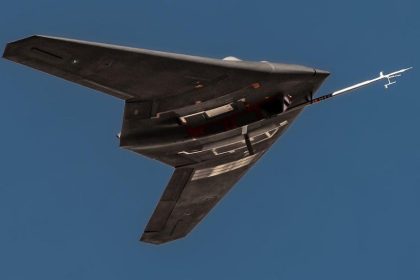
The following image, grabbed by Chinese forums, is circulating on the Internet.

RQ-170 copy

Image source: http://hobbyshanghai.com.cn/

It allegedly shows a series of brand new UAVs (unamanned aerial vehicles) one of those resembles the famous Lockheed Martin RQ-170 Sentinel, one of those was captured in Iran in 2011.

Last Februrary, Iran released footage that proves it has, if not literally decoded, at least accessed some of the data stored inside the U.S. stealthy RQ-170 drone captured in December 2011.

Previously, in Aug. 2012, The Aviationist published an article titled: Chinese delegation currently in Iran to copy the U.S. stealthy RQ-170 drone captured in 2011 about the news that a group of 17 Chinese expert had visited Iran not only to inspect, but also to collect and bring back to China some key components of the U.S. RQ-170 drone captured by Iran in December 2011.

That article ended with the following text:

“As already explained when commenting Iran’s claims that they had decoded the stealthy drone, while the internal memories were (probably) automatically erased as a consequence of the loss of control procedure and data will never been recovered, the circuitry, lenses, sensors have probably survived the mysterious crash landing.

Therefore they can be evaluated and tested.

And copied, one of the tasks China does better.

If the above image is genuine, China has already cloned the stealthy drone the U.S. lost (almost intact) in Iran.

Last week Iranian officials claimed they are ready to fly their own RQ-170 copy as well.

Enhanced by Zemanta

Why has Washington acknowledged loss of unknown drone in Somalia but has not admitted Predator crash in Turkey? May 30, 2013

Posted by David Cenciotti in : Drones, Military Aviation , 2comments

As already explained, on May 29 Pentagon acknowledged the loss of a scarcely known Camcopter drone in Somalia whose debris had been collected and shown all around the world by the Al-Shabaab group.

Interestingly, the mysterious drone was identified as a Schiebel Camcopter S-100 a tiny helicopter drone whose maximum take off weight is 200 kg.

It is at least odd, that Washington admitted the loss as the UAV (unmanned aerial vehicle) was not known (at least publicly) to be operated by any U.S. force or agency. Unless the drone carried some unit markings or national roundel, it is quite unlikely that anybody could tie the small drone crashed in Somalia with an American asset.

Unless they are forced to do that (as happened when the stealthy RQ-170 Sentinel drone was captured by Iran in December 2011), the DoD is rarely willing to disclose its involvement in overseas clandestine missions.

Schiebel_CAMCOPTER_S-100

Image credit: Wiki

For instance, neither Pentagon nor U.S. Air Force have ever admitted the downing of a Predator by the Kurdish rebels.

As we reported back then, pictures of the wreckage of a U.S. Air Force MQ-1 Predator emerged on Sept. 19, 2012. The drone was allegedly shot down by the rebels on Sept. 18, in the Hakkari prefecture, where the drone was flying  an operation against the rebel bastion of Uludere.

label

The MQ-1 was part of a force of four U.S. Predator UAVs deployed to Incirlik airbase, in southern Turkey (one of the airports used to launch drone surveillance missions over Syria).

Months later, the Air Force released an accident report about an MQ-1B Predator crashed in a U.S. Central Command area of responsibility shortly after losing its satellite data link  on Sept. 18, 2012.

The report did not say that the drone was shot down (because either it was not downed or the fact it was lost to enemy fire could not be confirmed) nor mentioned that it was lost in Turkey (exact location was withheld and replaced by the generic U.S. CENTCOM area of responsibility).

Isn’t this different approach on the two episodes a bit strange?

The fact that Predators were deployed in Turkey and were (and probably still are) flying surveillance missions over Kurdish rebels was not a secret. Still, they did not officially acknowledge that an MQ-1 crashed in Turkey.

A scarcely know Camcopter drone crashes in Somalia and they immediately tell the world that it was an American one.

Why did they disclose the Somalia crash and not the Turkish one?

Enhanced by Zemanta

Pentagon confirms drone crash in Somalia. But it doesn’t say it was an Austrian made PSYOPs-capable Camcopter May 29, 2013

Posted by David Cenciotti in : Drones , 1 comment so far

On May 27 a drone flying a routine surveillance mission along the coast of Somalia crashed in a remote area near the shoreline of Mogadishu.

The Pentagon confirmed the loss in Somalia after the Al-Shabaab group published some photos of the wreckage on Twitter but did not confirm the remotely piloted aircraft was shot down.

The UAV was found near Bulo Marer (a town in the southwestern Lower Shebelle region) the same place of a French Intelligence failed operation to rescue Denis Allex in January 2013.

Based on the images of the parts collected by Al-Shabaab,  the mysterious drone can be identified as a Schiebel Camcopter S-100 small UAV (unmanned aerial vehicle).

The Aviationist’s contributor Giuliano Ranieri highlighted the pieces of the Camcopter that have survived the crash and that can be clearly identified among the debris.

S-100-1

S-100-2

The little S-100 drone is produced by the Austrian company Schiebel.

It weights only 200 kilograms (440 lb) but with an endurance of 6 hours, a maximum speed of 220 kilometres per hour (140 mph), a ceiling of 5,500 metres (18,000 ft) and various payloads (including electro-optics and infrared sensors) it can carry out a wide array of clandestine missions.

If the UAV itself has not so many secrets, what is extremely interesting is the use of this type of drone by the U.S.

Even if it is impossible to say what the aircraft was doing, it is quite likely it was flying an espionnage mission for the CIA.

In 2009, Boeing and Schiebel made a demo for U.S. Army Special Operations Command (USASOC) at Ft. Bragg, North Carolina about the integration of the S-100 and ground unmanned systems for PSYOPs missions in-theatre.

“Equipped with an American Technology Corporation loudspeaker capable of addressing crowds at a distance of up to 2 km, a leaflet drop capability, as well as an IAI POP300 EO/IR camera payload. The John Deere R-Gator unmanned Ground Vehicle (UGV) was also equipped with a loudspeaker augmented with the Trident, Inc. data link, demonstrating the potential for teaming UGVs with an UAS. [...] The S-100 was utilized to survey the area and provide real-time aerial intelligence, as well as to address the public and drop information leaflets.”


Enhanced by Zemanta

Video shows U.S. Navy’s new gigantic drone on its first flight May 27, 2013

Posted by David Cenciotti in : Drones, Military Aviation , add a comment

On May 22, 2013, the Triton high-altitude unmanned aircraft successfully completed its first flight from Northrop Grumman’s Palmdale manufacturing plant, California.

The unmanned aerial vehicle took off at 07:10AM and remained aloft for about a 1.5 hour before being conducted back to the ground by a Navy and Northrop Grumman flight test team.

MQ-4C-Triton-ff

Image credit: U.S. Navy

The MQ-4C Triton is a drone designed to fly surveillance 24-hour missions at altitudes of more than 10 miles (16 km) covering  2,000 nautical miles (3,704 km) with an advanced suite of sensors that can detect and automatically classify different types of ships.

It has a wingspan of 130.9 feet (39.9 m), larger than a Boeing 737. It will complement the P-8A Poseidon (a military version of the 737) within the Navy’s Maritime Patrol and Reconnaissance Force family of systems.

The MQ-4C is a much advanced version than the first generation Global Hawk Block 10: it is believed to be a sort of Block 20 and Block 30 Global Hawk hybrid, carrying Navy payload. With a 130.9-foot wingspan, the giant drone features an AN/ZPY-3 multi-function active-sensor (MFAS) radar system, that gives the Triton the ability to cover more than 2.7 million square miles in a single Intelligence Surveillance Reconnaissance (ISR) mission.

Enhanced by Zemanta


Switch to our mobile site